
No new cases, no victims identified but Maldives escapes human trafficking downgrade
Immigration officials named in a bribery verdict remain in their jobs.
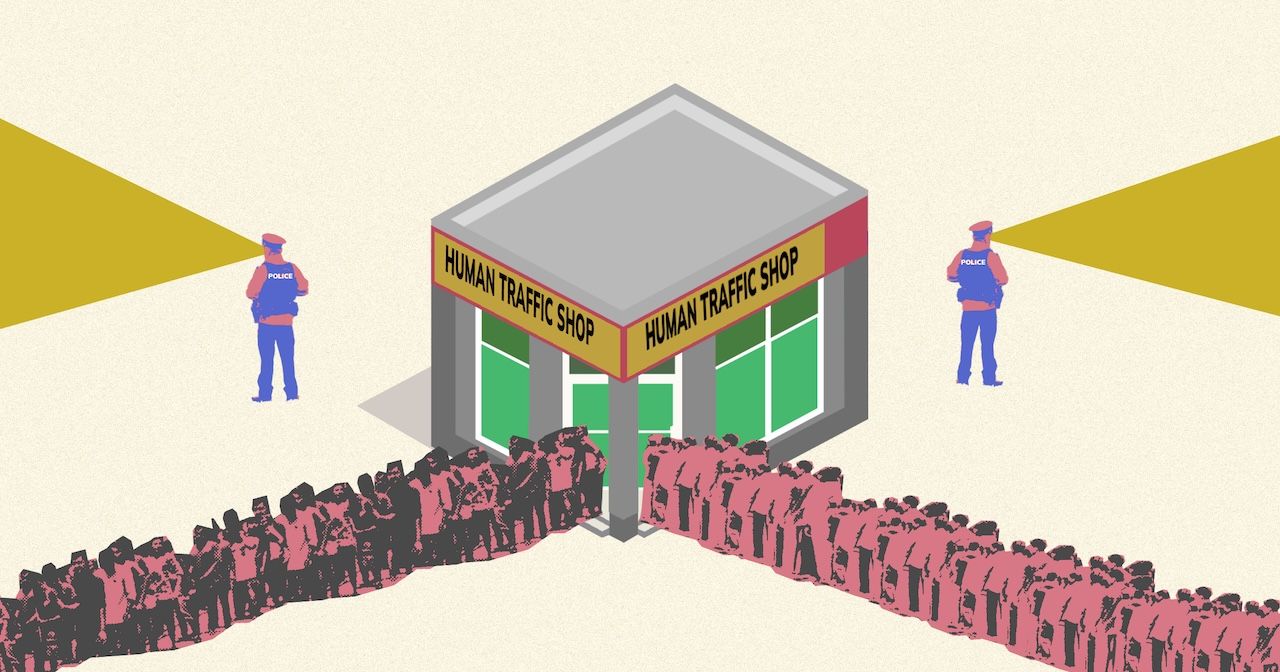
Artwork: Dosain
1 hour ago
The Maldives remained on the US State Department's watchlist for human trafficking in the 2026 Trafficking in Persons report released this week, avoiding an otherwise mandatory drop to the lowest ranking through a waiver granted because the government "has devoted sufficient resources to a written plan that, if implemented, would constitute significant efforts to meet the minimum standards."
The Maldives stayed on the Tier 2 Watch List for the third consecutive year. A drop to Tier 3 would have entailed non-humanitarian sanctions. The country has been here before. A written plan assured a reprieve in 2012 and 2013 after the US anti-trafficking ambassador warned the Maldives in 2013 that it would not be eligible for a third time. The drop was avoided again in 2020 after a national action plan was passed in February that year.
The Maldives was placed on the watch list several times over the years. On each occasion, the authorities did just enough to climb back to Tier 2. The Prevention of Human Trafficking Act was passed in 2014. The State Department credited increased efforts "considering the impact of the Covid-19 pandemic" in 2021.
No investigations, no victims
“The government did not demonstrate overall increasing efforts compared with the previous reporting period," the report stated.
The waiver came despite the failure to commence new trafficking investigations for the second consecutive years. In the April 2025 to March 2026 period covered by this year's report, there were no new prosecutions or convictions for the third year. No trafficking victims have been identified over the past two years. But police screened more than 70 people in cases with trafficking indicators, such as withheld wages, passport retention and fraudulent recruitment. Some 546 cases of unpaid wages and 111 cases of withheld passports were lodged with the Labour Relations Authority, which resolved the complaints through mediation or fines.
“Observers reported the lack of cohesive victim identification and referral procedures… resulted in the inappropriate penalization of potential victims solely for unlawful acts committed as a direct result of being trafficked," according to the report.
Positive efforts cited over the past year included setting up a migrant worker resource centre and portal for submitting complaints as well as new training for police on trafficking and victim identification.
"Official complicity in trafficking crimes remained a concern," the report stated. "Due to inadequate screening, the government did not take effective measures to prevent the inappropriate penalization of potential victims solely for unlawful acts committed as a direct result of being trafficked. Although the government could provide temporary accommodation in private guesthouses or in partnership with NGOs, it remained without a shelter to assist trafficking victims, hindering overall protection efforts."
Investigations launched in 2019 into 20 recruitment agencies, including current and former immigration officers, over alleged manipulation of the foreign worker quota system remained incomplete with no reported outcome. In December, Homeland Security Minister Ali Ihusaan said details about those cases had been shared with the US State Department. He believed "the next review period will take that into consideration," he said.
“Officials allegedly accepted bribes to overlook labor violations or dismiss cases, including potential labor violations involving construction companies," the report found.
It also noted that three Immigration officials named in a bribery verdict against a Bangladeshi recruiter "continue to perform their jobs while reportedly under investigation".
The grounds for granting the waiver are unclear from the report. It noted the national anti-trafficking coordination committee's approval of a national action plan for 2026–2029. The Anti-Trafficking in Persons Office was allocated a modest sum of MVR797,168 (US$51,700) for prevention work, up from MVR292,449 from the previous year. But the office "remained severely understaffed" and the police anti-trafficking department "lacked resources and adequate staffing".
'A hierarchy of suffering'
A 2024 study of 847 Bangladeshi workers by the Public Interest Law Centre (PILC) found respondents had paid an average of US$2,195 in recruitment fees. The entire cost of recruiting a worker was estimated to be US$1,407 and regulations bar the cost from being passed on to workers. Just over half had borrowed to pay.
Respondents worked an average of 64 hours a week. Seven in 10 said someone else, most often an employer, held their passport. Of the six in 10 presumed to be undocumented, more than half had arrived on work visas and fallen out of status afterwards.
The system recognises only the extreme end of a spectrum running from decent work to forced labour, the study argued. The result was a "hierarchy of suffering" in which workers "are unable to access remedies unless they are subjected to severe exploitation". A companion policy paper, From Exploitation to Decent Work, called for the sponsorship arrangement that binds workers to their employers to be abolished.
Lawyer Fathimath Eema Hussain, one of the study's lead authors, made the same case on Dhauru's weekly podcast last Friday. "All cases are viewed through the lens of trafficking," she said. "The labour exploitation that falls in between doesn't get criminal action. It is treated as a civil matter."
She described how a wage claim can cost a worker their legal status: once a court summons arrives, workers can be evicted from employer-provided housing and then reported missing, which makes it very difficult to go home.
Observers cited in the State Department report said changing employers still requires "the original employer’s permission and authorization from the government except when the employee presented evidence of forced labor, increasing vulnerabilities to trafficking". Observers also noted that "employers could report migrant workers missing to invalidate the worker’s request, and some employers reportedly abused this system to gain additional foreign workers".
Eema compared the Maldives system to those in Qatar and Kuwait and proposed replacing it with sectoral quotas, which would let workers move between employers within an industry. "The first thing that must be done is to change this system," she said.
Since 2019, US law has allowed the waiver only once: unless the 2027 report lifts the Maldives to Tier 2, it is likely to drop to Tier 3. Malaysia was downgraded in 2021 after the same three-year run. Tier 3 countries can face restrictions on non-humanitarian US assistance and US opposition to IMF and World Bank lending, though such penalties are often waived.
The assessment period for that report closes on 31 March.
Discussion
No comments yet. Be the first to share your thoughts!
No comments yet. Be the first to join the conversation!
Join the Conversation
Sign in to share your thoughts under an alias and take part in the discussion. Independent journalism thrives on open, respectful debate — your voice matters.
Support Independent Journalism
Help us keep the news free and fearless
Give once
$
or
Become a memberfrom $5/month