
War costs mount but austerity plan stays under wraps until after Saturday's vote
Uninterrupted supplies assured as government breaks ground on a dozen projects.

Artwork: Dosain
30 Mar, 16:58
One month into the US-Israeli war on Iran, the Maldives has faced an 18 percent collapse in tourist arrivals, nearly 500 cancelled flights, and an estimated US$ 85 million revenue shortfall. But an austerity plan has yet to be disclosed and the president denies withholding measures until after Saturday's election.
At his weekly press conference on Monday, President Dr Mohamed Muizzu told reporters that the government is monitoring the situation daily and will respond accordingly.
"To the extent that the war widens and we face difficulties, we will keep taking measures in proportion to that," he said. "When we’re forced to stop projects, we will prioritise the housing and health sector, which we will continue without any stoppage."
The launching of new projects will be delayed but ongoing projects with foreign funding or contractor financing will not be affected, he added.
Finance Minister Moosa Zameer told the press on Wednesday that the government has been cutting costs to manage cash flow, but "we're not doing it after announcing it." Non-essential overseas travel has been suspended with the exception of externally funded or foreign ministry trips, he said.
He acknowledged that the single-digit budget deficit target would now be hard to meet. A finance ministry team has identified savings, how to "contain some recurrent expenditures," and calculated "the revenue mismatch," all of which would be shared with the president in about a week, Zameer said, noting that "some financing mechanism" would be needed to plug gaps. "And the available amount of total financing will also change with such a large market volatility," he added.
But similar to the government's plan to repay a US$ 500 million sukuk on April 8, the austerity plan will not be published in detail because of "market sensitive" information concerning borrowing, Zameer said.
Even if the war ends in the near future, analysts warn that it will take at least four months for normalcy to be restored, he noted.
On Sunday, Foreign Minister Dr Abdulla Khaleel, who chairs the ministerial crisis committee, reiterated that the top priority is to "carry out cost-cutting in a way that doesn’t affect daily lives or impose a burden on any citizen." More details will be revealed later, he said.
Despite the remarks about restricting spending and ordering state-owned companies to freeze hiring, the government launched or broke ground on more than a dozen projects over the past week, including 1,624 housing units across three sites, road construction on five islands, a harbour, a central power station, and a new state-run taxi service with imported electric cars. Fuel subsidies were extended to yellowfin tuna fishing boats. Three memoranda of understanding were signed with Chinese construction firm CMEC for fisheries infrastructure.
At the crisis committee's weekly press briefing, the core message remained reassurance: fuel shipments are arriving and scheduled through April, sea freight has not been significantly disrupted, and the government is diversifying supply routes through deeper ties with India, China, Malaysia, Vietnam, Indonesia and Thailand. Flight capacity is recovering. Emirates, Etihad and FlyDubai are now averaging two daily flights and Qatar Airways is set to begin daily services from April 9. A digital marketing campaign targeting 100 million impressions launched over the weekend. Tourist visa extensions are due to be simplified. Bank of Maldives is preparing financial support for struggling resorts.
Elsewhere in Asia, governments have declared energy emergencies, activated contingency plans, cut subsidised fuel quotas and shortened working weeks. But the Maldives government insists the situation does not warrant fuel rationing or the kind of emergency restrictions imposed during the pandemic. The government would act only when conditions demanded it, ministers said.
Supplies: holding, with caveats
Foreign Minister Khaleel assured the public there was "no obstacle at all" to bringing oil and gas to the Maldives. He said the State Trading Organisation is able to secure fuel shipments from Oman, which lies outside the blockaded Strait of Hormuz. Economic Development Minister Mohamed Saeed provided a schedule of fuel and LPG deliveries through the end of April.
The government has made progress by ensuring "that Maldivians will go forward without running out of essential goods," he said.
Zameer said last week that the government is holding off on further increases after STO raised retail pump prices by more than 20 percent in early March. The Maldives sets fuel prices based on cash flow, stock levels and expected returns, he said, and the government wanted to see where global prices were heading by the time of the next shipment. If prices fall, "we can average it out."
Saeed said imports were up 13 percent year-on-year, though air cargo from the UAE fell sharply before Emirates resumed direct services. He acknowledged "difficulties and hardship in different ways" while insisting sea freight remained largely intact. The government is factoring in a potential Suez Canal closure after the Houthis in Yemen opened up a new front in the war, he noted.
The aim is to import fuel, staple foodstuff and construction materials in any scenario, Saeed said. Unlike the past, there are opportunities “from business-to-business ties to other countries. Relationships have been formed with very large markets.”
The strategic response is diversification, ministers stressed, describing efforts to deepen commercial ties with India, China, Malaysia, Vietnam, Indonesia and Thailand. The Maldives has traded with those countries but "deeper commercial connections created through documentation" were never established, Saeed said. An economic cooperation agreement signed with Thailand in 2016 never grew beyond its initial scope, he noted.
Saeed invoked the free trade agreement with China and proximity to India as buffers, while conceding higher costs. "In efforts for survival, transport cost, freight cost, insurance premium, we have to give consideration to all of this," he said.
Zameer revealed an estimate of US$85 million to US$ 90 million in lost government revenue for the first month, based on studies with the Maldives Monetary Authority and the Maldives Inland Revenue Authority.
The most recent fiscal data as of March 19 shows a year-to-date surplus of MVR 2.1 billion (US$ 136 million). Tourism goods and services tax was up 11.5 percent, a reflection of the pre-war booking surge and collection lags. But non-tax revenue was down 23 percent. Import duties fell 14 percent. Resort rent collection dropped by a third.
The Maldives spent US$ 648 million or 10 percent of GDP on fuel imports last year. Inhabited islands consume nearly 8,000 barrels of diesel daily for electricity.
Muizzu told the press on Monday the war had brought "new encouragement" on renewable energy. Investors expressed interest in the Maldives in the past two to three weeks, and "we want to make use of this moment and quickly bring these investments to the Maldives," he said, citing floating solar panels for lagoons and land-based installations on larger islands. The government's target is 33 percent renewable energy, of which 10 percent has been achieved to date, he said.
Tourism slump
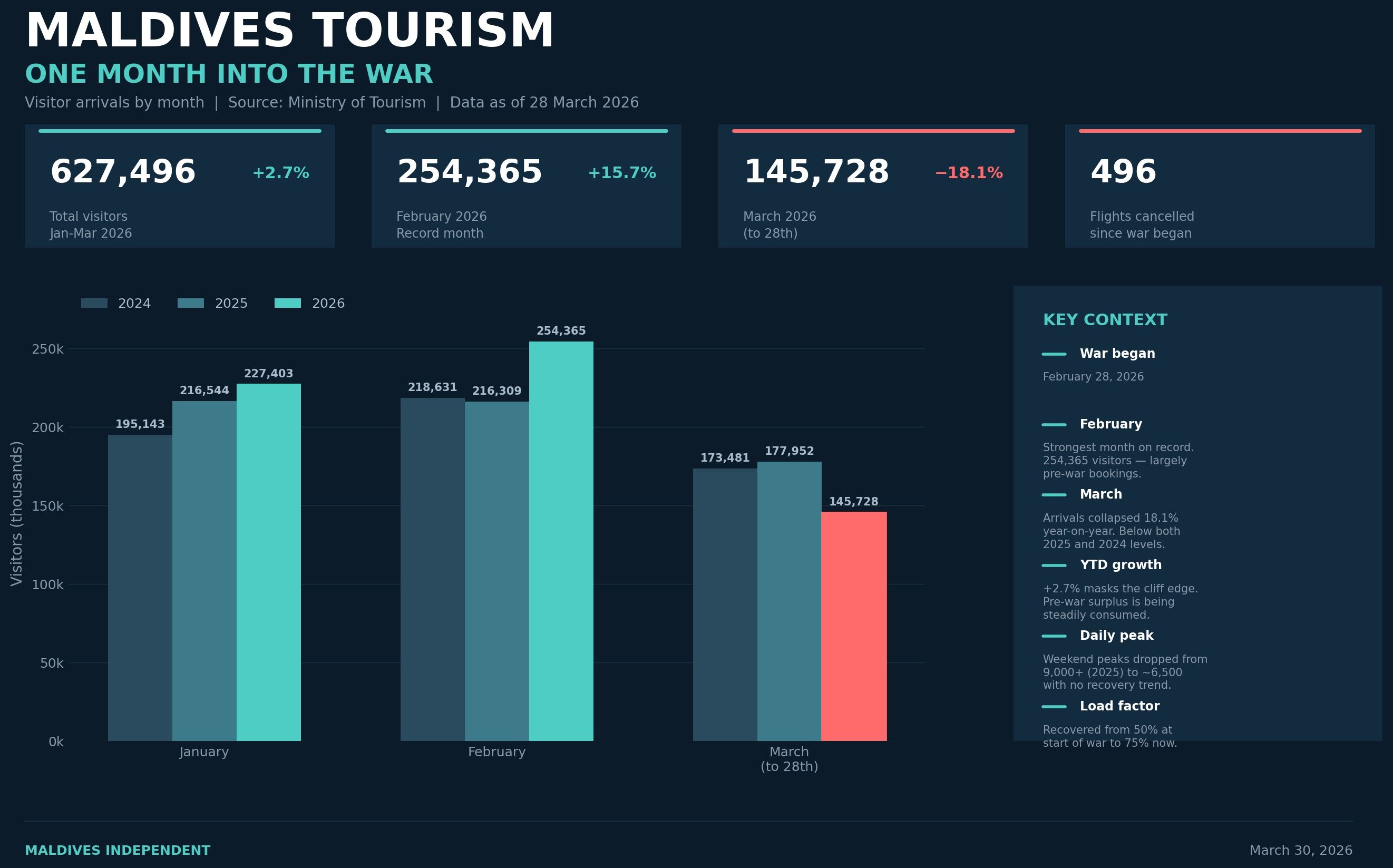
Before the war started, February was the strongest month on record with 254,365 visitors, up 15.7 percent from the same period last year. But as of March 28, tourist arrivals stood at 145,728, down 18.1 percent and below the same period in both 2025 and 2024. Daily arrivals that peaked above 9,000 on weekends last March now barely cross 6,500. No recovery trend was visible within the month.
About 30 percent of tourist arrivals to the Maldives transit through Gulf hubs, the corridor most directly disrupted by the war.
Tourism Minister Thoriq Ibrahim said 496 flights were cancelled between February 28 and March 28. But flight load factors have since recovered from 50 percent at the start of the war to 75 percent, Transport Minister Mohamed Ameen said. A new airline services agreement is being drafted with Ethiopian Airlines, and three additional weekly Aeroflot flights from Russia – the second largest source market – are planned for summer. Belarus carrier Belavia is completing administrative preparations to launch direct flights from Minsk in August.
The Visit Maldives Corporation launched a digital advertising campaign on Saturday titled "SeaSational Summer," targeting India, China, Russia, CIS and ASEAN markets across Google, YouTube and Meta. The campaign uses a two-stage funnel strategy – awareness followed by remarketing to warm audiences – and aims for 100 million impressions during the April-to-July shoulder season. India-specific campaigns will follow.
Thoriq said a simplified tourist visa extension process will be launched on April 1, requiring only a photo for online applications processed within 48 hours. Bank of Maldives has signalled readiness to provide financial support to resorts facing operational difficulties, including loan repayment adjustments, a measure requested by the Maldives Association of Tourism Industry.
"God willing, we will be prepared to provide assistance to the industry," he said.
Thoriq announced two new tourism segments: technical recreational diving beyond 30 metres, and the reopening of spear fishing after a 40-year ban. He previously announced plans for remote working and content creator visas to encourage longer stays, particularly at guesthouses.
Transport Minister Ameen rejected any parallel to the pandemic response. "None of our citizens would want to go into restrictions," he said, dismissing the need for preemptive action. Ameen said he did not want to restrict fuel supply in a situation "where it doesn't need to be restricted."
Trust us, don't ask
Foreign Minister Khaleel refused to identify which country had requested use of Maldivian airspace, maintaining that the rejection was government policy, and accusing the media of likely using such information "with some bad intent." Ameen lectured journalists on the distinction between sovereign airspace and the flight information region – "that's what you've confused in some of your articles" – and claimed media reporting had frightened potential airline partners.
"That’s where the reluctancy comes from. It’s not at all to hide. It’s for the good of the nation, for our future, for the positive change we’re trying to bring to the nation, we’re withholding that information a bit," he said.
When asked how many people had been hired into government positions this month – amid criticism of pre-election recruitment into state companies – Zameer said the finance ministry did not publish that data and directed the journalist to the President's Office.
Last week, Defence Minister Mohamed Ghassan Maumoon said there was no military threat to the Maldives, and that the policy of denying any country use of Maldivian territory or airspace for military purposes remained in force. The defence ministry separately clarified that Maldivian law does not extend to airspace beyond 12 nautical miles.
The ministers asked the public to take the government's assurances on faith, at least until after Saturday's vote.
Discussion
No comments yet. Be the first to share your thoughts!
No comments yet. Be the first to join the conversation!
Join the Conversation
Sign in to share your thoughts under an alias and take part in the discussion. Independent journalism thrives on open, respectful debate — your voice matters.
Support Independent Journalism
Help us keep the news free and fearless
Give once
$
or
Become a memberfrom $5/month