

Twelve years on, government meets "bare minimum" on right to information
Ministries still routinely ignore the requests citizens actually file.

Artwork: Dosain
10 Jun, 15:14
Twelve years after the Right to Information Act came into force, the President's Office and all 16 ministries finally met its proactive disclosure requirements this week. President Dr Mohamed Muizzu hailed it on Monday as a milestone for transparency.
Information Commissioner Ahid Rasheed calls it the bare minimum.
Of 712 complaints to the Information Commissioner's Office last year, two-thirds concerned state institutions simply not responding at all. This year, the President's Office alone breached the RTI law's 21-day deadline often enough to draw 26 complaints.
"This is the bare minimum. This is publicly disclosing things mandated by the law. This has only been achieved 12 years after the law came into effect," Ahid told the Maldives Independent.
At his last press conference on June 1, President Muizzu announced that achieving 100 percent proactive disclosure was a top priority. Ministries were also making it a priority to respond to RTI requests and to clear pending ones within a maximum of 15 days, he added.
“We give a high priority to sharing information and to improve it in the future as well,” he said.
Proactive disclosure refers to publishing basic institutional information without being asked, It is the least demanding of the RTI Act's obligations. The law requires state institutions to respond to requests in full and in time within the legal deadline. By that measure, the record remains poor and the President's Office is among the worst.
Of 712 complaints filed with ICO last year, 487 concerned a complete lack of response from state institutions.
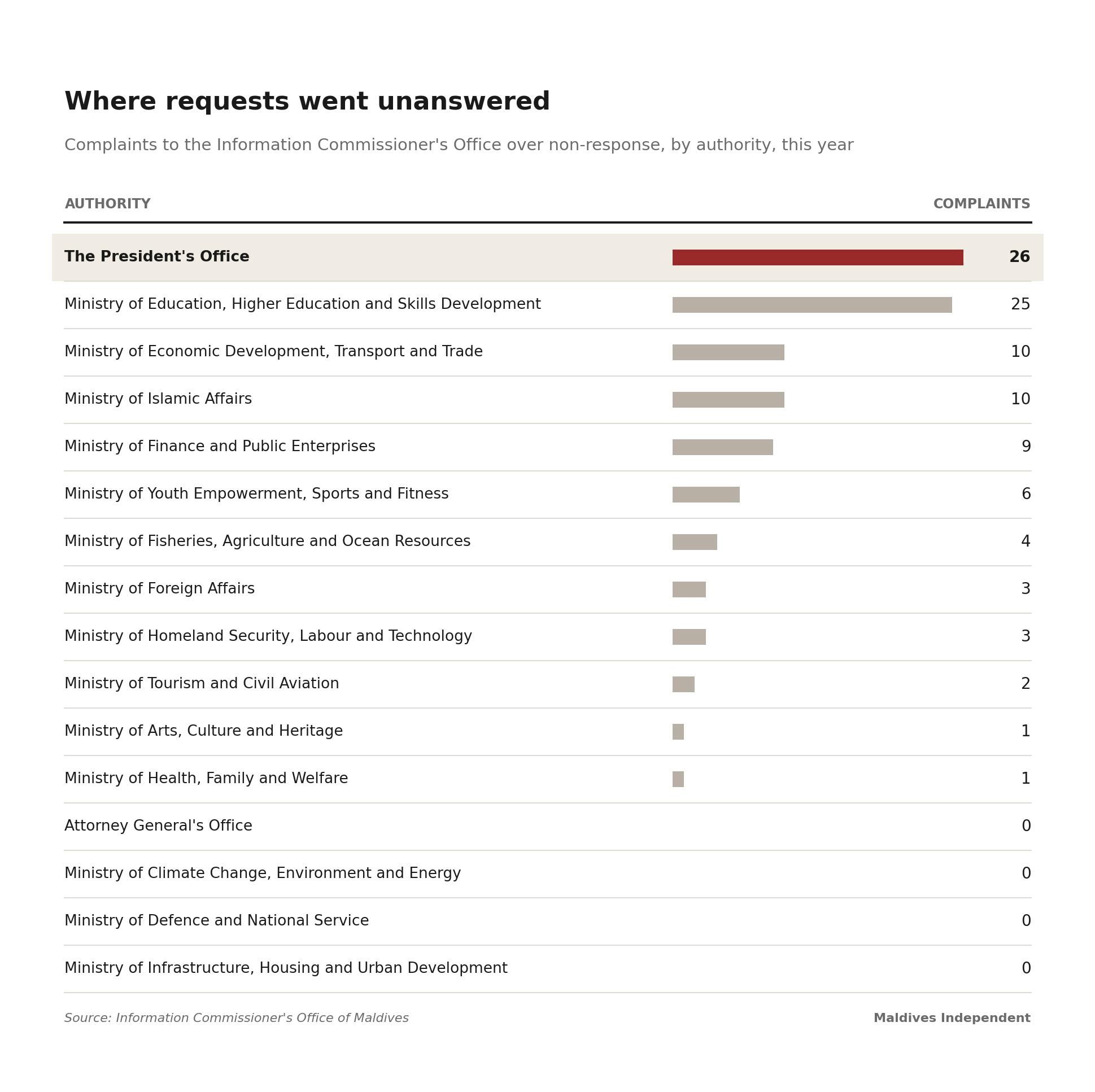
The progress on proactive disclosure follows weeks of friction between the commissioner's office and the government over how the law is being used and whether it is being followed.
On May 6, Ahid publicly pushed back against Attorney General Ahmed Usham's claim that the RTI Act was being "abused," saying his office had seen no evidence of systemic abuse and that mute refusals – where public authorities simply do not respond to requests – were far more prevalent than vexatious filings.
Usham said at a press briefing the same day that the RTI Act was being "heavily abused," forcing government agencies to spend excessive time processing requests. The remarks came in response to a question about the President's Office's failure to meet legal response deadlines.
Ahid said vexatious requests existed in isolated instances but did not constitute a trend. He invited the Attorney General's office to engage with the data in his annual reports and implementation assessment. Home Minister Ali Ihusan made similar criticisms of RTI as a costly process last year.
Ministries meeting proactive disclosure requirements is progress but RTI practices are still falling behind, Transparency Maldives' Governance Manager Azza Mohamed told the Maldives Independent. The 21-day deadline is commonly ignored and extended, appeals to ICO are rising, and contracts are hidden behind vague exemptions, she noted.
"The RTI framework covers more than ministries – it extends to state institutions, SOEs, and other organisations – but most lack working systems. Government must push for open data beyond ministries to break the culture of secrecy. Transparency is the foundational safeguard against corruption and access to information is the core of open governance," she said.
The process
Around early to mid-May, Ahid learned through information officers of a directive from the President's Office for all ministries to urgently meet the requirements of proactive disclosure. On May 23, the President's Office also claimed to have "processed and answered" all RTI requests.
It was direction from the very top that resulted in the progress. "It's something I had been saying, things like this will only happen with the political will from the top. And that's exactly what happened," Ahid said.
The task was not difficult to accomplish and all it required was the will and the push from the senior level, he added. "And that was proven. It just took some places a week. While others needed two weeks of working days or maybe about 10 working days," he said.
The way it came about, it seemed like a race to put everything together, Ahid suggested.
"Different ministries phoned us asking us to check the information they had added. That itself was a good sign," he said.
ICO did a special review for ministries. Reviews are normally conducted during the second half of the year, usually around September in line with an internal work plan. An office that achieved full compliance this year might lose that status the following year if documents are not updated. While it is not their job, Ahid said ICO often informs the authorities of missing documents during the review. Offices would then ask for some time to update what is missing. The person tasked with updating it often forgets if an internal reminder is not set.
In April, Ahid said his office had had "zero" engagement with the President's Office.
No meeting has taken place since but a political appointee and Spokesperson Mohamed Hussain Shareef 'Mundhu' had phoned Ahid. The President's Office requested speeding up the review of ministries and discussed identifying the best ways to provide information in response to RTI requests.
The conversations were a positive development, Ahid said.
On RTI requests, Ahid advised having a conversation with the applicant if the request is difficult. For instance, the President's Office could suggest how information could be provided in phases, especially if it is data sets. Ahid said there is a 50 percent chance the applicant would have no problem with that. However, if the applicant protests, Ahid suggested that the President's Office could provide as much possible with assurances of disclosing the rest later. In such cases, the applicant could bring the case to ICO for an open hearing.
"The point here is at any given time no one is going against the law. The law very clearly states how things should be done. Of course in doing so the point of view of the person requesting information and the point of view of the authority will not be the same in every area. That's the reason why if there is dispute it can be brought to different levels. So that was my advice to them," he said.
If an applicant is unhappy with an Information Officer's response, a complaint can be taken up to the review committee of the public authority, which has on occasion overruled the IO and provided information after considering the applicant's argument.
The President's Office's biggest problem was the failure to respond systematically over a period of time, and "that makes people frustrated and that makes people angry," Ahid observed.
Bare minimum
A response to an RTI does not necessarily always mean information was provided. This is a common misconception, Ahid explained. A response could be informing the applicant that the information cannot be provided or saying that the request cannot be accepted.
"Even to that level. I'm asking for the bare minimum actually. The next level can only be reached once this is complete. I'm not saying the President's Office provided information for everything to the measure as per the law," he said.
A significant number of requests are not accepted because of minor procedural requirements. In some cases, the applicant is only informed much later of what was missing in the request.
"And that person shouldn't have to wait three months to know this. In fact, the regulation states that much should be done within a maximum of three days. If something is missing in the original request, within three days they should be informed. For example, if the address is missing. We don't even have to go into a discussion yet whether the government is providing the information citizens request," he said.
The fulfilment of the proactive disclosure requirement by the government offices with the most resources was not cause for celebration, Ahid argued.
"They should have done this from day one and continued doing so from day one onwards. This is happening 12 years later, so when this is happening 12 years later, saying it is progress made towards transparency might not be the best way to go about it," he said.
On the President's Office touting its response to all pending RTI requests, Ahid noted the legal requirement to respond within 21 days. The President's Office often fails to answer within that period and sometimes takes even three months to respond, he said.
"So if we receive, for example, a 100 cases with regard to the President's Office, then those 100 cases are coming to us because a response was not provided within 21 days. So that means 100 instances of PO not following the law. Even if they respond late," Ahid said.
Next steps
Aside from ministries and the President's Office, Ahid noted that there are many other state authorities and companies that need to comply with the proactive disclosure requirement.
"These are places that have a large amount of resources, employ a lot of people, hold large funds that carry a big public interest," he said, referring to state-owned enterprises such as the Housing Development Corporation, the Maldives Transport and Contracting Company, the State Trading Organisation and the utility corporation Fenaka.
Ahid said the first step is how much is disclosed and the manner in which the information is disclosed.
"So the data sets being disclosed in a machine readable format or in a format that is easy for people to analyse, or disclosing some of the more complex information to a citizen friendly level. These are things that go beyond [the minimum requirements]," he said.
Second, authorities must ensure the proactive disclosure information is updated on an annual basis. The third step is a response to RTI requests. While this should have been the norm several years ago, to ensure that all authorities respond within the stipulated 21-day period would be a good start, Ahid said. Only then could the responses be reviewed for whether information is provided in their responses, or if information is being withheld where the public interest required disclosure.
The fourth step Ahid noted is how the Maldives has joined the Open Government Partnership (OGP), a multilateral initiative aimed at securing commitments from national and sub-national governments to promote open government, combat corruption, and improve governance, which helps governments and citizens work together, in 2024. However, no work has been done past joining the initiative. An action plan needs to be submitted at the latest within one and a half years, a deadline that has passed for the Maldives. The action plan put a strong focus on co-creation with civil society and engaging with the public in an inclusive manner, Ahid said.
"The OGP, in areas like transparency and even RTI, goes beyond the minimum requirements of the laws of the country in sharing guidance and pathways," Ahid said.
Azza from Transparency Maldives also noted the lack of progress "from the government's side to co-create and implement National Action Plans with measurable reforms based on the core values of access to information, civic participation, and public accountability."
She added: "Declaring intent alone is not enough – more work is required to show genuine intention by upholding those OGP core values in practice."
Ahid meanwhile faced criticism when he posted about the full compliance of the ministries and the President's Office.
"This is a positive moment for the current government, but the thing is, for whatever reason, [on Sunday] for the first time all ministries have met the full minimum requirements. That in itself is an achievement. I had never expected this would happen in any given time," he said.
The proactive disclosures gave a boost to ICO, which would now find it easier to ask other state institutions to comply. It will also be easier to push departments under the ministries, Ahid said, adding that ICO will instruct all ministries within the week to make all authorities under them fully compliant as well.
"What happens before is when we say this, the main public authority, the President's Office, has not bothered about this. So it's very easy for other authorities to ignore," Ahid said.
Discussion
No comments yet. Be the first to share your thoughts!
No comments yet. Be the first to join the conversation!
Join the Conversation
Sign in to share your thoughts under an alias and take part in the discussion. Independent journalism thrives on open, respectful debate — your voice matters.
Support Independent Journalism
Help us keep the news free and fearless
Give once
$
or
Become a memberfrom $5/month