
Q&A with Mohamed Nasheed, the former president running to lead the party he vowed to dismantle
On the 2023 split, the apology question, and the road to 2028.
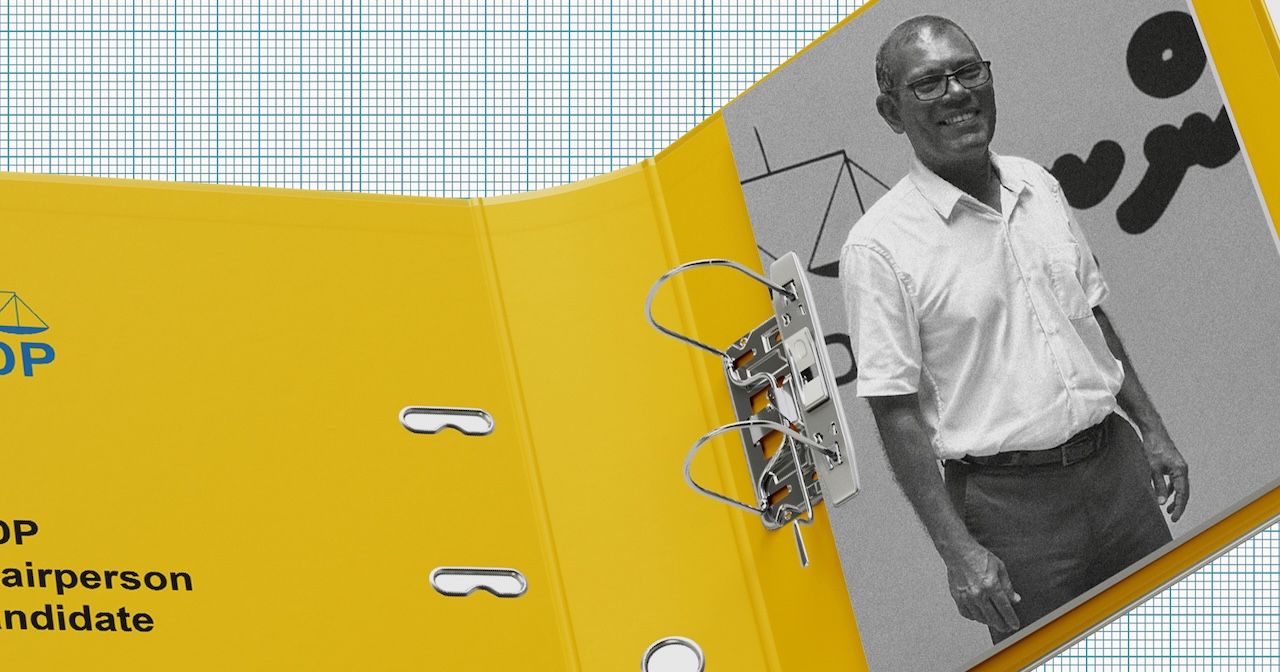
Artwork: Dosain
06 May, 13:57
The opposition Maldivian Democratic Party heads to a chairperson election on June 12 that has rapidly come to look like the opening round of the 2028 presidential contest. Galolhu South MP Meekail Ahmed Naseem, 32, is running with backing from former President Ibrahim Mohamed Solih and the MDP parliamentary group.
Former President Mohamed Nasheed launched his bid on a "Bodu Badhalu" platform of sweeping constitutional reform with former chairman Fayyaz Ismail is his pick for head of government. Nasheed left MDP after losing the 2023 primary to Solih and formed the Democrats, vowing to "dismantle" the party he co-founded, before folding the breakaway back into MDP last year.
The Maldives Independent sat down with Nasheed to discuss his record, the factional dynamics, and his reform agenda.
MI: The Democrats peeled off seven percent of MDP's base in 2023. Many MDP members blame you for President Solih's defeat. Do you accept responsibility and will you apologise?
Mohamed Nasheed: I think MDP has done an assessment of why they lost and I do not necessarily think that it was because the Democrats fielded a candidate. Now to assume that the seven percent that [Ilyas Labeeb] won was from an MDP base is a misconception. In my view, if Ilyas had not contested, [President Dr Mohamed] Muizzu probably would have won it in the first round.
You said you would "dismantle" the MDP. Two years later you want to lead it. Why should MDP members trust you not to walk away again?
I was sitting in Ghana and I was seeing MDP losing every election, one after the other, and this was very worrying, because, you know, after all, when everything is said and done, MDP is still my baby. I had spent a fair amount of my youth and my, let's say, 30s and 40s, on building this party. I feel that losing it would be bad and dismantling it also and making it weaker also would not be in the interest of the country and the wider society.
So I think MDP members are accepting it. They are welcoming me with open arms. I can see that everywhere, wherever I go. They all understand why I left. And I think also to assume, to believe that I actually left would be wrong. I had to leave. You know, there was no way that I could have saved my face by staying in there after having seen all that was done and said.
For two years you accused the leadership of stripping 39,000 members from the registry. On Saturday you called it a fingerprint issue. Why has your account changed now that you are running alongside Fayyaz Ismail, the chairman at the time?
So what I'm suggesting is that it wasn't necessarily Fayyaz’s own doing that 39,000 people were removed from the party. There was the rationale that they used. That was the fingerprint rationale. You might remember that I left the Qamuee Majlis [National Council] meeting while they were deciding [the issue]. I walked out and I did not want to be party to it. That was sad. But it was engineered so that I would lose the primary.
The Democrats won zero seats in 2024. Your own party president said there was "no chance" of forming a government. What did that experiment teach you about your political judgement and why should MDP members trust it now?
Because they know the value that I will be able to bring to the party. You know, MDP accepts many people who leave that party. And you would see that there are a number of people who have left the party and have come back again. So I don't think that's an abnormal thing in the MDP. So MDP members don’t necessarily feel that badly when someone leaves, but they feel very happy when someone comes back. Many of us have left and many of us have come back.
Beyond the factional contest, what is your actual pitch to members? If you win on June 12, what would you want the party to look like by the time of the 2028 primary, and what would you measure your chairmanship against?
MDP is the biggest institution of this country. it's a very resilient institution. And I think that whatever changes that we want to bring to our country, the platform to do it is the MDP. So I believe that strengthening the MDP is paramount. We have to do it for the benefit of not only the party, but for the country.
But beyond that. I think now, for instance, [Sri Lankan] President Dissanayake is meeting President Muizzu today [Tuesday, May 5]. President Dissanayake wouldn't know PNC [the ruling People’s National Congress]. But I am sure he would know the MDP. This would be the case if you meet any political leader in the region.
So I think we can become a political force, not only in the Maldives, but also internationally, among like-minded sister parties. And I also think that this is the strongest political organisation in small states. So if you compare MDP with any other political party in any other small state, let's say Barbados, or any other small [country] – small meaning anything below five million – I think we are a recognised force and I think we can be an example to many others.
I also think that this is a way through which conflict could be mitigated. Now let's say a place. I have always viewed this. Let's say Libya. Now instead of bombing Libya, we should have, the international community should have, built a political party there.
You know, we changed the regime. We changed a government in the Maldives, not by bombing the government, but by building political structures that would allow a smooth transfer of power. So I think we can put ourselves forward to the international community as a vehicle to democratise other countries. I think we understand these methods. I think if you see our campaigns and if you see our activities, they instantly come out and then start doing very systematic and methodical things – and very structurally – so that we get results.
So I think this is not only a political party that would bring prosperity to our own people. But we can also be a vehicle to change other countries as well, to bring democracy to many, many other places. So this is something that we can export. So I would like the MDP to be a vehicle for introducing democracy throughout the world.
In 2028, we would be in government. I think that is a given. We would be in government. But to do that also, we have to strengthen ourselves. You can never be sure of an election until the vote is counted. But I think it's not so difficult for us to get the government in 2028.
But beyond that, what is it that the Maldives is giving to others? Not just the beach and the sun and the turquoise beauty. Not just our beauty and the paradise, but also a belief, an ideology of peace and stability and democracy. I think we can export that and I think that would be a huge benefit for our country.
You have made splitting the head of state and head of government roles the centrepiece of Bodu Badhalu. Meekail says this is being pushed top-down without asking the public. What is your response and how realistic is it to deliver such a reform before 2028?
As I mentioned, as we said, this is a zero paper. For any idea to get traction, for debate and discussion, you have to have some kind of idea, some kind of outline there for people to go into these discussions. That doesn't necessarily mean we are asking everyone to accept this. We are only asking people to have a discussion on this. So I think it's a misconception to assume that this was top-down. No, this wasn't. We just simply mentioned that there is a need for change. And I think everyone now believes that there is a need for change. I'm seeing that.
I think it's very, very realistic. You see, we were able to get President [Maumoon Abdul] Gayoom to amend the constitution. We were able to form a political party, galvanise our people to political activism, amend our constitution, and have a free and fair election. That huge change took four years. Now the foundation is done. We should be able to do this in a matter of a year. And I believe that President Muizzu will ratify these changes.
Discussion
No comments yet. Be the first to share your thoughts!
No comments yet. Be the first to join the conversation!
Join the Conversation
Sign in to share your thoughts under an alias and take part in the discussion. Independent journalism thrives on open, respectful debate — your voice matters.
Support Independent Journalism
Help us keep the news free and fearless
Give once
$
or
Become a memberfrom $5/month