
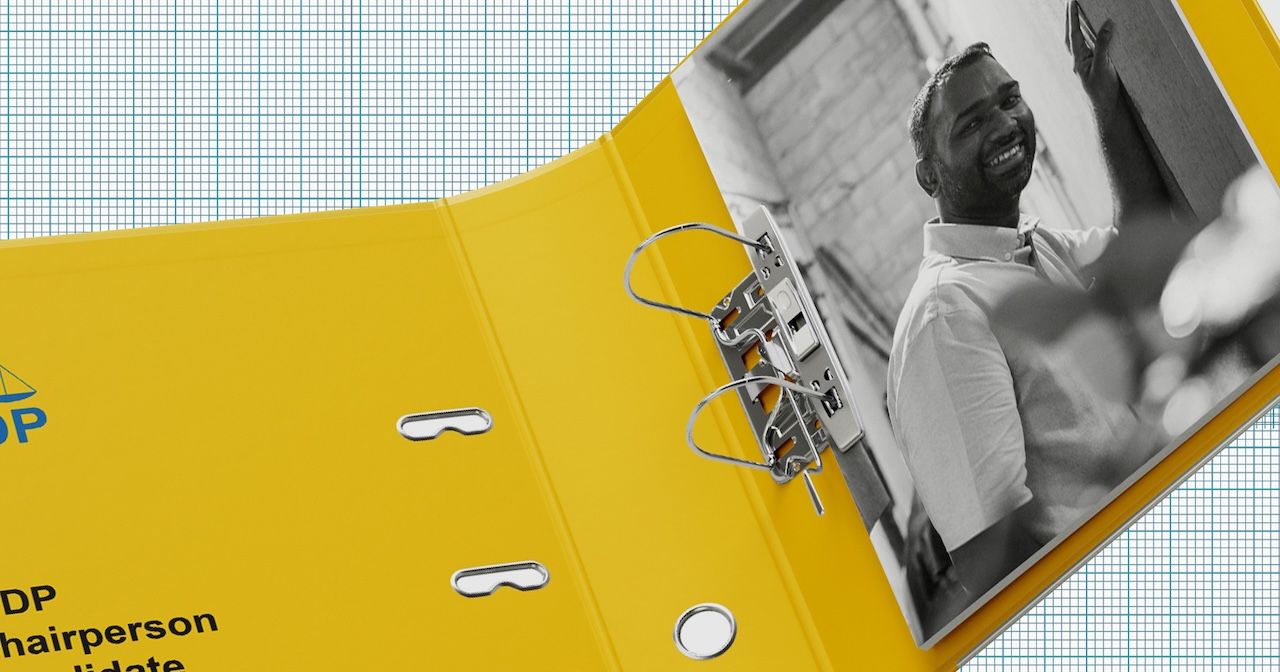
Q&A with Meekail Naseem, the 32-year-old pitching himself as MDP's neutral broker
On factional strife, the Nasheed switch, and the road to 2028.
29 Apr, 17:00
The opposition Maldivian Democratic Party's chairperson race is shaping up as the opening round of the contest for the 2028 presidential ticket. Former President Mohamed Nasheed is running on a "Bodu Badhalu" platform of sweeping constitutional reform with former chairman Fayyaz Ismail as his pick for Head of Government.
Meekail Ahmed Naseem, 32, two-term MP for Galolhu South, launched his bid with backing from former President Ibrahim Mohamed Solih and the MDP's parliamentary group, making him – at least on paper – the candidate of the party establishment against the Nasheed-Fayyaz ticket.
The Maldives Independent sat down with Meekail to discuss his record, the factional dynamics, and his response to the Nasheed-Fayyaz reform pitch.
MI: At 32, you would be one of the youngest chairpersons in MDP's history, running against a former president backed by a former chairperson. What in your record qualifies you to lead the party through opposition and into a 2028 campaign? And what do you say to members who think the job needs someone with more experience and political weight behind them?
Meekail: I believe I have the required political experience. I do not believe that political experience is connected to age. People accept that when you spend two terms in parliament, the individual has matured beyond the measure of a child. Secondly, in this race, I believe I have a very essential quality that is required for a chairperson that will help bring MDP success in 2028. And that is maintaining a neutral stand to unify the party. I’ve noticed that in this election, many are trying to label me as someone from a specific faction. However, from yesterday’s press conference alone, it will be very clear that it is not just a specific person or specific faction that supports me. People who subscribe to very different ideologies and people of various ages and MPs that support different political personalities are behind me.
Then there is the question of political weight. I do not believe the outcome of the upcoming presidential election depends on one individual. I believe it depends on the work we do together, the work our team and MDP do together. So my priority is planning and organising MDP in time for 2028 as a person with a neutral stand that will not divide the MDP and will hold a fair primary amongst all candidates. Unless the party is united 2028 cannot be won.
You're running with veteran backing while pitching "a new generation of youth" to lead MDP. How do you answer members who see those two things as contradictions?
I actually don’t believe that in its essence that is a contradiction. Those supporting me are not just the older people or people of a certain age. Very different people or various ages are with me. This includes the current youth wing leader, the youth wing deputy leader, deputy leader of the women’s wing Ema [Shafeeq]. A lot of young leaders that are popular amongst us are with me. So I believe that having party veterans with me is an advantage. I because it shows that they have that confidence in me. They trust me and I’m really pleased to be getting their assistance in shifting the MDP leadership towards a new generation.
You were once seen as one of Nasheed's closest allies before aligning with Solih. What changed? What’s your response to critics who allege that you switched sides out of self-interest?
I was aligned with the Nasheed faction for a very long time. I kept criticising some of the things the [Solih] government at the time did, because I believe those were things that needed to be criticised. So naturally I had been aligned with the Nasheed faction. However, when we reached a certain point, the presidential election was nearing. When we were nearing the party primary one thing that had become clear for me was that in this upcoming primary, depending on the outcome, they did not intend to remain with the party. That was not something I could accept. As someone who worked closely with them it had become very clear to me way before.
So I decided which way was in the party’s best interest. I believed unless the party got a second term our reform agenda, all our policies that come from our core principles would not be implemented. That is why I supported President Solih in the presidential election. I am still proud of this decision. I believe if I had left the party that day, the general members of the party would no longer be able to trust me.
Secondly, I would like to note a specific matter. Very often I see on social media and elsewhere that I changed factions because my wife got a job. My wife was in a non-political job that paid a very basic salary at the President’s Office. And that job was not received through me. And the biggest evidence that it is not the reason I decided to support Solih is, when I was out campaigning for Imthiyaz Fahmy against the government candidate Fayyaz Ismail in the chairperson election, my wife was still at the President’s Office in the same job.
You've committed to a fair presidential primary. Given that this race is widely seen as a proxy battle for the 2028 ticket, how will you ensure the process isn't tilted toward any candidate, including one aligned with the faction backing you?
My support does not come from a specific faction in this party. Even with my announcement I saw some media coverage that “President Solih’s team is with Meekail”. However, those there were not just President Solih’s supporters. Many people who will definitely not support President Solih in the presidential election are with me. So I don’t believe it is a specific faction. I have taken a neutral stand.
I have not decided which candidate I will personally support in the upcoming MDP primary. I also believe it would not be good for anyone with interest in the chairperson post to publicly take a stand. What we want from a chairperson is to hold a fair primary amongst all candidates.
Secondly, to keep the party united, the primary should not only be fair but has to be seen to be fair. So if anyone that supports a specific presidential candidate becomes the chairperson, that will mean there is a lot of room for conflict running up to 2028. So I believe the main reason I can do this is that I have taken a neutral stand and have the trust from everyone, including my opponents, that a fair primary will be held under my chairmanship.
Beyond the factional contest, what's your actual pitch to MDP members? If you win, what would you want the party to look like by the time of the 2028 primary and what would you measure your chairmanship against?
I have a vision with regards to the party. And that vision is not something I decided on my own. I went to a lot of islands in the local council election and across various other elections over the years. And during this local council election alone, I went to over a 100 islands. So I know the sentiments of MDP members.
One of the main things they note is ‘the state gives you funds in our name. What happened to that?’ Even this time the party could not pay the council candidates the MVR 1,500 [US$ 100] candidacy submission. Why? So I will give the answer to that during my chairmanship. I will create a fair and transparent system. I have announced now, that as chairperson, I will publicise how the state’s funding is used month by month.
Secondly, while the party has reached 20 years, the party’s assets have not been looked after. The party does not have an inventory. The party's tables and chairs need to be bought for each election. It is unclear what happens to that. TVs were sent to all islands for the presidential election, but the TVs are not there now. They are there only in a very few islands. I will create a proper system for that to reduce waste.
And third, I believe the party formed as a party of the youth. It was formed against an authoritarian government. However, today when we look at our party membership, only 14 or so percent is youth. So I will try to bring that membership as close to the national average representation and reduce that gap. As per the information I have received, in 2028 the national electorate’s 45 percent will be youth. However, this is not reflected in our party membership. I will work towards that.
And as for one of the most important things, I will do everything I can to organise a fair presidential primary. I believe that is the key thing to keep the party a unified one up to 2028.
Nasheed and Fayyaz have proposed sweeping constitutional reforms, including splitting the roles of Head of State and Head of Government. Do you support that proposal and if not, what is your alternative answer to the governance failures they say it would fix?
Firstly I believe those reforms, that “bodu badhalu” [big change] is not a matter that relates to the chairperson election. It relates to governance of the state. It is another matter relating to solving some constitutional issues. The current election is to decide how to run the party, which direction the party should go. That is one thing.
Secondly, I believe their proposals have not followed the proper sequence. The process followed was wrong. First we have to go to the people. We have to go and ask what changes the constitution requires. For me to go and say ‘I want to become the Prime Minister. Give that person the presidency’ is wrong. We should not divide pieces of the pie like this. We should go out to sell reforms to the people after receiving that proposal from them. We should not try to push this from the top down.
Third, we hear a lot that this needs to happen before 2028. Which means before the presidential election. So, they need to show in which manner this reform can actually be implemented before 2028. And the citizens of Maldives need to be asked the question of whether they even see this as a reform! Is this really a reform or something the citizens actually want? Why should we go for a referendum on that? First we need to ask the citizens what it is that they want.
We have been saying on behalf of MDP that we should not be frequently bringing changes to the constitution. While we say that, the next day, how can we go and say ‘include a Prime Minister in the constitution, include a Head of State, the Majlis must be like this.’ How do we do that? Constitutions are amended in countries through a long process, after many years and discussions, conducted amongst many stakeholders, with proposals that are in the citizens’ actual interest. So I cannot welcome these proposed changes without giving space for that process.
Editor's note: This interview was conducted in Dhivehi. The responses have been translated.
Discussion
No comments yet. Be the first to share your thoughts!
No comments yet. Be the first to join the conversation!
Join the Conversation
Sign in to share your thoughts under an alias and take part in the discussion. Independent journalism thrives on open, respectful debate — your voice matters.
Support Independent Journalism
Help us keep the news free and fearless
Give once
$
or
Become a memberfrom $5/month