
Politics

Maldives media stands firm in standoff over "control bill"

Parliament pushes ahead with creation of new regulator.
Artwork: Dosain

Artwork: Dosain

28 Aug, 11:00 PM
The Maldives media fraternity united in opposition to the proposed creation of a new regulator with broad powers to slap fines and shutter news outlets, bracing for a fresh crackdown as the government rebuffed demands to scrap the "media control bill."
Parliament reconvened for an extraordinary sitting on Wednesday and concluded preliminary debate on the widely-condemned legislation. The ruling party supermajority pressed ahead with the media and broadcasting regulation bill in a 49-12 vote, sending it to a committee and returning to recess until October.
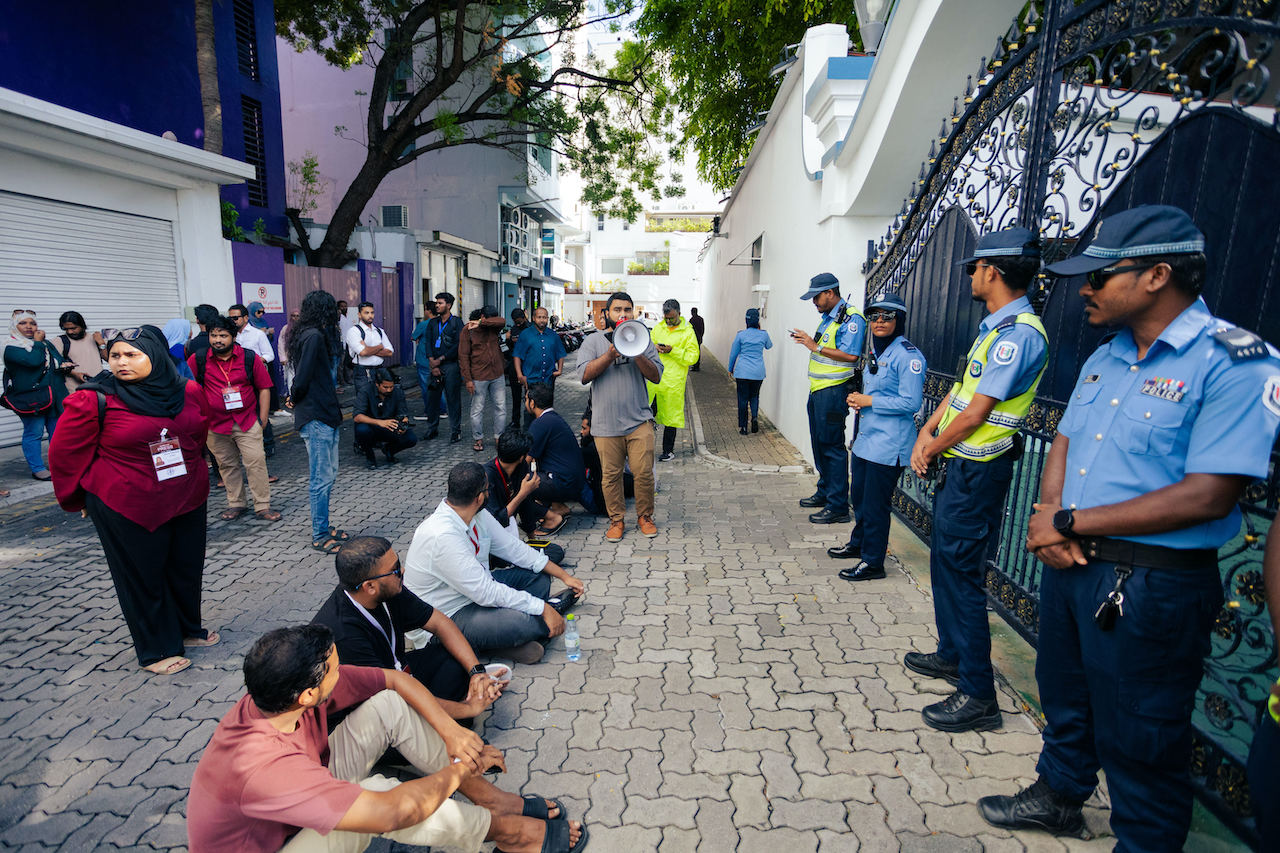
Outside the People's Majlis in Malé, journalists protested against the anticipated shift from self-regulation to government control. 
When the group attempted a sit-in outside the President's Office after the vote, riot police dragged away six journalist and detained two inside a vehicle. Both were released about 20 minutes later. 
But police denied making any arrests, claiming the journalists were "instructed to move out of the designated green zone, as this area is not legally authorised for protests or public gatherings."
However, the journalists were allowed to continue protesting outside the President's Office. After office hours, they moved to the nearby Muleeage presidential palace. 
Outside parliament. Photo: Anoof Junaid.
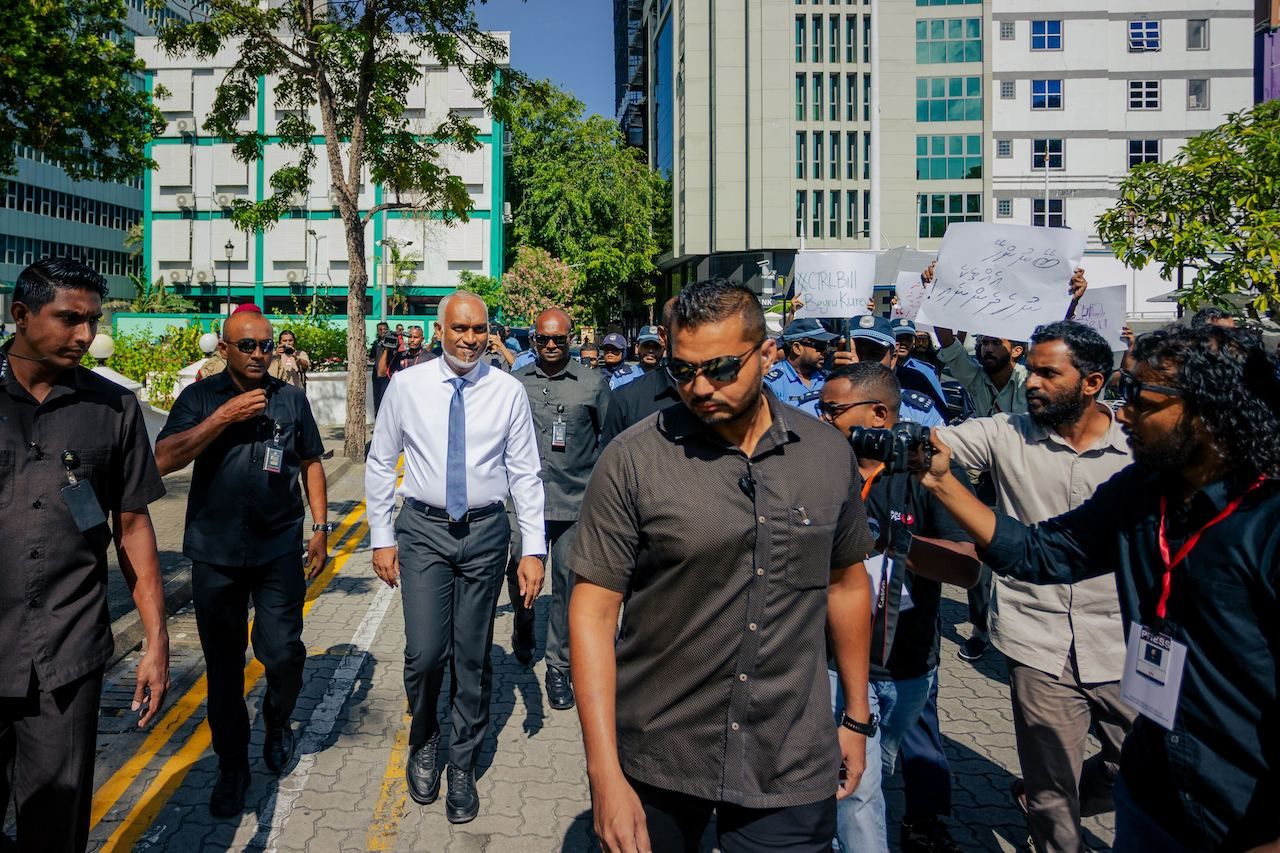
Arrest of Dhauru journalist Muzayyin. Photo: Anoof Junaid.
Protest outside presidential residence. Photo: Anoof Junaid.
Journalists remained unconvinced of amendments promised to address concerns, casting the bill as irredeemable. On Thursday morning, they returned to protest at the "media fenda" opposite the President's Office. Awaiting a meeting with the president, they sparred with Information Minister Ibrahim 'Asward' Waheed and Communications Minister Ibrahim Khaleel, both of whom were formerly broadcast journalists.
Asward acknowledged "concerning" provisions in the bill, but declined to name specific clauses when pressed. Both ministers repeatedly assured that changes could be made during the committee stage. 
Parliament's independent institutions oversight committee took up the bill on Thursday morning, seeking public opinion before September 7, setting a deadline of September 15 to complete the review, and scheduling stakeholder meetings from Sunday to Tuesday. Media representatives were invited to Monday's meeting. 
However, both the Maldives Journalists Association and the Maldives Media Council – a 15-member print and online media regulator that would be dissolved if the bill is passed – have refused to engage in consultation over what they regard as ill-intentioned and fundamentally flawed.
On Thursday afternoon, MJA and MMC members met with President Dr Mohamed Muizzu and Attorney General Ahmed Usham for over an hour. The president denied seeking to control the media or restrict constitutional rights, describing his administration as "100 percent pro-media," they said. The group said they emphasised scuttling the bill as wholesale revisions would take longer than drafting a new one. The president promised to take that into consideration and to seek the AG's advice, they said.
Muizzu "attentively considered all recommendations and pledged due regard," the President's Office said.
Their hopes were dashed when Usham met the press later and dismissed the key demand. "Our opinion is that we could go ahead with the current proposed bill with reforms after further review. I don't believe the bill needs to be withdrawn," the attorney general said.   
The present legislation was substantially the same as a draft prepared by the Media Council in 2022, Usham argued. No "extreme" provisions in the current bill were absent from the one "proposed by the media," he said. The government will refine the legislation on fines, punishments, the regulator's composition, and vague provisions with broad interpretations, Usham said.
But journalists pushed back against his characterisation of the former Media Council's paper as one endorsed by the media. Following testy exchanges, most journalists walked out of the press conference when the AG made the government's stand clear. 
Photo: Anoof Junaid.

Beyond the pale 

Speaking to protesting journalists outside parliament on Wednesday, Majority Leader Ibrahim Falah also assured them that they would be heard at the committee.
Ahead of the vote – which was called despite Speaker Abdul Raheem Abdulla's earlier announcement of "ending the debate for today" – Falah declared "full support" for the bill from the 75-member People's National Congress parliamentary group.
Doubling down on the PNC's defence on the grounds of allegedly unrestrained defamation, Falah bemoaned false claims of his appearance in a gay sex tape. “When you work at this level, the media shouldn’t be jailed, they should be impaled!” he declared. 
The remarks sparked an outcry. The MJA condemned the outburst and demanded disciplinary action as well as an apology from Falah for the "direct and dangerous incitement to violence against journalists".
The main opposition Maldivian Democratic Party – whose activists and leaders also protested outside parliament on Wednesday morning – echoed the condemnation of the "disturbingly cruel and inhumane suggestion". 
At a press conference on Wednesday night, many members of the Media Council expressed alarm over Falah's remarks – which are protected from legal action by parliamentary immunity.
The council questioned the motivation behind the bill's sudden revival last week without any consultation with the watchdog or media groups. Members criticised the proposed legislation as offering no solution for misinformation or fixing shortcomings in regulation, which they blamed on a small budget of MVR 3 million (US$ 194,550) that leaves no funds for legal expertise or an ombudsperson to handle complaints. 

Fighting the tide

The bill will "plunge the country back 20 years" before multi-party democracy under the 2008 election, 'Hiriga' Ahmed Zahir, a veteran editor with more than 30 years of experience, warned at a press briefing organised by the MJA on Tuesday. 
Contrary to Deputy Speaker Ahmed Nazim's debunked claim that the bill complies with Scandinavian and European media laws, Dhauru editor Moosa Latheef suggested the sources were closer to countries like Malaysia or Singapore.
Frustrated with its complaints piling up at the Media Council, the President's Office is "finding a path to take action" against critical coverage, said Adhadhu CEO Hussain Fiyaz Moosa, noting how the presidential appointees on the Broadcasting Commission recently suspended Channel 13's broadcast for an hour.  
The veteran editors warned that muzzling mainstream media would push outlets underground and drive news consumption to unfettered social media platforms. The "vacuum" will be filled by unscrupulous actors and unverified claims, said Hiriga, referring to the infamous Dhivehi Observer anti-government website in the 2000s. 
The government fears anonymous social media users and whistleblowers who expose corruption, Moosa Latheef observed. But it is trying to "swim against the current" with a futile censorship drive, he suggested.   
Concerns raised by journalists and rights groups:

The president appointing three of seven members with parliamentary approval

Parliament can dismiss four members elected by the media with no-confidence votes

Voting rights for state media across multiple channels operated by the Public Service Media could be exploited in the election of media representatives

Commission can block websites, halt broadcasts and suspend media licenses during investigations

Courts can permanently revoke registration

Media outlets can be shut down indefinitely without formal verdicts

Social media posts and content creators could be targeted

"National security" clause allows commission to enter newsrooms through police

Individual journalists can be fined up to MVR 25,000 (US$ 1,620) for not making corrections quickly enough

Journalists can be forced to apologise for publishing "false information"

Vague definitions of "fake news," "false information," and what incites "fear or hatred"

No clear criteria for who determines what constitutes "false information"

Terms "ripe for abuse" and could lead to criminal prosecution

Bill allows investigation of complaints from 12 months before the law takes effect 

May violate constitutional prohibition on retrospective legislation

Discussion

No comments yet. Be the first to share your thoughts!

No comments yet. Be the first to join the conversation!

Join the Conversation

Sign in to share your thoughts under an alias and take part in the discussion. Independent journalism thrives on open, respectful debate — your voice matters.

Support independent journalism