
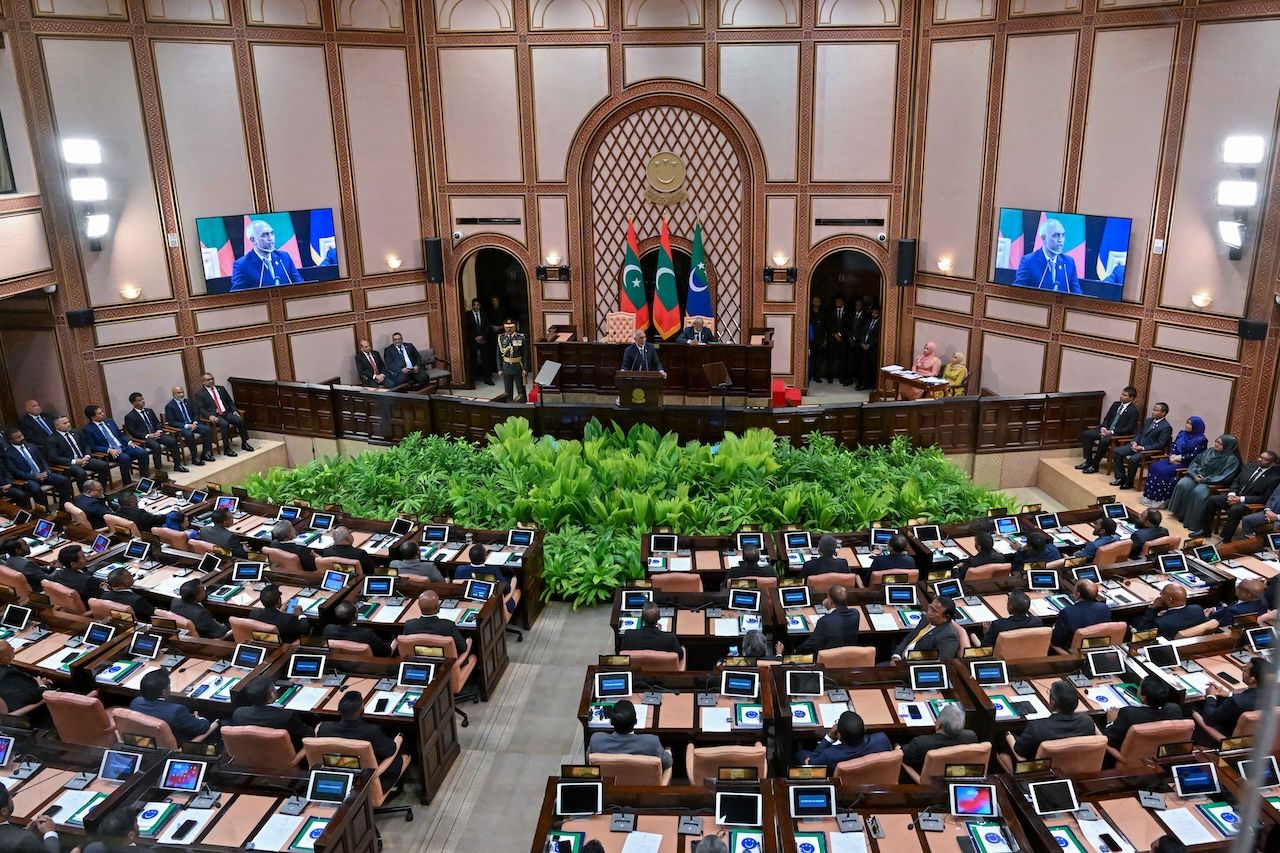
From resort dividends to an open prison: everything Muizzu pledged in his three-hour address
Bold pledges, questionable maths, and a three-hour spending spree.

Artwork: Dosain
In 2025, 90 new projects were under way: 74 mosques, seven Islamic centres, three Quran centres, and six Waqf buildings.
Has Alif Dhidhdhoo Islamic Centre and mosques on 10 islands were completed and opened.
Eight more mosques will open across the country before Ramadan.
MVR 19.4 million was spent on mosque repairs across the country in 2025; MVR 15 million allocated for mosque repairs in 2026.
Construction of Islamic centres on 10 more islands will begin in 2026, with agreements for three signed on January 21.
Construction of mosques on 17 more islands will begin in 2026.
The Hulhumalé Grand Mosque masterplan has been drawn up; construction will begin this year.
Mosques with main halls accommodating 800+ worshippers will have their main halls and women's prayer areas air-conditioned. Four such mosques in Malé will be air-conditioned before Ramadan.
Hafiz allowance doubled from MVR 2,000 to MVR 4,000.
A record 30 Huffaz graduated in 2025 – the most in the country's history.
By the end of 2028, every inhabited island will have a branch of the National Centre for the Holy Quran. Work began in 2025.
A dedicated Quran Waqf building will be constructed in Malé this year to provide sustainable funding for Quran-related activities.
The National Quran Competition is now fully government-funded. Prizes have been doubled. The overall winner receives a presidential scholarship to study up to PhD level, in any field, in any country.
More Quran teachers for children with disabilities will be recruited this year.
The Maldives became the 8th permanent member of Saudi Arabia's Makkah Route Initiative, providing modern facilitation for pilgrims departing from the Maldives.
Services in Mina upgraded from Category C to Category B.
The journey from Makkah to Medina shifted from bus to air-conditioned high-speed rail, cutting travel time from seven hours to two hours.
Free medical services provided to pilgrims during Hajj, including a medical clinic at the pilgrim hotel through an agreement with a Saudi hospital.
All improvements made at no additional cost to pilgrims.
The Maldives was among the first eight countries to complete 100 percent of Hajj preparations for 2026 in Saudi Arabia, including accommodation in Makkah and Madinah.
The Maldives' first-ever Zakat law has been enacted, described as ending years of waiting and a major milestone for strengthening Islamic affairs.
Public trust in the Zakat system has increased and collections are rising.
MVR 107,205,043 was collected in Zakat in 2025, the highest amount in five years.
Work has begun on collecting Maldivian memories, identifying unique heritage characteristics, and training heritage practitioners nationwide.
A scholarly community for heritage – the first in Maldivian history – has been established, with 50 researchers beginning work.
National heritage projects are under way in Haa Alif Utheemu, Thakandoo, and Baarashu.
Research for nominating Maldivian coral stone mosques and stonework to the UNESCO World Heritage List has been completed. The nomination dossier has been submitted to the UNESCO World Heritage Centre.
The country's first "Interactive Immersive Museum" is under construction at the Usgekolu site and will open this year.
National Occupational Competency Standards (Level 3) and training packages are being developed for: thundu kunaa weaving, silverwork (thileru), saan weaving, boat building (maavadi), lacquer work (liyela), kasabu weaving, faili weaving, and palm/coconut leaf weaving.
Training centres to be established this year: Baa Thulhaadhoo (lacquer work), Dhaal Rinbudhoo (handicrafts), Gaaf Dhaal Gadhdhoo (thundu kunaa weaving).
A national vision for restoring Maldivian etiquette and values will be drawn up.
A National Respect Project and nationwide respect campaign will be launched this year.
"Bingaa," a year-long character education programme – the first of its kind – has been launched in all schools nationwide.
Legislation is being drafted: the National Symbols Bill and Heritage College Bill will be submitted to parliament in the second session this year.
The largest military vessel ever introduced to the MNDF – provided as free aid by Türkiye – was commissioned in 2025.
Three interceptor craft have been commissioned for maritime security and search-and-rescue operations. An additional 17 will be deployed this year.
Japan has agreed to fund the procurement of two harbour craft patrol vessels.
A surveillance vessel provided with Australian assistance will be commissioned this year.
The MNDF's first air station was established and opened in Addu City in 2025.
A northern air station at Shaviyani Funadhoo will be completed and become operational this year.
Modern armoured vehicles were procured for the MNDF Marine Corps in 2025.
Further equipment and facilities for the Marine Corps will be acquired this year.
Girifushi land reclamation and infrastructure development has begun.
The MNDF Addu Training Centre is being further developed.
Infrastructure projects at Kalhuthukkala Koshi (military HQ in Malé) will begin this year.
Major improvements are needed across fire and rescue services, emergency operations, operational logistics, accommodation, and administrative management.
Infrastructure development across the country and modernisation of training systems are planned for this year.
The Aviation Security Command has been renamed the Aviation and Port Security Command, adding commercial port security to its mandate.
Security now covers: Malé Commercial Harbour, Hulhumalé International Terminal, Kulhudhuffushi Regional Port, and Hithadhoo Regional Port. This addresses a longstanding gap – previously no government agency was responsible for commercial port security.
"Maldives First" foreign policy: prioritising neighbours and Islamic nations, pursuing trade and economic partnerships, guided by consultation and diplomacy.
Elected Vice President of the 80th session of the UN General Assembly.
Elected Vice President of the UN Human Rights Council.
Elected to the Commission on the Status of Women for the first time.
Won three additional international elections.
Submitted a statement to the International Court of Justice on Israel's obligations in the occupied Palestinian territories.
Filed a written statement in the ICJ case brought by The Gambia against Myanmar over atrocities against Rohingya Muslims.
Participated in eight OIC meetings, condemning Israeli actions in Palestine in the strongest terms at each.
Affirmed the Maldives will always be at the forefront of supporting an independent Palestinian state.
The 2025 budget of MVR 56.6 billion – the government's first budget – was executed without exceeding the amount approved by parliament by "even one Rufiyaa."
First budget in five years completed without a supplementary budget.
Breakdown of 2025 spending: MVR 34.8B recurrent expenditure; MVR 14.2B on staff costs (including pay harmonisation from November 2025); MVR 4.6B on interest payments; MVR 9.9B on subsidies, contributions, and government assistance; MVR 6B on other recurrent costs; MVR 6B on capital expenditure; MVR 7.9B on PSIP; MVR 5.2B on debt repayment; MVR 5.6B on loans and other investments.
The overall deficit averaged above nine percent of GDP over the previous five years.
The deficit has now been reduced below nine percent of GDP; in 2025, it stood at five percent of GDP.
For the first 40 weeks of 2025, the budget ran a surplus – unprecedented in recent history.
The government plans to keep the deficit below nine percent of GDP in 2026 and over the medium term.
Total revenue and grants in 2025: MVR 38 billion. Tax revenue: MVR 28.1B. Non-tax revenue: MVR 9.6B. Grants: MVR 378.2M.
Revenue grew 12 percent compared to 2024.
Projected revenue for 2026: MVR 40.4 billion.
Foreign currency revenue in 2025: US$ 1.2 billion.
Gross official reserves now exceed US$ 1.13 billion – the highest in Maldivian history.
The Sovereign Development Fund (SDF) now holds over US$ 275 million. When the government took office, the SDF had only US$ 2 million in usable funds.
Credit rating agencies have noted the improvement in the SDF's foreign currency liquidity.
The biggest financial concern inherited was a US$ 500 million sukuk issued in 2021 by the previous government (at a higher cost) to repay a US$ 250 million bond taken in 2017, both now due for repayment.
The IMF's November 2022 Article IV report classified the Maldives as "at high risk of debt distress."
The effective cost of financing across the two previous governments' transactions reached double digits – 10.5 percent.
US$ 150 million of the sukuk due in April 2026 will be repaid from the SDF's foreign currency holdings.
The remainder will be refinanced at an interest rate guaranteed not to exceed nine percent – a firm assurance given to parliament and the public.
The government's goal is to free the Maldives from the "debt trap" inherited from previous administrations and achieve fiscal and debt sustainability.
China has agreed to refinance a portion of its loans to the Maldives on terms that do not burden the treasury.
India has rolled over its swap facility, removing a previous condition requiring an IMF programme.
The Abu Dhabi Fund for Development has agreed terms to roll over a US$ 100 million bond (originally taken in April 2018) and extend its maturity by five years.
An additional US$ 100 million in confirmed non-tax revenue will be deposited within 45 days.
Triple-A-rated insurance agencies are providing insurance cover for Maldivian creditors; arrangements for an additional US$ 150 million are nearing completion.
The Foreign Currency Act, in force since January 2025, resulted in US$ 492 million being exchanged through the MMA during 2025.
The medium-term budget plans to use the SDF to repay upcoming foreign currency debts, reducing the need to borrow to repay debt, and gradually reducing the debt stock year on year.
The Maldives spends an average of US$ 443.6 million per year on diesel imports, most of it for electricity generation. Dependence on diesel is described as the biggest threat to the country's "energy security."
When the government took office, renewable energy accounted for only four percent of electricity generation (53 MW).
Over two years, renewable capacity has been doubled to 110 MW.
Target for end of 2026: double again to 220 MW – representing 50 percent of the 2028 renewable energy target.
The government's Climate Mitigation Policy aims for 33 percent of electricity to come from renewable sources by end of 2028.
Diverse renewable energy projects will be rolled out across Malé, other cities, and islands in 2026, reducing diesel dependence and foreign currency outflows.
The SME sector is the largest employer of Maldivians. Special attention to SMEs is a core government policy.
2026 has been designated the national "Year of Productivity."
Government's vision: make every Maldivian citizen a productive participant in national development; aim for the Maldives to be classified as a developed country by 2040.
The country's largest-ever expo – "Dhivehin'ge Ufeddhuntherikamuge Maurazu 2025" (Maldivian Productivity Expo) – was held in 2025.
A new Trademark Law has been enacted and the Maldives' first Intellectual Property Office was established on 1 January 2026.
The first-ever MSME Awards were introduced, recognising outstanding SMEs across various sectors.
SME Development Finance Corporation rebranded as "SME Digital" and made a subsidiary of Bank of Maldives (BML). Loans from the old entity have been converted to Islamic financing facilities with extended repayment periods.
MVR 349 million disbursed to 595 small businesses to date.
New products introduced: "Tijaara Rashu Fathuru" (Islamic financing for tourism SMEs); "Vessel Financing" (up to MVR 5 million for maritime businesses); financing for content creators and film producers (up to MVR 500,000).
Women's business financing scheme: MVR 25,000 to MVR 250,000 under Sharia principles.
Islamic Micro Financing (through MISFI and SME Digital): up to MVR 100,000 at 2.5 percent per year – the lowest rate in the country – targeting those who have never received financing from any bank or financial institution.
From February 1, 2026, general financing at low interest rates for SMEs is available through SME Digital.
Business loan equity requirement reduced from 30 percent to 20 percent; repayment period extended from 15 to 20 years.
BML merchant fee on card transactions reduced from 2.5 percent to one percent.
Indian rupee and Chinese yuan accounts can now be opened online by individuals and businesses.
Airport import clearance time extended from 80 to 124 hours.
Demurrage-free storage at Malé and Hulhumalé ports extended from 5 to 10 days.
Demurrage fees and freight charges can now be paid in Maldivian rufiyaa.
Registration fees for small and medium cafés and restaurants reduced by 50 percent for the next two years.
Companies with fewer than 20 foreign worker quotas will not need to pay annual quota fees from March 2026 (legislation to be submitted to parliament in the first session).
PayPal is expected to begin operating in the Maldives "very soon."
BML has launched "Swap" – a 100 percent Maldivian multi-currency digital wallet for domestic and international transactions, also usable by tourists.
WeChat Pay has been enabled on BML's POS terminal network.
An agreement with Alibaba Group allows Maldivian products to be sold internationally; a platform has been set up on Alibaba with 400 vendors from Authentic Maldives.
The government paid MVR 6.3 billion in outstanding bills to Maldivian businesses in 2025.
MVR 882 million was allocated to SOEs to clear long-standing "legacy" bills owed to private suppliers; MVR 469 million verified and paid so far.
The government also directly paid MVR 1 billion in SOE bills.
The Business Centre Corporation (BCC) is building a "Creator Hub" in Malé – a one-stop centre for SME services, co-working spaces, Authentic Maldives retail, and creative economy support.
The 8th floor slab has been completed; the building will open on 11 November 2026.
Addu City (including Hulhudhoo and Meedhoo) will be designated a special incentive zone for SME investment from January 2027 for three years.
Incentives will include exemptions from land rent and income tax, among others.
The government invites all interested parties to develop Addu as the Maldives' IT hub.
The first phase of relocating Malé's commercial port to Thilafushi is under way.
A contract for the 125-metre international quay wall will be awarded today (February 5, 2026).
The two-kilometre domestic quay wall, paving, buildings, and equipment procurement will be contracted by mid-2026.
Target: complete the move to Thilafushi by November 11, 2027.
Expected benefits: ship unloading time reduced from seven days to 48 hours; longer storage periods; lower import costs and consumer prices; wholesale trade relocated from the Malé market area to Thilafushi; reduced congestion in Malé's market and MPL areas.
A duty-free goods storage zone was established at Kulhudhuffushi Port on August 26, 2025.
A similar zone at Addu Port will be established and begin operations this month (February 2026).
The list of controlled essential commodities has been expanded to 23 items, with availability at affordable prices guaranteed in the Malé market.
STO agents are being recruited to supply all 23 items at STO rates to islands with populations of 3,000 or more.
STO has begun importing all 23 essential items directly to Addu City and Kulhudhuffushi City from abroad, ensuring prices match Malé.
An STO distribution centre has opened at the Malé harbour. An STO outlet will be established in Hulhumalé before Ramadan.
54 foreign investments were registered in the Maldives in 2025.
Headline investment: Google's international submarine cable project "Dhivaru" – cited as evidence that global tech giants now trust the Maldives' economic reforms.
The "Ayla" project in Noonu Atoll (launched January 29, 2026) is the largest private-sector investment in Maldivian history: US$ 790 million in the first phase, under a sustainable township concept.
A residency visa programme offering residency in exchange for investment in designated sectors.
Operated by Henley & Partners.
Legal framework being finalised with parliament; applications expected to open in April 2026.
Aims to increase foreign currency circulation, attract investment capital, and create new industries.
21,174 jobs have been created in the Maldivian economy since November 17, 2023, including 6,724 private-sector jobs (per the Pension Office).
From February 5, 2027, only Maldivians will be permitted to work as cashiers anywhere in the country. This cabinet decision is expected to create at least 25,000 additional jobs for Maldivians within one year.
The government will provide training, work ethic awareness programmes, and full support to businesses to prepare for the transition.
A three-year operation to address undocumented foreign workers.
Phase 1: Biometrics (10 fingerprints and facial recognition photos) have been collected from 205,701 foreign workers. Any worker found without biometrics or a valid work permit is deported immediately.
Between November 17, 2025 and January 31, 2026: 228 unregistered workers deported. Since November 17, 2023: 11,496 undocumented workers deported (compared to only 2,649 between 2018 and 2023).
Phase 2 (started 1 January 2026): Legalisation programme for workers who gave biometrics but have not regularised. 3,837 applications received so far.
Phase 3 (starting 3 May 2026): Joint operations by police, councils, and immigration across all islands to deport workers who have not regularised and have no valid work permit.
Target: by 2 May 2027, the exact number and identity of all undocumented foreign workers in the Maldives will be established, and a permanent solution achieved.
The first-ever National Human Capital Needs Analysis has been completed and published.
Training programmes run through Maldives Polytechnic across designated specialist fields and technical areas.
852 scholarships awarded; 880 students received loans targeting various national development sectors.
Technical Vocational Education programmes in the school system have been reviewed and restructured to match economic needs.
A vocational education stream has been introduced at the higher secondary level.
The Maldives' first Vocational High School has been established and will expand in the current academic year.
For the first time, campuses are being established in every atoll that lacked a government higher education institution: 26 Maldives National University projects across 16 atolls; 12 Islamic University of Maldives projects across 10 atolls.
10 Technical Vocational Centres and 14 accommodation facilities are being built across the atolls.
First Degree Scheme: 2,728 new students enrolled in 2025, bringing the total to 11,252 students; MVR 921.6 million disbursed to date.
Student loans have been made Sharia-compliant for the first time; the administrative fee charged on top of loan amounts has been abolished entirely.
Card withdrawal limit for students studying abroad increased to US$ 1,200 per month.
A new digital platform ("Kuri") launched on 3 February 2026 to modernise student services.
Features: direct integration with the government's SAP financial system for instant payments; automated eligibility checks (blacklist, dual enrolment); "Verify Once" principle – students submit documents once for life; automated evaluation and "one-click awarding" for scholarship selection; auto-generated agreements with electronic signatures; AI chatbot providing instant answers in Dhivehi and English.
2.2 million tourists visited the Maldives in 2025 – a 9.8 percent increase over 2024.
Tourism revenue in 2025: US$ 5.55 billion (13.8 percent increase over 2024), per MMA data.
Projected tourism revenue for 2026: US$ 5.6 billion.
Target for 2026: 2.5 million tourists (11.3 percent growth).
2027 has been designated "Visit Maldives Year" – a national campaign involving all stakeholders in tourism, both domestic and international.
Not a single resort or tourist hotel opened in 2023. Over the past two years, 6,535 tourist beds have been added: 1,474 beds from 6 new resorts (3 in 2024, 3 in 2025); 708 beds from 3 tourist hotels; 3,574 beds from 194 guesthouses; 463 beds from 22 tourist vessels; 316 beds from homestays.
391 new travel agencies and 45 dive centres were registered.
An additional seven resorts and more guesthouses are expected to open in 2026.
Special incentives have been opened for investment – including halal tourism – in six atolls where tourism has not adequately developed. Eight sites awarded so far; six lease agreements signed; one halal tourism island leased.
The closed Shangri-La resort in Addu has been reopened through government negotiations with management.
The stalled Addu Hankede project has been re-awarded for integrated tourism development.
Cabinet has decided: a government company will develop at least 10 resorts within three years. Every Maldivian citizen (ID card holder) will be made an equal shareholder in all these resorts by law.
Profits will be distributed annually in foreign currency to every citizen's bank account, equally, with no one excluded.
Estimated start: 2030. Estimated minimum annual dividend: US$ 400 per citizen. A family of five would receive at least US$ 2,000 per year, in addition to each member being a shareholder of at least 10 resorts.
Velana International Airport new terminal opened July 26, 2025.
Hanimaadhoo International Airport developed and opened November 9, 2025.
Maafaru International Airport runway and apron expanded to handle Boeing 777 and Airbus A350 aircraft; terminal expansion under way.
Muli Airport (Meemu Atoll) opened May 8, 2025.
Maldivian introduced wide-body aircraft operations, launching commercial flights to three Chinese destinations from January 22, 2025. A second wide-body aircraft will be brought into operation this year.
New airports under construction or development at various stages: Haa Alif Dhidhdhoo, Haa Dhaal Makunudhoo, Shaviyani Bileyfahi, Shaviyani Komandoo, Shaviyani Milandhoo, Noonu Vihafaru, Raa Alifushi, Raa Fainnu, Baa Thulhaadhoo, Alif Alif Mathiveri, Faafu Nilandhoo, Faafu Magoodhoo, Thaa Guraidhoo, Thaa Vilufushi, Laamu Kadhdhoo, Gaaf Alif Villingili, Gaaf Dhaal Kaadedhdhoo, Addu Gan.
Airports being upgraded: HA. Horafushi, HDh. Kulhudhuffushi, Sh. Funadhoo, GA. Maavarulu, Fuvahmulah City.
All operational airports in the Maldives can now handle night flights – a first.
Baa Dharavandhoo Airport will be transferred to Island Aviation by the end of this month, with development work starting soon after.
A second airport for Laamu Atoll will begin construction this year.
Twin Otter on-wheels flights to Addu Gan, Fuvahmulah, and Huvadhoo Atoll began February 1, 2026, connecting the four southernmost atolls in an Integrated Development Zone air network.
A similar air connectivity network for the three northernmost atolls (Haa Alif Horafushi, Haa Alif Dhidhdhoo, Haa Dhaal Kulhudhuffushi, Haa Dhaal Hanimaadhoo, Haa Dhaal Makunudhoo) will be established once all airports are completed.
Seaplane services expanded to Noonu Velidhoo from January 22, 2026. Services to Alif Alif Thoddoo will begin this month.
Speed ferry services launched in three atolls in 2025. Services will be established in the remaining eight atolls without coverage within six months.
14 harbour projects completed since November 2023.
102 harbour projects now under way across the country (including 33 newly signed in 2025). An additional 16 harbours will be contracted this year.
All 118 harbours to be completed within 19 months.
Bulk procurement and stockpiling of boulders has begun to reduce costs and accelerate work.
Road construction completed on six islands in 2025.
97 road projects under way across the country (including 57 newly signed in 2025). An additional 13 islands will be contracted this year.
All 110 road projects to be completed within 22 months.
At the request of islands with growing local tourism, many roads will be built as quality sand roads with proper drainage systems.
Road Development Corporation will receive a full set of modern machinery and equipment by end of April 2026 to enable simultaneous work on multiple islands at lower cost.
One machinery setup will be deployed to Gulhifalhu in May 2026 to begin water, sewerage, electricity, and road work.
A second setup will go to Giraavaru once land reclamation is complete, with work starting mid-2026.
Malé and Vilimalé road redevelopment (funded by China grant aid): design work begins early 2026, construction expected to start late 2026.
Since November 17, 2023: water systems established and operational on 42 islands; sewerage systems on 39 islands.
Remaining: 51 islands need water systems; 40 islands need sewerage systems. All will be completed within 18 months, achieving universal water and sewerage coverage across all inhabited islands.
Addu City water production system to begin service by end of April 2026.
Malé–Hulhumalé water networks connected via Sinamalé Bridge, now operational.
A 10,000-tonne water tank completed and in use.
Two 13,000-tonne tanks: construction under way in Malé.
An additional 13,000-tonne storage facility for Hulhumalé will begin construction this year.
By 2027, Malé area water storage capacity will increase by 130 percent.
Water production capacity in the Malé area increased by 16 percent in 2025. A 5,000-tonne project completing by March 2026 will raise total production capacity by 25 percent.
Public Works Units will be established with modern equipment on 19 islands across 15 atolls that currently lack them, by mid-2026.
These units will handle: harbour dredging, channel clearing, harbour and road repairs, building maintenance, and infrastructure upkeep – faster, cheaper, and more reliably than the current system.
A national Coastal Zone Management Policy has been formulated.
Shoreline change data for all inhabited islands (2015–2023) has been compiled using remote sensing and AI.
Six shore protection projects completed. 62 projects under way (including 14 newly signed in 2025). 15 more islands to begin this year. All 77 projects to be completed within 18 months.
Waste management centres are being built on 135 islands that currently lack them. All to be completed within 15 months.
A climate mitigation project to plant five million trees by end of 2028 is under way. 1.5 million planted to date. Schedule: one million in 2026, 1.5 million in 2027, 1 million in 2028.
Cold storage facilities under construction in Gaaf Dhaal Thinadhoo, Lhaviyani Felivaru, Meemu Mulah, Gaaf Alif Kooddoo, Addu Hulhudhoo, Haa Alif Ihavandhoo, Gaaf Dhaal Fiyoaree, and Faafu Nilandhoo – all to be completed within 15 months.
New ice plants opened and operational in Gaaf Alif Dhevvadhoo, Shaviyani Funadhoo, Dhaal Meedhoo, and Bandidhoo.
Ice plants in Meemu Veyvah and Laamu Maabaidhoo to be completed by mid-2026.
Ice plants under construction in 12 additional islands (Haa Alif Dhidhdhoo, Alif Alif Rasdhoo, Gaaf Dhaal Rathafandhoo, Haa Dhaal Kulhudhuffushi, Gaaf Alif Villingili, Gaaf Alif Nilandhoo, Kaafu Gaafaru, Dhaalu Hulhudheli, Shaviyani Komandoo, Lhaviyani Naifaru, Laamu Maavah, Laamu Hithadhoo) – all to open this year.
RSW (Refrigerated Sea Water) systems: 45 approvals granted, MVR 25 million disbursed. Applications open for 200 more fishing vessels through SME Digital.
STO's first fuel skid opened in R. Dhuvaafaru on 13 December 2025. STO fuel skids will open in every atoll within three months.
Since December 2024, fishermen are paid within 48 hours.
MVR 1,016,329,376 (MVR 1.016 billion) paid out from December 10, 2024 to February 3, 2026 without interruption.
Arrangements are being made for subsidised fuel access for yellowfin (big-eye) tuna fishermen, matching skipjack fishermen.
A 100-tonne modern packing facility for tuna exporters will be built in Hulhumalé on a 25,000 sq ft site (agreement signed); construction starts mid-2026.
The government is also working to begin purchasing yellowfin tuna directly.
41 FADs deployed in 2025 – the most in any single year in Maldivian history.
Design improvements are being explored to extend FAD lifespan and reduce breakage.
100 percent of active fishing vessels are now registered in the national fisher registry (established by this government).
Through the registry, fishermen now access financial services: MVR 10.4 million in loans to 80 fishermen via BML.
Registered fishermen can now access: personal financing, credit cards, housing loans, construction and renovation loans, and education loans for their children – based on their income.
Launched on Fishermen's Day 2025. Provides MVR 50,000 to 400,000 for fish processing, packaging, and cold storage businesses.
200 sea cages to be financed under Islamic principles: MVR 80,000 to MVR 640,000 per cage.
Four locations designated for sports fishing: Kaafu Bochchufaru, Vaavu Maadhiggaru lagoon, Gaaf Dhaal Bolimathaidhoo, Gaaf Alif Maafaru.
Sports fishing harbour legislation to be submitted to parliament in the first session this year.
Five mariculture zones designated: Bodu Thiladhunmathi (Haa Alif/Haa Dhaa), Raa Atoll, Kaafu Atoll, Meemu Atoll, Thaa Atoll.
Investors get no acquisition fee and three years' rent-free.
A multi-species hatchery at Gaaf Alif Maanagala will open this year.
Public-Private Partnership agricultural projects are open for investment in Kodey and Kaashidhoo. Laamu Gan and Has Dhaal Nolhivaramu will open this year.
Projects will focus on sustainable farming and solving market access challenges for island-level farmers.
A "National Curriculum Examination" for Grade 6 students was introduced in 2025 – the first standardised assessment measuring whether primary education graduates meet national curriculum benchmarks.
The Assessment of Minimum Proficiency Level exam was piloted for the first time for Key Stage 1 and Key Stage 2 completers in 2025. It will be rolled out nationwide this year, enabling international benchmarking of Maldivian students.
Primary curriculum is being revised: a curriculum integration model is being developed, and Key Stage 1 textbooks are being redesigned as thematic books that link lessons across subjects.
A digitised education data management system will be established this academic year (aligned with Maldives 2.0), enabling real-time, evidence-based decision-making. Digital infrastructure and equipment will be installed in all schools this year.
Completed: 142 classrooms, nine multipurpose halls, 56 educational support facilities (science labs, libraries, staff rooms).
Ready for the current academic year: an additional 216 classrooms, 7 multipurpose halls, 250 educational support facilities.
Currently under construction: 955 classrooms, 78 multipurpose halls, 2,923 educational support facilities across the country.
A comprehensive inclusive education programme will launch this year.
The biggest challenge is a shortage of SEN teachers. A national training programme for SEN teachers began in 2025 and will be expanded this year.
All schools lacking SEN classrooms, specially designed bathrooms, equipment, devices, and learning materials will have them provided this year.
Specialised textbooks for students with disabilities will be prepared, along with tailored O-Level preparation programmes.
A home schooling pathway will be enabled by law (amendment to be submitted to parliament in the first session this year) for students whose disability or mental health condition warrants it, based on professional assessment.
From March 1, 2026: Civil service employees who are parents/guardians of children with disabilities will be entitled to work from home.
Equal emphasis on preventive and curative health care, delivered equitably across the population.
Goals: end Malé-dependence for health services; reduce need for overseas treatment.
The first GP and Urban Primary Health Care Centre opened in Malé. Additional clinics opening this year in Hulhumalé Phase 1, Phase 2, and two more locations in Malé.
Pesticide residue and heavy metal testing in food will be established this year.
Generational tobacco ban enacted through amendments to the Tobacco Control Act. Tobacco cessation services available on all islands; 433 health workers trained. Nicotine Replacement Therapy now covered by Aasandha nationwide. 2,003 people enrolled in the cessation programme; 375 have successfully quit.
56 new ambulances delivered to islands (replacing broken-down fleet). An additional 31 ambulances and 10 paramedic ambulances arriving in March 2026.
Sea ambulances: 12 new sea ambulances to enter service this year. The first is already stationed and operational in Noonu Velidhoo.
Air ambulances: Agreements signed (16 November 2025) for government-funded air ambulance transfers to UAE, Thailand, Malaysia, and Singapore. Medical evacuation helicopter service will launch this year.
The dilapidated Thalassaemia Centre was relocated to Orange Hiyaa (Hulhumalé), renovated by MNDF as a national project, and placed under Malé City Group of Hospitals.
Patients now receive previously unavailable specialist services: endocrinology, internal medicine, haematology.
38 new positions authorised; 30 staff recruited.
MRI T2* scanning (previously only available abroad) now available at Hulhumalé Hospital – 28 patients served so far.
Free bone marrow transplant programme: 10 more children sent for transplants in 2025; 24 children total to date.
A new MVR 2,000 monthly allowance for thalassaemia patients begins this year.
An automated DNA analysis laboratory capable of identifying 27 haemoglobin mutation types has been set up – the first in a government hospital. It will begin service within the coming week through Maldivian Blood Services.
A dedicated Thalassaemia Hospital will begin construction this year.
A national programme to train 250 Maldivian therapists (degree-level, with employment agreements) will launch in March 2026.
50 therapists (speech, occupational, behavioural, physiotherapy, psychotherapy) will be recruited from abroad within six months.
A state-of-the-art "National Disability Services and Therapy Centre" will begin construction in Hulhumalé mid-2026, with branches in all other cities simultaneously.
Once centres are operational, current Aasandha therapy funding model will be reviewed and partially redirected to fund free services at the centres.
A 24-hour National Mental Health Helpline was established on 21 February 2025 – 13,741 people served to date.
Mental health services established for the first time at Hulhumalé Hospital.
From 1 January 2026, all mental health treatment is covered by Aasandha.
Mental health services will be expanded to hospitals on other islands this year.
Endometriosis treatment via Aasandha: 1,965 patients treated.
PCOS treatment via Aasandha: 9,650 patients treated.
IVF programme: 68 patients completed IVF; 23 successful pregnancies. Two IVF babies born in the Maldives (7 and 11 January 2026) – a historic first: free treatment, at home with family.
Fertility Care Fund: MVR 30 million deposited; 93 patients treated; 20 babies born. An additional 35 patients qualified for IVF this year.
State Pharmaceutical and Medical Supply Corporation ("State Farm") established. Currently sourcing critical medicines unavailable in the Maldives, with supply expected by end of April 2026.
Working with regional and international partners for a permanent, sustainable pharmaceutical supply solution.
1,711 health workers recruited: 669 for atoll health facilities, 1,042 for Malé City Group of Hospitals.
1,957 additional health workers to be recruited this year for new facilities and services (budgeted).
Radiology expansion (MRI, CT, X-ray, ultrasound) programme launched.
Dialysis services newly established on 9 islands.
143 health infrastructure projects under way across 143 islands.
Laboratories to be established on all 76 islands currently without them, by end of this year.
Broken/unmaintained medical equipment replacement programme contracted to STO – to be completed within six months.
Medical equipment procurement (MRI, CT, decompression chambers, dental equipment, X-ray) contracted for regional and seven urban centre hospitals – delivery within seven months.
Vilimalé: 100-bed tertiary hospital (China grant aid) – construction begins this year.
Hulhumalé Phase 2: 500-bed multi-specialty hospital – construction starts mid-2026.
Cancer diagnostic centre with radiation chamber – construction starts mid-2026.
Hulhumalé Hospital extension: 250-bed multi-specialty tertiary hospital – construction starts mid-2026.
Hulhumalé Hospital new services this year: additional MRI, urology with urodynamics, gastroenterology with endoscopy suite, neurology (OPD and EEG), CXL surgery (ophthalmology expansion), dental laboratory.
Dharumavantha Hospital: dedicated cath lab, National Cardiac Centre expansion, plus new services – cardiothoracic and vascular surgery, interventional radiology, gastro ERCP, robotic surgery.
National Centre for Neuroscience and Stroke opening at Dharumavantha Hospital within the coming week. Will enable brain and spinal surgeries with robotic technology, and a nationwide stroke treatment network linked to atoll hospitals.
Mammography to be introduced at all tertiary and regional hospitals that currently lack it.
Addu City Hospital: private ward, admin expansion, mental health centre, integrated therapy services, two-shift OPD.
Kulhudhuffushi, Thinadhoo, Fuvahmulah, and Ungoofaaru hospitals: equipment completion and full tertiary service establishment.
Hospital construction starting this year (foreign-funded): Fuvahmulah, Alif Dhaal Mahibadhoo, Thaa Veymandoo, Laamu Fonadhoo, Faafu Nilandhoo.
92 sports and fitness projects completed to date (33 started and completed by this government + 59 inherited incomplete projects finished).
879 sports and fitness projects currently under way across the country – all to be completed within 12 months.
Fitness and Recreation Centres being established on every inhabited island.
16 modern sports complexes (1,200-spectator capacity, indoor sports) being built across the country including Hulhumalé (both phases) and Vilimalé. Five more to be contracted this year.
Skate Park Arena at Usfasgandu: includes inline speed skating/roller skating ring. Regional competition standard. Opening by end of March 2026. (First proper skating facility since the sport began in the Maldives in the 1980s.)
Racing and drifting arena: Land reclamation begins March 2026.
Multi-storey netball complex in Hulhumalé: international-standard indoor stadium + four indoor training pitches. Construction starts April 2026.
E-Sports Centre in Malé: construction starts April 2026.
Arcade, bowling arena, and children's indoor activities complex: construction starts April 2026.
110 children in state care have been placed in family environments.
Training programme for staff at children's centres will begin this year.
An "Empowerment Hub" to develop skills and financial independence for persons with disabilities began construction in January 2026.
Three regulations passed and gazetted in 2025 to facilitate employment for persons with disabilities. 356 persons with disabilities employed so far.
Target: 500 additional persons with disabilities employed each year for the next three years.
"Fashaa Madadhu" loan scheme for women entrepreneurs: 92 loans disbursed to date.
Women's Development Committees (WDCs): share of council budget doubled from five percent to 10 percent (via amendment to Decentralisation Act). Ramadan allowance now paid from council budget.
WDC President is now a full-time position elected by direct public vote, with full legal authority to carry out duties.
"Ufaaveri Raasthaa" (Happy Path) programme: 1,185 seniors from 13 atolls participated in 2025; 15,213 seniors participated in club programmes. Will be extended to all islands.
Elderly care centres: Addu City centre construction began January 2026. Two more centres (north and south) to begin this year.
Re-employment Act enacted: seniors can now continue working from age 65 to 75 on annually renewable contracts, instead of mandatory retirement at 65.
"Housing for All" policy approved by cabinet. Three tiers: real estate for affluent families, affordable homes via bank mortgages for middle-income families, social housing for those who cannot afford to buy.
15,000 plots from Rasmalé and 7,900 three-bedroom flats from Hulhumalé and Vilimalé announced; applications open.
Targeted at families with no housing whatsoever.
A new category will open soon allowing applicants whose spouse already has housing to apply for a plot.
A separate category for Binveriya scheme recipients who wish to surrender their jointly-held plot and receive individual plots instead (each person gets a separate plot). 1,000 plots reserved for each of these two categories.
Rasmalé land reclamation progressing rapidly; target completion: end of April 2026.
2,256 applications received (Rashvehi, Saharu, and Fahimalé loans); 821 approved and sent to banks. Total approved value: MVR 9.089 million+.
Three projects completed and being handed over.
13 projects under active construction; 25 more signed.
BML contractor-finance model: 800 housing units on 13 islands – construction starts April 2026.
Total: 9,175 housing units under way across various stages – all to be completed within 26 months.
An additional 1,300 housing units on various islands: construction starts August 2026.
A set number of units in island projects will be reserved for fisheries and tourism sector workers.
Gulhifalhu: 2,781 of 3,548 plot registries handed over.
Hulhumalé Phase 3: 689 plots allocated via lottery (lagoon area reclaimed).
Giraavaru: lottery held January 31, 2026 for all eligible recipients. Land reclamation to complete within three months, followed by registry handover.
Gedhoruveri scheme: 3,850 agreements signed; 3,647 flat keys handed over.
MMA's Inclusive National Affordable Housing framework requires banks to allocate 10 to 15 percent of lending to affordable housing.
BML awarded construction of 3,260 housing units in Hulhumalé and Vilimalé to two international and three local firms. Construction starting soon; completion within 30 months. Units allocated via social housing selection.
Home loan reforms: BML equity requirement reduced from 20 percent to 5 percent; Malé construction loan ceiling raised from MVR 15M to MVR 45M; repayment period extended from 15 to 20 years. On any island, up to MVR 3 million in construction/renovation loans now available without additional collateral.
Amendments submitted to Pension Act to allow pension funds to be collateralised for home purchases, construction, or renovation (currently limited to down payments on completed properties only).
Submitted to parliament; currently in committee stage. Establishes housing provider registration, project standards, and a Housing Fund.
Police service established on all 39 previously unserved inhabited islands – every inhabited island in the Maldives now has a resident police presence.
At the start of this government, only 17 islands had purpose-built police stations. 147 police station construction projects now contracted and under way – all to be completed within 15 months. (Largest simultaneous police infrastructure programme in Maldivian history.)
Police organisational structure under review to increase operational capacity and investigation quality, and improve accountability and public trust.
212 drug operations conducted in 2025.
"Operation Alimaqu" (nationwide): launched with 500 officers simultaneously searching 100 locations. To date: 204 locations searched, 271 arrested, 120 cases investigated, 37 prosecuted. 2025 seizures: 712 kg of drugs + 7,245 bottles/cans of alcohol (street value: MVR 1 billion+).
Cumulative since November 17, 2023: 1,366 kg of drugs + 14,825 alcohol bottles seized (street value: MVR 2.3 billion). The most seized in the first two years of any government in the last three terms.
Targeted operations against drug trafficking and money laundering networks launched across cities; leaders and key operatives arrested. Operations expanding to all atolls this year.
Major amendments to the Drugs Act enacted:
Death penalty provision for drug trafficking above specified weight thresholds (requires unanimous Supreme Court bench ruling).
Enhanced treatment framework for addicts.
Drug Court procedures and treatment programmes revised.
Expanded law enforcement powers.
Strengthened asset seizure and forfeiture provisions.
Legal loopholes in investigation and treatment closed.
Islamic education (Risaalath programme from Islamic ministry) formally incorporated into drug rehabilitation from May 2026.
Rehabilitation centres under construction in Kaafu Kaashidhoo, Noonu Velidhoo, and Laamu Gan – to open soon.
Gang Crime Prevention Act enacted in 2025. Gang activity has declined and many youth are leaving gangs.
Government will provide all opportunities for reformed youth to reintegrate as responsible citizens.
First-ever gang designation in Maldivian history: a group has been referred to the Prosecutor General for formal gang designation; case filed with the High Court.
A club associated with an identified gang group has been referred to the Commissioner of Sports for dissolution.
Juvenile Residential Treatment Centre and Juvenile Halfway House – both mandated by the 2019 Juvenile Justice Act (required within 18 months, but not built by the previous government over four years) – have been established by this government and are now operational, providing rehabilitation programmes for at-risk youth.
Batch 1: 344 youth trained; graduated December 28, 2025.
65 selected for advanced vocational training at Baa Kihadhoo Technical and Vocational Centre (started January 15, 2026).
Remaining graduates placed in jobs: 171 in MNDF, 7 as MNDF auxiliary firemen, 32 in Aviation and Port Security Command, 23 in Police, five in Immigration, three in MACL. 38 released to private sector by choice.
Batch 2: 350 youth departed for Maafilafushi on January 24, 2026.
Target for 2026: 1,000 additional youth trained.
Youth Hub opened; 680 youth have used its services (entertainment, arts training, civil society empowerment, reading culture).
Youth Hubs to be established in all cities. Land allocated in Gaaf Alif Vilingili, Haa Alif Dhidhdhoo, Alif Dhaal Mahibadhoo, Baa Eydhafushi, Dhaal Kudahuvadhoo, Faafu Nilandhoo, Laamu Fonadhoo, Lhaviyani Naifaru, and Raa Ungoofaaru – construction this year.
National Youth Conference and Youth Parliament to be established.
Youth consultation integrated into government ministry activities.
Reintegration programmes for at-risk youth launched.
Religious awareness programme to counter extremism among youth planned.
Electricity provided to all prison cells (previously many cells had no power as of November 17, 2023).
State-of-the-art body scanner delivered to Maafushi Prison; operational from April 2026 (will stop scam calls and contraband smuggling from prison).
Rehabilitation incentive: inmates who regularly participate in rehabilitation programmes and maintain good conduct now receive one additional day off their sentence for each day in the programme.
Open Prison Island: For the first time in Maldivian history, an entire island will be designated as an open prison focused on rehabilitation. Handed to Maldives Correctional Service; infrastructure work starts mid-2026; inmates to be placed by end of 2026. For minimum-security offenders only; inmates will learn agriculture and other skills.
27 uninhabited islands designated for council revenue generation; six councils awarded seven islands so far.
ID card and passport services now available in every atoll (launched 2025), with multiple locations in larger atolls.
Self-service ATMs on every inhabited island. Dollar ATMs opened on seven islands; 70 more dollar ATMs by end of March 2026.
55 council office buildings under construction (started 2025) – all to be completed this year. 6 more completed under PSIP; 19 more under way. 50 additional council offices to be built with China grant aid (feasibility completed).
Addu Hulhudhoo and Addu Meedhoo – the two newly created councils (by public vote) – will receive expanded office space and administrative/municipal staff.
Atoll shops redevelopment: The historic atoll shop row in Malé will be redeveloped into a modern commercial front while preserving the heritage façade. Investment bids opening mid-2026.
Launched May 21, 2025. Over three years, the programme will deliver: cybersecurity, digital ID, data exchange, sovereign cloud, citizen services, digital literacy.
Digital Transformation Roadmap approved by cabinet; dedicated budget allocated for 2026.
Three bills to be submitted in the first parliamentary session this year: Digital Transformation Bill, Digital Identity Bill, Cybersecurity Bill.
Civil registration: unified digital network by end of 2026, making Maldives the regional leader in civil registration services. National ID card to be upgraded to a smart card.
Bills to be submitted in the first parliamentary session: Anti-Corruption Act amendment, Asset Recovery Bill, Criminal Procedure Code amendment.
Bills already in committee stage: Illicit Enrichment (Penal Code amendment), Evidence Act amendment.
President's personal pledge: action will be taken without hesitation against any party whose corruption is brought to him with evidence.
Criminal Court and Drug Court relocated from dilapidated buildings to a spacious, quality facility in Hulhumalé.
Judiciary granted full budget execution independence.
2026 judiciary budget: MVR 808 million (two percent of projected revenue) – MVR 200 million more than the MVR 600 million spent by end of 2025. Budget execution rules gazetted 19 January 2026.
Superior Court Complex construction in Hulhumalé to begin this year.
A 24-hour "Citizens' Complaints Bureau" to be established in the President's Office within five months.
Will manage complaints via letter, email, Rayyithunge Adu, GEMS, phone, and social media through an AI-powered automated digital system.
Every complaint will be ticketed and tracked until resolved.
Includes a 24-hour call centre.
The same digital system will be deployed across all government agencies ("One Single Complaints Management Mechanism"), with the Bureau serving as the overarching monitoring and accountability body.
Staffed by redeploying and training existing government employees (no major new recruitment).
First-ever state budget allocation to media: MVR 27 million+ disbursed to 40 media outlets.
Media Village in Hulhumalé Phase 1 (34 spaces for offices and studios at very low rent): opening mid-2026.
2025 government media engagement: 424 direct minister media appearances/interviews; 493 senior official briefings; 40,875 social media posts.
RTI (Right to Information): 1,341 RTI requests to President's Office and ministries in 2025; 1,251 answered (93 percent response rate). Remaining responses in progress.
Presidential press conferences: From March 2026, the President will hold weekly press conferences every Monday 10:00am to 11:00am Each cabinet minister will also hold weekly one-hour press briefings (schedule to be published by President's Office).
Consultation completed: 10,088 people consulted across 192 public meetings on all inhabited islands, 96 focus group sessions (youth, women, business, fisheries, agriculture), 67 meetings with SOEs, private companies, and civil society, plus parliamentary and political party engagement.
66 thematic topics discussed; 20 sectoral roundtables held; 40 state institutions consulted.
Main framework of the 20-year plan has been drafted.
Next steps: Regional validation workshops by end of May 2026 → National Symposium by end of June 2026 → Final plan with implementation and monitoring framework by end of July 2026.
Discussion
No comments yet. Be the first to share your thoughts!
No comments yet. Be the first to join the conversation!
Join the Conversation
Sign in to share your thoughts under an alias and take part in the discussion. Independent journalism thrives on open, respectful debate — your voice matters.
Support Independent Journalism
Help us keep the news free and fearless
Give once


