

"Dangerous precedent": pension board clears path for MVR 2.4 billion money printing scheme
Five officials resigned in protest over the purchase of government bonds.
Artwork: Dosain
04 Feb, 19:08
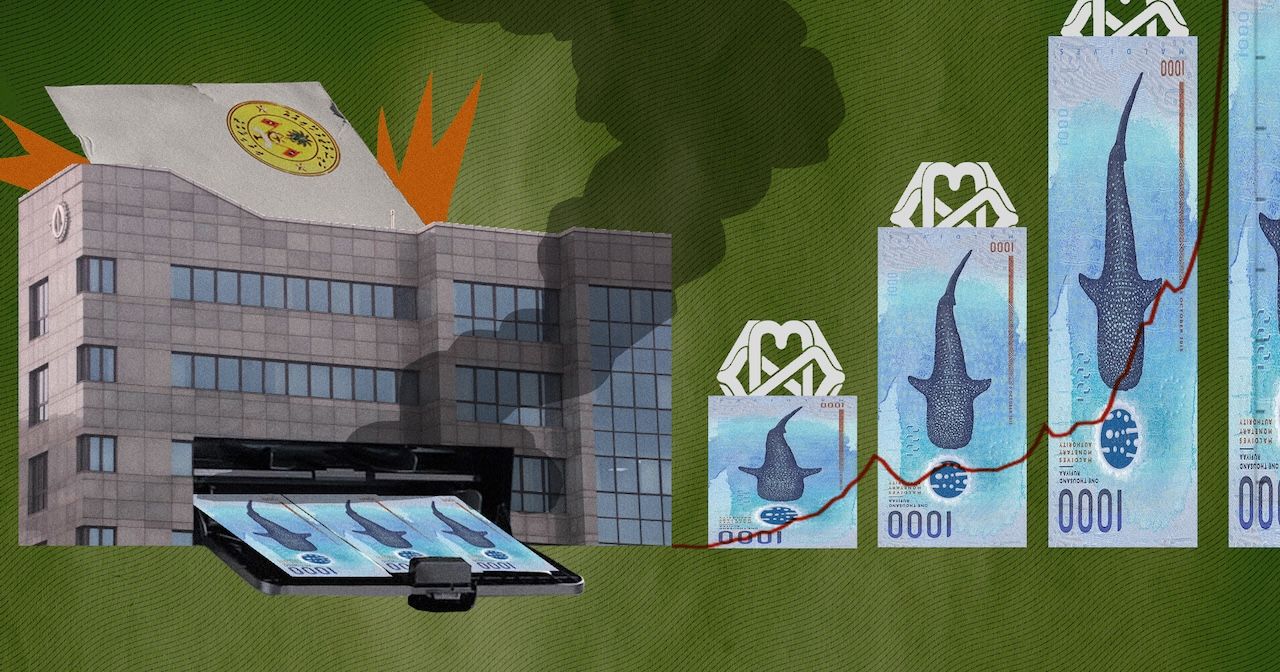
The Maldives Pension Administration Office’s board has approved the purchase of an MVR 2.4 billion (US$ 155.5 million) government bond, pushing ahead despite an unprecedented exodus over a transaction critics say amounts to printing money with potentially catastrophic consequences.
CEO Sujatha Haleem resigned on Wednesday – the fifth official to walk out after Chairman Ahmed Inaz, two board members and Chief Financial Officer Hawwa Fajwa – a day after the Pension Office confirmed the investment in a "dual currency" bond as proposed by the finance ministry. A press statement on Tuesday defended the decision as routine portfolio management, noting that the investment would be made with proceeds from the sale of MVR 2.4 billion worth of treasury bonds in the secondary market "in a manner that would not cause any loss to the pension fund".
The board's main considerations were "investing in a bond with returns in dollars, extending the average duration of invested assets, and increasing portfolio returns in order to diversify investments and strengthen the resilience of the fund in line with recommendations from consultants on formulating the long-term investment strategy of the Maldives Retirement Pension Scheme," the Pension Office said.
The transaction would create a foreign currency reserve in the pension fund and enable the conversion of treasury bills to long-term treasury bonds, it added.
Since the government is legally restricted from obtaining a loan directly from the central bank, the opposition says it is using the pension fund as a workaround: the Pension Office sells treasury bonds it already holds to the Maldives Monetary Authority, then reinvests in a new MVR 2.4 billion government bond. But because the central bank lacks the reserves to fund the purchase, critics say the funds must be created – the definition of printing money – and the resulting increase in the money supply will stoke inflation, further weaken the Rufiyaa, and erode the real value of pension savings at a time when the government faces more than US$ 500 million in debt payments coming due in April. For the average Maldivian who has MVR 123,000 in their pension account, critics warn the transaction could wipe out 30 to 40 percent of that value through inflation and currency depreciation.
The transaction "has not commenced" yet, the Pension Office told the Maldives Independent. Asked who is serving as chair following Inaz's resignation, it said board members "determine the chairperson for each board meeting."
A legal opinion had been obtained on the transaction's compliance with the fiscal responsibility law, which concluded that "the key legal consideration for the Pension Office is compliance with its fiduciary duties, requiring that any decision be supported by a demonstrably prudent, transparent, and commercially sound technical assessment showing that the transaction is aligned with the best interests of MRPS [Maldives Retirement Pension Scheme] members."
The Pension Office also confirmed the departure of CEO Sujatha Haleem, "who has submitted her resignation to the board."
"No accounting loss on day one"
"The transaction may be structured in a way that avoids an immediate nominal loss to members. However, that does not eliminate risk," he told the Maldives Independent. "While there may be no accounting loss on day one, the long-term purchasing power of pensions can still be reduced."
Saruvash contested the government's characterisation of the transaction as quantitative easing (central bank buying existing government bonds from the open market).
"In a textbook sense, this does resemble quantitative easing: the central bank is purchasing government securities and expanding the money supply," he explained. "The key issue is that the Maldives economy is not in a situation that warrants QE or expansionary monetary policy. In fact, by the central bank's own admission, the economy requires a contractionary monetary stance, not monetary expansion."
In August, the MMA issued a rare public statement detailing the consequences of printing money during the Covid-19 pandemic. Excess liquidity of MVR 7 billion – up 178 percent since 2020 – worsened "mismatches between demand and supply in the foreign exchange market." In mid-2025, the bank launched reverse repurchase operations to absorb MVR 2.1 billion.
Suravash warned that the Pension Office board's decision set a dangerous precedent for the fund's independence.
"The board's decision to override internal management and control mechanisms, even on a temporary basis, signals that political or fiscal pressures can penetrate the governance framework of the pension fund," he said, pointing to Ghana and Zimbabwe as examples of what happens "when governance safeguards are weakened and pension assets are used to support short-term fiscal objectives."
Pressure from the top
Saruvash's resignation in October was followed by the departures of board member Ashraf Rasheed, who represented the finance ministry, and CFO Hawwa Fajwa. Chairman Inaz, a former finance minister, resigned on Sunday, citing "failure to reach a sustainable solution despite extensive discussions" and warning that financing the transaction through the central bank would damage the economy.
Before his resignation, Inaz and other Pension Office officials tried to negotiate conditions for approving the transaction, Dhauru reported. They sought assurances that the funds would be used for boosting exports and for economically productive purposes, and that the government would commit to spending cuts and measures to defend the Rufiyaa.
President Dr Mohamed Muizzu refused to meet them in person, calling by phone instead to request approval. The private sector representatives on the board did not back Inaz, going along with what the government wanted despite his attempts to explain the economic risks, sources told Dhauru.
The government has maintained that the transaction is a form of quantitative easing, not money printing, and that the funds are needed to clear billions in unpaid bills owed to private contractors. But critics say the money will be used to cover recurrent expenditures, such as paying salaries, and to finance white elephant infrastructure projects ahead of the April 4 local council elections.
As an alternative to using pension funds, Inaz had proposed reducing bank reserve requirements to allow commercial banks to buy more treasury bills through normal market channels. But the government reportedly refused to agree.
Risk to pension savers
Asked what safeguards are in place to prevent the transaction being repeated with the remaining MVR 25 billion in government securities held by the pension fund, the Pension Office pointed the Maldives Independent to its governance framework under the Pension Act, including oversight by the board, external audits, and supervision by the Capital Market Development Authority.
"In accordance with section 9(b) of the Pension Act, the Investment Committee formulates the Statement of Investment Principles which defines the investment objectives, principles, and policies for the investment of Pension Assets. Investable asset classes are defined within the Pension Act," it said.
But officials feared that approving this transaction would set a precedent. "This is a beginning," a source familiar with the discussions told Dhauru. "If they say yes to the MVR 2.4 billion bond, the government could do this again up to MVR 25 billion."
Currency depreciation triggered by the transaction could wipe out up to 40 percent of retirement savings, according to analysis cited by Dhauru, which estimated a loss of around MVR 52,000 per person.
Saruvash warned that an increase in money supply of over MVR 2 billion "will be inflationary and is likely to erode the 0.11 percentage point gain from this transaction."
"If the transaction locks the fund into returns that are only marginally above inflation, then even a small inflation surprise can erase members' real gains," he told the Maldives Independent.
Cautionary tale
Ghana used similar deficit financing after Covid-19 in 2020. Its central bank funded government spending through monetary expansion. The result was runaway inflation, currency collapse, depleted reserves, and an IMF bailout that forced the government to abandon the practice and adopt painful reforms.
Critics warn the Maldives cannot afford to follow that path with more than US$ 500 million owed to sukuk bondholders in April.
When a similar scheme involving the Housing Development Corporation was floated last March, former MMA governor Ali Hashim warned it could trigger an inflation crisis.
"When MMA pays HDC, HDC is sure to spend on bonds and investments. The money will one way or the other end up on the streets. An inflationary impact is unavoidable," he told the Maldives Independent at the time.
Earlier this week, former finance minister Ibrahim Ameer accused the government of abandoning "proactive debt management" and sidelining the international institutions best positioned to support the country.
"Forcing the Maldives Pension Administration Office to fund government operations, with liquidity injected by the MMA, is another serious misstep," Ameer wrote. "Relying on hope or questionable 'scam' financing proposals will only accelerate the damage."
Ameer previously warned that the government would soon need to draw on dollar deposits at the Bank of Maldives and the MMA's gross reserves to meet external debt obligations. To buy those dollars, it would need Rufiyaa that "the public bank account does not seem to have."
"The only remaining option, therefore, is more money printing, which could amount to around MVR 7.7 billion by early next year [2026]," he predicted.
The central bank previously declared that the Maldives needs a contractionary monetary policy, former foreign minister Abdulla Shahid noted. "When the government is incapable of funding its budget, the whole Maldivian economy having to pay the price is an injustice to the people," he tweeted, describing the lack of transparency as eroding public trust in the Pension Office.
Former President Mohamed Nasheed stressed the importance of the pension fund for social security. "That money should not be spent on paying government salaries or on any recurrent expenditure," he said.
Following Inaz's resignation, former MDP chairman Fayyaz Ismail accused President Muizzu of pursuing "nothing short of economic ruin." Sovereign bond investors "won't be fooled" by the government framing the pension fund operation as an investment, he argued.
After the fund approved the transaction, Fayyaz questioned why the government had not explained the terms of the transaction or its impact on beneficiaries, the exchange rate, and inflation: "The lack of transparency is how institutions fail."
Discussion
No comments yet. Be the first to share your thoughts!
No comments yet. Be the first to join the conversation!
Join the Conversation
Sign in to share your thoughts under an alias and take part in the discussion. Independent journalism thrives on open, respectful debate — your voice matters.
Support Independent Journalism
Help us keep the news free and fearless
Give once
$
or
Become a memberfrom $5/month

