
Opinion

The tharaggee illusion: why degrowth may be the Maldives' only option

We're building and borrowing beyond what this nation can bear.
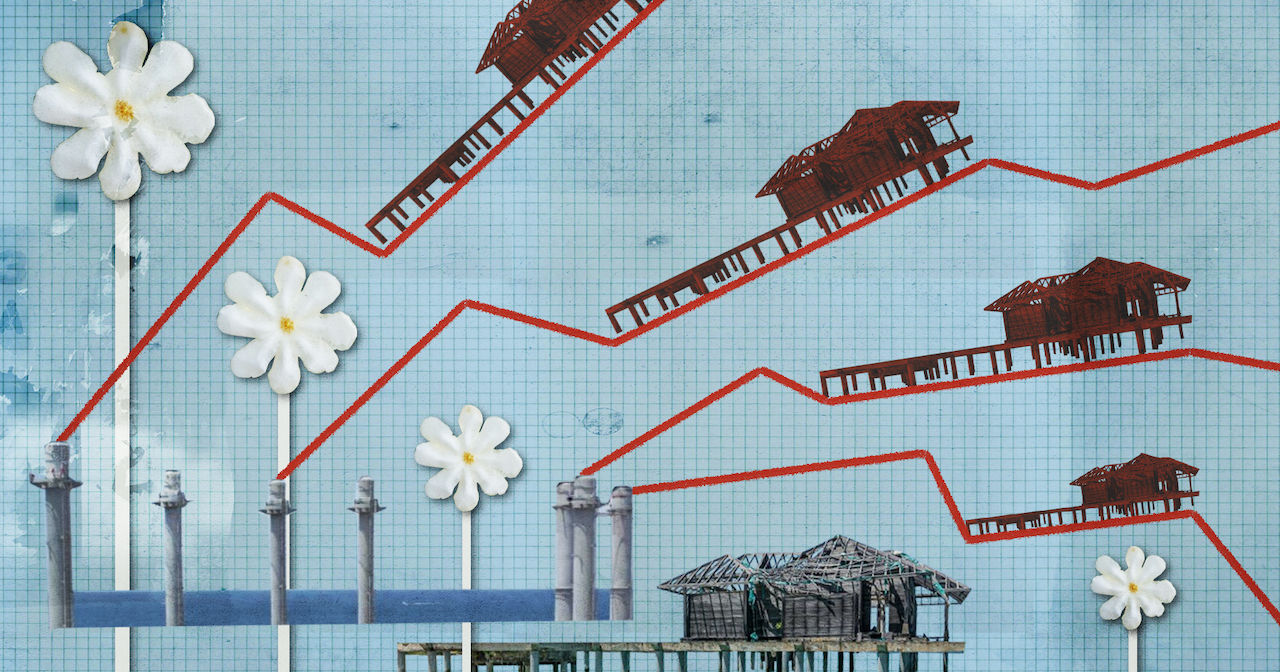
Artwork: Dosain

Artwork: Dosain

05 Jan, 4:03 PM
“We will turn Maldives into the next Dubai/Qatar/Singapore."
Ever heard this tagline before? I bet you have. It’s every politician’s favourite thing to say. It was most likely accompanied by ramblings about "tharaggee" (development) and over-the-top architectural design blueprints and vivid futuristic imagery.
Unfortunately, these promises will never materialise. It doesn’t matter if it’s led by MDP, PPM, DRP, PNC, Adhaalath, other parties, or any so-called "independent" legacy politicians, it’s impossible in every sense of the word. The world inches closer to greater warfare, climate collapse, and resource crises therefrom.
All this blather about tharaggee are just illusions, lies, and distractions. They are just fancy pictures and blueprints that will only exist as that and nothing more. They dangle the prospects of owning a home, having access to essential goods and services, good healthcare, and other necessities like bait on a hook while they take turns to slip into power and rob whatever you have left to secure their exits from this sinking ship and buy their kids and relatives lands from God knows where.
Post-growth economics is not just an intentional choice we must make, it is the reality of our inevitable economic future, and it is the resistance’s utmost responsibility.
I need us to understand this. If we don’t wise up, most of us are going to suffer.
Why is societal collapse "unavoidable"? Isn’t that alarmist?
Let’s zoom out for a bit; forget the parties, forget the politicians, forget the Maldives.
Consider this paper by professor William Rees, best known for conceptualising the "ecological footprint." Read it when you have time, don’t just take my paraphrase for it. What he says is simple but critical to my op-ed, let’s break it down:

Human beings are reproducing exponentially, consuming more than what nature can provide, and expelling more waste than our ecosystems can handle (mainly in carbon-dioxide emissions)

Humanity is therefore in an overshoot, and our modern techno-industrial societies are headed for collapse, exhibiting symptoms similar to other complex biophysical living systems undergoing the same cycles

If world leaders choose to continue polluting and burning the planet with fossil fuels, plastics, and capitalism’s economic model of infinite growth on a finite planet, billions will die in a population correction event, or in other words, a sixth mass extinction event

Climate records are broken exponentially every year. The weather is getting worse than normal. Global warming is occurring faster than predicted before. It’s not exactly groundbreaking news that the rapid destruction of the environment from which we extract our resources and energy would lead to societal decay through resource wars, not to mention a severe global food security crisis which is projected to get worse.
Climate crisis-driven resource colonialism and resource wars are already happening. Palestine, Iraq, Afghanistan, and Sudan are examples you’d be familiar with for land seizure and resource extraction (particularly fossil fuels). Green colonialism for lithium in places like Portugal and Chile are good examples; they even predicted that lithium would fuel conflict in places like Nigeria. These wars, genocides, and internal conflicts are driven mainly by two things: the imperial-capitalist quest for profits, and the increasing demand for dwindling resources and energy.
When I say "collapse," people usually imagine something dramatic, apocalyptic, and sudden. I, like Andrew Dessler, imagine it differently as a "death by a thousand cuts." It happens incrementally. Destruction, damages, and casualties multiply over time. Sudden catastrophic shifts only occur at the peak when a local biosystem can no longer provide energy or resources like they have before (i.e., overshoot) and are forced to ration things. That is the final cut. We’re somewhere in the middle of the other 999 cuts.
I don’t need to give you a whole reading list for you to know that the world is getting hotter, crops are dying, food is becoming more expensive, energy costs are rising, and people are starting to tear each other apart for access to these things as societies crumble because they can’t feed or provide enough for everyone.
The world you knew 10 years ago – the world you base your imagination of the future on – no longer exists.

Maldives in overshoot perspective

We are unprepared for the coming turns in global affairs.
Whatever measures they currently have planned against our soaring national debts and plummeting foreign currency reserves are useless. It’s less about the money itself and more about where it’s going and the systems of circulation currently in place.
We spend millions of Rufiyaa on a single ministry alone every month, according to right to information data from Zinmaadhaaru. We’re paying more for goods, services, and rent every year because of rising inflation. The black market rufiyaa value for a dollar reached MVR 20.20 earlier this year, which is worse than the rates during the pandemic. 
Our wealth distribution systems still funnel most of our tourism earnings into the hands of the resort elites and foreign multi-national corporations via profit – mostly the latter. If that wasn’t enough, we’re destroying the very nature upon which we rely for safety and profit: cutting down trees, even more reclamation projects on top of unused reclaimed land, obliterating our shark "sanctuary," green lighting even more construction projects while our own citizens struggle with home-ownership and rent.
That US$ 500 million debt we’ll refinance this year means absolutely nothing when our entire economic model is designed to squeeze every last cent out of the treasury and public assets like the tourism industry into the fattening pockets of our salaried-politician class, corporate elites, and foreign capitalist giants.
We are nowhere nearly as prepared as we should be – financially, structurally, politically, or even as a community – for what’s to come in global affairs. We import 90 percent of our food while 13.4 percent of our adult population are already experiencing moderate to severe food insecurity. Not only do we import all of our energy, 99 percent of our energy comes from fossil fuels, which continues to grow increasingly expensive due to warfare and natural crises, as previously discussed.
This country is not one you’d exactly describe as insulated against risks. Our politicians are actively looting the treasury, much of the wealth from tourism isn’t even going to us, and we don’t produce much resources to use let alone export. Yet somehow, every wretched god-forsaken politician insists on promising and initiating tharaggee mega-projects they can’t humanly finish or repay. It’s lunacy.
Don’t you see? We’re building, borrowing, and consuming beyond what our nation can provide or bear, and we continue to do so under the assumption that tharaggee will magically make all these burdens and corruptions disappear, as if sweeping them under a rug.

Collapse preparation: crushing the tharaggee brain worm

Suffice it to say, much like William Rees believes a global population correction is incoming and inevitable because of our rapid destruction of nature and our leaders’ stubborn insistence on economic growth at all costs, I hold the same view for the economic microcosm here in the Maldives, especially when the ramifications of global overshoot come to our doorstep.
With no end to corruption, looting, capitalist exploitation, environmental destruction, and global decay, societal collapse in the Maldives seems inevitable to me. It’s a matter of when, not if; unless all our politicians, their supporters, and the general public somehow miraculously decide to unite and reorganise the country’s resources. Unfortunately, we all know that isn’t happening anytime soon. If no one does anything to prepare for that now, even just intellectually, thousands will die, and thousands more will suffer horribly.
The first thing we need to do as a people is to throw out the illusion of tharaggee.
The most important task, as I see it, is to intentionally implement degrowth policies before we’re forced to anyway. For a larger but simple introduction, read Jason Hickel’s book on the subject. It is the frontier of post-capitalist economics. The specifics deserve an article of its own. The blueprints for post-growth economic policy models already exist, even early analyses specifically tailored to the Maldives
In sum, the most crucial degrowth-informed reforms for the Maldives are the following:
1-

Radical redistribution: redistributing excess private wealth from our mutli-millionaire resort elites and salaried-politician classes back into the hands of public ownership. Nationalisation of the resort industry is ideal for continuity; profits go directly to the public treasury instead of crumbs from tax revenue.

2-

Necessity fulfilment: using this redistributed income to give everyone homes and access to other necessities without conditions. Dedicate these funds into raising our domestic food security up to 80% through agricultural reforms, healthcare accessibility, utility provisions, education, etc.

3-

Abolition of excess: every single needless tharaggee project – dredging, airports, futsal fields, whatever – must be immediately stopped and scrapped. Payments must be reimbursed and refunded to us where possible, including whatever cuts taken by our own politicians. Politicians must be paid minimum wage and not a single cent more, including the president.

4-

Nature restoration: replant our mangroves, work with marine biologists and others to take better care of our marine ecosystems, eliminate vectors of pollution, build greener walkable cities that won’t boil us alive with better public transit systems, and transition to renewables rapidly (this is more than possible for a small nation like ours).

Of course there’s far more to discuss, like four-day work weeks and shorter working hours, but in the context of an incoming collapse for this article, these are the best reparational measures we can take now (or when it happens).
If we can do at least these things, I can promise you this with confidence. No matter what happens, we will survive it together if we’re prepared and intentional. No matter what our economic conditions are, we will get to those dreams that these politicians are trying to sell you with tharaggee:
A roof for your family to sleep under, food to fill your bellies, nature to bask in, energy to keep your indoors cooled, existential security, mental wellbeing, and most importantly, a mutually supportive community you can always rely on. We may not be living in filthy luxury, but what luxury is greater than a safe home and community to come back to?
And these aren’t things we can obtain by asking our oppressors politely. This hopeful future must be wrested away from their hands by revolution first, followed by a complete overhaul of our constitution and governing systems to sever the roots of corruption once and for all first.
  
Mahal Ibrahim Abdulla is a writer, artist, musician, and aspiring social scientist. He works as the managing editor for Moosumi magazine. He is an honours graduate in Politics and Social Policy from the University of Leeds. His goal is to become a researcher – to eventually settle down and live a quiet life. His current research interests are political communication, social psychology, and the degrowth paradigm.  
All comment pieces are the sole view of the author and do not reflect the editorial policy of the Maldives Independent. If you would like to write an opinion piece, please send proposals to editorial@maldivesindependent.com.

Discussion

No comments yet. Be the first to share your thoughts!

No comments yet. Be the first to join the conversation!

Join the Conversation

Sign in to share your thoughts under an alias and take part in the discussion. Independent journalism thrives on open, respectful debate — your voice matters.

Support independent journalism

Explore more