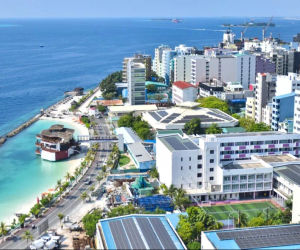

Most of Maldives' reclaimed land sits unused – yet new projects continue
Analysis of satellite imagery reveals decades-old undeveloped land.

Artwork: Dosain
09 Oct 2025, 17:37
Presidents keep promising it. Island communities keep asking for it. But does the Maldives actually need more reclaimed land – or does it need to use what it already has?
At least 52 land reclamation projects have been carried out since 2007, according to data obtained by the Maldives Independent under a right to information request. Satellite imagery shows a majority of the expensive reclaimed land sits unused and untended, overgrown with grass, some barren for years. But successive administrations have launched new projects before utilising this existing land.
“All these reclaimed lands are not used anywhere close to an adequate level. But at the same time, additional land is reclaimed right next to it, with a big plan that says, ‘this land is not sufficient,’ and a bigger project is drawn up to add more reclaimed areas.” Ibrahim Naeem, the former director general of the Environmental Protection Agency, told parliament’s climate change committee in 2022, referring to proposals submitted to the rebranded watchdog for regulatory approval.
Some reclaimed land has been undeveloped for 20 years, he noted, “now left just full of grass and not allocated for any use.”
“When we reclaim land, it should be based on necessity and to the extent of that necessity,” Naeem stressed. “We should not reclaim it unless we really need to.”
The warnings have gone unheeded.
Manta rays and ballot boxes
President Dr Mohamed Muizzu, who assumed office a year after the EPA chief’s criticism, found himself in an awkward situation last month. Following intense pressure from environmental groups and the tourism industry to cancel reclamation in Baa Dhonfanu – an island home to fewer than 400 people that lies less than a kilometre from a marine protected area and manta ray sanctuary – Muizzu scrapped the US$ 13.8 million project. He blamed the U-turn on supposed appeals from the Dhonfanu community, a claim that was immediately disputed when protests erupted on the island.
The reversal came after conservationists warned that reclamation could imperil one of the most ecologically-rich and popular tourism spots in the country. Land reclamation involves dredging up sand from the ocean floor, sucking it through pipes and dumping it to expand coastlines or create new land on shallow lagoons. Massive sediment plumes generated by dredging spread far and wide, enveloping coral reefs and devastating fragile ecosystems.
However, land reclamation dominates campaign pledges during every election cycle, reflecting the desire of voters on small islands to alleviate land scarcity.
During his recent atoll tours ahead of next year’s local council elections, President Muizzu has inaugurated or promised land reclamation for several islands. On Wednesday, he launched the reclamation of the Maafaru lagoon near Alif Dhaal Mahibadhoo, assuring timely completion as “a major step towards transforming the island into a key urban centre.”
During his visit to Kun’burudhoo on the following day, the state-owned Maldives Transport and Contracting Company was enlisted to reclaim 9.8 hectares of land. Earlier in the week, MTCC was contracted to reclaim 27.32 hectares to double the size of Dhagethi.
A different diagnosis
Ali Shameem, president of the Kudafari island council, understands a small community's need for additional land. But Kudafari is trying to find other ways to solve what he calls a “land lock” dilemma where privately-owned plots remain vacant despite a housing shortage.
“In the past 20 years, only 11 percent of people who own land were able to develop it. So the remaining weren’t able to do it. Four hectares of land has been allocated during this period. All these remaining plots have been cleared of vegetation. This was land that was previously used publicly for agricultural purposes, too, so we lost that as well,” he explained.
“Even if we reclaim land and hand it out, it will not be developed unless the circumstances change. The only change will be the livelihood activities derived from the marine areas.”
The question of whether the state’s responsibility should be to award plots of land or to provide finished housing units was the “bigger conversation,” Shameem suggested.
“In this island also, there aren't even 15 people to a hectare. But we are also facing a land scarcity problem. So it isn’t really a scarcity of land. It’s a problem with how we use land and conduct land transactions. And the solution to this is shown as land reclamation and it is carried out by governments.”
Instead, governments and island councils should prioritise multi-purpose land use, Shameem stressed.
"The biggest plots in single parcels are allocated for football and school," Shameem explained, questioning whether it was fair to reserve the largest land area for a sport that perhaps 20 men play while most women's livelihood activities – linked to jungle areas for collecting coconuts and palm leaves – have "almost non-existent" space.
"Each island has this typology. We have to question the fairness of this model. But it is an unpopular conversation."
The Maldives Independent analysed satellite imagery and government allocation records to estimate utilisation rates. With the exception of the industrial village in Malé and the reclaimed area of Thaa Vilifushi, less than half of the reclaimed land has been put to use.
Selected reclamation projects over the past 20 years:
Thaa Vilufushi, 2007, 40.5 hectares
This project stands out as an exception. The reclamation followed the devastating 2004 tsunami, which killed 18 residents and completely displaced the population. The reconstruction plan included a land reclamation and coastal protection project funded by the Netherlands government and carried out by the Dutch company Boskalis. When president Maumoon Abdul Gayoom launched the reconstruction efforts in June 2006, he said the island would grow in size from 16 hectares to 61 hectares. The expansion would make it more resilient to future climate shocks and reconstruction would be better planned, he said.
Vilufushi was the recipient of substantial international aid and support. The British Red Cross built houses, the German Red Cross rebuilt the health centre, and Australian Aid supported housing and infrastructure development. The planned, internationally-supported approach shows what's possible when reclamation is tied to genuine need and careful planning.
Estimated use: 80 percent


 Interactive Image - Slide to compare
Gaaf Dhaal Gadhdhoo, 2007, 0.9 hectares
This project started in 2005. It was carried out by MTCC at a cost of MVR 24 million (US$ 1.5 million). The project faced resistance as the community was unhappy with the reclaimed area.
Estimated use: 30 percent

 Interactive Image - Slide to compare
Gaaf Alif Villingili, 2009, 15 hectares
Estimated use: 20 percent

 Interactive Image - Slide to compare
Meemu Maduvvari, January 2010, 88,524 cbm (8.9 hectares)
MTCC launched the MVR 6.7 million project in May 2009.
Estimated use: 10 percent

 Interactive Image - Slide to compare
Meemu Dhiggaru, July 2010, 42,486 cbm (4.2 hectares)
Estimated use: 10 percent

Haa Dhaal Kulhudhuffushi, October 2010, 28 hectares
Boskalis started in September 2010 and finished within a month. However, the only infrastructure or development for years was a series of half-finished row houses.
Estimated use: 30 percent

 Interactive Image - Slide to compare
The pattern is most stark in Gaaf Dhaal Thinadhoo, where 53 hectares reclaimed in 2017 remains almost entirely empty – yet a project to add 14.3 more hectares is currently underway.

 Interactive Image - Slide to compare
Discussion
No comments yet. Be the first to share your thoughts!
No comments yet. Be the first to join the conversation!
Join the Conversation
Sign in to share your thoughts under an alias and take part in the discussion. Independent journalism thrives on open, respectful debate — your voice matters.
Support Independent Journalism
Help us keep the news free and fearless
Give once
$
or
Become a memberfrom $5/month