
Prosperity for all?
A polycentric vision on paper, metropolitan consolidation in practice.
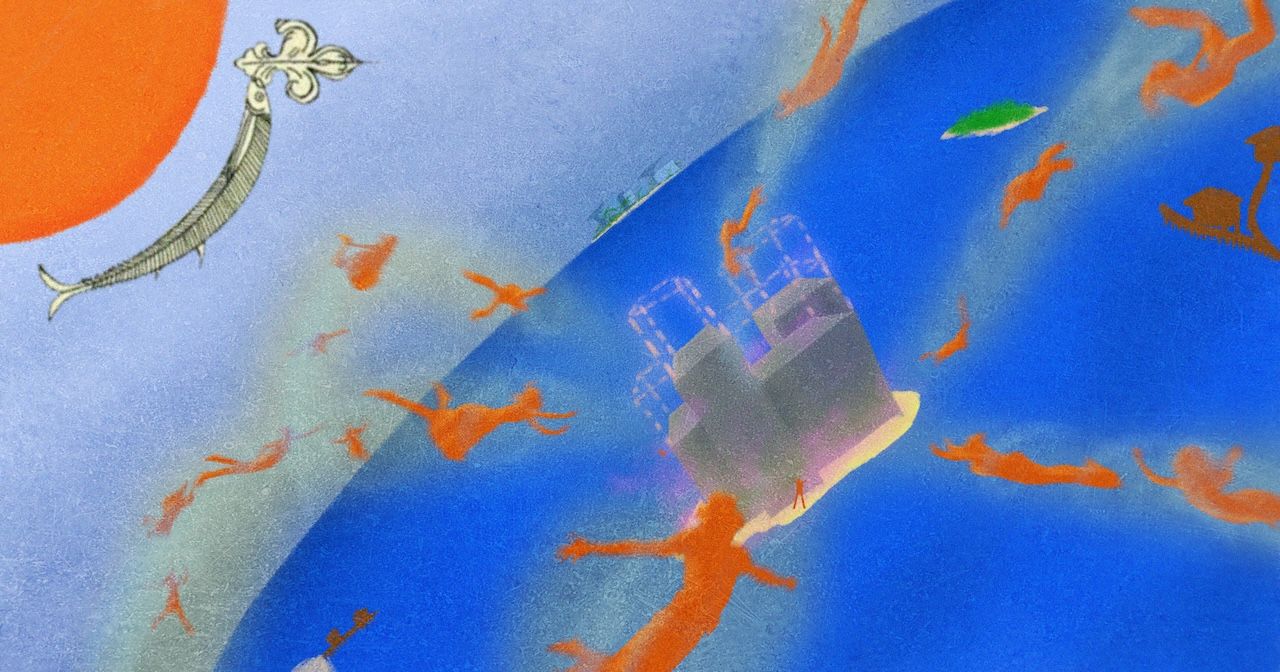
Artwork: Dosain
05 Jul, 15:54
The single most important document that articulates a country’s development strategies is it’s National Development Plan. It examines and identifies challenges and specifies policies based on principles the government chooses to guide the direction of the country to achieve a long-term vision. The policies and vision therein acquire legitimacy with citizens, only when government(s) act accordingly.
The government of Maldives recently concluded formulation of a National Development Plan (NDP) intended to shape the country’s long-term future. The Plan is titled Resilient Maldives 2045: Prosperity for All.
While we await the adoption of the NDP as legally binding, the government has already set in motion two of the most consequential development policies to emerge since the advent of tourism in Maldives. These two policies will carry its legacy on Maldivians for generations to come.
First, the creation of Ras Malé, as a new urban center added to the growing metropolitan urban area of Malé City, undertaken with a view to consolidate population and development. This is the largest land reclamation and urban development project the country has so far undertaken. The mega project involves investing millions in reclamation and billions more to build the infrastructure, services and facilities to support the creation of the mega-urban centre.
This raises an obvious question. Is this the development model described in the NDP? The NDP identifies the concentration of population and services in Greater Malé as a daunting challenge. The solution the NDP proposes is polycentric development – so that economic activity, services and opportunities are spread to other regions. It envisages a polycentric archipelago, with regional hubs, spatial clustering of islands and strengthened transport networks. Even if millions were not spent to commission a document specifying an archipelago should be developed likewise, this is a concept that those who governed the country and shaped it’s laws, could not have missed even in past years. In fact, ordinary Maldivians have long discussed the issue on their island holhuashis, perhaps using another term rather than “polycentric development."
The primary driver of human migration is the creation of pull factors. Pull factors do not arise spontaneously, by chance. They are deliberately created through policy choices, public investment and strategic planning. They are forces intentionally created to attract people, much like a magnetic force. A majority of Maldivians today are compelled to endure the consequences of these pull factors as their everyday reality.
The Ras Malé project is an undertaking of extraordinary scale, which if implemented as planned, will easily absorb the entire population of Maldives within the Greater Malé area. This stands in contrast to the polycentric development envisioned in the NDP. If the country’s long-term vision is polycentric, but the overwhelming share of public investment flows towards metropolitan consolidation, what then becomes of spatial regional development? Is the polycentric development intended to enable Maldivians to reside and prosper across the atolls of their own country or is it merely a framework to enable an altogether different pattern of residency?
Closely connected to this question, is the second consequential development for the Maldives. One that has serious implications on land, sea and sovereignty of the Maldives. This is the establishment of “sustainable townships” under the framework of special economic zones as part of the government’s economic diversification policy. These townships permit 100 percent foreign ownership, materials required for construction are allowed to be imported duty-free. Capital goods imported for the development of the zone are exempt from import duty. Income tax on business income earned in the zone is levied at five per cent for the first 10 years. Profit from the sale of residential villas and rooms developed in the zone is exempt from income tax. Licensing and permits will be fast tracked by the government. Three lagoons, one reef and one uninhabited island in Noonu Atoll have already been designated for a sustainable township and an agreement to that effect signed with foreign company Crystal Holdings & BluRock. Marketing of the residency programme for the sustainable township called “Maldives Pearl Residency,” has been entrusted to another foreign company, Henley & Partners – a firm with a rather colourful history of well-documented corruption allegations.
The NDP repeatedly emphasises that benefits derived from the natural resources of the Maldives should accrue to the Maldivian people. It promotes the idea of property and asset ownership among citizens, increased citizen participation in development, equitable distribution of economic gains and strengthening trust and confidence in governing institutions. However, the NDP does not answer how these objectives are reconciled with the creation of foreign-owned enclaves within the Maldives. Nor does it explain how such an arrangement strengthens resilience, sovereignty and independence of Maldivians.
The manner in which successive Maldivian governments have shaped the country’s development has consequences that extend far beyond a single generation. The effects, both positive and negative, are inherited by generations to follow. Many of us live today, with the consequences of development decisions taken about three decades ago – the concentration of housing, transport facilities, other major infrastructure investments and services in a single location is our every day reality. Once those investments took root, subsequent governments could not reverse course because of the immense financial and institutional commitments accrued. The whole process became path dependent.
The NDP warns against locking Maldivians into development trajectories that are not sustainable and/or that do not serve the interests of it’s citizens. Yet, the current development trajectory again seems to reinforce that same path dependency Maldivians have been subjected to in the past decades, with renewed vigour. There is every reason to believe future generations will be placed in a position – bound by choices made today and constrained by the immense investments and agreements made in the name of development.
The justification for development of the current NDP is to ensure that there is “unity of purpose” so that governments remain committed to achieving set national goals in years to come. Beyond dispute, regardless of the different political colours and ideological differences professed by Maldivian politicians, and even in the absence of a formal national development document, they were then, as they are now, “united for a purpose.”
Correction, 2 August 2026: An earlier version of this article stated that businesses in sustainable townships pay no income tax, GST or withholding tax, and that land transfer sales tax does not apply. Under section 70-2 of the Special Economic Zones Act, as amended, townships are eligible only for the concessions that section sets out and for no others under the act, and the incentives in section 23 do not apply to them. Income tax is levied at reduced rates of five and 10 per cent over the first 20 years, and a property transfer tax of between one and four per cent applies to transactions. The duty exemption covers capital goods imported for development. The article has been amended.
All comment pieces are the sole view of the author and do not necessarily reflect the editorial policy of the Maldives Independent. If you would like to write an opinion piece, please send proposals to editorial@maldivesindependent.com.
Discussion
No comments yet. Be the first to share your thoughts!
No comments yet. Be the first to join the conversation!
Join the Conversation
Sign in to share your thoughts under an alias and take part in the discussion. Independent journalism thrives on open, respectful debate — your voice matters.
Support Independent Journalism
Help us keep the news free and fearless
Give once
$
or
Become a memberfrom $5/month

