
Independence is not a date. It is a daily decision.
President Muizzu on Chagos, the bond repayment and children's screen time.
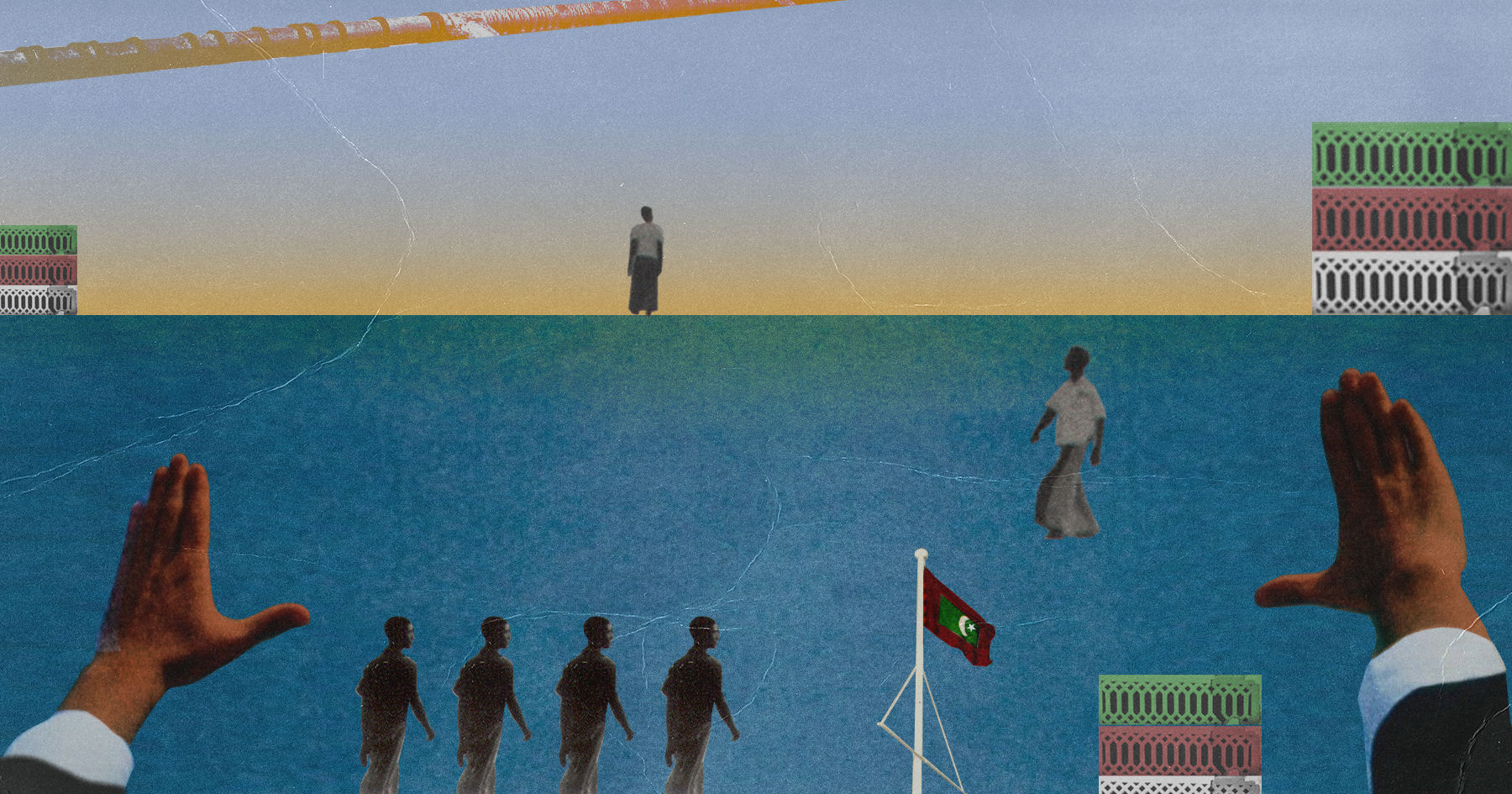
Artwork: Dosain
26 Jul, 14:09
Every year on this day, we raise a flag, sing an anthem, and call it Independence Day. I think we sometimes treat that word as settled. We treat it as something won once and simply kept, like a deed filed away. It isn't. Independence has to be maintained, and the pressures on it now don't look like the pressures our grandparents faced.
Here is what I mean, plainly.
Our forefathers knew their adversary by his flag and his fort. Today the pressure on a small country is less visible. It shows up in markets, in capital flows, and in credit terms written into agreements most people never read. Defending sovereignty now means paying attention to boardrooms and bond markets, not only borders. I think we have, at times, been slower than we should be to treat that seriously.
This is part of why, when a boundary settlement was reached without our full involvement, we did not let it stand unchallenged. We reasserted our claim to Foalhavahi, known internationally as the Chagos Archipelago, based on documented Maldivian historical presence there. We have also deployed our Coast Guard to patrol the disputed waters. A claim that exists only on paper carries little weight. We chose to back ours with a presence at sea as well.
We are still developing the institutions and habits that make a democracy function well. That includes learning how to transfer power and how to disagree without instability. At the same time, self-governance is not new to us. Maldivians have navigated these waters independently for a very long time, well before the current constitutional system existed. Our democracy is young. Our practice of self-determination is not.
Part of that development depends on the quality of the opposition a democracy produces. Disagreement with government policy is legitimate and necessary, and criticism, when it is substantive, makes governance better rather than weaker. What does not serve the country, regardless of which side engages in it, is opposition conducted through personal attacks or character assassination rather than argument. I would ask those who oppose this administration, as I would ask any public figure, to hold to that distinction. A mature opposition improves the democratic process. Rhetoric aimed at a person rather than a policy does not.
The stated principle of my foreign policy is that agreements should serve Maldivian interests first, regardless of who the partner is, unless in the case of rogue nations butchering our Muslim brothers. In practice, that has meant diversifying our international relationships rather than relying on any single country, while continuing to engage with our neighbours. It has also meant meeting our own financial obligations directly. This year, a US$500 million sovereign bond came due, and it was repaid in full and on time from our own reserves. A foreign policy that claims to put the country first has to hold up when the bills come due, not just in the language used with other governments.
Global commerce and culture used to arrive mainly through trade. Now they arrive through a screen, often before a child is old enough to evaluate what they're seeing. We are not trying to close the country off. We remain a trading nation, and that will continue. But we think some limits are warranted. This is part of the reasoning behind restricting social media access for children under 16. The goal is not to isolate them from the world, but to delay their exposure to platforms built around holding attention rather than serving their interests.
The same logic applies to the country's physical assets. Land, beaches, and lagoons are the kind of resource that can quietly change hands through structures set up specifically to obscure who owns what. Our position is that these remain Maldivian-owned, and we intend to keep it that way.
These two trends are happening at the same time, and neither is going away. We are investing in digital infrastructure and skills, part of what the government calls the Maldives 2.0 initiative, because the opportunity in this technology is real. At the same time, workers' ability to earn a fair wage should not be left to be decided by automated systems without oversight. We intend to pursue both: adopting the technology and setting the terms on which it's used.
Alongside these economic and technological questions, we've taken smaller but deliberate steps, such as protecting prayer times at public sports facilities, to reflect that Islamic practice and community life remain part of how the country intends to develop, not something set aside in the process.
Independence, in short, is not something we finished securing at one point in the past. It gets tested continually, in trade terms, in maritime claims, in how we manage new technology, and in what we choose to protect. That is the argument I wanted to make plainly, on this day.
Happy Independence Day, to all Maldivians.
Dr Mohamed Muizzu is the president of the Republic of Maldives.
This op-ed was submitted exclusively to Maldives Independent. All comment pieces are the sole view of the author and do not necessarily reflect the editorial policy of the Maldives Independent. If you would like to write an opinion piece, please send proposals to editorial@maldivesindependent.com.
Discussion
No comments yet. Be the first to share your thoughts!
No comments yet. Be the first to join the conversation!
Join the Conversation
Sign in to share your thoughts under an alias and take part in the discussion. Independent journalism thrives on open, respectful debate — your voice matters.
Support Independent Journalism
Help us keep the news free and fearless
Give once
$
or
Become a memberfrom $5/month

