
Forced checkmate: why MDP's likely 2028 win could be its last
A two-party reflex, a collapsing world, and a party out of plans.

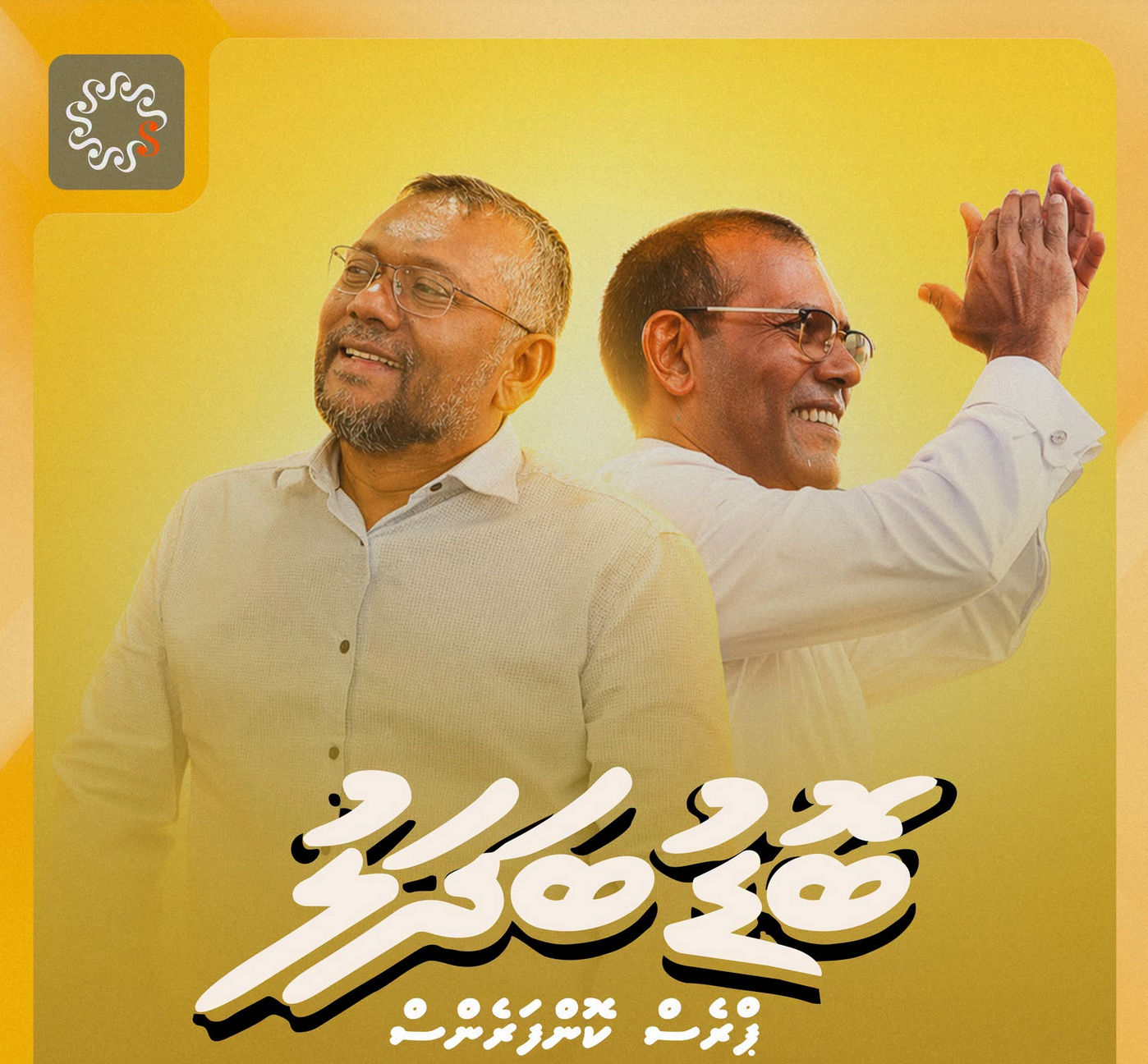
Artwork: Dosain
10 May, 17:04
Honestly, it doesn’t really matter who wins in 2028, it may still be the last presidential election cycle, at least under the Fehi Gaanoonu. This isn’t an endorsement of the Maldivian Democratic Party (MDP), nor am I voting for anyone in 2028. It’s a stochastic observation of a clearly documented historical pattern.
I’d held this position since before the 2023 elections: that people will vote the Mohamed Muizzu administration in solely to vote against ex-president Ibrahim Mohamed Solih, and that as soon as the Muizzu administration cyclically fails, people will vote for whatever slop MDP (or their popular faction leaders’ breakaways) would cook up this time to vote against Muizzu. “Wow, people are frustrated with the ruling party in a two-party system and will vote for the other big party!” isn’t exactly some award-winning genius analysis, you know.
Here’s a clear reminder to #ReformMDP marketeers: MDP cannot be reformed. You cannot leftwash a centre-right party, even if you prop up left co-opting leaders or cuddly-capitalist new breakaway parties.
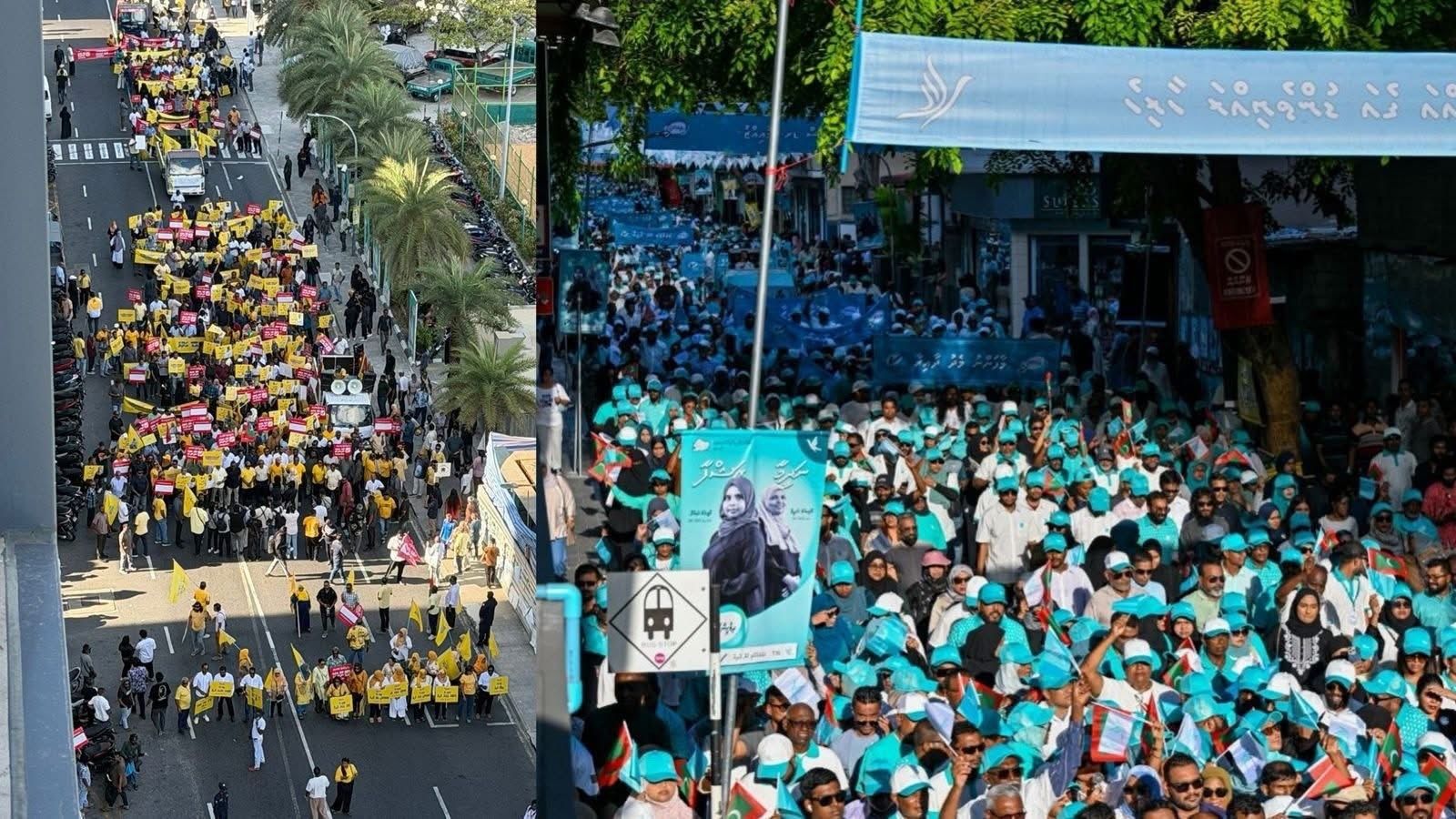
MDP leadership and youth wing’s arrogance has led them to believe that the defiance of the April referendum is their “overwhelming” victory. I didn’t vote “no” in the referendum because you told me to with your irritating “noonekey!” marketing posters. I voted “no” from my own volition despite not voting for anyone in the council elections. Here are some cumulative results from the 2026 elections:
148,859 people voted “no” in the April referendum out of the 74.98 percent of the voters that showed up
Approximately 87,393 people voted for MDP and Democrats in the local council elections
That’s a mere 58.7 percent of the “no” votes (and that’s also assuming they all voted no or voted at all)!
Where do you think the rest of the 41.3 percent of the “no” votes materialised from? Thin air? That was the rest of us. Out of the 294,876 eligible referendum votes (counting no-shows as non-MDP too), MDP voters’ share is a measly 29.64 percent. The “yes” votes, by comparison, is 22.95 percent (counting no-shows as non-PNC too). Together, that’s 52.59 percent. So… who are the other 47.41 percent?
Enough pretext, let’s get into the meat of the article’s premise that MDP may win one more presidential cycle, and why it may be the last under the old Fehi Gaanoonu Asaasee ("green" constitution of 2008).
World War Two’s waves of fascism: history has returned!
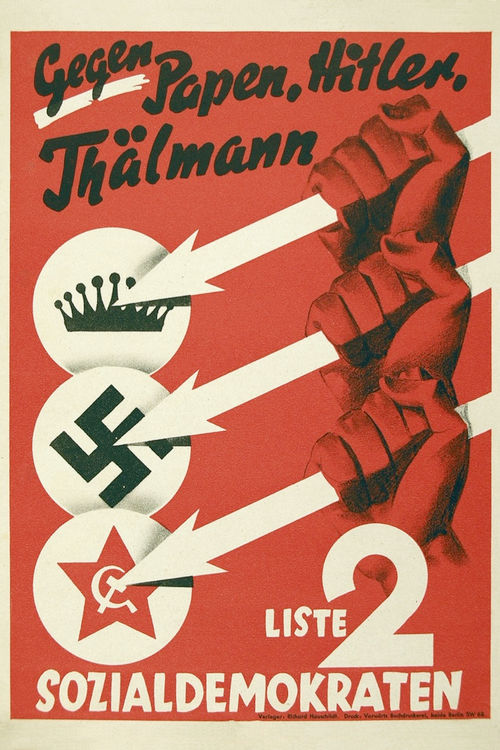
First, a tangent into World War One and Two.
Sartori’s case for polarised pluralism being an unstable form of government that will eventually collapse remains historically relevant to the Maldives. By the way, in page 155, one of the core examples he uses is Pre-Nazi Germany in the Weimar Republic. Polarised pluralism is the eventual end of liberal democracy.
Polarised pluralism, as Babones and Pelizzo summarised it, is characterised “by the presence by more than five relevant parties, by high levels of ideological polarisation, by ideological patterning, by the presence of anti-system parties, by the presence of bilateral opposition, by the fact that the opposition was irresponsible, by the fact that the centre position of the party system was occupied and by the fact that there was a haemorrhage of votes from the centre to one or both of the extremes”. Political instability of this manner is what gives rise to fascism.
Sound familiar?
But it’s not just Maldives.
Even beyond just economic similarities, the global landscape of the 2010s was eerily similar to the 1920s. The 2008 financial crisis was our generation’s combination of the late 1910s recession and the early 1920s recession. It should be no surprise to you, therefore, that there is a consequent surge in fascist politics and a rapid rate of “autocratisation” around the world: in Argentina, Germany, Poland, America, Britain, Netherlands, Belgium, Australia, Turkey, Sweden, Italy, Denmark, Switzerland, and so on. Notice how I’ve listed all the prime examples of “successful” modern liberal democracies, whether as parliamentary, semi-presidential, or presidential systems?
This is the abject failure of liberal democracy, social democracy, and neoliberal capitalism around the world. Contrary to Francis Fukuyama’s now embarrassing claim that “western liberal democracy is the final form of human government” in his “The End of History,” history is back, and with a vengeance. Sartori’s observation of polarised pluralism has been nothing short of prescient in defining today’s politics.
In that regard, for historical parallels for an “upper-middle income economy” that is considered a “young democracy”, our political landscape reflects the historical Taisho era in Japan, liberal era in Italy, or more closely, the Weimar Republic in Germany. The politics of our country bears greater resemblance to the global north than with our peers in the global south, being a heavily neoliberalised and Reaganised country as it is. The Weimar Republic is a perfect example: here, today, our “multi-party” system is heavily polarised into a center-leaning two-party system, with other available parties comprising a rising ethno-nationalist fringe. And, predictably, in order to preserve the interests of capital and elitism, we can observe all available major “opposition” forces tactically organise with the fascists rather than commit to class struggle.
2028: A forced checkmate for MDP/Democrats – our own Weimar Republic
In chess, a forced checkmate marks a point in the game where checkmate is unavoidable within the next few moves, usually through forced moves.
Let’s think beyond the narrow, capitalistic confines of electoral liberal democracy.
MDP – the so-called “opposition” – is in a desperate situation. They are the “main” opposition. The continuity of not only the party itself but the leadership as well depends on the party engaging with the elections to the bitter end. To give up and go home means to lose all connections to power, wealth, and status. MDP’s bureaucrat capitalists and their national and comprador bourgeois allies will not want that.
The point is, they’re forced to play.
MDP is going to win, solely because people will want to vote against Muizzu, and they will vote for the party that’s most likely to win. Abdulla Yameen’s party People’s National Front (PNF) will contribute to a spoiler effect, and PNC would simply lose the same way MDP lost last time because of the Democrats. As with 2013, 2017, 2020, 2023, 2026…you get the point. Even if another party somehow wins, the material and economic outcomes remain the same.
“But if MDP wins,” I hear you ask, “how is that a forced checkmate for them?”
What MDP will inherit, by the time 2028 comes to pass, is a government that is either collapsing or on the verge thereof. That is guaranteed. The tides of war abroad are accelerating as is the incoming population correction event triggered by the climate crisis. When the American empire collapses, its global death throes will make things harder first before the world gets better.
We are about to face times of incredible hardship. MDP, by the virtue of being spiritually capitalist, will resort to austerity measures instead of addressing capitalism completely (social democracy won’t work here: unlike Scandinavian countries with their Nordic model, we don’t have colonial resources to extract to make social democracy work). That is essentially all they have planned – well, honestly, you can’t really even call it a plan since Nasheed described it as a “zero paper”.
MDP will win the next presidential election in a second round run, unless PNC drops out of the race and leaves it up to other opposition parties to contest.
Mahal Ibrahim Abdulla is a writer, artist, musician, and an interdisciplinary researcher. He is a co-founder of Moosumi. He is an honours graduate in Politics and Social Policy from the University of Leeds. His current research interest is post-growth economics, and is studying physics to progress into a multi-disciplinary post-graduate pathway in his academic career.
All comment pieces are the sole view of the author and do not reflect the editorial policy of the Maldives Independent. If you would like to write an opinion piece, please send proposals to editorial@maldivesindependent.com.
Discussion
No comments yet. Be the first to share your thoughts!
No comments yet. Be the first to join the conversation!
Join the Conversation
Sign in to share your thoughts under an alias and take part in the discussion. Independent journalism thrives on open, respectful debate — your voice matters.
Support Independent Journalism
Help us keep the news free and fearless
Give once
$
or
Become a memberfrom $5/month