
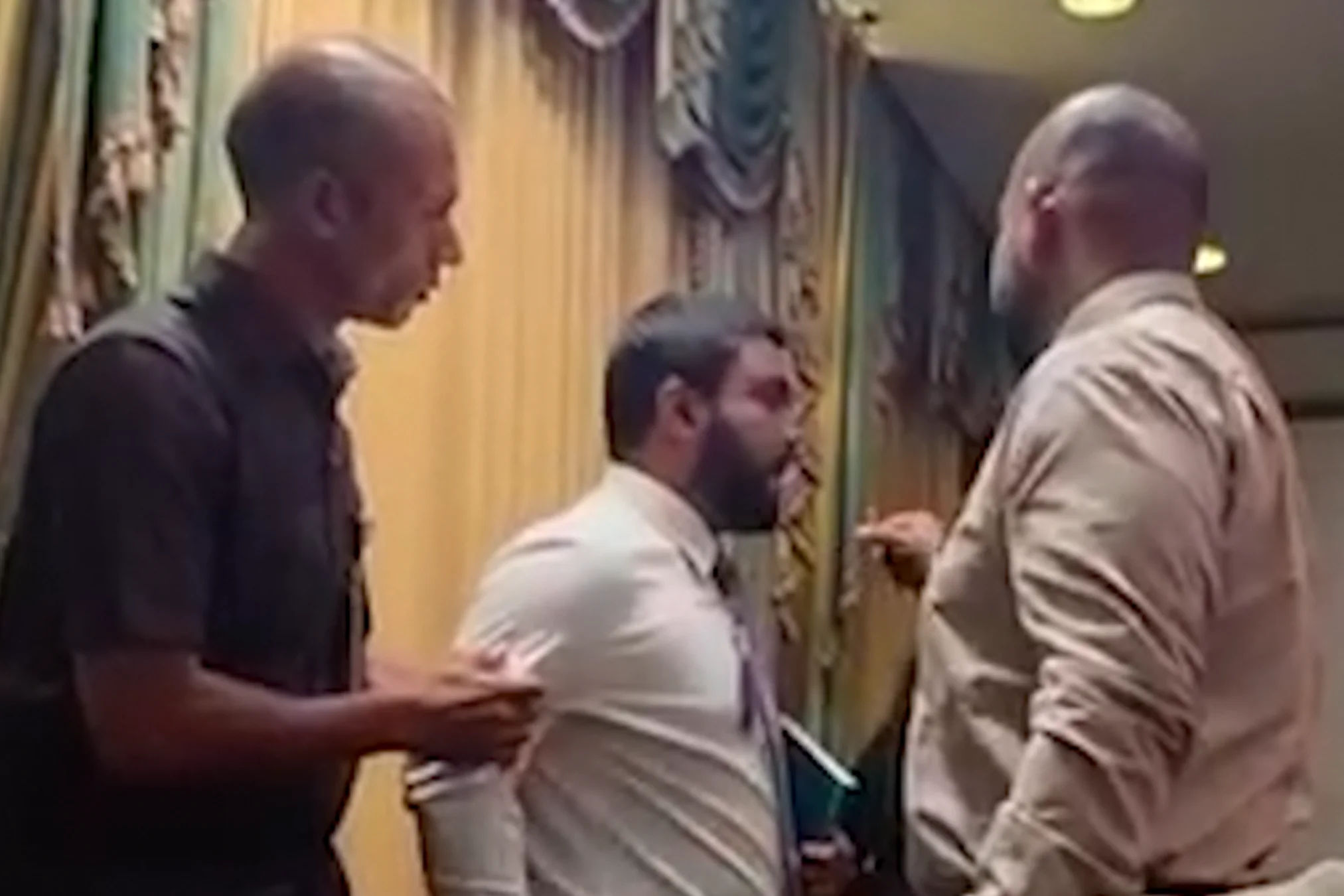
Adhadhu journalist Mohamed Shahzan was expelled from a presidential press conference and summoned to the Criminal Court after he questioned President Mohamed Muizzu about allegations of sexual misconduct. During Monday's briefing, Shahzan asked why the President had repeatedly contacted the former President's Office staffer who features in the "Aisha" documentary, 58 calls from January to April 2025, including late at night and in the early hours of the morning. Muizzu refused to answer, accused the journalist of violating the Criminal Court's gag order on the case and ordered MNDF security personnel to remove him from the hall. "You are making a blatant lie and a false accusation against me," Muizzu told Shahzan. "No one will be allowed to violate a court order within this hall. The rule of law will be upheld within the President's Office." The court has since summoned Shahzan to appear at 1pm on Tuesday. A second Adhadhu journalist, Leevan Ali Nasir, has been summoned at 11am. the same day over a news article reporting the existence of the gag order itself, published under the headline "Court issues gag order prohibiting discussion on 'Aisha' documentary."
MNDF officers attempted to seize and search a Raajje TV journalist's phone after Monday's presidential press conference, in what Raajje TV described as the first such incident at the President's Office. Officers approached Shaihan Zareer over an allegation that he had filmed the moments when Adhadhu's Mohamed Shahzan was being expelled from the briefing, and asked several other journalists to hand over their phones. Those journalists refused. President's Office spokesman Mohamed Hussain Shareef 'Mundhu' told Adhadhu that the briefings were governed by a special policy and referred further questions to the MNDF, which had not commented as of publication. A presidential press conference policy issued on March 31 bars the use of mobile phones for photography, video or audio recording, permitting them only for taking notes. Restrictions on phones at presidential briefings date back to April 2024, when the previous outright ban on smartphones was introduced and later reversed after journalists protested.
The President's Office banned Adhadhu and all its journalists from attending its press conferences indefinitely, hours after Shahzan was expelled from President Muizzu's Monday's briefing. A message sent to the office's official media WhatsApp group cited the Criminal Court's gag order on the "Aisha" case, claiming Shahzan's question to President Mohamed Muizzu about his contacts with the documentary's accuser had violated the order. The office also invoked articles 40 and 44 of the Maldives Media and Broadcasting Regulation Act – the government-created media law covering codes of conduct and the duty to disclose accurate information – and exercised authority granted to it under article 13 of the policy governing attendance at presidential press conferences. The ban applies to Adhadhu and any journalist representing it, and will remain in place until both the Criminal Court case against CEO Hussain Fiyaz Moosa and Editor Hassan Mohamed and the parallel investigation by the Media and Broadcasting Commission are concluded.
The Maldives Journalists Association and the Committee to Protect Journalists condemned the criminal charges against Adhadhu's editors, the Criminal Court's gag order on the "Aisha" case, and the expulsion of Adhadhu journalist Mohamed Shahzan from a presidential press conference. In a statement, the MJA called the prosecution "a blatant abuse of state power, designed to intimidate the press, hinder their vital work, and suppress journalistic operations," and urged the Prosecutor General's Office to drop the charges immediately. The association said the gag order – which bars the public from repeating the documentary's allegations – was unconstitutional and unprecedented, noting that past gag orders had been limited to preventing parties from debating legal details outside court or declaring suspects guilty before trial. "Never before has the general public been entirely banned from discussing a case in its entirety," the MJA said. It argued that blanket gag orders were a practice typically reserved for countries with jury systems and described the decision to hold the trial behind closed doors as "reminiscent of military tribunals in authoritarian regimes," warning that the pattern marked "the return of authoritarian characteristics to the Maldivian state." The CPJ called on the Prosecutor General's Office to drop all charges against CEO Hussain Fiyaz Moosa and Managing Editor Hassan Mohamed, saying that "criminalizing journalism poses a serious threat to press freedom and democratic accountability." CPJ also condemned Shahzan's removal from the press briefing, saying journalists "must be able to ask questions and carry out their work without intimidation or exclusion."
The Media and Broadcasting Commission ordered all media outlets to comply with the Criminal Court's gag order on the "Aisha" documentary. The commission said it was acting "in its capacity as the regulator of the media." The court order bans the documentary and prohibits any direct or indirect discussion of its subject matter and applies to the public at large. The commission's directive comes alongside parallel instructions from the Prosecutor General's Office routed through the Elections Commission to political parties.
The Elections Commission fined People's National Front MVR 100,000 (US$ 6,500) over street protests at which supporters have aired the sexual misconduct allegations against President Mohamed Muizzu. Since the publication of Adhadhu's "Aisha" documentary on March 28, supporters of former President Yameen's party have raised the allegations at nightly gatherings, where they have also taken to placing a sofa on the street – a reference to the staffer's account of physical encounters in Muizzu's office. The EC, in a letter signed by deputy chair Abdul Rahman Salah Rasheed and addressed to Yameen, said PNF had repeatedly held public gatherings without the permission required under the Political Parties Act, breached the political parties' code of conduct, and refused to attend a meeting called by the Commission. The EC warned that individuals could also face legal action if such conduct continues. PNF had previously told the Commission it held no street activities and that its only gatherings were town hall meetings at the party office. The party called the fine a "lowly act" carried out under government influence and outside the standards expected of an independent institution. Separately, the Media and Broadcasting Commission ordered Channel 13 to halt its live coverage of the gatherings.
The government repaid a US$50 million loan to India, the final instalment after a previous payment in January 2024, President Mohamed Muizzu told the press. The loan was one of three US$ 50 million tranches taken by the Solih administration in March, June and October 2019 and rolled over annually in 2020, 2021 and 2022. Muizzu said US$ 50 million had been repaid in January 2024 and another US$50 million remained outstanding, with that final payment due on September 17. He characterised the repayments as part of a broader effort to "free the people from a debt trap," saying the government had cleared US$ 974 million in debt obligations over the past 40 days, including a US$ 524 million sukuk repayment and a US$ 400 million currency swap. The president expressed frustration with former senior officials raising public concerns about the economy, saying it was "not very cool" to criticise the government's repayments when their own administrations had taken on the debts. Former President Mohamed Nasheed said at last week's Indian Ocean Dialogue in New Delhi that the government's use of loans and grants from partner states and financial institutions was wasteful, and called for a programme on how proceeds from the India bond would be deployed.
Parliament voted unanimously to lift the import ban on methylphenidate, an essential medication for children with attention deficit hyperactivity disorder (ADHD). All 51 MPs present voted to remove the drug from the list of prohibited substances under the first schedule of the Drugs Act, where it is currently classified as a narcotic. President Mohamed Muizzu had requested parliament's approval after the cabinet decided last month to drop methylphenidate from the prohibited list, acting on advice from the National Drug Control Council. The Maldives Food and Drug Authority had also asked parliament to remove the drug last year. Methylphenidate is the scientifically established first-line treatment for ADHD. The cabinet's decision followed a letter from opposition MP Mohamed Ibrahim raising concerns about the ban. Parliament's 241 committee approved the removal at a meeting on Thursday.
The tax authority collected MVR 2.63 billion in revenue for April, down 0.3 percent from the same period last year but up 16.6 percent from the forecast – which had been revised downward to reflect lower tourist arrivals – due to higher collections of GST, tourism land rent and work permit fees. Nearly a third of revenue was collected through late payments from past deadlines.