

Shadows beside the king: the queens of Kalaafaan

The women behind the tomb grants, recovered from a Frenchman's account.

Artwork: Dosain

Artwork: Dosain

2 hours ago
When I compiled King Kalaafaan Manuscripts in 2019, my subject was the eight faiykolhu – the paper grants – by which the Maldivian monarchy maintained the tomb of Sultan Ibrahim III (1585–1609), King Kalaafaan, as a waqf for more than three centuries. 
Two of those grants matter especially for what follows: Paper Grant 1, relating to the Death of King Ibrahim III Kalaafaan (1609 AD), and the endowment of Queen Kanba Aisha. These are the two documents I cite in the chronicle below as the [Kalāfānu Faiykolhu] and the [Kanbā Faiykolhu] respectively, and between them they preserve the names by which tradition remembers the king, his trusted lord, and his queens. Yet the women behind those names remained, for the most part, only shadows beside the king.
This short chronicle returns to those women. Reading again the Voyage of François Pyrard de Laval – the Frenchman who lived at Kalaafaan's court, and our nearest eyewitness – and working this time with the assistance of artificial intelligence to weigh each passage against the text line by line, I have recovered a fuller account of the king's wives than I possessed in 2019: how many there were, who they were and whence they came, the order in which he married and set them aside, and the fates that overtook them in the disaster of 1607 (1609 by the grants' reckoning).
Some of what follows is documented by Pyrard and quoted from him directly; some rests on local Faiykolhu tradition – chiefly these two grants – which I have marked as such throughout, so the reader may always see where record ends and memory or inference begins. The reconstruction is necessarily provisional – dates are reconciled rather than proven, and an identification or two remains open – but it restores to the grants a cast of living people: the high-born chief queen, Aisha Kanba; the "Delhi Queen," Dhillee Ranikilege, drawn as a child from a shipwreck; and the two foreign wives who stood beside the king at the end.

The three queens alive at the king's death (1607)
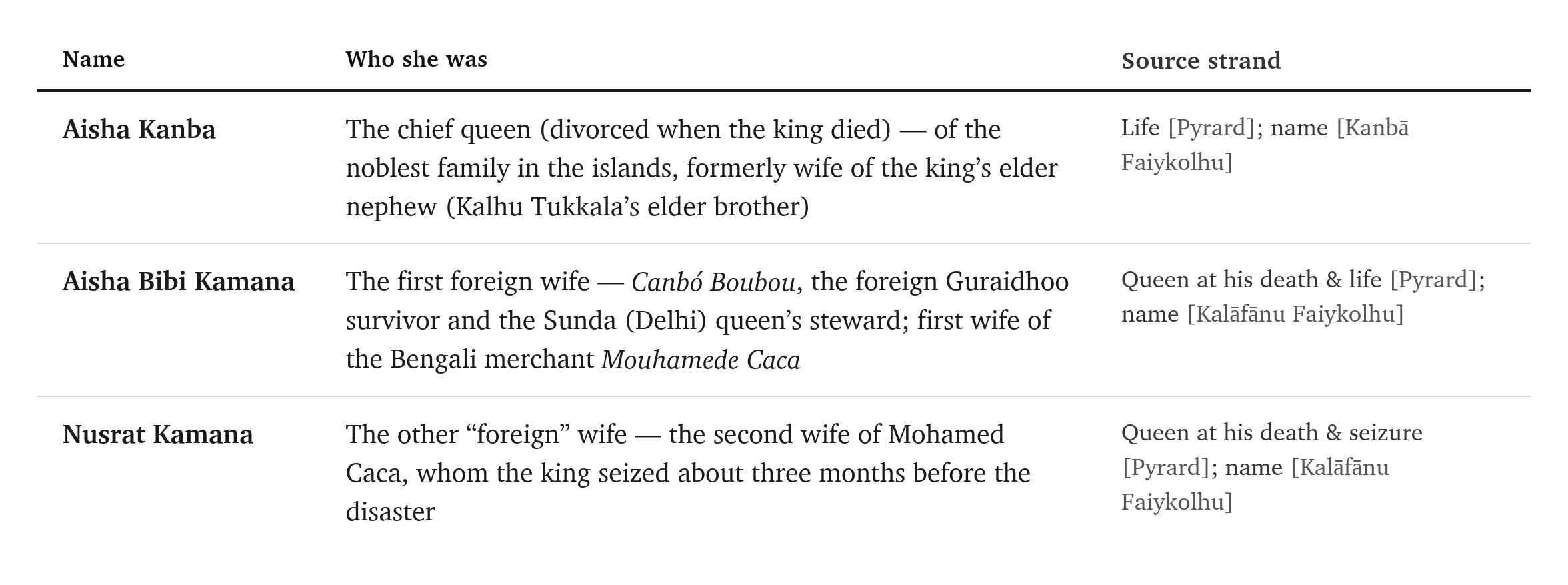
According to Pyrard, the king's three queens at the time he was killed were:
This matches Pyrard's note that, when the king was killed, the chief queen "was still with him, with two foreign women."
Pyrard confirms the three directly. Moving among the captured queens after the king's death in 1607, he records that they "told me in private a great deal about each other," and names them: "the chief queen, the foreigner from Bengal, who was as fair and white as the women of this country; and the young one, whom the king had but recently taken." The "foreigner from Bengal" is Canbó Boubou (Aisha Bibi Kamana); "the young one" is Mohamed Caca's second wife (Nusrat Kamana). So both of Mohamed Caca's former wives were indeed among the king's queens at his death – on Pyrard's own testimony, not Faiykolhu alone.
A fourth wife, the Sunda (Delhi) foreign queen – the Delhi Queen (Dhillee Ranikilege) in Kanbā Faiykolhu – had already died in childbirth c. 1605 and so was not among the three.

The King's earlier wives – set aside before his death 

Before the three queens of 1607, Pyrard records two earlier wives, both set aside. The sources supply no Faiykolhu names for either.
The first wife  an arranged match made by his father
Pyrard mentions her only in passing: the king "abandoned his first wife, whom his father had made him espouse," when he became enamoured of the pilot's [Nevi Kaloge] wife. She was thus a dynastic marriage arranged for him – set aside early – and the sources give her no name and record no children.
The second wife  the pilot's [Nevi Kaloge] wife (Pyrard's "first queen")
The most celebrated beauty in the islands, and the king's second wife:

A renowned fair beauty. "...a married woman, the fairest in complexion and beauty in all the land." Pyrard remarked on her skin: she showed her bare arm "out of coquetry," and it was "as white as that of the fairest in our country here."

Already a wife and mother. She was married to a master pilot – "the cleverest in the country in his profession and in trade, and a man of large means" – and had three daughters by him, "all married to princes and great lords."

The pilot blinded. The king coveted her; she urged him to kill her husband. Summoning the pilot on a pretext about navigation charts, "the king gave him a blow with a dagger... but the man raised his hand to parry the stroke, and turned the dagger straight into his eye, which it put out." The pilot survived, one-eyed – "I saw him often afterwards."

Married, then divorced. "She got the king to marry her" – he set aside his arranged first wife to do so – "but, after living together for a while, he fell in love with her who was the chief queen [Aisha Kanba]...and so got tired of the other." Pyrard calls her "the lewdest woman in the world." To free himself for Aisha Kanba (c. 1595–98) the king gave the pilot's wife "her dowry and rank, and left her."

Her later life. She "remained unmarried ever after, for the king did not permit her to marry again," and lived in luxury – "very gay in her dress, pearls, and jewels," with a fine house, servants and slaves, who "spent her time in pleasure, and was much visited." Her pilot ex-husband "would not speak to her again, although they had had three daughters of their marriage."

Note on numbering. Pyrard calls the pilot's wife "this first queen" (i.e. the first of his prominent queens), though by order of marriage she was his second wife, after the arranged match.
Aisha Kanba  the Chief Queen [Pyrard, with Kanbā Faiykolhu name]
The wife Pyrard describes in fullest detail.

Of the first family of the islands – "of the best family in the country, being of nobler birth than the king himself"; granddaughter of the lord who governed under the Portuguese, with her own islands and a widowed mother at Māfilāfushi.

Already married to the king's elder nephew (Kalhu Tukkala's elder brother) when the king coveted her: "This lady was of noble birth, young and beautiful, and so the king became enamoured of her." She "had no ambition to be queen, preferring her first condition and liberty."

Taken by force; her husband, made to give her up, "for sorrow whereof he was for a whole year without going beyond his house, and so died."

Bore the king a son and a daughter, both of whom "died at six or seven years of age"; the king then kept apart from her for the last four or five years.

Resented the marriage, and with her brother attempted sorcery and then flight against the king: "she hated the king to the death... for she was tired of being kept by force as a captive."

Survived the 1607 raid; the raiders freed the queens, taking only her brother (Samiya Fashana), who later returned with a Cananor fleet to fight against the next king on the throne.

Estimated marriage to the king: c. 1595–1598, while she was still in her teens. Working back from two children reaching ages 6–7 plus a 4–5-year estrangement before 1607 places the marriage in the late 1590s. As to her age, Pyrard makes plain that Maldivian girls married very young: a girl with a living father was given "in marriage as soon as possible after the age of ten years... at the age of ten or eleven to the first that asks them," while a fatherless girl "may not [marry] till they have attained the age of fifteen years." Aisha Kanba's father was dead (Pyrard mentions only her widowed mother at Māfilāfushi, and it was her brother who later acted for her), so by that rule she would first have married – to the king's nephew – at about 15, and been seized by the king only a few years afterward. She was therefore most likely in her teens, roughly 15–19, when the king took her. This implies a birth around 1578–1582, which sits far closer to the traditional date of c. 1586 (and would make her about 84–88, rather than 80, at her death in 1666).
Aisha Bibi Kamana (Canbó Boubou)  the first foreign wife
Her origin and rise [Pyrard]: She and her husband Mohamed Caca were foreigners wrecked at Guraidhoo with the future Sunda (Delhi) queen, and served her from youth:
"...a merchant of Bengal, called Mouhamede Caca, and his wife, also a foreigner... She was called Canbó Boubou... Both were wrecked with the queen; they were her slaves, and were about thirty years of age, and had no children."
The Sunda (Delhi) queen raised them to run her household, "seeing that they had been about her in their youth" – so Aisha Bibi Kamana effectively reared and attended the orphan-queen. Her age ("about thirty") falls around 1602–05, so ~32 by the king's death.
Pyrard records that after the Sunda (Delhi) queen's death (c. 1605) she took the Portuguese factor Simon Rodrigue as a lover; the king had the factor killed and seized his wealth, and she was punished "as all others are who are taken in adultery... but somewhat more rigorously," after which her husband cast her off.
She was nonetheless one of the king's queens at his death  confirmed by Pyrard. Among the captives after the king fell, Pyrard expressly names "the foreigner from Bengal, who was as fair and white as the women of this country" as one of the three queens who "told me in private a great deal about each other." That is Canbó Boubou herself – so Pyrard's own narrative places her among the royal wives at the end.
Nusrat Kamana  the second "foreign" wife 
After Mohamed Caca put aside his first wife, he married a young local woman, "thought to be the most lovely in all the islands... eighteen or twenty years of age." The king seized her too:
"...no sooner did the king set eyes on this wife, than he became violently enamoured of her, and... even compelled her to separate from her husband, whom he threatened to cast into the sea..."
"...three months before the great Maldive disaster, the king took her to wife, because the Pandiare told him that, to free his conscience, it were better for him to marry her than to continue in the sin wherein he was."
So Nusrat Kamana entered the royal household barely three months before the catastrophe and was the second of the two "foreign" wives present at the king's death. (Pyrard calls her "a young girl of the country" – local-born; "foreign" here means the foreign merchant's wife.)
The omen  "sompas" [Sunpa]. Among the captive queens it was this young, recently-taken wife who confided in Pyrard. He writes that she was "the young one, whom the king had but recently taken," and "told me with sorrow that she brought misfortune wherever she was (this they call Sunpa), and that since the king had taken her, every disaster had befallen them." In other words she believed herself ill-omened, and traced the catastrophe to the king's seizing of her about three months earlier.
The Sunda (Delhi) foreign queen  "the Delhi Queen" (Dhillee Ranikilege) [Pyrard; name from Kanbā Faiykolhu]
The child survivor of the great ship of Sunda (Delhi) wrecked at Guraidhoo, known in Kanbā Faiykolhu as Dhillee Ranikilege.
Pyrard says:
"...I saw the mast and rudder of the ship that was lost there, wherein was the foreign queen who died in child-bed while I was about the king."
She was "but a child" when saved; her parents (the ship's owners) drowned. She married the king and died in childbirth c. 1605, the year of the great eclipse, which the islanders read as a portent: "an evil omen... that they should lose the greatest of them." Pyrard saw only the wreckage, not the wrecking; since her attendant Aisha Bibi Kamana was only ~30 around 1602–05, the wreck itself falls c. 1580s–early 1590s (queen and young attendants all wrecked together).
Dhillee Miskiyy, now Masjid al-Afeefuddeen, in Malé. AI reconstruction from a 1950s photograph. The namesake of this mosque is believed to be Dillee Ranikilege of Kaalaafaanu.
Comment  was it really a "Sunda" ship? [interpretation]. Pyrard states the lost vessel "came from Sunda [western Java, Indonesia], laden with all kinds of spices and other merchandise of China and Sunda." Yet the two survivors who came ashore with the infant queen and served her ever after – Mohamed Caca and Canbó Boubou – were emphatically from Bengal ("a merchant of Bengal... his wife, also a foreigner... Canbo being her personal name in the language of Bengal"), and Pyrard calls the ship's company "Indians" who "take the greater part of their household to sea with them." That pulls against a purely Javanese identity. The natural reconciliation is that "from Sunda" describes the ship's last trading leg and cargo (the Sunda–China spice run), while its owners, household and people were Indian – specifically Bengali.
This matters for the queen's Maldivian name. In her day Bengal was a province of the Mughal Empire, and it is telling that local tradition remembers her not as a Sunda or Javanese princess but as Dhillee Ranikilege – "the Delhi Queen," Delhi being the Mughal capital. The Bengali survivors and the "Delhi" epithet together point to a Mughal-realm vessel rather than an Indonesian one – the Maldivians, it seems, identified the ship's people by their sovereign's seat (Delhi/the Mughals), not by the spice-port it had last sailed from. Suggestively, in the very next lines Pyrard turns to the largest ships he knew, those "from the coast of Arabia, Persia, and Mogor" – Mogor being, as the Hakluyt editor notes, the Portuguese term for the dominions of the Great Mughal.
(This remains an inference, not Pyrard's claim: an Indian-owned merchantman could trade out of Sunda without being "Mughal," and "Delhi" may be a folk shorthand for the North-Indian/subcontinental world rather than a literal port of origin. But the Bengal–Delhi convergence is a genuine clue that the "ship of Sunda" was, in people and ownership, a ship of Mughal India.)
Revised master timeline

c. 1552–1555 – Birth of the king (he and his lifelong friend, the great lord Hassan Kaiulhennaa Kaloge – Pyrard's "Assant Caonas Calogue" – "each was now fifty"). [Pyrard]

c. 1580s–early 1590s The Sunda (Delhi) ship wrecks at Guraidhoo; a small girl – the future Delhi queen (Dhillee Ranikilege) – survives with her young attendants, the foreign couple later known as Aisha Bibi Kamana (Canbó Boubou) and Mohamed Caca. [Pyrard; name from Kanbā Faiykolhu]

c. 1578–1582 Birth of the chief queen, Aisha Kanba (inferred from a teenage marriage; tradition gives c. 1586 if counted backwards from the Hukuru Miskiy inscription).

1583 King Kalafaan comes to power.

c. 1583 or before The king marries his first wife, an arranged dynastic match made by his father (later set aside). [Pyrard]

c. late 1580s–early 1590s The king takes the pilot's [Nevi Kaloge] wife as his second wife: enamoured of her, he has her master-pilot husband summoned and stabs out his eye, and sets aside his arranged first wife to marry her. [Pyrard]

c. 1595–1598 The king divorces the pilot's wife and marries Aisha Kanba, the chief queen, then in her teens. [Pyrard]

c. 1602 Pyrard reaches the court; the king is childless. [Pyrard]

c. 1605 – Death of the Sunda (Delhi) foreign queen (the Delhi Queen) in childbirth, the eclipse-omen year. [Pyrard]

c. 1605–1606 – Aisha Bibi Kamana becomes a royal wife (Pyrard names her — "the foreigner from Bengal" – among the queens at the king's death, despite the earlier adultery episode). [Pyrard]

c. early 1607 – The king seizes and marries Nusrat Kamana (Mohamed Caca's second wife), ~3 months before the disaster. [Pyrard]

1607 – Bengali raid; the king killed at sea; the three queens Aisha Kanba (divorced), Aisha Bibi Kamana, Nusrat Kamana taken, then freed. Pyrard's record ends here. [Pyrard]

1666 – Death of the chief queen, Aisha Kanba, aged 80 (Hukuru Miskiy).

Reconciliation and source notes

The "two foreign women" are now Pyrard-confirmed. Pyrard's account of the captive queens names "the chief queen, the foreigner from Bengal...and the young one, whom the king had but recently taken" – i.e. Aisha Kanba, Aisha Bibi Kamana (Canbó Boubou), and Nusrat Kamana. So both of Mohamed Caca's wives were the king's queens at his death by Pyrard's own testimony.

Aisha Kanba married in her teens. Pyrard's marriage-custom passage (Maldivian girls married off at 10–11 with a father, or from 15 if fatherless) places her teenage marriage on firm ground. A marriage at ~15–19 implies a birth c. 1578–1582 – close to the traditional c. 1586 – and makes her ~84–88 at her death in 1666, easing (though not perfectly closing) the old gap with the "aged 80" tradition. 

The adultery / queen tension. Pyrard both reports Canbó Boubou punished for adultery and lists her among the queens at the king's death. The chronicle follows Pyrard's later, explicit listing: she was a royal wife at the end.

The two earlier wives are unnamed in the sources. Pyrard gives no name for the arranged first wife or the pilot's [Nevi Kaloge] wife (his "first queen"); if Faiykolhu supplies names, they can be added.

Hassan Kaiulhennaa Kaloge (Pyrard's "Assant Caonas Calogue"). This man appears in Pyrard. In Ch. VII a "great lord named Assant Caounas Calogue" arrives from the king's island as the second royal commissioner to Pyrard's wrecked ship and takes Pyrard back to court; the footnote says "this lord and his family, with whom the author had the warmest friendship, are mentioned several times hereafter." In Kalāfānu Faiykolhu he is Hassan Kaiulhennaa Kaloge. Pyrard says he is the king's most trusted noble ("having more confidence in him than in any other") and the lifelong friend of the "each was now fifty".

The "ship of Sunda" may have been a Mughal vessel. Pyrard calls it a ship "from Sunda," but the survivors were Bengali and the company "Indians," and the queen is remembered as the "Delhi Queen" — pointing to a Mughal-realm ship (Bengal was then Mughal; Delhi the Mughal capital) whose "Sunda" tag reflects its trade route, not its people. Offered as interpretation, not as Pyrard's statement.

Two women "died in child-bed": the Sunda (Delhi) queen (Ch. XXII) and, separately, the king's nephew's (Kalhu Thukkala) abducted (Baarashu) wife (Ch. XXIII).

Discussion

No comments yet. Be the first to share your thoughts!

No comments yet. Be the first to join the conversation!

Join the Conversation

Sign in to share your thoughts under an alias and take part in the discussion. Independent journalism thrives on open, respectful debate — your voice matters.

Support Independent Journalism

Help us keep the news free and fearless

Give once
or
Become a memberfrom $5/month

Explore more