
Gender equality, a game changer for nature
Aban Marker Kabraji, Asia Regional Director of the International Union for Conservation of Nature, writes about the importance of gender equality in effective natural resource management.

08 Mar 2017, 09:00
In Fiyoaree, Maldives, Leena wakes up every day just a little before sunrise for her morning prayer. She prepares breakfast for her family and gets her two children, 9-year-old Fathimah and 5-year-old Ahmed, ready for school, which starts at 7:30 a.m. Once she returns home, she tidies her house and takes care of the laundry, before she heads out to her parents’ farm, located 1.5 km away, to help water their vegetables. Approximately two hours later, Leena returns home to prepare lunch for her children.
Throughout the day, she juggles other household duties, including tending to her 4-month-old baby, Moan, while her husband, a fisherman, is out at sea.
At night, after she tucks her children in, Leena spends three hours making mats out of reeds that grow in nearby marshlands and wetlands.
Along with 30 other women in her village, 30-year-old Leena sells these multi-coloured woven mats to a cooperative in the capital, Malé. The co-op then sells the handicrafts to high-end tourist resorts. If the women weave on a regular basis, they can earn up to MVR1,000 (US$65) per month from the activity – which amounts to approximately 30 percent additional income to the average household income in Fiyoaree.
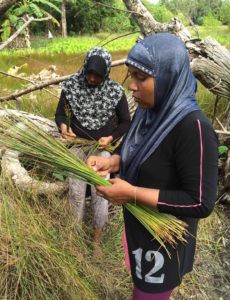
Like many other women in her village, and many parts of the world, Leena is the primary caregiver for the family, while her husband goes out to work. Most of the time, these women also take on the responsibility of collecting water and firewood, as well as growing and harvesting crops.
Even though the past decades have seen huge changes for women in many communities in terms of employment, there are still many women who simply cannot have a job away from their villages because of their duties at home. This is why home or village-based income-generating opportunities, such as Leena’s weaving, are so important.
Leena is a beneficiary of a regional coastal conservation initiative spanning 11 countries in Asia and the Indian Ocean that aims to empower women economically by training them in the traditional Maldivian art of Thun’du Kunaa weaving. Implemented through Mangroves for the Future (MFF), a partnership-based coastal programme co-chaired by the International Union for the Conservation of Nature (IUCN) and UNDP, this income-generating initiative also helps women better understand the value of wetlands – and the fundamentally important services they provide, such as the supply of reed for their weaving.
With their traditional knowledge of sustainability at the household and community level, women can play a critical role in the conservation of natural resources. Coupled with the fact that they are instrumental in running the household, they also hold the key to positively influencing and shaping their husbands’ and children’s views about the importance of safeguarding nature. They, in turn, then go on to positively influence their peers, creating ripples of change that spread across the community.
Empowered with more knowledge on the sustainable use of natural resources, these women can become strong advocates for nature-based approaches to sustainable development. Numerous studies have indicated that women also play a crucial part in building resilience: from ensuring that fragile ecosystems are protected, to helping their families become more resilient in the face of natural disasters.
Additionally, the United Nations’ 2030 Agenda for Sustainable Development has made it crystal clear that a commitment to gender equality is necessary to secure a better future for all. This is explicitly evidenced in Sustainable Development Goal No. 5 “Achieve gender equality and empower all women and girls”.
Unfortunately, in many nations, gender-based discrimination and inequality are still deeply woven into the social fabric. And despite the fact that women play such a critical role in the conservation of ecosystems, their contribution is often overlooked, undervalued, and sadly, undermined. The recent World Economic Forum predicts that the gender gap won’t close entirely until 2186.
Though Asia’s unprecedented economic growth has brought many benefits to its communities through higher incomes and a better quality of life, it has also exacerbated threats to the region’s ecosystems through natural habitat degradation and biodiversity loss, due to commercial, agricultural and industrial activity. Rates of mangrove, wetland and forest loss in Asia are among the highest in the world; 95 percent of Southeast Asian coral reefs are at risk; and almost 1,400 plants and animals in the region are listed as Critically Endangered and Endangered.
All is not lost, though. Thankfully, this is the 21st century, and the vital role of gender equality, equity and inclusion in conservation and environmental protection has been receiving increasing attention from both the scientific and political community. A large number of international organisations have been relentlessly advocating for the empowerment of women, and for them to take real ownership of the ecosystems on which they rely.
For instance, IUCN’s gender policy calls for the promotion of equity and equality as a crucial factor for environmental sustainability, and as an integral part of all conservation efforts.
Since its inception, 38 percent of MFF’s projects have directly contributed to addressing women’s needs. Through the provision of education and skills development training to women and their families, more than 80 percent of these projects resulted in measurable increases in women’s incomes, and went hand-in-hand with improved management of natural resources.
This year’s theme for International Women’s Day is “Be bold for change”.
In the Maldives, women like Leena are leading the way. By fruitfully engaging in a sustainable income generating activity, Leena encourages other women to take the leap and do the same.
As increasing numbers of women are empowered through conservation projects that systemically mainstream gender equality into programmatic outcomes, collective efforts in sustainable development become more impactful, and can indeed secure a better future for all.
Aban Marker Kabraji is the Asia Regional Director of the International Union for Conservation of Nature.
All comment pieces are the sole view of the author and do not reflect the editorial policy of The Maldives Independent. If you would like to write an opinion piece please send proposals to [email protected]
Discussion
No comments yet. Be the first to share your thoughts!
No comments yet. Be the first to join the conversation!
Join the Conversation
Sign in to share your thoughts under an alias and take part in the discussion. Independent journalism thrives on open, respectful debate — your voice matters.
Support Independent Journalism
Help us keep the news free and fearless
Give once
$
or
Become a memberfrom $5/month