
'Not an inch sold': the Eagle Hills deal and the foreign ownership question

UAE developer says every resale or inheritance restarts a 99-year lease.
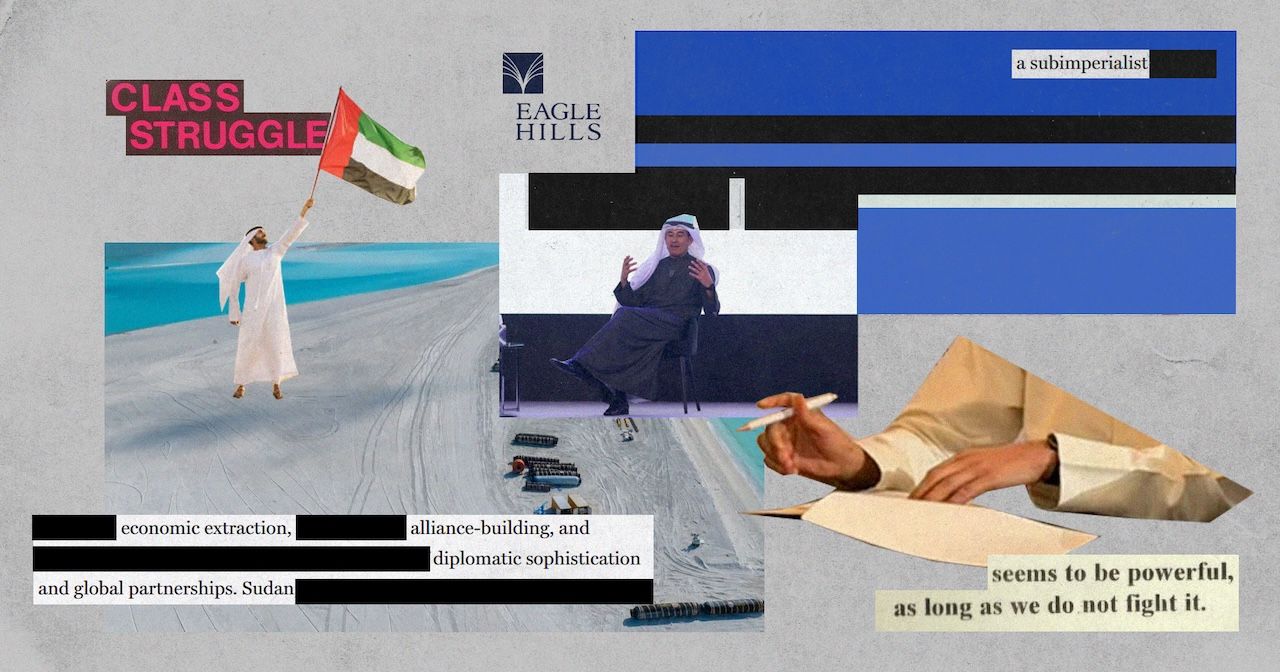
Artwork: Dosain

Artwork: Dosain

3 hours ago
The government called it "the largest investment programme in the country's history." At a ceremony in Dubai on Monday, Infrastructure, Housing and Urban Development Minister Dr Abdulla Muththalib and Mohamed Alabbar, chairman of Abu Dhabi-based Eagle Hills, agreed the "principal commercial terms" of Maldives Waterfront and Marina, a development of hotels, branded residences, a marina, schools and hospitals on reclaimed land in Rasmalé.
The investment of US$20 billion touted by the government eclipses the total GDP of the Maldives. The Eagle Hills announcement carries no figure or commitment at all. Alabbar told Khaleej Times the project could reach US$20 billion. The National News reported US$12 billion. As did Bloomberg and Reuters
The "major new integrated island destination" is to be developed on land reclaimed as the centrepiece of President Dr Mohamed Muizzu's pledge to end the capital's housing crisis.
At a press conference on 29 June, Muizzu denied the rumoured sale of Rasmalé land to a UAE developer under the Pearl Residence visa scheme. “We are not going to give any part of Rasmalé to any party to carry out the Pearl Residence program. That is not true at all,” he said.  
On social media, government supporters and ruling lawmakers rejoiced and hailed the deal as "transformative" for the economy.
Critics objected to the opacity and the potential for foreign freeholds. The massive lagoons on which Rasmalé and the Crossroads integrated resorts stand are the country's "most valuable assets" that governments should not lease for long periods, opposition MP Ahmed Shamheed argued, estimating that the reclaimed land was worth between US$10 and US$17 billion. As claims that Rasmalé had been handed over "for 99 years plus unlimited resets" circulated, Finance Minister Hassan Zareer went on state television to insist that "not even an inch" of land would be sold. The next day, Muththalib laid out the financial terms in a long LinkedIn post: a 10 per cent revenue share, a four per cent levy on property sales and an escrow account for proceeds.
Here is what we know.

What was signed?

A "commercial terms agreement" is closer to a term sheet than a final contract. According to the press release – differing versions of which were published by the infrastructure ministry and Eagle Hills – it outlines "the shared vision and principal commercial terms" with detailed terms "to be developed as the project progresses".
The agreement has not been published. Finance Minister Zareer told PSM that 500 hectares from the 1,100-hectares to be reclaimed in the Fushi Dhiggaru lagoon south of Malé will be allocated. The plan includes three resorts, he said.
The press release said the development will combine hotels and resorts, "premium" and branded residences, a marina, waterfront promenades, retail, dining and entertainment with schools, healthcare and community facilities. According to Bloomberg, Alabbar said it would be built in five districts and would progress in line with demand. Zawya reported that the company aims to start construction in the first quarter of 2027. 
Alabbar also said Emaar Properties, the Dubai developer he founded, which built the Burj Khalifa, could join the project, possibly as an equal partner, depending on a decision by Emaar's investment committee. The current agreement is with Eagle Hills alone. 

How much will Eagle Hills invest?

The US$ 20 billion figure is the "overall development scale envisioned" across all phases. 
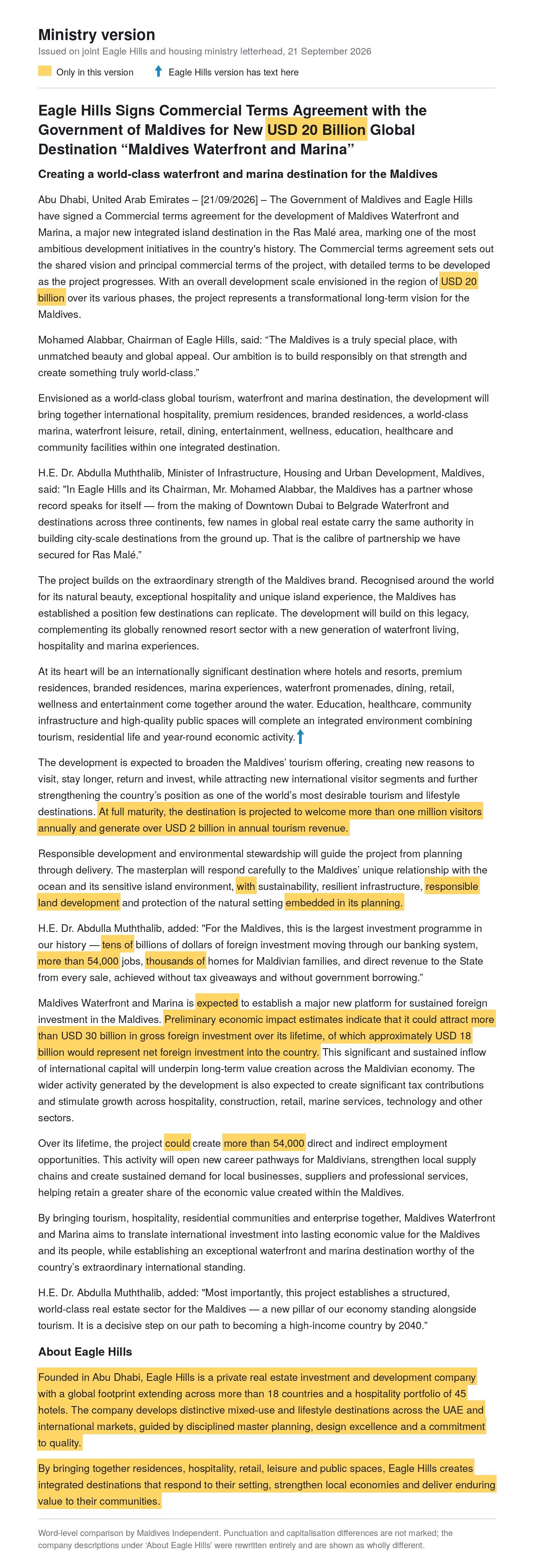
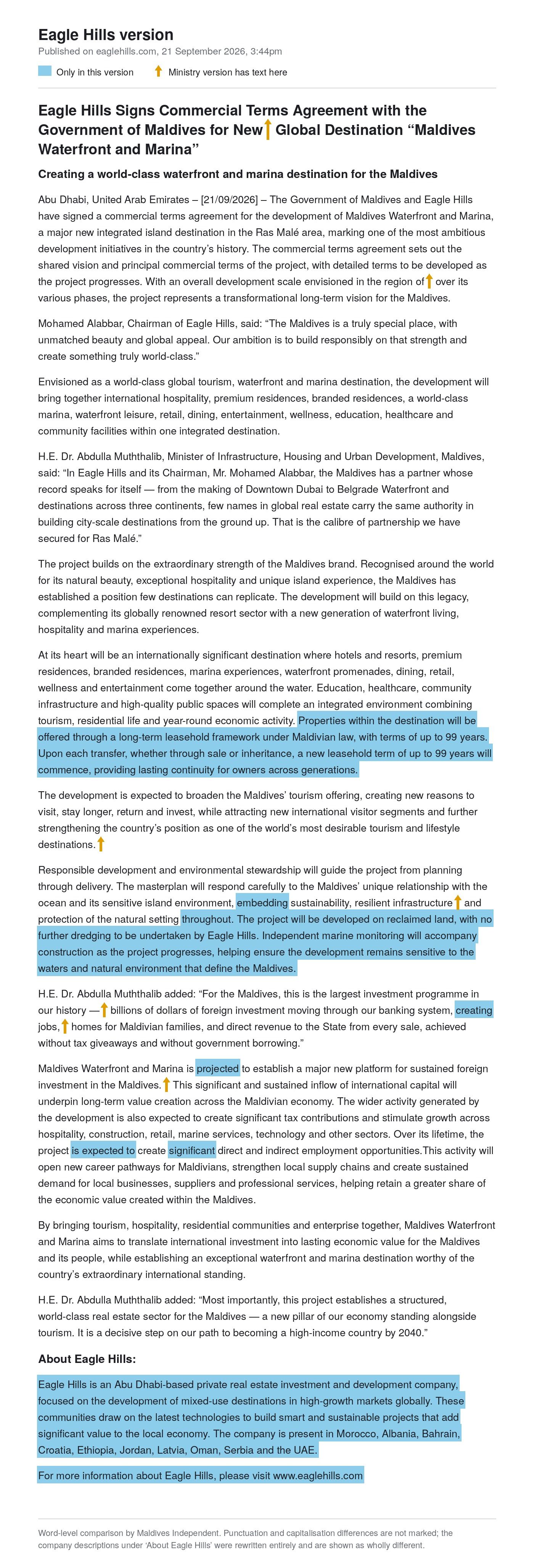
The infrastructure ministry's version of the joint press release was headlined as a "USD 20 Billion" project. The sentence on the project's scale in Eagle Hills' version, on its website, reads "in the region of over [blank space] its various phases" with the number missing. The visitor, revenue, investment and jobs projections in the government version are all missing.
The ministry's version projects more than one million visitors a year and more than US$2 billion in annual tourism revenue "at full maturity". 
The country welcomed a record 2.2 million tourists last year.
In his LinkedIn post, Muththalib said the state expects more than US$11 billion in revenue over the development period. The project would reach maturity "in roughly ten years". 
In the ministry's version of the press statement, Muththalib spoke of "tens of billions of dollars of foreign investment" and "more than 54,000 jobs". In Eagle Hills', the same quote refers to "billions of dollars" and "creating jobs". 
Interactive Image - Slide to compare

How much of Rasmalé does it take?

Muththalib confirmed that 500 hectares of Rasmalé will be designated for the project. The other half "remains for locals only". Bloomberg reported that Eagle Hills is eyeing a 5.2 million square metre island (520 hectares) about 20 minutes from Malé.
When Muizzu launched his flagship zero carbon "eco city" project in December 2023, the plan was to reclaim 1,153 hectares for Rasmalé. The Housing Development Corporation and the Maldives Airports Company now give the total as 1,009 hectares. The Eagle Hills site alone is larger than the three phases of Hulhumalé combined, Zareer noted.
The master plan for Rasmalé envisaged about 65,000 housing units. The president promised to award 15,000 residential plots. In an op-ed published in The Guardian in May 2024, Muizzu called Hulhumalé "a lifeline, a blueprint for survival that has since evolved into a thriving urban centre."
"Similarly, our upcoming project, Ras Malé, aims to be the Indian Ocean’s first eco city, raised three metres above sea level. This is true climate adaptation if ever I saw it," he wrote.
Eagle Hills says it will do no further dredging and that independent marine monitoring will accompany construction. Its sales website promises coral nurseries, protected turtle beaches, car-free streets and electric water taxis at Rasmalé. "We protect the reef because without it, there is no island," it says. 

Can foreigners own land in the Maldives?

No. Article 251 of the constitution bars foreign ownership of any part of Maldivian territory. It allows land to be leased to foreign parties for up to 99 years.
During former President Abdulla Yameen's administration in July 2015, parliament amended Article 251 to let foreigners who invested more than US$1 billion own land in a project, provided at least 70 per cent of the site was reclaimed from the sea. A project on the scale of Rasmalé would have qualified. The amendment passed with opposition votes. 
In early 2017, Yameen told residents of Faafu Magoodhoo that members of the Saudi elite wanted to invest in the atoll. He described a US$10 billion development like the "mixed development projects in the French Riviera" with high-end resorts, homes and airports. 
In March 2017, a leaked recording of Ahmed Nihan, parliamentary leader for Yameen's Progressive Party of Maldives, gave a different account. Speaking to a group of supporters, Nihan said the amendment was made for Mohammed bin Salman, then Saudi Arabia's deputy crown prince, who wanted to develop the island of Himithi. A 99-year lease was not enough because the prince wanted land he could leave to his heirs. "This is the reason the constitution was changed, because we wanted him to own the land," the majority leader said. 
As the opposition campaigned against what it called the sale of Faafu, the government cracked down. Ahead of a planned state visit by King Salman, police twice raided the Maldivian Democratic Party's meeting hall in Malé. They seized paint and 21 rolls of banner fabric under a warrant citing activities "demeaning" to visiting dignitaries. Party members on Bilehfahi were detained and questioned over a banner reading "Don't sell Faafu atoll", and two people tweeting under #SaveFaafu were arrested. 
King Salman postponed his visit indefinitely. The government cited an outbreak of H1N1 flu. In July 2017, Yameen blamed opposition leaders for the failure to secure the Saudi investment, signalling that the plan had been dropped.
No land was sold under the 2015 rules. After Yameen lost the 2018 election, parliament unanimously repealed the amendment in April 2019, restoring the ban on foreign ownership and the 99-year limit on leases.
Eagle Hills addressed the concern of an investor who might want property his heirs could inherit. "Properties within the destination will be offered through a long-term leasehold framework under Maldivian law, with terms of up to 99 years. Upon each transfer, whether through sale or inheritance, a new leasehold term of up to 99 years will commence, providing lasting continuity for owners across generations," it stated, in a paragraph missing from the Maldives version.

What is the 99-year lease that 'resets'?

Appearing on PSM's Raajje Miadhu, Finance Minister Zareer said Rasmalé land would be leased under the same framework used to lease islands for resorts for up to 99 years. Ownership of the land would remain with the state while the developer would enjoy "lease rights". 
Muththalib wrote: "There is no freehold. Maldivian laws and regulations apply at all times."
But leases can be sold and transferred, Zareer noted. "The lease of these properties can be sold as a trading commodity," he said, adding that the sale of lease rights within the 99-year period would foster a real estate market. 
But while a resort lease is held by one operator for a fixed term, buyers of Rasmalé properties can resell or pass on homes with a fresh 99-year clock each time. No single lease would breach the constitutional limit. Neither minister has addressed the resetting lease that Eagle Hills published it on the day of the signing. 
"There is not much difference between selling and leasing for 99 years. Selling islands of the Maldives like that for foreigners to inhabit is high treason. You're selling the rights of generations to come and the future of our children," former MP Ali Hussain tweeted.
According to Eagle Hills, the resetting lease applies to buyers of individual properties. The terms of Eagle Hills' own lease over the 500 hectares – its length, rent and conditions – have not been disclosed. 

Does buying a home come with residency?

Zareer told PSM that holding a lease right would accord the buyer the opportunity to live in the Maldives.
Muththalib wrote that the government would approve who may buy and would keep the power to issue or refuse a visa. There was "no pathway – and there will never be a pathway – from owning a property to permanent residency or citizenship".
Eagle Hills' sales website for the project (eaglehillsmaldives.com) pitches it as "Make Maldives your new home". It says the Maldives Corporate Resident Visa grants five years of residency, renewable, for investments from US$ 250,000, with a one-time fee payable once the visa is approved. 
The site offers one-, two- and three-bedroom serviced apartments and villas of 250 to more than 400 square metres. Servicing and "dedicated leasing management" to be provided by the developer. Homes are pitched as rental investments as well as residences. Alabbar told Bloomberg there was demand from the Gulf, Europe and India for a product offering wealthy retirees a modern home on the island.
The other route is Maldives Pearl Residence, the residency-by-investment programme the government is developing with Henley & Partners. It was due to launch in April 2026. The website now says the second half of the year. 

What happens to housing for Maldivians?

"Most importantly, this project will bring no change to the previously announced social housing numbers," Muththalib told Mihaaru. The housing ministry said the deal would not affect the number of residential plots allocated for public distribution.
As part of the deal, Eagle Hills will build 5,000 homes. But in Hulhumalé. Initial reports said the government will not pay and that the homes are part of Eagle Hills' commitment. Muththalib then told Mihaaru that it would be done through contractor finance at the company's expense. The government would pay after completion and handover from the proceeds of their sale, he said. 
He later wrote on LinkedIn that Eagle Hills will build 5,000 three-bedroom homes costing US$400–500 million. The company will provide funding upfront with the cost to be deducted from the government's 10 per cent revenue share.
"Not one dollar of debt is added to the government," Muththalib wrote.
Critics say the country has built social housing at this scale before without trading land for it. Midhuam Saud, a commentator and analyst on social media, noted that more than 10,000 units were started under President Yameen, including 7,000 Hiya flats in Hulhumalé, and 4,000 under President Ibrahim Mohamed Solih with Indian EXIM Bank financing. 
The original plan for Rasmalé envisioned about 65,000 housing units on the artificial island. Muththalib now says the remaining 500 hectares can house "150,000 or more" people.

What does the state get?

Muththalib said the government agreed a revenue share "instead of an acquisition cost". Instead of a one-off payment, the state will receive:

Tourism GST on every hotel stay, meal, shop and service in the development, "with no concessions".

A 10 per cent share of revenue from the master developer.

4 per cent on every property transaction.

An escrow account in the Maldives holding every sale receipt from the development.

The government will not take any loan or provide sovereign guarantees, he said. Both Muththalib and Zareer said that no tax concession will be granted.
All project funds will flow through Maldivian banks, Muththalib said. The developer will have no claim on state revenue, he added, referring to the cancelled GMR airport deal, under which the government levied a fee on passengers and passed it to the concessionaire.
Muththalib cited tourism land rent as bringing in MVR2.07 billion in 2025, while tourism GST brought in more than MVR10.9 billion.
The minister did not say whether the state's 10 per cent would come from gross sales, operating income or profit. It is also unclear whether it covers hotels and resorts, or only the master developer's own income, or for how many years it would apply. Part of it will first have to go toward repaying the cost of the 5,000 Hulhumalé apartments.
The insistence on no tax incentives suggests that Rasmalé will not be declared a special economic zone. In November 2024 the Supreme Court held that strata villa sales fall outside GST. The "sustainable township" amendment made to the SEZ Act in November 2025 introduced a progressive property transfer tax of up to four per cent "on income derived from a long-term strata-based lease of a villa or room in a zone, or from the sale of rights to such a villa or room".
It is also unclear whose money will be invested. A "Co-Invest With Us" page on the project's sales website invites qualified investors to register interest in co-investing through "The Office of Mr. Mohamed Ali Alabbar". It says "particular priority" will be given to Maldivian individuals, businesses and institutions.
"More importantly than that is that the contribution to the local economy, to the local society, something close to my heart," Alabbar said in a video posted by the ministry. "And you know, I'm I'm I'm a Muslim. I have a soft touch for my brothers and sisters."

Why do critics object?

Opposition to Rasmalé predates the Eagle Hills deal. Former President Yameen has argued the government should stop Rasmalé and build housing in Hulhumalé instead. Former President Mohamed Nasheed has called for major projects including Rasmalé to be halted. Most leaders and MPs of the main opposition MDP have called the reclamation a waste of public funds.
Muizzu launched the reclamation on 18 December 2023 without a budget allocation. Parliament, then controlled by the MDP supermajority, had removed the MVR400 million earmarked for it. The contract was awarded to Sri Lanka's Capital Marine and Civil Construction (CMCC) without the public announcement procedure normally required, according to a complaint later filed with the Anti-Corruption Commission, in exchange for 70 hectares of land in Rasmalé and Hulhumalé. The MDP alleged corruption worth MVR70 billion, based on its valuation of the land. The ACC opened an investigation in March 2024.
The government cancelled the CMCC contract in May 2024 after 29 hectares had been reclaimed. The Housing Development Corporation agreed to pay the company US$21 million for the work. The reclamation has since been split between several contractors.
Opposition politicians say the government is spending scarce foreign currency on dredging while the country runs short of dollars. MDP presidential hopefuls Fayyaz Ismail and Abdulla Shahid have both singled out Rasmalé spending. In June, Muizzu said the reclamation was about 60 per cent complete and had slowed because of rising fuel costs linked to the war in the Middle East.
Critics also argue there was no need for a new island. Under the previous government's Binveriya scheme, about 19,000 people were found eligible for 9,003 housing plots in Hulhumalé, Gulhifalhu and Giraavaru. Land reclaimed for the latter two remains uninhabited. 
Midhuam Saud, who writes an independent blog on public affairs, argued that the master plan should have come before the deal. Hulhumalé's second phase was planned by a team led by Professor Heng Chye Kiang of the National University of Singapore, then developed with many investors, without handing a whole zone to one developer. He said the government dropped an earlier process to hire master planners for Rasmalé, which Heng's team had applied for, and that Muththalib instead made study trips to Dubai (four in 2026 and three in 2025). 
Midhuam predicted that the project cannot go ahead under current law. Enabling amendments on land, foreign ownership, special economic zones or residency will follow when parliament returns from recess, he wrote. 
Critics also point to the government's record. The US$8.8 billion Maldives International Financial Centre, signed with Dubai-based MBS Global Investments in May 2025, has not progressed. The foreign CEO of the Development Bank of Maldives, established in 2024, resigned. Muththalib acknowledged public scepticism about "mega projects that are announced and never built", but said Eagle Hills "is not a paper company".

What is the case for the deal?

"Reclaiming land is the cheap part; servicing it is expensive," Muththalib wrote. Successive governments have reclaimed hundreds of hectares, but only a handful of those areas have full roads, power, water and sewerage. No government can borrow abroad to build them at the speed people want, he said.
"The real waste is reclaimed land that sits idle and empty for a decade because there is no economy to pay for what goes on top of it," he argued.
Muththalib mades three further points:

Revenue over rent. The state earns far more from taxing tourism activity than from land rent, so a deal built on revenue shares and GST is worth more than a one-off payment.

Jobs near home. Rasmalé is 17 minutes from Malé by speedboat, so hotel, marina, school and clinic jobs there would let workers go home each night, unlike resort jobs that keep people away from their families for most of the year.

Diversification. The government has repaid more than US$1 billion in foreign debt but cannot keep absorbing fuel shocks and subsidies on its current revenue base. He compared the approach to Dubai and Singapore, which grew from the economic activity that investment set in motion rather than from payments at signing.

He characterised the deal as creating "a new pillar of our economy standing alongside tourism" on the path to achieving Muizzu's goal of making the Maldives a high-income country by 2040. Some government supporters also argued that a city-scale project will do more for the economy. 

Who is Eagle Hills?

A private Abu Dhabi developer founded in 2014 by Mohamed Alabbar, who also founded and chairs Dubai's Emaar Properties. The two are separate companies. Semafor describes Eagle Hills as having close ties to Abu Dhabi's ruling family. Its current projects include the Lulu Island redevelopment in Abu Dhabi, Maryam Island in Sharjah and a US$2.5 billion marina project in Durrës, Albania.
The ministry's release says Eagle Hills operates in more than 18 countries with 45 hotels. The company's release lists 10 countries. Its website lists 16, including Georgia, Azerbaijan and Montenegro. The Maldives sales website claims more than 20 countries and 90 hotels.
Muththalib said Alabbar's record "speaks for itself", citing Downtown Dubai and Belgrade Waterfront. But Downtown Dubai was built by Emaar, not Eagle Hills.
The "developer" page of the Maldives sales website cites 28 years of building, more than US$450 billion in total development cost, 400,000 homes, 90 hotels and 17 malls. It features Armani Hotels and Address Hotels and Resorts, illustrated with a photo of Downtown Dubai. Eagle Hills is 12 years old; the hotel brands and Downtown Dubai belong to Emaar. The figures appear to be Alabbar's career totals across both companies, but the page never mentions Emaar. 
In the video posted by the ministry, Alabbar said he "jumped" at the invitation to invest in the Maldives. He acknowledged past errors: "We made a lot of mistakes," he said, promising "minimum mistakes" this time, adding that if the project was not done well, "my mother will be very upset".
Belgrade Waterfront is both Eagle Hills' best-known and most contested government partnership. In 2015, Serbia passed a special law to allow the project, bypassing rules on expropriation, planning and permits. Eagle Hills was chosen without a competitive tender and the contract was published only months after signing. The company holds 68 per cent of the project. The demolition of buildings in the Savamala district to clear the site prompted mass protests.
Similar concerns about opaque terms and fast-tracked approvals have followed Eagle Hills projects in Albania and in Georgia, where a US$6 billion plan was agreed last year. 

What we still don't know

How much will Eagle Hills invest directly, does the signed agreement include the resetting lease Eagle Hills published, what is the 10 per cent revenue share calculated on (and for how long), who controls the escrow account, which visa will buyers get (Corporate or Pearl?) and will Rasmalé become a special economic zone?
Will any laws have to change? Will parliament see the agreement? Where is the master plan for the other half of Rasmalé? These and most other questions that decide who benefits remain open.

Discussion

No comments yet. Be the first to share your thoughts!

No comments yet. Be the first to join the conversation!

Join the Conversation

Sign in to share your thoughts under an alias and take part in the discussion. Independent journalism thrives on open, respectful debate — your voice matters.

Support Independent Journalism

Help us keep the news free and fearless

Give once

or
Become a memberfrom $5/month

Explore more