

Uprooted
A memoir of migration and the emptying of Maldivian islands.
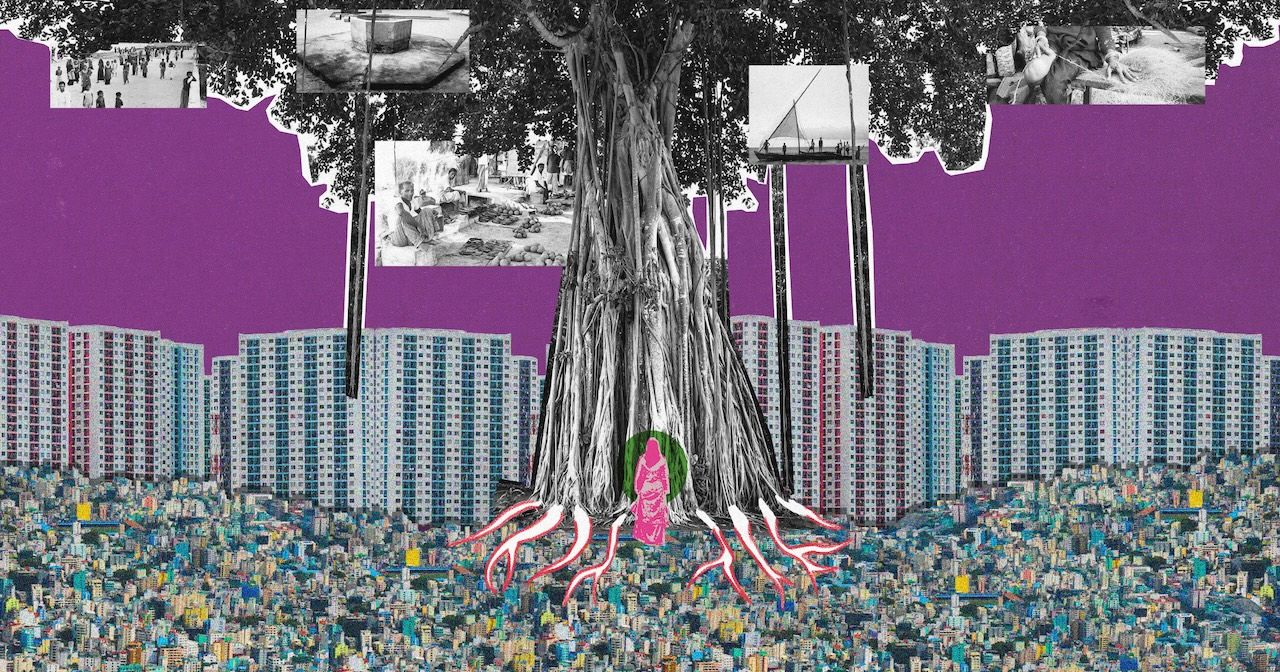
Artwork: Dosain
18 Jul, 11:47
"This is My Home. I want to live here and be buried here," was my aunt's repeated wish every time the impending move from her island, Dhidhdhoo, to the capital city, Malé, had come up in our conversations. Now that she had been unwillingly brought here, I dreaded meeting her knowing we were unable to fulfil her wishes.
The towering edifice of concrete and steel seemed to bear down on me as I waited in line to enter the elevator. Cramped inside the box, I could hardly breathe as it ascended to the fourteenth floor where my aunt had moved in a few days ago.
She looked defeated. She had refused the move for many years and only did so now to please her children who wanted better healthcare for her – services not available on or near my island. Her concerns were many. These big buildings scared her; the elevator took the life out of her. Would she be able to make her own rihaakuru (fish paste) and valhomas (smoked dried tuna) here? "Mithaa kihineh'tha meehun dhiri ulhenee??" (How do people even live here??).
I recalled my own journey from my beautiful home, my paradise in Thiladhunmathi Atoll, to the capital city of Malé.
* * *
In the Maldives, our lives unfold at the intersection of land and sea. We are an archipelagic country cradling the vast Indian Ocean. Marco Polo, the Venetian merchant explorer, called the Maldives "the flower of the Indies", while Moroccan traveller and scholar Ibn Battuta termed it "One of the Wonders of the World". "Dhivehin are creatures of the sea, and the sea is their lifeline", said François Pyrard de Laval, a French traveller shipwrecked in the Maldives in the 17th century.
Far from the madding crowd, we lived a life of simple ease. With the morning's first light, women would sweep the compounds of their homes and the roads. They would prepare roshi and mas-huni for breakfast, collect water from the miskithu-valhu and tend to crops in the backyard. Most men would set out to sea before dawn for fishing; those left behind did odd jobs – carpentry, repairing a bokkuraa (a small boat) or construction work.
By mid-morning, valhomas would be removed from the dhumashi, the smoking rack above the kitchen hearth, and spread out on mats on the streets to sun-dry. Men and women would sit around, slicing banbukeyo and a'la in order to fry them or making roanu out of coir. Children would accompany their sisters to the forest to collect dharu (firewood) and madhu (tropical almonds). We would eat garudhiya and bai for lunch and have afternoon tea with hedhikaa and kalhu.
In the late afternoon, we would laze on the beach, on the holhu-ashi, the seats of bound palm trunks placed near the shore, listening to idle banter, playing raazuvaa or dozing off in the cool sea breeze. Towards dusk, we would watch fishing dhoanis land with their catch, and fishermen would gut and clean fish on the beach. Women would stroll over to observe the activity while keeping an eye on their children swinging beneath the roots of the huge nika trees.
Like every community in the Maldives, this was our daily routine – the everyday scene on my island of Dhidhdhoo, where I was born.
* * *
One of my earliest memories is a discussion about finding the location of Paradise.
"Suvaruge is at Thundee Kolhu," seven or eight-year-old me declared to my friends. "How do we go to Suvaruge?" my friends inquired. "It's far away, at the very end of the island. We have to wait for Mamma to take us there on a Friday."
Thiladhunmathi Atoll is among the largest atoll formations in the world, spanning 3,788 km². For administrative purposes, the geographic atoll is subdivided into four administrative atolls. I was born on Dhidhdhoo Island, the capital island of Haa Alif Atoll.
In the 1700s, when Malabar pirates from the southwestern region of the Indian subcontinent raided the islands of the Maldives, the people of Dhonakulhi abandoned their home and settled on other islands nearby. One of those was Naridhoo. The settlers chose this particular island because it was not easily accessible due to the treacherous reef and rough waves surrounding it. They reasoned this would deter aggressors. Historians say the people who settled in Naridhoo later moved to Dhidhdhoo. Their original island, Dhonakulhi, is now a tourist resort.
Dhidhdhoo is located between Vashafaru and Utheem islands. A little further off are the islands of Muraidhoo, Alidhoo, Maafahi, Kelaa, Filladhoo and Baarah. These islands sit in a somewhat circular formation atop large, submerged fringing coral reefs.

The sea separates Dhidhdhoo from the other islands in the atoll, but our lives were not confined to Dhidhdhoo alone. Our existence was intertwined with the bounty of uninhabited islands around us, as well as with the communities of Dhivehin across the region.
We, in the community of Dhidhdhoo, depended greatly on two uninhabited islands – Alidhoo and Maafahi – for firewood, food and livelihood. We had family, relatives and friends in the surrounding inhabited islands, and our relationships extended all the way to Maliku (Minicoy Island), now part of India.
Many of the uninhabited islands in the Maldives show signs of Dhivehin having once lived on or used them. Old wells, graveyards, tombstones and ruins across many islands are proof of active habitation and utilisation. Each local community in the Maldives is characterised by its distinct physical boundaries, but their economic activities, social connections, cultural practices, traditions, health, well-being and overall happiness are inextricably linked with the reefs, islands, forests, mangroves, sandbanks and lagoons surrounding them.
* * *
The most exhilarating trip out of Dhidhdhoo for us back in the day was for the "Bodu Maaloodh", a ceremony no longer held, on Utheem island. The host island would welcome guests from neighbouring islands with a specially prepared feast of traditional cuisine. Men would sing hymns, and guests would be treated and fed like royalty. Each island would compete to outdo the others during the ceremonial event.
My most cherished memories include picnics to Dhapparu on Filladhoo island. Picnics to Dhapparu were the kind of holiday that would cost a fortune elsewhere. Filladhoo is a large, densely forested island with white sand lining its entire perimeter. The area of Dhapparu on Filladhoo is an ecosystem of immense diversity and beauty. It is one of many sites coveted by today's big businesses eyeing the Maldives.
At Dhapparu, we would swim in the crystal-clear, shallow lagoon in its shades of turquoise and jade, cook meals on makeshift pits, quench our thirst with fresh coconuts and play hide-and-seek among the thick shrubs dotting the cove. We chased birds, caught fish, collected shells and gathered fallen tropical almonds. To this day, nothing compares to the immense satisfaction of eating mudi-kaashi – the sponge-like ball that forms inside a coconut as it germinates – on Dhapparu. The day would end with kulhi-boakibaa that Maama had baked over an open fire the night before, served during our afternoon tea while listening to my aunt's stories of jinni inhabiting the screw-pine thickets around us.
* * *
Beneath our Paradise, older fault lines stirred…My ancestors were an empowered people. They travelled the high seas to trade in distant shores in their own boats. Cowrie shells, ambergris, coir rope, smoked tuna and other local produce from our islands were sold directly by our merchant ships. These ships would then return to us with food and other essentials.
During World War II, direct exports from the atoll communities of the Maldives to nearby countries were prohibited by the government. Instead, we were henceforth required to travel to Malé, the capital, with our local products. Our dependence on Malé increased significantly since then as we had to sell our goods and buy essentials there.
This and other grievances led to an uprising known as "Uthuru Gadu Badu" – the Northern Uprising – against the government based in Malé. Nearly 500 sailboats set sail from Thiladhunmathi Atoll to demand solutions. The brave people who travelled to Malé in March 1943 had a set of demands, including better education. The leaders of this "act of aggression" were imprisoned and punished.
In the early 1970s, my country discovered the "golden goose" – tourism. George Corbin, an Italian specialising in dive tours, realised the country's enormous potential as a tourist destination while flying over the Maldives. He teamed up with local businessmen to bring the first tourists to the country in 1972. "It was love at first sight. I saw all these beautiful small islands with white sandy beaches. I said then, this is Paradise", he said in an interview in 2023.
And so, it was. We built a reputation as "Paradise on Earth" for tourists seeking sun, sea and sand – a place where, as the official tourism slogans went, you "Learn the Art of Doing Nothing" in the "Sunny Side of Life".
* * *
The emerging tourism industry needed workers. Within a few years, many people from Dhidhdhoo and elsewhere migrated to Malé to work in the resorts that were springing up around the city and the airport.
When my family moved to Malé in the early 1980s, it was primarily for our education. We rented a small single room in a house in Maafanu district. We cooked and ate, studied and played and slept huddled in that one room. I did not understand why we had to leave our beautiful, spacious home in Dhidhdhoo, but as the years passed, I realised it was the price I had to pay in order to have an education, ironically one of those demands made by those who led the Northern Uprising in 1943.
A few years later, I was diagnosed with a health condition which further reinforced our migration to Malé as health services in Dhidhdhoo at the time were very limited.
With the influx of new migrants from other islands, landlords often raised rents and found new tenants. We changed houses countless times in Malé. We encountered others from across the country, but there was no neighbourhood where we truly belonged – no childhood friends who would be lifelong companions. Over time, we adapted to the tone and accent of Malé Bas, to the pace and rhythm of the city, inevitably losing crucial symbols of our identity passed down through generations.
Malé, an island barely 2 km² when I first moved there, felt crowded. However, in the 1980s, it was still manageable; you could walk the roads, and some homes had yards with shady trees, fruits, vegetables and flowers. The roads were unpaved, and life was relatively peaceful, and crimes were few and far between.
All this changed rapidly. When there was no more space to expand horizontally – since the lagoon had been reclaimed to the very edge of the sea – Malé began to grow vertically.
Trees were felled to make way for concrete, leaving precious little greenery. A tetrapod seawall was built around the island to protect it from waves. Roads were paved, and schools, colleges and hospitals were established. Bicycles, once the normal mode of transport, were replaced by motorcycles, taxis and cars that filled the streets. Crimes rose exponentially, and many neighbourhoods came to be "ruled" by neighbourhood gangs. Houses were divided and subdivided among siblings, and as living spaces grew smaller, the rents skyrocketed.
To meet housing demands, the island adjacent to Malé, a former resort, was incorporated into the city and named as Villimalé. A few years later, land was reclaimed from the Hulhule Faru (reef) to create the artificial island of Hulhumalé.
Hulhumalé has undergone various reclamation phases. Accommodation towers housing approximately 70,000 people, along with schools, hospitals and all necessary infrastructure for a modern city are now established. Ongoing projects include more social housing schemes, additional reclamation, plans for bridges, an underwater tunnel and even a floating city in the Greater Malé region.
* * *
For residents of Malé, the only respite from the overcrowding was the nearby island of Kuda Bandos. It served as their picnic island, a few kilometres from the city's hustle and bustle.
Picnics on Kuda Bandos resembled those trips to Dhapparu and other uninhabited islands in Thiladhunmathi Atoll. It was a place of fun and relaxation – a sanctuary to reconnect with nature. In 2014, the island was designated as a tourist resort. For many in Malé, already suffering urban claustrophobia, this was yet another layer of suffocation. Feydhoo Finolhu, another small islet near Malé used mainly for educational trips, faced a similar fate. It was also leased for resort development.
In 2014-2015, at least 50 islands and lagoons across the Maldives were sold or leased by the government for tourism development without public tender, benefiting several officials and local and international companies. The monetary loss was estimated at over US$ 200 million, but the socio-cultural and intergenerational costs – such as the erosion of traditional livelihoods and community ties – have never been properly valued.
Maamadduvari in Baa Atoll was leased to a resort operator who already manages several resorts. Locals say Maamadduvari was granted as waqf – an inalienable charitable endowment – by the Sultan in the 1700s to the people of Baa Atoll Hithaadhoo.
In 2020, the Vaavu Atoll community petitioned over concerns regarding the lease of Bodumohora in Vaavu Atoll, leased as a tourist resort to a Member of Parliament. In 2021, the community, along with local council officials, held an overnight vigil on Hulhidhoo Island, leased as an agricultural island to a lawmaker five years earlier. In 2024, the Vaavu Atoll community again protested the lease of Bodufinolhu for resort development. Bodufinolhu was the only remaining site used by local guesthouses for excursions. All 14 uninhabited islands in Vaavu Atoll are now leased long-term to various businesses.
The inaccessibility to our resources continues to aggravate already scarce livelihood and sustenance in our communities. Combined with paucity of services, local populations are pulled towards the capital city area. This trend threatens to uproot communities and depopulate many islands.
Official projections estimate that 64 percent of the total population will live in the Greater Malé region by 2054. When the local population departs, the stakes for selling or long-term leasing of these islands to private businesses are high.
Whispers of uninhabited islands lost, taken, restricted without consent or consultation are subtle through the airwaves. No one seems to hear or foresee the impact on generations that will follow us.
* * *
Back in my home atoll of Thiladhunmathi, conditions are no better.
Years ago, we travelled to Maafahi Island to gather coconuts, timber, palm leaves, forest fruits and edible herbs. These uninhabited islands were vital sources of sustenance.
We marvelled at how large Maafahi was. Most islands are about 22 hectares or less, but Maafahi spanned 99 hectares. The abundance of trees and coconuts indicated fertile soil.
In the 1990s, Maafahi was leased for agricultural purposes to a private party. The lease was extended in 2014 for industrial agriculture.
Armed with a newly earned MBA, I initially thought that bringing modern agriculture to Maafahi was progressive, especially given the restrictions on direct exports from the atoll. My friends and family in Dhidhdhoo were less optimistic:
"How many locals benefit? How many locals work there? Our mothers and wives are unemployed. The youth are jobless. Why do we have to migrate far from home for a decent income? Why can't our community have farms on Maafahi?"
* * *
A decade later, most of my friends and family relocated to the Greater Malé region. Every time I visit Home, I am met with an emptiness – many have migrated; the neighbourhood looks alien; the streets are paved, yet there are precious few pedestrians, and I am left feeling hollow inside.
"What happened to your dream of farming on Maafahi?" I asked my cousin unpacking boxes of their belongings.
"You know how it is. There's no space to farm on Dhidhdhoo, and all the uninhabited islands are off-limits for us", he replied.
He showed me a YouTube influencer based in Dubai boasting over 3.1 million followers, selling our islands as real estate: "I wonder what it feels like to wake up and see the sun rising over the ocean. To look outside and see dolphins swimming. To walk along the beach at night and ask yourself – is this really my home?"
For generations, we have been forced to leave our homes, and now we watch them being sold abroad at prices no ordinary Maldivian can afford.
Homes in Paradise, for the wealthy, are emerging on the graveyards of an ancient civilisation while we continue being Uprooted.
First published in adda, 2025 by the Commonwealth Foundation. Republished with the authors' permission.
Discussion
No comments yet. Be the first to share your thoughts!
No comments yet. Be the first to join the conversation!
Join the Conversation
Sign in to share your thoughts under an alias and take part in the discussion. Independent journalism thrives on open, respectful debate — your voice matters.
Support Independent Journalism
Help us keep the news free and fearless
Give once
$
or
Become a memberfrom $5/month

