

The bag levy could have been a waste revolution. Instead it's just a tax
Pay-as-you-throw charges households for what they actually throw away.
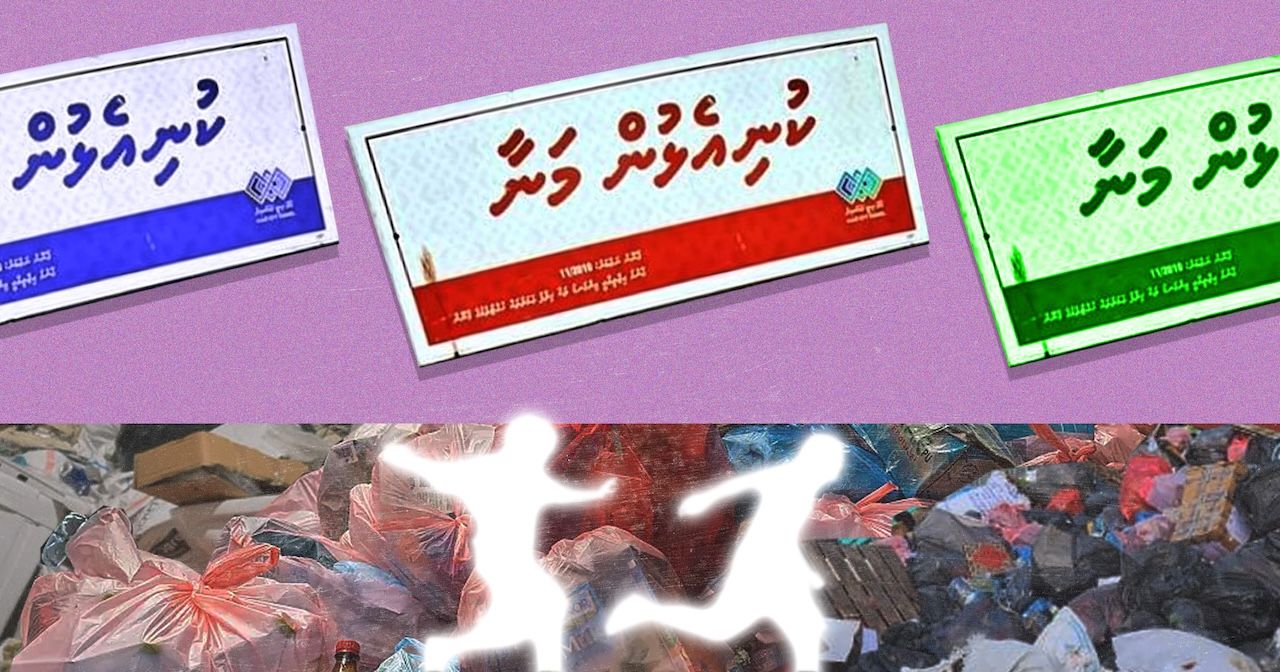
Artwork: Dosain
14 Sep, 15:02
A household of two and a household of eight pay the same waste collection fee in Malé: MVR150 (US$10) a month, flat, regardless of how much either one actually throws away. This isn't a footnote in our waste management system. It's the design. And it's a missed opportunity that the plastic bag levy could have quietly fixed.
When the levy was introduced, it landed the way most of our environmental policy does: fast, unexplained and disconnected from the systems it was supposed to support. Businesses and consumers were told bags would cost money, with almost no lead time to adjust. The Waste Management Corporation had over 600 days to introduce exempt, colour-coded bags for waste segregation and never did. Communication came only after public backlash, not before it. These are real problems, and they deserve scrutiny. But they're symptoms of a bigger failure: nobody asked what the levy could actually be used for beyond raising a bit of revenue. That's exactly how it looked to the public too. The opposition branded it the "kothalhu tax," even though the actual objective was a financial disincentive against single-use plastic, not a revenue grab. Once that framing stuck, the government never really managed to shake it.
Here's what we missed. A bag levy, done right, is a metering tool. Every time someone reaches for a plastic bag, that's a data point about how much waste they're about to generate. If the government had partnered with WAMCO to roll out standardised, colour-coded bags for organic, dry and plastic waste, and priced those bags into the cost of collection, Malé could have quietly built the foundation for a pay-as-you-throw (PAYT) system.
None of this works if PAYT is treated as just another fee-collection mechanism. The goal has to be waste reduction itself, with PAYT as the tool that gets us there, and the investment should follow that goal. Even if the state subsidises the cost of the bags outright, the return shows up in lower collection volumes, lower landfill pressure and a system that finally rewards households for generating less. That's a better use of government money than a flat fee that collects revenue but changes no behaviour. And for low-income households specifically, a targeted subsidy makes more sense than exempting them from the system entirely: right now, the blanket MVR150 fee plus the MVR2 per-bag levy is a straightforward additional cost with no relief built in. A subsidy that keeps them inside the PAYT system, just at a lower bag price, fixes that without recreating the flat-fee problem for everyone else.
PAYT is not a new or radical idea. Cities across Europe, Japan, and South Korea use it. The principle is simple: instead of a flat monthly fee, households pay based on the volume or weight of waste they actually put out. You buy your bags, and the price of the bag is the price of disposal. Generate less waste, buy fewer bags, pay less. Segregate your recyclables properly, and your "residual waste" bag count drops. The incentive to reduce and sort waste isn't a poster on a wall. It's built into every trip to the corner shop.
Compare that to what we have now. A household of eight and a household of two are billed the same MVR150 a month, regardless of what either one puts out on the curb. There is no financial signal telling the eight-person household to compost, recycle or think twice before throwing something away. If anything, the flat fee does the opposite: it tells you that once you've paid, more waste costs you nothing extra. We built a system that is, quite literally, indifferent to conservation. And this isn't just a house-by-house model that falls apart in Malé's apartment blocks: waste fees are already billed at the individual household unit even in shared buildings, so the same billing structure in place today could carry bag counts without any new administrative layer.
The bags were sitting right there, ready to be the mechanism. Instead, WAMCO's colour-coded bags never materialised and dustbin bags stayed outside the exemption for weeks, so people just kept using ordinary shopping bags to line their bins. The levy taxed a substitute nobody meant to tax, while the tool that could have measured and priced actual waste generation never got built.
This also would have solved a fairness problem that's been raised, rightly, since day one: MVR2 per bag hits a low-income household far harder than a wealthier one, for the exact same shopping trip. A PAYT model tied to waste bags doesn't have that flaw in the same way, because the fee scales with what you're actually disposing of, not with how many times you go to the shop.
None of this requires new technology or a five-year plan. It requires WAMCO to finally deliver on colour-coded bags, a pricing structure that replaces the flat fee and a government willing to treat the plastic bag levy as infrastructure rather than a line item in the annual budget. It also requires the revenue from any future levy to be ring-fenced for exactly this kind of system-building, rather than disappearing into general government funds where it does nothing for the problem it was collected to solve.
We still have the chance to fix this. WAMCO can introduce the bags it promised in 2021. The regulation can be amended to link bag colour, bag price and collection fee into one coherent system. The alternative is what we have now: a levy that discourages nothing, measures nothing and asks the same of every household regardless of what they actually throw away.
Ahmed Afrah Ismail is a co-founder of Zero Waste Maldives, a civil society organisation working on waste management and climate policy.
Discussion
No comments yet. Be the first to share your thoughts!
No comments yet. Be the first to join the conversation!
Join the Conversation
Sign in to share your thoughts under an alias and take part in the discussion. Independent journalism thrives on open, respectful debate — your voice matters.
Support Independent Journalism
Help us keep the news free and fearless
Give once
$
or
Become a memberfrom $5/month

