
Rasmalé and the emptying atolls
What if a plot in Rasmalé let families live anywhere?
Artwork: Dosain
1 hour ago
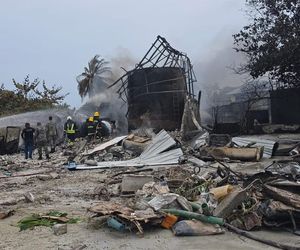
Rasmalé is the largest piece of land the Maldives has ever made and it is not finished. It was announced in December 2023 at 1,153 hectares with 65,000 homes promised on it. On 21 September the state signed commercial terms with Eagle Hills for a waterfront and marina development on about 500 hectares under leases of up to 99 years. The full agreement has not been finalised and what was signed is described as principal terms. The other half is promised as housing plots with no fixed land-use plan.
Much of the discussion asks whether the Eagle Hills deal is a good one, weighed in costs and benefits. That question treats the form of Rasmalé as given: one half for investment, the other half for plots.
There is no need to take a side on the deal to ask what the land could become, who could participate in deciding and what that decision could mean for the rest of the country, while the land-use plan is still open.
Twenty years of waiting
Social housing has been delivered across the Maldives for more than 20 years, by every government and in different ways, from flats built on foreign loans to plots allocated on reclaimed land. None of it has amounted to a full delivery of what Maldivians are entitled to under article 23 of the constitution, which commits the state to the progressive realisation of every citizen’s right to housing, by reasonable measures within its ability and resources. Land allocations and concessionally priced rent-to-own housing are the forms successive governments have chosen to meet that commitment. In 2018, about 25,000 people applied for 7,000 flats. This year, the state received more than 58,000 applications for 22,900 plots and flats, many still to be built. Each government draws up a new list, and the waiting begins again, even though one list could be carried across governments, with delivery planned across the Maldives. A Maldivian citizen’s entitlement to a home has been acknowledged by every government, and fully delivered by none.
Where housing leads
The first 15,000 plots go to people registered in Malé, or resident there for at least 15 years. They are not an incentive to move to the capital, and relieving crowded, expensive rental housing is a legitimate aim. But Rasmalé could still deepen centralisation in quieter ways. A plot ties a household’s largest asset to Greater Malé for generations.
The 15-year rule tells people living outside Malé that long residence in Malé eventually becomes land. With more than 54,000 jobs projected from the Eagle Hills development, there is an implied pathway: the plots go to existing residents, the jobs to whoever arrives and those newcomers could form the queue for the next scheme.
What the next generation inherits
Twenty-five thousand plots of 1,250 square feet cover about 290 hectares before a single road or school is added. Once allocated as permanent building plots, no future government is likely to reassemble them. On the other half, Eagle Hills says each sale or inheritance of a property will start a new lease of up to 99 years. If that term is in the agreement, leases meant to expire could renew indefinitely. By different routes, both halves are heading towards land the next generation has very little room to reconsider.
What is being exchanged
Eagle Hills pays no acquisition cost for its half of Rasmalé. The state instead takes a share of the developer’s revenue from first sales and leases, plus a percentage of property value on every transfer, with up to US$500 million of its share advanced as 5,000 flats in Hulhumalé.
The land’s value is being banked against social housing. It is not yet clear whether that value accounts for the Fushidhiggaru lagoon itself, and the biodiversity and natural heritage given up to make Rasmalé. Under article 22, the state has a fundamental duty to protect the natural environment and biodiversity for present and future generations, and to pursue its economic and social goals without ecological degradation.
Rasmalé is not the first project where land was conceived as a way to fund social housing. Hulhumalé is said to have been planned partly to sell land for the same purpose. It was later built out on commercial borrowing. Nor is the turn to residency and townships new: residency for foreign investors began in 2015, the next government leased large lagoons to foreign developers, including the Noonu lagoon where Ayla is now being built, and the current one made Ayla the first sustainable township.
The critique of the deal has not asked what the state lacks that keeps it from exploring other ways to finance development, or whether the enclave economy is the only model the Maldives has.
What forms the entitlement
A bandaara goathi is a plot allocated by the state for residential use. Two households can receive identical plots. One has savings and finance, builds, rents out floors and holds a growing asset. The other holds the same land and still has nowhere to live. In March the state acknowledged this, committing to let earlier recipients exchange their land for a home.
Land reclaimed at Gulhifalhu and Giraavaru for the earlier Binveriya scheme remains uninhabited, and the housing minister has noted that reclaiming land is cheap while servicing it is costly. For a household without savings, a finished home is the quicker route. Asking what forms the entitlement need not delay anyone. It could shorten the wait.
The constitution frames the entitlement as housing. Long before there was a constitution, the state honoured it with a bandaara goathi, a plot for residential use, and in practice it became a right to land tied to housing, with access to soil and sky.
A goathi is now valued as private property, by the rent it earns once built, a measure that leaves out soil and sky. This could be a chance to redefine the entitlement for both land and housing. Its goathi component is a household’s relationship with land; its ge’ component is a habitable home. The two need not be the same thing, but could be within daily reach of each other.
The land allocated in Rasmalé could form the goathi component of the entitlement: a holding in land with lasting value, rather than a site on which every household adds another home to the Greater Malé Region. As other regions develop, that holding could be exchanged with the state for land elsewhere, so a household could move to another region if it chose, carrying its entitlement with it.
Bandaara land for residential use could be recoverable, but only by the state. The state could initiate recovery for a defined public purpose, provided the household is fairly compensated for any investment it has made on that land and its entitlement is honoured elsewhere. A household that wishes to let go of its land and property would, in turn, have the right to propose that the state relieve it, and to receive its entitlement elsewhere.
How liveable a plot is depends largely on the road it faces, yet residential land has been allocated with no regard for the road. A plot’s setbacks and open share exist for light, air and the openness of the street. Building height is already tied to the width of the road a plot faces, and no one has ever been able to widen the road. In Malé, some plots on the narrowest lanes can no longer be built on, because banks will not finance them. A bandaara entitlement could include the road, and a commitment to its municipal management.
The entitlement could be taken where a household decides, at a different scale in each place: smaller in an urban area, larger in a rural one. An entitlement that can only be taken in Greater Malé draws households towards the capital. One that can be taken anywhere leaves the choice to them. None of this diminishes an existing claim. The question is what exactly forms the entitlement, and whether it could be honoured in more than one form, with more choices offered.
One city, not two halves
The same thinking could apply to the form of the city. The split between investment and plots is a planning choice. Rather than moving the investment elsewhere, the land use of Rasmalé could be redrawn so that the plots Malé residents receive are held for commercial use, not for dwelling, with the state’s investment opportunities in hotels, commerce and waterfront woven through them. A household’s home could then be taken elsewhere, and far fewer people would need to live in Greater Malé. The choice is between integration and separation: foreign investment among the plots Malé residents hold, or beside them.
Presence on the land
Where people live shapes sovereignty, because presence, memory and access give it its meaning. The 2022 census found about 41 per cent of the population living in the Malé area, and at least 13 islands with more than half of their registered population living in the capital.
The state’s own target is 200,000 residents on Rasmalé within 20 years, and Gulhifalhu and Giraavaru could house about 210,000 more. As Malé households move to these islands, the homes they leave are likely to fill again, so Malé need not shrink. On these plans, more than 80 per cent of the country could be living in Greater Malé within 15 to 20 years, and the atolls could hold far fewer people than they do today.
Inhabited islands are where sovereignty is exercised in daily life, where reefs and channels are watched and used. They hold memory, much of it unwritten, of fishing grounds, old settlements and customary use, and that memory is lost when a community disperses. They also hold access to the country’s natural resources, which the constitution recognises as every citizen’s equal right. As populations fall, islands and lagoons become easier to lease or remove from council control, because fewer people remain to object. An island no one lives on is the easiest to lease. This is not an argument against foreign residents or investment. The Maldives has long been shaped by people who came and stayed to contribute to the productivity of the Maldivian economy. The risk lies in the absence of Maldivians across the country and the erosion of their agency, not in the arrival of foreigners.
The institutions that could protect that presence are shifting too. Atoll councils were dissolved in May. When the Maldivian Democratic Party, a party committed to decentralisation, held a supermajority in parliament and amended the Decentralisation Act in 2019, it strengthened councils’ finances, but atoll councils were never made the planning authority for their atolls, and any plan they drew had no force in law. That left them easy to remove. In October the president established atoll-level service centres under a ministry, and cabinet can now take land from island councils for state projects. Greenland’s new defence agreement with the United States is a reminder of how a country can remain fully sovereign in law while its practical room for choice narrows.
Malé has never been the only place where power in the Maldives lived. Those who contest it today already live mostly in Malé, and as the atolls empty, both power and the means to contest it could end up there.
Concentrating more than 80 per cent of the country in one city needs careful evaluation, and reservations about Gulhifalhu and Giraavaru need to be raised now, while their plans can still change.
A space to decide
What is missing is a space to ask the question before the answer is fixed: open deliberation on what the land could become, in which urban planners, architects, economists, lawyers and universities make the options clear, citizens and councils weigh them and elected institutions decide in the open. With reclamation incomplete, there is unlikely to be a better moment.
Malé City Council has said little about the planning of Rasmalé. When Gulhifalhu’s land-use plan was revised, the council commissioned a technical review of it. No comparable planning view on Rasmalé, whose plots go first to residents of Malé, has been made public.
Remedies that come afterwards can repair what can be undone. They cannot return a lagoon, reassemble a city of fixed parcels or give back the years a family spent waiting. Where a decision cannot be reversed, the justice it carries lies in how it is made. The end does not justify the means; the means are all there is.
If housing, entitlement, the form of the city and the future of the atolls were weighed together, would Rasmalé still be planned as it is today? And if not, what could the Maldives make of it?
Mohamed Shain Yoosuf is an architectural designer and a partner at Atollscape, a design and planning practice. He has supported atoll and island councils on land use planning, and has held leading roles in Maldivian civil society over the past decade.
Discussion
No comments yet. Be the first to share your thoughts!
No comments yet. Be the first to join the conversation!
Join the Conversation
Sign in to share your thoughts under an alias and take part in the discussion. Independent journalism thrives on open, respectful debate — your voice matters.
Support Independent Journalism
Help us keep the news free and fearless
Give once
$
or
Become a memberfrom $5/month