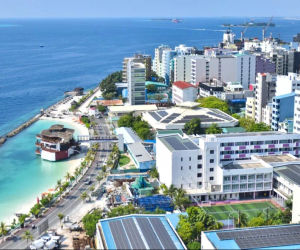

One island preserved a community, the other assembled a population
What island reclamation builds and what it quietly takes apart.

Artwork: Dosain
20 Jul, 16:23
My country has embarked on one of the world's most ambitious programmes of island engineering, creating entirely new islands from lagoons, raising land above sea level, and armouring coastlines against rising waters. It's a story of human ingenuity triumphing over nature's forces. A story about resilience. But after four years of research, I've come to a troubling conclusion: we're getting the engineering right, but we're getting the people wrong.
For my doctoral research at the University of Melbourne, I spent nearly four years studying three engineered islands in the Maldives: Hulhumalé, the flagship artificial island in our capital region; and Raa Dhuvaafaru and Thaa Vilufushi, two islands rebuilt after the devastating 2004 tsunami under the "Safer Island" concept. I surveyed 160 households, conducted dozens of in-depth interviews, and traced the political decisions and budgets that brought these islands into being. What I found challenges everything we assume about climate adaptation.
Money doesn't buy resilience
Here's the first surprise: the households best equipped to cope with climate change weren't the wealthiest. The top-scoring families in my study lived in low-income housing in Hulhumalé and in rural Vilufushi, not in the luxury apartments or private beachfront plots. What set them apart wasn't their bank balance; it was their social networks. Having extended families nearby, multiple income streams, deep roots in the community. Meanwhile, some affluent homeowners, cut off from kin and dependent on a single salary, scored poorly on adaptive capacity measures.
This finding upends conventional thinking about climate vulnerability. We assume that if we build safer places and help people afford to live there, the problem is solved. But physical safety and financial security are only part of the equation. When the next crisis comes, whether a storm, a pandemic, or an economic shock, it's social capital that pulls families through. Neighbours who grow and share food and extend care when needed, relatives who step in, communities who organise. This is how small island communities have survived for thousands of years.
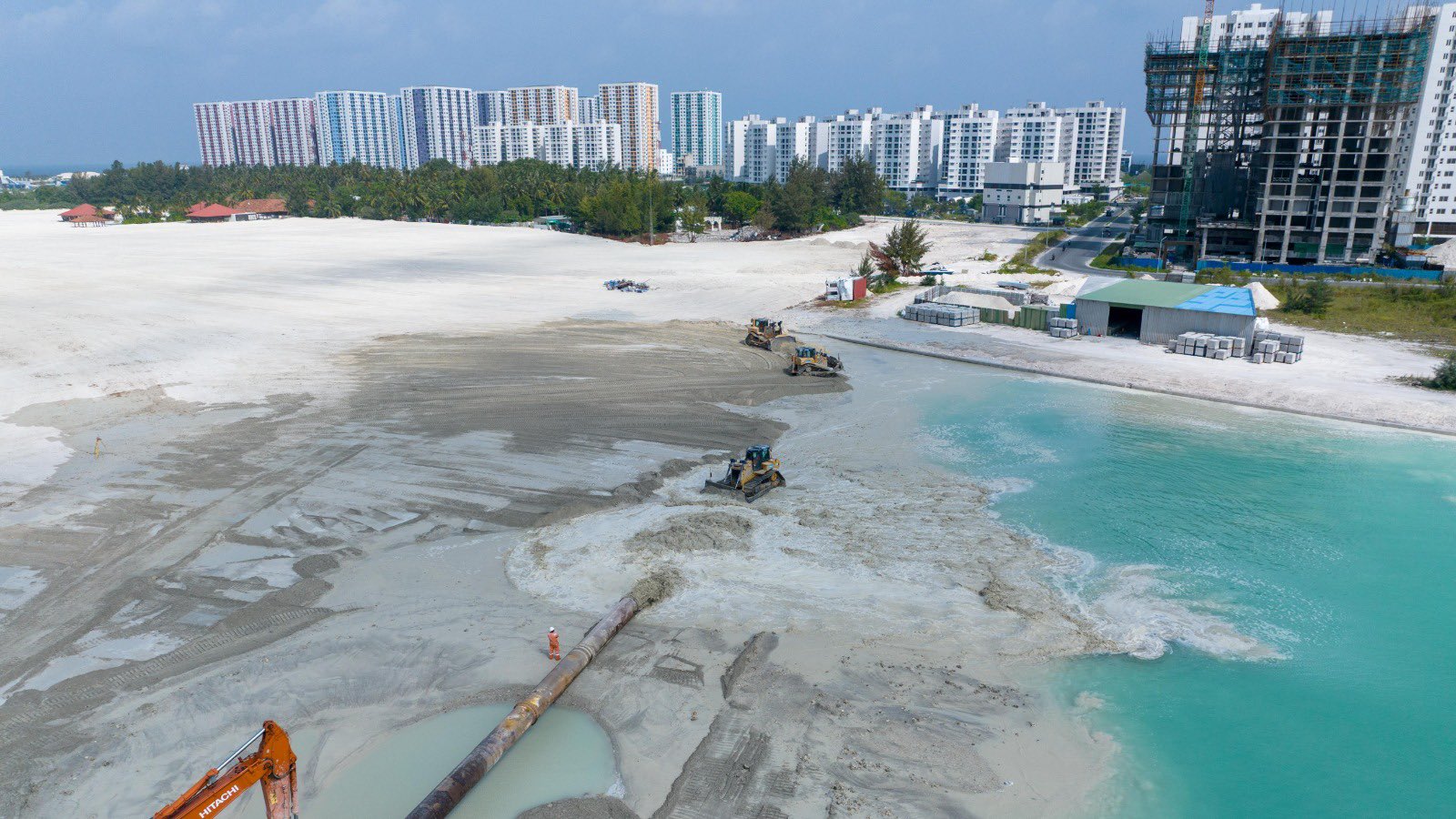
Strangers in a manufactured paradise
Engineered islands bring together strangers. In natural communities, settlements were organic. People share histories, marriages, disputes settled over generations, relied on their neighbours. These form an invisible architecture of belonging. On a newly reclaimed island, residents arrive from across the country with nothing in common but an address. The result, I found, is a profound deficit of social trust. This is the tragedy of urbanisation.
In Hulhumalé's high-rise social housing blocks, residents shared they don't know their neighbours. More concerning was that younger generations had no interest in getting to know their neighbours. Parents keep children indoors because shared spaces feel unsafe. Women, in particular, described feeling isolated without the female relatives who traditionally provide childcare and economic support. "I have no one here," one mother said. "If something happens to me, who will take my children?"
By contrast, in Vilufushi, an island rebuilt to house a single displaced community, residents maintained the bonds that held them together through the tsunami. They knew who to turn to in crisis. They participated in island governance. They felt safe. The difference wasn't engineering; both islands have elevated land, sea walls, and modern utilities. The difference was that one island preserved a community, while the other assembled a population.
When adaptation destroys livelihoods
There's a bitter irony in climate adaptation: the very projects meant to protect us often destroy what sustains us. Land reclamation devastates marine ecosystems, no matter what safeguards are applied. The reefs and lagoons that generations of Maldivians have relied upon for fishing, sustenance, and traditional crafts are compromised. I believe that reclamation is necessary in places where land is scarce. But I also question how much are we willing to compromise to gain new land?
My research shows that true resilience is much more than being physically safe from hazards. Take Dhuvaafaru for example. Before the tsunami, the community (living in Kandholhudhoo) dominated northern fishing. Men went fishing daily. Women, in organised neighbourhood groups, processed the daily catch. This was their whole identity. After the decision was made to relocate the population to Dhuvaafaru, the focus was rebuilding physical infrastructure. Housing. Improved roads. Stronger coastal defence. Less attention was given to how the community organised their lives and livelihoods. The new island, Dhuvaafaru, was much further away from traditional fishing grounds. But fishermen were able to adapt by building larger boats and diversifying to sea-cucumber harvesting and grouper fisheries.
Women, on the other hand, faced many barriers to continue with fish processing work. The kitchens were much smaller, leaving very little storage space for their fish processing utensils. Island zoning regulations prohibited fish processing work inside residential homes. Commercial land plots from the industrial zone were inaccessible for most women. The result? Women stopped processing fish, almost entirely. Not only did relocation interrupt supply of their main raw material, but it also imposed new structural barriers to continue with their livelihoods.
The ideas that went into planning Dhuvaafaru did not intend these outcomes. They were not malicious decisions made to favour one party at the expense of another. In fact, they were made with good intentions. It was a time of national crisis. A critical juncture in our country’s history. The focus at the time was national reconstruction, and fast. In such extraordinary situations, social issues often get sidelined. The implications of these only emerge after people start living in these new developments.
The politics of sand
How did we end up here? My research traces 55 years of land reclamation in the Maldives, from the first mechanised dredging in the 1960s to the massive construction boom of today. The consistent thread is political self-interest. Every government, regardless of ideology, has used land reclamation to shore up electoral support. Housing is the perennial promise; reclaimed land is the delivery mechanism. The result is a self-perpetuating cycle: politicians promise land for housing, voters expect land and housing, and any leader who questions the model risks defeat.
This political logic explains why Hulhumalé's master plan has been revised by every incoming administration. Each leader eager to put their stamp on the project, each willing to overturn predecessors' decisions. Each building their own legacy, quite literally. Population density limits have been scrapped; commercial land designated for sale has been given away for political favour; building heights have ballooned from five storeys to 25. The result is development that serves political timelines rather than human needs.
It also explains the troubling question of governance. Hulhumalé is technically under the jurisdiction of an elected city council, but the Housing Development Corporation, a state-owned enterprise which is in essence, a commercial entity, exercises effective control over land use, policing, and services. Residents have no democratic voice in decisions that shape their daily lives. They are, in a sense, tenants of the state.
A different path
None of this means we should abandon engineered islands. For a country like the Maldives, with no higher ground to retreat to and acute land scarcity, they are essential. But we need to build them differently.
First, we must recognise that island engineering is not a product but a process. It requires continuous attention to social dynamics, not just construction schedules and political cycles. It must be in tandem with institutional development. Communities don't form automatically when you house strangers together; they need space for gathering, mechanisms for collective decision-making, time to develop trust. We need to get targeting right, so that the most deserving families benefit from state-constructed housing.
Second, we need planning that accounts for gender and livelihoods. This means consulting women and micro-enterprises about their work and ensuring space for informal economic activities. It means understanding what people do before deciding where they should live.
Third, we must resolve the contradictions of governance. Residents of engineered islands deserve democratic representation and clear channels for grievance. Corporate entities managing debt should not also be managing communities. The infamous debate between "ownership" and "jurisdiction" needs settling.
Finally, we need honesty about costs, not just financial, but ecological and social. Land reclamation destroys the natural systems that have sustained Maldivians for millennia. If we choose this path, we should do so with eyes open, understanding the trade-offs. We also need to figure out how everyday people can afford housing on reclaimed islands. The country has been on a learning curve, to say the least. And it appears that these social issues are finally surfacing and reforms are on the way.
What my daughters will inherit
I dedicated my thesis to my two daughters, with the hope that it might be a small contribution to the world they will inherit. As I write this, they are growing up in Hulhumalé. On land that didn't exist when I was born, surrounded by families from every corner of our scattered nation.
Their generation will face challenges we can barely imagine – rising seas, intensifying storms, an uncertain climate future – as the most individualistic generation our society has ever produced.
What I want for them is not just safe ground to stand on. I want them to belong somewhere, to be surrounded by people who will catch them if they fall, to have an equal voice in shaping their home. I want them to inherit not just engineered islands, but resilient communities.
Building those communities is harder than pouring sand. But it's the only adaptation that truly matters.
Dr Aishath Azfa completed her PhD at the University of Melbourne with a thesis titled 'The political-economy of engineered islands in the Maldives.' The findings in this essay are drawn from that research, which was conducted before she took up her current role as a consultant to the Ministry of Infrastructure, Housing and Urban Development. She writes in a personal capacity.
Discussion
No comments yet. Be the first to share your thoughts!
No comments yet. Be the first to join the conversation!
Join the Conversation
Sign in to share your thoughts under an alias and take part in the discussion. Independent journalism thrives on open, respectful debate — your voice matters.
Support Independent Journalism
Help us keep the news free and fearless
Give once
$
or
Become a memberfrom $5/month