
Where tourism ends and community begins: the little big island of Kudafari
Fathers once returned nightly. Now they disappear for months.

Artwork: Dosain
17 Jul 2025, 18:42
This story was supported by Climate Exchange UK (cXc climate culture grant).
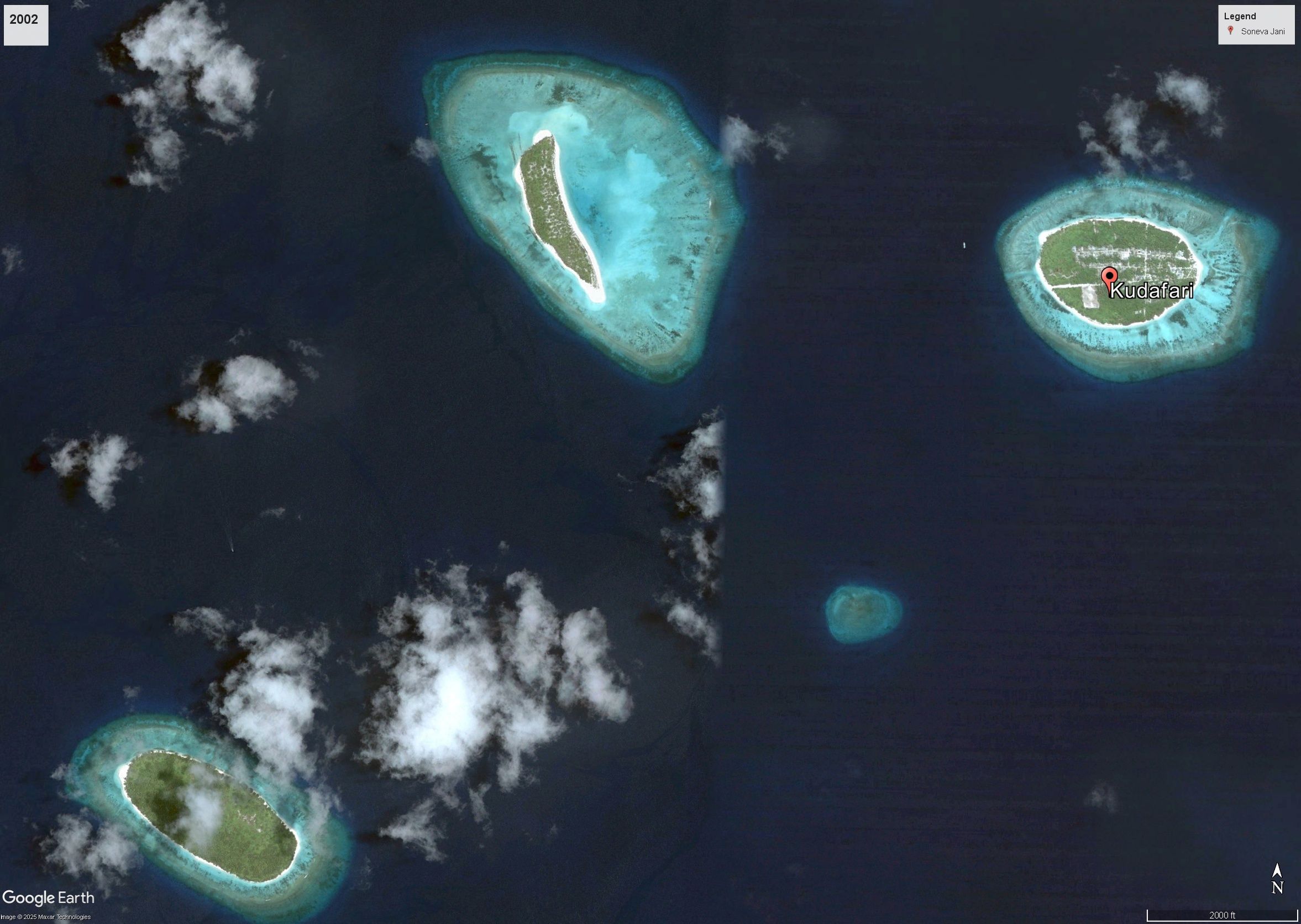
Ali Shameem remembers when fathers returned from fishing each evening, creating "a daily reunion of sorts" on the island of Kudafari – an expansive recent past when the community's existence stretched across neighbouring islands. The islanders grew crops on Kudafunafaru. On Maafunafaru, they gathered coconuts and other gifts of the palm.
The first island is now a luxury resort; the second, dedicated to commercial farming. Younger generations now know a different rhythm – fathers who don’t return every evening, but disappear to far away resort islands for months at a time.
"The tourism industry of Maldives was built at a price. It's an industry built at a great social cost to communities and families,” says Shameem, the island council president, lounging on a joali (traditional chair) underneath a sea almond tree, one of many shaded spots where the island’s young and old relax by the beach.

Ensconced on the southeastern edge of the Maldives’ northernmost geographic atoll, Kudafari is home to a resident population of just over 600 people. A speck of just 30 hectares in the Indian Ocean, the egg-shaped island is encircled by a white sandy shoreline. Breadfruit trees cover every corner, other shady trees remain untouched in the middle of the road. It is more verdant than most of the 186 inhabited islands in the Maldives, Asia's smallest country by landmass, but a “large ocean state” across the equator with an exclusive economic zone of 923,000 square kilometres – a maritime territory nearly the size of Portugal.
Inland from the Kudafari harbour, brick and coral stone walls mark casual boundaries along roads lined with open homes and leafy garden yards. Ornamental plants with vibrant blooms grow alongside more practical greenery: guava and mango, moringa for nutrition, curry leaves for cooking.
Kudafari is one of the smallest islands in Noonu atoll, an administrative cluster of more than 70 islands, only 13 of which are inhabited by locals. But true to its brand as the "little big island," the small community is making big waves in local governance, claiming ownership of its resources and fiercely protecting its heritage and culture in the face of climate threats, rapid urbanisation, erosion, prolific dredging and encroaching central government.

Kudafari is one of 1,192 islands that make up the Maldives archipelago, all of which sit just 1.5 metres above a rising sea level that threatens to submerge the world's lowest-lying nation. Since the 1950s, ocean temperatures have risen by one degree Celsius, triggering mass coral bleaching that devastated reefs across the country in 2016 and 2020. Over the past five years, ocean acidification caused by the sea absorbing excess carbon dioxide has been weakening the coral skeletons that form the foundations of every Maldivian island.
For small communities like Kudafari, these environmental pressures compound the social and economic upheavals reshaping island life in the 21st century. The climate crisis has compressed centuries of cultural evolution into decades of urgent adaptation, transforming questions of development and identity into matters of survival.
Resort economy
The shift from fishing to tourism began in the 1990s. Men moved closer to the capital island of Malé, around which the vast majority of resorts were built by the industry pioneers of the 1970s. Tourism came late to Noonu. But since the first resort opened in 2007 as the Sun Siyam Irufushi, it has become a hotspot with high-end properties like Robinson Club Noonu, Cheval Blanc Randheli and Soneva Jani where guests stay for weeks and rooms go for upwards of US$ 3,000 a night.
Workers at these nearby resorts are at least able to visit home once a week, says Shameem. For women, tourism has brought economic opportunities home. Like clockwork at 3:15pm in the afternoon, the council's meeting hall transforms into a packaging line. Groups of women drop off bundles of roshi (flatbread) wrapped in aluminium foil. Speedboats from nearby resorts arrive twice daily for collection.
The project led by the Women's Development Committee and the council supplies fresh homemade meals and hedhika (tuna-filled snacks) to three resorts.
"Either myself or someone else on the committee will do this every day,” says Milhana Ibrahim, the WDC’s president, carefully sorting out bundles. A council staff places boxes on a buggy bound for the harbour. A Siyam speedboat is due at 5pm.
"We now have 49 women who are involved in preparing roshi to supply to three resorts every day, and an additional four women who make hedhika once a week. There's also seven more women who go to Siyam World resort to sweep the island."
The initiative has dropped the unemployment rate among women from 70 percent to less than 20 percent, says Milhana.
Shrinking horizons
But tourism development has left only a few uninhabited islands for communal use in Noonu atoll. An international airport developed in Maafaru after land reclamation became emblematic of the changing geography. In 2019, a turtle that came ashore to nest on the runway grabbed international attention. The viral image epitomised the cost of rapid development.

The creation of new land continues unabated. One of the largest lagoons in the atoll was recently reclaimed to build 11 resorts. In March, the government granted permission to build townships on the manmade islands, a special economic zone (SEZ) project “aimed at attracting high net-worth individuals and families to reside in the Maldives.”
Land reclamation involves dredging up sand from the seabed, sucking it through pipes and dumping it to expand coastlines or create new land on shallow lagoons. Massive sediment plumes generated by dredging spread far and wide, enveloping coral reefs and imperilling fragile marine ecosystems.
Reclamation projects such as the Maafaru airport and the SEZ township require sourcing huge volumes of sand.


 Interactive Image - Slide to compare
“In the past our development activities were limited to land up to the shoreline of each island. But now, ever since we got [hopper suction] dredgers, it has gone to the extreme and our exploitation has extended to the sea,” says Shameem.
“For those two projects, they mined sand from various points in the atoll. A lot of shallow lagoons and productive fishing locations have been completely dredged up. So we can’t even get any fish from those places anymore, it’s a huge loss.”
The devastating impact of sand mining and dredging on inner atoll reefs has been well-documented. Coral reefs form the bedrock of Maldives islands, offering a natural defence for coastal protection, promoting continuous growth, and supporting tourism and fisheries, the twin pillars of the Maldivian economy.

Shallow reefs are a critical habitat for bait fish, which Maldivian fishers have relied on for centuries to catch tuna through the sustainable pole-and-line method, locating schools of fish and pulling them in one by one. Tuna fishers experienced the collapse of bait fisheries after sand was sourced from the atoll’s reefs to expand the island of Kulhudhuffushi in 2010, a population hub in the northern atolls.
For an atoll like Noonu where tourism is booming, coral reefs attract visitors who want to see the country’s famed underwater beauty and exotic marine life.
The biggest and “most beautiful” lagoon in the atoll has been destroyed for the township project, says Shameem, who visited on a recent family picnic and saw the transformation up close.
“They’re talking about 11 new resorts there. We can’t even imagine how it will change things.”
Ancestral roots
Kudafari is young by Maldivian standards. The original inhabitants are believed to have settled only 570 years ago. They were African slaves brought from Makkah to Malé by Sultan Hassan, who later split them into two groups and sent them away following a series of incidents in the capital. The king bequeathed Kudafari to the northern group along with Kudafunafaru and Maafunafaru. The other group settled in Feridhoo in Alif Alif atoll.
Accounts of the first settlers have been passed down as folklore and oral history. Adam Naseem, 74, says he’s unsure of the exact story but is reasonably certain of the island’s African origins. “You might still be able to identify certain Afro characteristics among some people here,“ he suggests.
Traces are most evident in the propulsive form of boduberu performed by Kudafari and Feridhoo communities with its feverish drums. The present populace has mixed ancestry after intermarriage with other islands, says Shameem. Much like the rest of the Maldives, Kudafari’s cultural identity is a blend of intrinsically South Asian values, Sunni Muslim beliefs and practices, and a deep connection to the surrounding sea. On most roads, walls bear signs with religious messages and reminders to start the day with the dawn prayer.

Shameem points to historical accounts of the sultan’s decree that granted ownership of Kudafunafaru and Maafunafaru to the first settlers of Kudafari.
"Even then it was understood that this little island alone was not sufficient for them to live on. They needed the surrounding islands for food security,” he says.
Naseem recalls corn plantations on the two islands, growing enough to feed the small community for months. In 2008, Kudafunafaru became Zitahli Resort and Spa (later rebranded as Noku Maldives). Maafunafaru was leased for agriculture to a company called Hortifarm in 2018.
Executive control exerted over uninhabited islands from the distant capital has long been a source of contention for remote atolls. In 2022, the Noonu atoll council – an outspoken critic of central government overreach – sued the agriculture ministry over the lease of the uninhabited island of Tholhendhoo without mandatory consultation. After the civil court granted a stay order to halt the lease, the government scrapped the plans.
"Through the atoll council, we've tried to stop the development of uninhabited islands that are used by communities, but we only managed to save Tholhendhoo over there," says Shameem, pointing to an island visible from the Kudafari shore.
“There’s not even a conversation. They [executive] won’t talk to us before taking [islands] so there’s not even a conversation on what the community will lose. If people use it for agriculture, what is the alternative the state will provide? No such discussion and suddenly we lose it one day, that was the case with Kudafunafaru and Maafunafaru.”
"Right now, we have only 10 islands remaining [in the atoll], only 10 islands that are among the smallest, that can barely be called islands," he adds somberly.

 Interactive Image - Slide to compare
Little Big Festival
On June 10, 2023, the sun beat down mercilessly upon hundreds of people who congregated in Kudafari to celebrate World Ocean Day and World Environment Day. It was aptly dubbed the “Little Big Festival.” The event showcased local craftsmanship, cultural stories, and climate-resilient building designs, putting a national media spotlight on the island's many initiatives.
Shameem delivered a speech describing how record-breaking temperature spikes forced the island school to cancel classes. He spoke passionately about what the loss of Maldivian islands would represent.
"The message we were trying to get across is that it’s not just climate change impacts like erosion and sea level rise, but an impact on an entire civilisation. We the Maldives are a civilisation, and this affects our food, our livelihood, our culture and craftsmanship,” he says.
Ahead of the festival, the council built an outdoor space called Anbaage to host presentations. It was developed with traditional materials like palm fronds and thatch. Tropic-friendly designs allowed natural ventilation and cooling on a sweltering day. Over the course of the festival, Anbaage hosted sessions by environmental NGOs, design professionals, architects, local historians and storytellers who shared ambitious ideas and stories of sustainability, innovation and resilience.
The council shared its experiences of leading sustainability initiatives: successful pilot programmes to segregate waste and eliminate single-use plastics. The latter effort was supported by the Soneva resort, providing weaved containers for shopping. A sewage project design was meanwhile altered after strong public opposition to uprooting trees, a clear sign the people of Kudafari value their natural environment.
But two years later, some of the council’s green initiatives have hit roadblocks. Others continue with varying degrees of success. Unlike the capital, the island still practices waste segregation. Plastic bags are almost non-existent. But tackling plastic water bottles has proven to be more challenging. Regulatory approvals, bureaucratic hurdles and concerns over bottling water quality have hampered plans, Shameem explains.
Surrounded by a small garden, Anbaage now hosts community gatherings and school events. Shameem says the festival will return this year with plans for a week-long event.
Back at the harbour, small children frolic with carefree abandon, diving into depths dredged for boats to enter and dock. Speedboats and dinghies bob with the currents of the southwest monsoon.
Some of these children will grow up confined to the single-island rhythms their parents have learned to navigate. Others may follow Shameem’s footsteps in fighting back and redefining what it means to be from Kudafari.
Little Kudafari has big stories to tell. And it’s not finished telling them.

Please take a moment to answer this short, anonymous reader survey to help the Maldives Independent and Climate Exchange better understand how climate culture journalism can be more impactful.
Discussion
No comments yet. Be the first to share your thoughts!
No comments yet. Be the first to join the conversation!
Join the Conversation
Sign in to share your thoughts under an alias and take part in the discussion. Independent journalism thrives on open, respectful debate — your voice matters.
Support Independent Journalism
Help us keep the news free and fearless
Give once
$
or
Become a memberfrom $5/month