
Fishermen say Muizzu "misspoke" as gulper shark plan faces global opposition
No plan, trade restrictions loom, PADI warns of tourism damage.
Artwork: Dosain
14 Oct 2025, 18:10
With less than three weeks until President Dr Mohamed Muizzu’s promised reopening of gulper shark fisheries, the management plan justifying the move remains unpublished, conservationists warn lifting the 15-year ban will strip the Maldives of its prized sanctuary status, and fishermen in Kulhudhuffushi say he may have gotten the wrong species.
What they really wanted was for the government to re-authorise longline fisheries, fishermen who attended a meeting with government officials on October 3 told the Maldives Independent, expressing surprise and confusion over the president's announcement in late August.
"I think [President Muizzu] said gulper sharks by mistake. [Fisheries Minister Ahmed] Shiyam and a few other people told me that the plan they had wasn't for gulper sharks, but it was for longline fishing," said Abdul Majeed Ali, a 48-year-old fisherman from Kulhudhuffushi.
Long-lining uses baited hooks to catch large quantities of tuna. It is a cost-effective method but generates sharks and turtles as bycatch. Kulhudhuffushi fishermen used long-lining to target and catch sharks before the 2010 ban on shark trade and export made Maldivian waters one of only 17 shark sanctuaries in the world.
Gulper sharks – a deepwater species that was traditionally targeted for the high concentration of squalene found in its liver oil – are caught by sinking a weighted line with several hooks deep into the ocean.
Last year, the current administration reversed a decision to grant new longline fishing licenses after more than 30,000 people signed a petition. Amid mounting pressure from both domestic and international environmental against lifting the shark fishing ban as planned on November 1, more than 10,000 people so far have signed a petition to keep gulper shark fisheries closed.
"Devastating" consequences
“The Maldives has been a beacon of shark conservation for more than a decade. It would be a tragedy to see this progress undone. Protecting sharks is the best path for the Maldives, for biodiversity, for tourism and for future generations," said Dr Judith Brown, project director of the Blue Marine Foundation, a UK-based ocean conservation charity.
In a recent online poll commissioned in the Maldives by the Blue Marine Foundation in partnership with local NGOs Maldives Resilient Reefs and Miyaru, 77 percent of respondents feared reopening gulper shark fisheries would damage both the marine environment and the economy.
Ahmed Mohamed, known as Ricky, co-owner of Oceanic Nomad Divers and a member of the Miyaru Shark Programme warned that long-lining could "put all deep-diving sharks and rays at risk of bycatch, including many of the species at the heart of the local wildlife tourism industry."
The Professional Association of Diving Instructors (PADI), the world's largest recreational diving training organisation, wrote to President Muizzu on October 13 warning that lifting the ban could damage the tourism industry. "Any weakening of those protections could lead divers to choose alternative destinations recognised for conservation leadership," the letter stated. "The potential loss of revenue and local employment would far outweigh any short-term gains from reopening the fishery."
According to a 2012 study, shark divers contributed US$ 14.4 million as direct revenue for businesses, with an additional US$ 51.4 million in value to local businesses and US$ 7.2 million collected through taxes.
“The Maldives’ shark sanctuary is one of the country’s greatest conservation achievements, recognised worldwide,” said Shaha Hashim, executive director of Maldives Resilient Reefs. "The government has a critical role to play in safeguarding this legacy – the science is clear: gulper shark populations cannot withstand fishing pressure and their loss would have devastating ripple effects.”
As gulper sharks grow slow and mature late, fisheries globally collapse within years. In the Maldives, populations were estimated to have declined by 97 percent between 1998 and 2002.
But a revived gulper shark fishery in Kulhudhuffushi could be doomed much sooner. Trade restrictions under the Convention on International Trade in Endangered Species (CITES), which could limit the Maldives' ability to export shark products, could come into force in late November.
Citing the Maldives' commitments under CITES, the conservation groups called on the government to maintain the shark sanctuary, which they said "remains the most effective and economically beneficial strategy for the Maldives."
"Not the sharks you're looking for"
Kulhudhuffushi fishermen say conservationists and the diving industry are "twisting the narrative" by conflating the sharks they target with reef species that draw tourists.
"These sharks and the reef sharks that guests come to see are completely different. The reef sharks like madi miyaru, kattafulhi miyaru, olhafathi – these species you can identify by their fins too," Adam Waheed, 53, told the Maldives Independent.
Before the 2010 ban, Kulhudhuffushi fishermen traveled 60 to 200 miles into open ocean to set their longlines, far from dive sites where tourists encounter reef sharks in channels and near atolls.
"No tourist comes here to see sharks that we catch 150 miles or 200 miles out in the open sea," Abdul Majeed insisted.
Majeed said his grandfather was involved in gulper shark fishing decades ago, but he doesn't remember anyone doing it during his lifetime. "What we did was longline fishing," he said. "There were three or four groups who used to buy sharks at the time. It wasn't just the fins – they bought everything except the head and the bones."
The sharks were sold to suppliers in Malé who exported them to countries like Thailand and Sri Lanka. At its peak, Kulhudhuffushi operated the largest shark fishing fleet in the northern atolls.
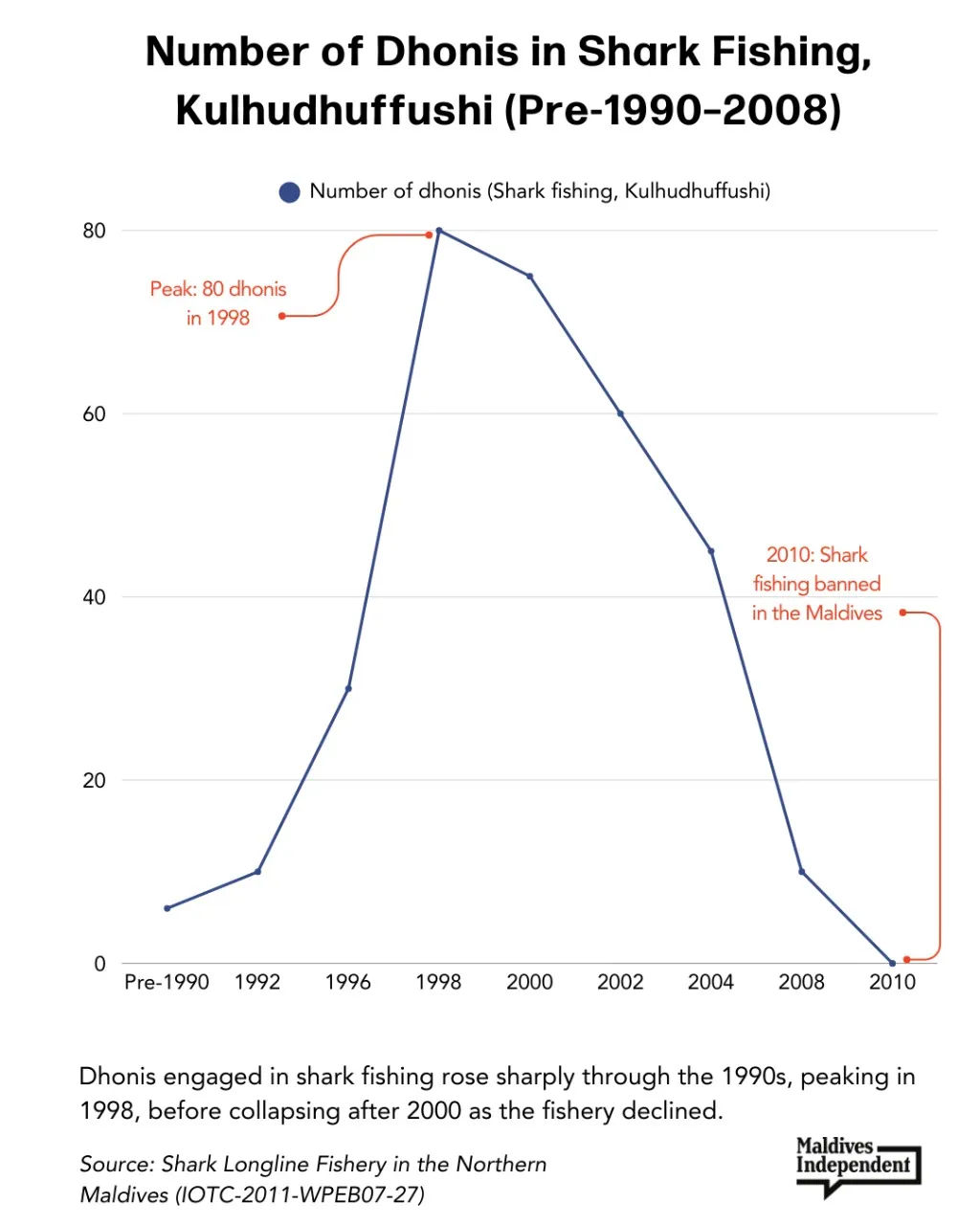
According to Adam Waheed, northern fishermen transitioned to the more profitable longline method long before the 2010 ban, "since the income was greater."
When the ban came in 2010, the economic impact on Kulhudhuffushi was severe. "Three quarters of this island used to get an income from this – to be honest, all families would have benefited in some form," said Majeed. "The ban came without showing us another way and it was like a sudden knife to our necks."
The government offered a gear buyback scheme – about MVR 1,700 (US$ 110) per hook line – but fishermen say it fell far short of compensating for lost livelihoods. No meaningful alternative employment materialised, they said.
An MVR 7 million fund was launched at the time for the buyback scheme and the government conducted livelihood diversification workshops for former shark fishermen. But Kulhudhuffushi fishermen who spoke to Maldives Independent this week said they were unaware of anyone who found additional livelihood opportunities.
“It was expected that the tourism industry, which will reap the main benefits from the ban, would assist in compensating those who are bearing the main cost. Unfortunately only a few resorts offered help to raise funds," a report by the Maldivian government to the Food and Agriculture Organisation in 2011 stated.
Open to limits
Both Adam and Majeed pointed to what they see as a double standard for foreign vessels operating in the region under yellowfin tuna licenses. "The foreign longline boats which obtained licenses used to catch these sharks by 300 or 400," Adam said.
“Those people used their big vessels in this region with over 2,000 ends (hooks). The lines that they put near Makunudhoo will stretch all the way to Naagoshi. Sometimes we would go out and our lines would get tangled in theirs."
He added that sharks caught by Kulhudhuffushi fishermen often had foreign hooks embedded in their intestines. "The shark butchers here would know. The hooks we used were iron, but they used steel hooks."
Adam expressed willingness to accept sustainable management measures. "I believe that in other countries who hunt land animals, they also have measures like seasonal closures," he said. "So I think within a year, even if it is for six months, Maldivian fishermen need to be given the chance to do this."
But Abdul Majeed said the October 3 meeting did little to reassure him. "The discussions didn't give us a lot of confidence that the government had a way forward to do this," he said.
Despite President Muizzu’s claim to have completed the management plan in August, a fisheries ministry official told the Maldives Independent that work on the plan and discussions were still ongoing.
Asked about the potential trade restrictions that could take effect in late November, the official was unable to comment. The Maldives Independent was awaiting a response from Fisheries Minister Shiyam at the time of publication.
Abdul Majeed expressed skepticism that international trade restrictions would have any practical effect. "The countries who have signed that treaty, like India and Sri Lanka, are catching sharks in these waters," he said.
"When tourists come to Haa Dhaal and start spending bednights, I will be at the front to stop shark fishing. But until then, I will take sharks every day as long as I am a free man. You should not stop our way of earning an income without giving us an alternative."
Discussion
No comments yet. Be the first to share your thoughts!
No comments yet. Be the first to join the conversation!
Join the Conversation
Sign in to share your thoughts under an alias and take part in the discussion. Independent journalism thrives on open, respectful debate — your voice matters.
Support Independent Journalism
Help us keep the news free and fearless
Give once
$
or
Become a memberfrom $5/month