Reform or remorse? The president’s new policy on state hiring
Is a pledge to end political patronage encouraging, or incriminating?
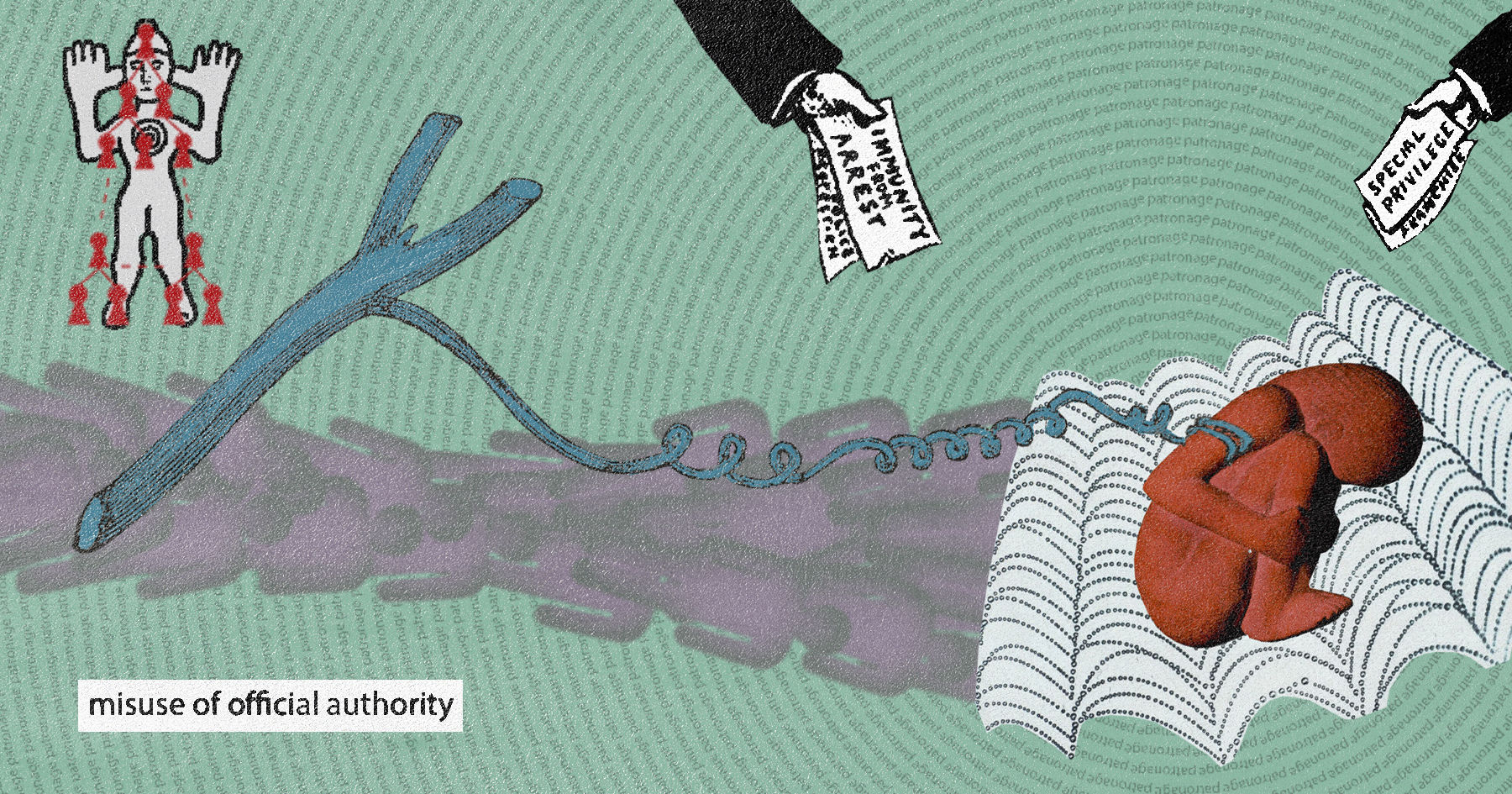
Artwork: Dosain
21 Apr, 16:20
I was taken aback by the president’s admission. Speaking at his weekly Monday press conference, President Dr Mohamed Muizzu made a startling declaration:
“From now onward, the people have made it clear that no one should be given jobs due to elections or political ties. I too will follow this principle,” he said. “As I have stated, no hiring should take place in an SOE or a ministry without publicly announcing vacancies, receiving applicants’ CVs and assessing them on merit.”
From now onward? At no point was any president permitted to hire and fire for political benefit. It is striking that it took the rejection of an election proposition by 68.77 percent for this realisation to surface. The suggestion that merit-based hiring is a new principle is itself revealing.
Under the Maldives Penal Code, misuse of official authority is not a matter of opinion but of law. Article 513 criminalises the use of official position for improper purposes, including to obtain benefit for oneself or another. Article 518 addresses trading in influence, where authority or connections are used to secure advantage. These sit alongside offences such as bribery under Article 510 and illicit enrichment under Article 515. Taken together, they form a clear legal framework: public office cannot be used as a tool of patronage.
This makes the president’s statement difficult to treat as reform. It reads more as an admission of what has long been denied.
Patronage as governance
This comes from the same president who, on March 30, denied that hirings or projects were being used as election favours, insisting that “hirings are not made in connection with election”.
That denial rings hollow. For years, it has been public knowledge that appointments, dismissals and recruitment within state-owned enterprises are driven by political ties and patronage. Merit is secondary and often irrelevant. One does not need the right education, experience or even a defined role. Proximity to power is sufficient. Ministries and SOEs have absorbed hires regardless of whether there is a genuine need, a defined function or even the most basic resources to accommodate them.
Successive governments have denied such practices. Yet the pattern remains unmistakable. State resources are used to reward loyalty, consolidate power and secure electoral advantage. What is now presented as a course correction is in reality a continuation of a long-standing cycle.
This is not merely poor governance. It raises clear constitutional concerns. Article 115(f) of the constitution empowers the president to make political appointments only to facilitate the proper functioning of the duties of his office. It does not authorise the use of public employment as a mechanism of electoral clientelism. Hiring for political gain amounts to an abuse of power and a misuse of state resources for private political benefit.
Untethered power, weakened oversight
The deeper problem lies in the structure of power itself. The Maldivian presidency remains largely untethered. The entire state apparatus continues to orbit the executive. From appointing Supreme Court justices, including the chief justice, to commanding the armed forces and influencing institutions such as the Anti-Corruption Commission and the Elections Commission, the reach of the presidency extends across the system.
Checks and balances exist in theory but are often weakened in practice. Parliament, despite its constitutional role, has frequently functioned as a rubber stamp under administrations with commanding majorities. Members of parliament, dependent on the executive for development projects in their constituencies, are incentivised to align rather than scrutinise. Oversight becomes conditional and accountability becomes selective.
Political appointments further entrench this imbalance. Outside of cabinet ministers, the president can make appointments without meaningful parliamentary scrutiny. Loyalty often outweighs competence. Institutions are then staffed by individuals who are neither qualified nor accountable to the public.
Against this backdrop, the president’s statement is more than a policy shift. It is an acknowledgment of how power has been exercised. When authority is so centralised and so weakly constrained, abuse is not an exception. It becomes routine.
Damning figures
The scale of the issue is reflected in the numbers. On Sunday, finance minister Moosa Zameer revealed that state-owned enterprises now employ approximately 42,000 people, compared to 34,000 in the civil service. This marks an increase of 5,300 since the last reported figures from the second quarter of 2025. Yet he was unable to provide precise data or disclose the total expenditure on salaries and benefits.
Even delayed statistics from the Privatisation and Corporatisation Board (PCB) indicate that over 36,700 people were employed by SOEs by the second quarter of last year.
Unfortunately, the consequences of this system are becoming clear. Many of those hired through politically influenced expansion now face the prospect of losing their jobs. The government has pledged to “right-size” state-owned enterprises, aiming to reduce staff numbers by 33 percent, or roughly 13,000 employees.
This pattern is not new. The decision to expand government-owned companies despite limited progress or profitability has long raised questions. During the Maldivian Democratic Party’s presidential primaries in 2023, Fenaka reportedly grew from around 2,000 employees to 3,800. Employees of state-owned companies were even observed in uniform assisting with campaign banners, flags and related activities.
At the same press conference this week, President Muizzu also announced that deputy ministers must now hold at least an undergraduate degree, while state ministers must possess a master’s qualification. It remains unclear whether those currently in post who do not meet these requirements will be dismissed.
Some argue that stronger oversight by the PCB could address the issue. But the question remains. Who appoints the PCB? Its members and chairperson are decided by the president. Oversight, in this context, risks becoming circular.
This lack of transparency deepens concern. A rapidly expanding payroll, coupled with opaque spending and politically influenced hiring, points to a system under strain both financially and institutionally.
No Maldivian president has been re-elected since the 2008 constitution came into force. That fact alone should prompt reflection. It suggests not only dissatisfaction with individuals but a structural flaw in a system that concentrates immense power while offering limited avenues for accountability between elections.
The president’s admission is therefore not just about hiring practices. It is a window into a broader problem. An executive presidency that remains dangerously unconstrained. Unless that concentration of power is meaningfully addressed, declarations of reform will continue to ring hollow, and the cycle of abuse will persist.
Column By Saif Fathih
Saif Fathih is a columnist at the Maldives Independent and a serving member of the Malé City Council for Galolhu North. With his educational background in communications, international studies and public policy, he previously worked as a journalist, editor and public policy advisor, with roles including senior policy director at the ministry of national planning and editor of Ocean Weekly Magazine. Saif began his career as a radio producer and presenter at Minivan Radio, writer for Minivan Daily, and translator for the British High Commission and the European Union Mission to Sri Lanka and the Maldives. He is also the host of Ithuru Vaahaka, the Maldives Independent podcast.
All comment pieces are the sole view of the author and do not reflect the editorial policy of the Maldives Independent. If you would like to write an opinion piece, please send proposals to editorial@maldivesindependent.com.
Column By Saif Fathih
Saif Fathih is a columnist at the Maldives Independent and a serving member of the Malé City Council for Galolhu North. With his educational background in communications, international studies and public policy, he previously worked as a journalist, editor and public policy advisor, with roles including senior policy director at the ministry of national planning and editor of Ocean Weekly Magazine. Saif began his career as a radio producer and presenter at Minivan Radio, writer for Minivan Daily, and translator for the British High Commission and the European Union Mission to Sri Lanka and the Maldives. He is also the host of Ithuru Vaahaka, the Maldives Independent podcast.
All comment pieces are the sole view of the author and do not reflect the editorial policy of the Maldives Independent. If you would like to write an opinion piece, please send proposals to editorial@maldivesindependent.com.
Discussion
No comments yet. Be the first to share your thoughts!
No comments yet. Be the first to join the conversation!
Join the Conversation
Sign in to share your thoughts under an alias and take part in the discussion. Independent journalism thrives on open, respectful debate — your voice matters.
Support Independent Journalism
Help us keep the news free and fearless
Give once
$
or
Become a memberfrom $5/month