
Britain calls Chagos bilateral. The tuna do not
One purse-seine year in Chagos nearly matched our whole yellowfin catch.
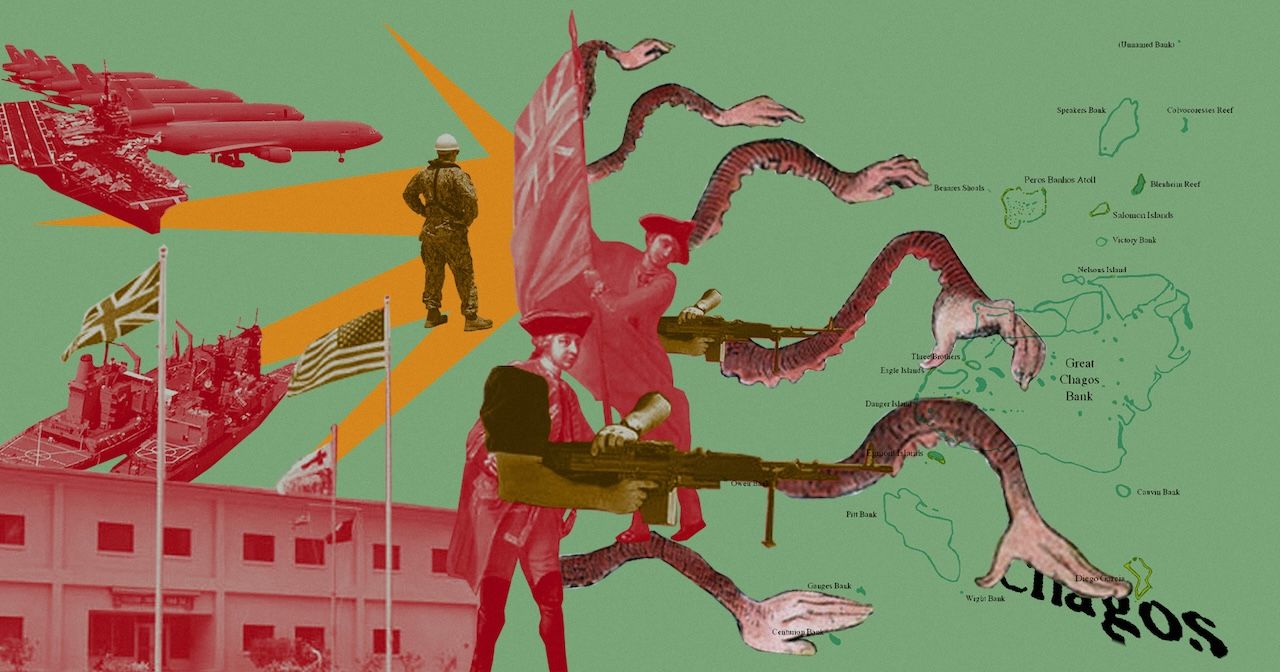
Artwork: Dosain
15 Sep, 14:54
Fisheries are not bilateral. Marine ecosystems are not bilateral. Migratory tuna do not become Mauritian fish at one maritime boundary and Maldivian fish at another. Decisions on conservation, enforcement and industrial fishing in Chagos can affect waters far beyond it.
Before Britain closed Chagos to commercial fishing in 2010, foreign industrial fleets operated throughout the archipelago’s waters.
Research into the final years of that fishery found that longliners, principally Taiwanese and Japanese vessels, took between 371 and 1,366 tonnes a year during the final five years examined. Purse-seine catches were much more volatile, falling below 100 tonnes in some years but reaching approximately 24,000 tonnes in a single year.
For comparison, Maldives’ entire yellowfin catch in 2025 was just under 32,000 tonnes. The comparison is not species-for-species because purse-seine catches around Chagos included tropical tuna other than yellowfin. But 24,000 tonnes demonstrates the scale of extraction possible when industrial purse-seine fleets concentrate on a productive area.
A bilateral deal with regional consequences
Last week, President Dr Mohamed Muizzu asked British Prime Minister Andy Burnham to reopen discussions over the transfer of Chagos sovereignty to Mauritius, arguing that the Maldives should have been consulted. Britain’s Foreign Office rejected the request, insisting sovereignty over Chagos was a bilateral matter between London and Port Louis.
On the narrow question of transferring sovereignty, Britain can call the treaty bilateral. The consequences are not.
Apparently Chagos is Britain’s business, from roughly 5,800 miles away. It is America’s business, from about 9,500 miles away. It is Mauritius’ business, from around 1,360 miles away. Guess whose business it apparently is not? Maldives, barely 740 miles to the north.
Britain spent more than two centuries rearranging the political geography of this part of the Indian Ocean. It cannot now pretend borders make neighbouring interests disappear.
What the treaty concedes
The agreement signed on May 22, 2025 recognises Mauritian sovereignty over the Chagos Archipelago while allowing Britain to continue exercising the powers necessary for the operation of Diego Garcia for an initial 99 years. Britain is therefore not exactly leaving. Sovereignty changes hands while the strategic arrangement survives deep into the next century.
The agreement itself acknowledges consequences beyond a change of flag. Under its arrangements concerning international organisations, Britain’s position in the Indian Ocean Tuna Commission (IOTC) in respect of Chagos is to change from that of a coastal state to that of a distant-water fishing nation when the treaty enters into force, while Mauritius assumes the position flowing from sovereignty over the archipelago. Fisheries governance is already part of the institutional consequences of the handover.
The maritime legal relationship is not entirely closed either. On April 28, 2023, the Special Chamber of the International Tribunal for the Law of the Sea delimited the Maldives–Mauritius maritime boundary within 200 nautical miles, but refused to delimit the continental shelf beyond 200 nautical miles. Mauritius had advanced three routes to establish a natural prolongation from the northern Chagos archipelago. The tribunal rejected one on legal grounds and found “significant uncertainty” over the other two. Both the Maldives and Mauritius had made submissions to the Commission on the Limits of the Continental Shelf. Those claims overlap. The outer continental shelf between them therefore remains undelimited.
So even in international maritime law, Chagos is not a closed chapter for the Maldives.
The real Maldivian interest is the ocean
For the Maldives, the sharper concern is the ocean around Chagos. Fishing is not a nostalgic side industry. It has sustained island communities for generations and remains one of the country’s major productive sectors. Maldivian fishermen depend overwhelmingly on highly migratory tuna, while the traditional pole-and-line fishery catches tuna individually rather than surrounding entire schools with industrial purse-seine nets.
Maldives caught 150,133 tonnes of fish in 2025, almost all of it tuna and tuna-related species. That included more than 117,000 tonnes of skipjack and nearly 32,000 tonnes of yellowfin. Mauritius recorded total fish production of about 37,900 tonnes in the same year, while its industrial tuna fleet caught roughly 34,700 tonnes during the 2024–25 financial year, most of it by purse seiners.
The IOTC allocations put the difference in exposure into sharper relief. For 2026, Maldives has an allocated yellowfin catch limit of 47,195 tonnes, compared with 39,577 tonnes for Seychelles, 33,123 tonnes for Sri Lanka and 10,490 tonnes for Mauritius. The European Union has the largest listed limit at 73,078 tonnes. The Maldives also has a 2026 skipjack catch limit of 123,504 tonnes.
Those figures do not give the Maldives ownership over Chagos or a greater sovereign right to its waters. They quantify how heavily the Maldives depends on the same regional tuna resources.
These are already shared stocks
The IOTC exists because tuna cannot sensibly be managed as isolated national resources. Yellowfin, skipjack and bigeye cross exclusive economic zones and the high seas, and catch limits are allocated among fleets because fishing mortality imposed by one fleet contributes to pressure on populations harvested by others.
Yellowfin is particularly relevant. The IOTC has operated an interim rebuilding plan for Indian Ocean yellowfin since Resolution 21/01 entered into force on December 17, 2021. This is already a stock for which coordinated regional restrictions have been deemed necessary.
That is the context in which any future fishing regime around Chagos has to be considered.
Britain created the problem
For more than two and a half millennia, the Maldives has appeared in the written record of other civilisations. Vedic literature refers to a Maladvipa, the "garland of islands." Buddhist Pāli texts spoke of thousands of small islands in these waters. The first-century Periplus of the Erythraean Sea described coral islands in the southern Indian Ocean. Around 150AD, Ptolemy wrote of 1,378 islands southwest of India. Chinese, Arab, Persian, Tamil and European chroniclers followed.
The names changed, empires came and went, and we remained. The Maldives did not begin with a European cartographer drawing it onto a map.
That does not give the Maldives sovereignty over Chagos either, nor does ancient geography settle competing historical claims. But it is worth remembering when Britain tells the Maldives that what happens immediately south of us is essentially none of our business.
The modern population of Chagos arose through European colonisation. France established plantations and brought enslaved labourers, principally from Africa and Madagascar. Britain acquired Mauritius and its dependencies after the Napoleonic Wars. Chagos remained administered as a dependency of Mauritius until 1965, when Britain detached the islands shortly before Mauritian independence and created the British Indian Ocean Territory.
A year later, Britain and the United States reached arrangements that turned Diego Garcia into a major American military facility. The Chagossian population was subsequently removed, mainly to Mauritius and Seychelles, and prevented from returning.
The Maldives had nothing to do with any of this. We did not colonise Chagos, detach it from Mauritius or expel the Chagossians. Britain did. Nor is it for the Maldives to settle Britain’s colonial guilt, decide compensation for Chagossians or determine the terms of Mauritian decolonisation. But Britain cannot settle those obligations with Mauritius and then declare that the country immediately north of Chagos has no legitimate interest in what follows.
What the leaked cable tells us
A confidential US diplomatic cable dated May 15, 2009, later leaked publicly, records discussions between the US Embassy in London and senior British Foreign Office officials about plans for what would become a vast marine reserve around Chagos.
The environmental case was real, but the private discussion shows conservation, military strategy and Chagossian resettlement were intertwined. Colin Roberts, then a senior Foreign Office official responsible for overseas territories, told US diplomats that Britain wanted comprehensive protection for Chagos waters while ensuring no restriction on US military operations at Diego Garcia.
The discussion of resettlement was more revealing. Roberts said a marine reserve covering the archipelago would make resettlement difficult, if not impossible. The proposal envisaged "no human footprints" on the uninhabited islands, while the US embassy concluded that a marine reserve could be an especially effective long-term obstacle to the return of Chagossians and their descendants.
The cable also records Roberts saying Britain did "not regret the removal of the population", arguing that the removals had enabled the territory to fulfil its strategic purpose while helping preserve the outer islands.
That matters because the present settlement is also being sold through the language of decolonisation while preserving the strategic arrangement Britain and the United States value most. Sovereignty changes, but Diego Garcia remains available to Britain and the United States for another 99 years.
This is not Britain simply walking away from an old colony. It is a decolonisation settlement designed around preservation of the military status quo.
Mauritius and fishing access
The 2009 cable is also revealing about Mauritius. British officials told the Americans that they wanted Mauritian assent before establishing the marine reserve because Mauritius disputed British sovereignty and London wanted to avoid further complaints at the United Nations.
According to Roberts, Mauritian representatives had focused heavily on "fishery control" during formal UK–Mauritius talks in January 2009. One participant reportedly complained that the Indian Ocean was "the only ocean in the world where the fish die of old age", reflecting a view that fisheries resources were being underexploited.
That does not prove what Mauritius will do with Chagos in 2026, much less what a future government will do in 2046 or 2066. But it establishes that access to Chagos fisheries was explicitly part of Mauritian thinking long before the present sovereignty settlement.
Mauritius also already manages substantial foreign fishing access. Between 2019 and 2024, the government issued 780 fishing licences: 294 under the Sustainable Fisheries Partnership Agreement with the European Union, 105 under the Mauritius-Seychelles Reciprocal Fishing Agreement, 311 to vessels operating outside fishing agreements and 70 to Mauritian semi-industrial vessels. The latest complete annual breakdown shows 86 foreign vessels licensed in 2024.
Those figures do not mean 780 foreign vessels were fishing simultaneously, and they do not show that Mauritius intends to open Chagos to them. Its present commitment is the opposite.
The relevance is institutional. Mauritius already has fishing agreements, licensing procedures and a commercial framework through which foreign fleets obtain legal access. If a future government relaxed restrictions around Chagos, it would not be creating such a system from scratch.
There is no evidence Mauritius is preparing to do that today. The question is how durable the present prohibition will be, and what safeguards exist if policy changes later.
The protected area is not a permanent guarantee
Environmental protection is part of the sovereignty settlement itself. The May 22, 2025 UK–Mauritius agreement provides for the establishment and management of a Mauritian Marine Protected Area across the Chagos archipelago, with Britain committed to supporting its development and management.
Mauritius has proposed a Chagos Archipelago Marine Protected Area covering approximately 645,835 square kilometres, divided into four zones. The largest, the Conservation Zone, would cover 612,611 square kilometres, or 94.86 per cent of the protected area. A further 23,712 square kilometres, or 3.67 per cent, would form a Strict Conservation Zone around particularly sensitive ecosystems including the Great Chagos Bank. Commercial fishing is to be prohibited, with only limited artisanal, traditional, ceremonial and subsistence fishing allowed in designated areas.
That is a significant conservation commitment and the Maldives has every reason to welcome it. But the treaty does not freeze every present-day zoning decision, fishing restriction, exemption or enforcement arrangement for the next century. Governments change, regulations change, economic pressures shift and fisheries policy changes with them. A protected area can remain while what is permitted within it changes substantially.
Nobody in 2026 can guarantee what a Mauritian government in 2046, 2066 or 2096 will decide about fishing access. The history of Chagos is enough reason not to assume an environmental designation is politically immutable.
Chagos waters have already moved once from an industrial fishing ground to a no-commercial-fishing regime. There is nothing historically inevitable about either policy.
Tuna, spawning and Chagos
The biological connection is equally concrete. Yellowfin, skipjack and bigeye move through large areas of the Indian Ocean to feed and reproduce. IOTC scientific material describes yellowfin spawning as occurring principally between the equator and 10°S, with the main spawning grounds west of 75°E and peak activity generally between December and March.
Chagos lies at approximately 4° to 7°S and 71° to 72°E. The archipelago therefore sits inside that broad latitude-longitude belt.
That does not mean Chagos is the sole spawning ground for Indian Ocean yellowfin, much less that every fish spawned there eventually reaches the Maldives. Other spawning areas have been identified off Sri Lanka, in the Mozambique Channel and elsewhere in the Indian Ocean. But Chagos sits within a recognised reproductive zone for a stock already managed collectively by the IOTC.
Scientific work on mature bigeye has likewise identified potential spawning concentrations across a broad area between Somali and Chagos waters. Skipjack are less tied to a narrow season or location and are thought to spawn opportunistically through much of the year where conditions are favourable.
The implications are straightforward. Chagos lies within feeding, migratory and reproductive habitat used by tropical tuna managed as Indian Ocean-wide stocks. Removing mature fish reduces the spawning component of a stock; heavy juvenile catches reduce recruitment into later fisheries; and fishing migrating adults affects abundance elsewhere. The Maldives can restrict itself to pole-and-line fishing and comply with IOTC limits, but it cannot insulate its fishermen from fishing mortality imposed on the same stocks elsewhere.
Protection is only as good as enforcement
The proposed marine protected area is roughly 646,000 square kilometres. Its value depends on whether that area can actually be policed.
That means vessel-monitoring systems, satellite surveillance, patrol vessels, inspections, catch documentation, prosecution of illegal operators and access to fisheries data. Mauritius and Britain have already identified maritime-security cooperation, patrol capability and fisheries protection as areas of cooperation under their wider strategic partnership.
The Maldives should be asking for specifics. Will vessel-position data around Chagos be shared with neighbouring states? Will the Maldives receive advance notice if commercial-fishing rules are altered? Will IOTC catch-and-effort data allow changes in fishing pressure around Chagos to be identified separately? How will suspected illegal fishing be investigated? What consultation mechanism exists if future governments expand exemptions or reconsider commercial access?
These are practical fisheries questions, not competing sovereignty claims.
This is not a sovereignty claim
As a Maldivian, I do not have particularly strong views about competing historical sovereignty claims stretching back centuries. The Maldives does not need such a claim to have a legitimate interest in what happens immediately to its south.
Mauritius has a legitimate decolonisation claim. Britain has colonial obligations to resolve. The Chagossians have claims and interests of their own that neither should erase. None of that changes the geography, or the fact that Chagos sits within the same regional fisheries system on which the Maldives depends.
If Mauritius maintains a genuinely protected, well-policed no-commercial-fishing area, the Maldives should welcome it. But today’s prohibition is not a guarantee for future generations. The Maldives should insist on consultation, fisheries-data sharing, credible enforcement cooperation and advance engagement over any future change to commercial fishing access.
If industrial fishing returns to Chagos at scale, the Maldives will not experience the consequences as an argument over colonial history. We will experience them at the end of a fishing line.
Column By Saif Fathih
Saif Fathih is a columnist at the Maldives Independent and a former member of the Malé City Council for Galolhu North. With his educational background in communications, international studies and public policy, he previously worked as a journalist, editor and public policy advisor, with roles including senior policy director at the ministry of national planning and editor of Ocean Weekly Magazine. Saif began his career as a radio producer and presenter at Minivan Radio, writer for Minivan Daily, and translator for the British High Commission and the European Union Mission to Sri Lanka and the Maldives. He is also the host of Ithuru Vaahaka, the Maldives Independent podcast.
All comment pieces are the sole view of the author and do not necessarily reflect the editorial policy of the Maldives Independent. If you would like to write an opinion piece, please send proposals to editorial@maldivesindependent.com.
Discussion
No comments yet. Be the first to share your thoughts!
No comments yet. Be the first to join the conversation!
Join the Conversation
Sign in to share your thoughts under an alias and take part in the discussion. Independent journalism thrives on open, respectful debate — your voice matters.
Support Independent Journalism
Help us keep the news free and fearless
Give once
$
or
Become a memberfrom $5/month

