

The lingering ghosts of Maldives
Why fear runs through our folklore and what it was for.
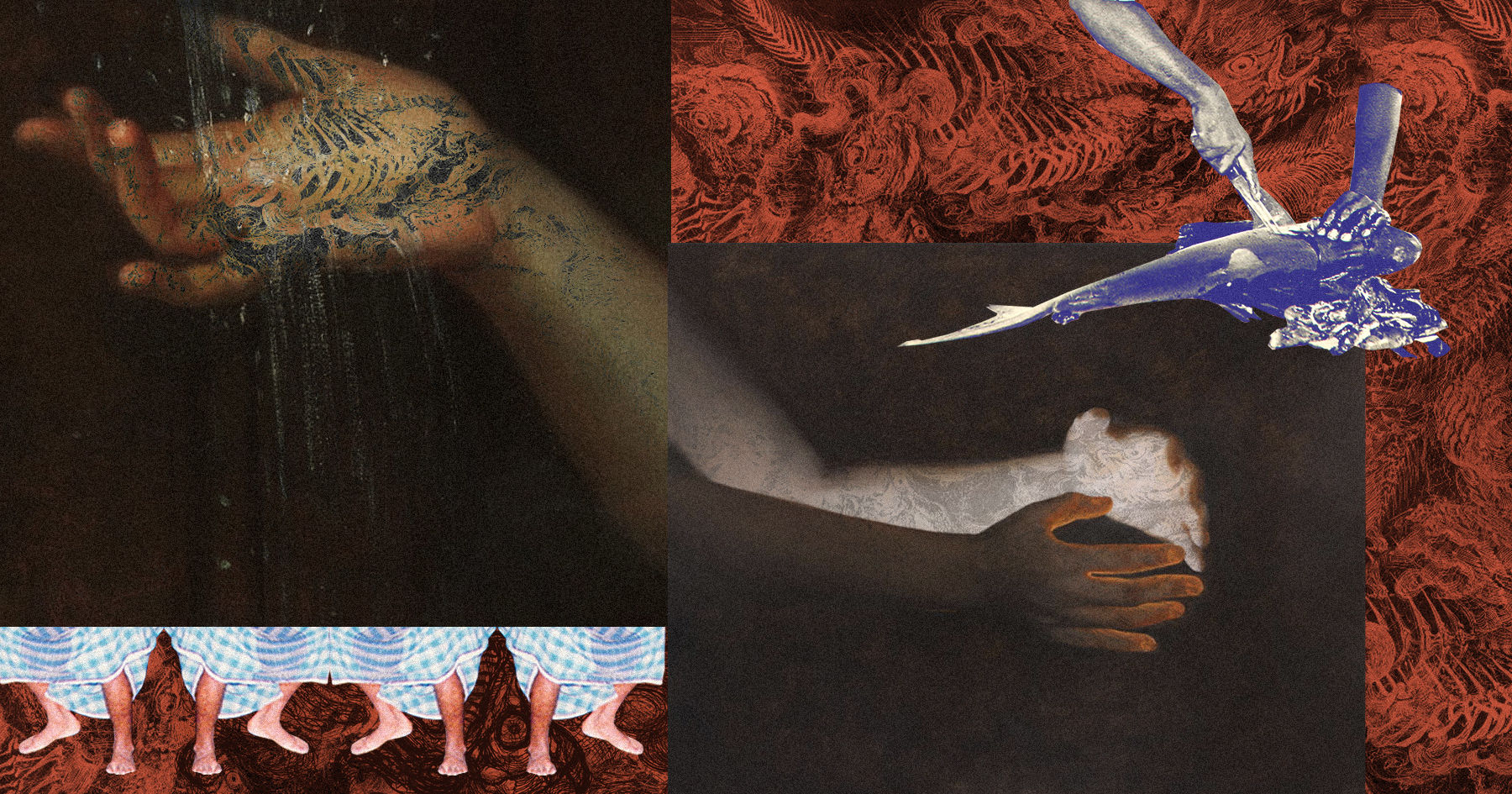
Artwork: Dosain
15 Aug, 15:07
I am not afraid of the dark.
Yet as I walk under towering palms or sit on a Maldivian beach at night, I feel my senses sharpen. A fear lingers that I can’t quite shake off. People whom I know who did not grow up in Maldives rarely share this fear. Those who did are intimately aware of it. The wind sounds louder at night. The unshakeable feeling of something watching in the woods. The dark sea stretches all the way into nothingness.
Long forgotten memories of sitting with my family surface. Why do all storytelling with Maldivians eventually lead to horror stories? Tales of jinn possessions and sea demons, of following mysterious women into the forest only to find delirium and madness. Of turning your head back at the wrong time and seeing that which none should see. These stories often warn one to be wary of one's curiosity. For it is better to not know certain things. I wonder though. Why is fear the overwhelming emotional state that runs through much of our folklore?
Folktales are the stories, parables, superstitions, and lessons a culture tells itself over and over again both as a prescription for living in the world and as an explanation for the endless mysteries of one's surroundings. To understand why fear and horror are so prevalent, perhaps we may need to imagine ourselves in a world far older than ours. Infant mortality was (and remains in much of the world) incredibly high across all cultures for most of human history. Talk to any elder in the community and it is completely normal that many have lost their infants. Not always, but often enough. Countries with access to modern healthcare and monitoring have reduced the infant mortality rate significantly. What we take for granted now is really an anomaly for human civilisations.
Now, what does this have to do with fear? Two things. One: children, especially babies, are curious to a fault. Two: this world is full of beauty and danger. One can only imagine how waves lapping at the shore must look to a baby. And if one has just learned how to walk, why would you not walk into the sea? In such a world, many must have come to a realisation that curiosity is not always a virtue. It is easier to convince a child to not wander off into the woods or the sea if there are bloodthirsty demons wandering about.
This is not to say that people deliberately created these stories as warnings. But when a story is powerful enough, contains the right amount of allure, drama, and fear, it is repeated and endures. In a world of early deaths and disease, we might have needed our demons and monsters to understand causation. Because otherwise, we are left with a reality that is far more frightening than a world inhabited by monsters. That tragedy can and will happen to people for truly no reason.
In the same way that a mother may tell her daughter tales of sea demons and spirits to protect her daughter from the ocean, a ruler may tell similarly frightening stories to keep the people in check. Is the island chief concerned that the people are raising suspicions about all his recently amassed coconut palms? A spirit haunts the coconut groves and it turns those who see it impotent. The chief's palms are unfortunately (or fortunately, for the chief) growing right where it is haunted. This is a simplification. Though the worlds we inhabited are starkly different, we may not be so entirely different from our ancestors. Neither are they from us. For every genuine fandithaveriya, there are bound to be charlatans. Those who claim knowledge over the esoteric mysteries and supposedly communed with the spirit world. To claim such knowledge and power is to place oneself at a unique position in the Maldivian class structure. These charlatans, like many of our politicians today, would deceive their communities and abuse their power. Why? For the same reasons one does it today. For prestige, power, and the material benefits. The charlatan need not toil under the boiling sun and fish nor travel perilous journeys as a trader. The more frightening the story is, the easier it is to control people.
Could fear have maintained that fragile balance between us and the natural environment? Tourism promotional materials and anthropological texts about Maldives often share one similarity: the construction of an idealised history where people lived in harmony with the natural world. Though words such as "harmony" and "fragile balance" remain obscure, I accuse myself of keeping these words obscure. The illusion of a harmonious past ignores one of our most enduring and hopeful characteristics. The ability to make mistakes and learn from it. Throughout our centuries long history, isn’t it entirely likely that our ancestors fished the oceans dry, decimated bird populations, or chopped down far too many trees? We may have then learned, forgot, learned again, and forgot. Each time the environment, which really can be thought of as the one and only source of nourishment, is destroyed. Death, disease and sorrow are likely to follow.
I have not experienced famine in the Maldives. Or the desperate gnawing of real, true hunger. My grandmother has. And when she speaks to me of what hunger really is and what one might do to be relieved of that feeling. I understand what possession could be. But never how it feels. Each time a reef is decimated, sea demons inhabit it. Cut down these trees again and its inhabitants may possess you. Careful not to fish during these weeks, for death and sorrow is sure to follow.
What about what we do to each other? Within all of us lies the capacity to do wonders for the world or inflict insurmountable suffering and harm. The scale of good and the scale of pain one can inflict depends upon their power and reach. As we have our assortment of good and terrible (mostly terrible) politicians, we would also have had our fair share of terrible sultans, chiefs and other leaders. We can never fathom how much food might have been hoarded during our history as countless starved. Nor could we fathom the pain and misery inflicted by our elders on the youth and vulnerable. It is unfortunately too common today. It may have been common throughout our history as well. Every time we turn a blind eye to an abuser in our community, in our households, they become whispers. Whispered to protect one another from such people. Generations pass and these whispers endure. Such men live in the walls. With time, they become what they truly were as they lived. Demons.
As I sit on the beach and stare at the endless nothingness, I feel a fear in my heart that is all too real. A fear of the ghosts that linger. Of the charlatans and abusers. Of the haunting of everyday life. Of monsters that look nothing like monsters of stories. For they look just like you and me.
Discussion
No comments yet. Be the first to share your thoughts!
No comments yet. Be the first to join the conversation!
Join the Conversation
Sign in to share your thoughts under an alias and take part in the discussion. Independent journalism thrives on open, respectful debate — your voice matters.
Support Independent Journalism
Help us keep the news free and fearless
Give once
$
or
Become a memberfrom $5/month