
Ocean Junk Reimagined: a field guide to the reef that replaces us
Inside Afzal Shafiu’s gallery of impossible fish, assembled from collected waste.
Artwork: Dosain
05 Sep, 18:19
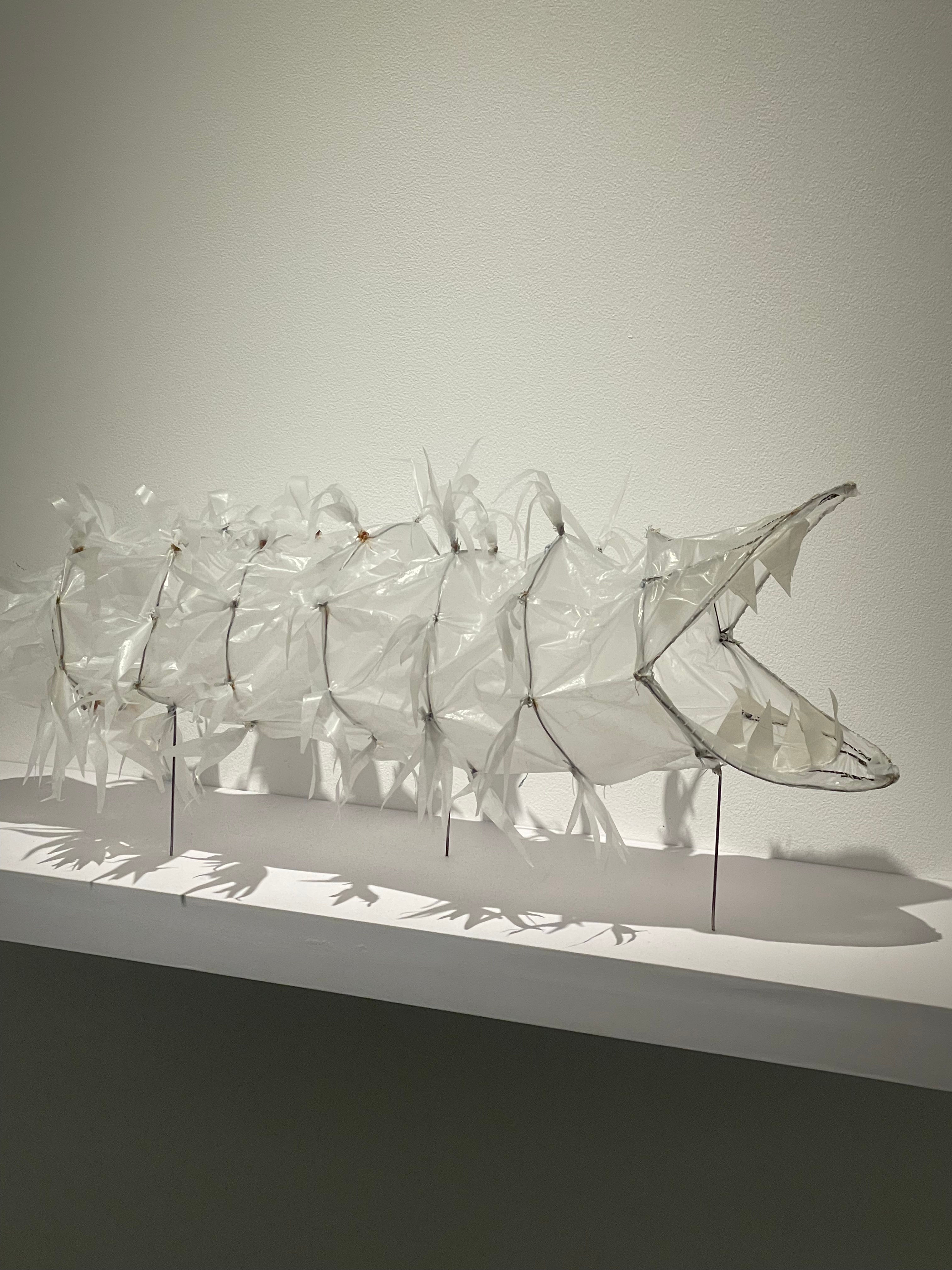
At the swim track in Malé, Afzal Shafiu lowered a fish made of polythene, wire and thread into the water and waited. The sea took an interest.
“The fish were curious and came by to see what this new fish was,” he says laughing, recalling the reaction.
The specimen ‘Shaafiurus caecus - Blind Hollow Oarfish - Holotype’ looks simple, airy and almost playful. Yet creating something so delicate that it moves convincingly like a fish is anything but simple.
'Ocean Junk Reimagined,' Afzal’s new exhibition at Gallery 350, takes a scientific approach to a dystopian future, expressed through surreal and whimsical illustrations, an installation, a specimen and video.
But beneath the humour is another layer to the work.
"I’m also saying that we humans are like this blind hollow oarfish," says Afzal, known affectionately as Afu. "We are blind and hollow in the sense that we claim we are intelligent and we dominate the earth. But we produce so much, we consume so much, we waste so much. We are blind and hollow in that sense.”
That approach to his work is what I find particularly refreshing. There is a message, but it is rarely delivered with a heavy hand. Instead, Afu lets the absurdity of the work draw us in before allowing the meaning to settle.
In the Maldives’ relatively small art community, Afzal Shafiu’s name has endured across generations, accompanied by a body of work that has continually shifted, experimented and evolved. His dedication to art and his craft has been evident for decades. Born in 1975, he began making art at 18, eventually carving out a professional career in graphic design and advertising, where his artistic instincts and creative thinking found an early outlet.
Those who remember BIG – Business Image Group – in the early 2000s may remember the striking visual language Afu and his team brought to Malé. At a time when the local advertising landscape was still finding its visual identity, their work introduced imagery that felt fresh, imaginative and, in many ways, ahead of its time.
After 13 years at Maldives Post, Afu made the decision in 2010 to devote himself entirely to fine art.
My own familiarity with Afu’s work goes back much further. I grew up accompanying my dad to art exhibitions, where I would encounter his work alongside that of other emerging and established Maldivian artists. Years later, in 2010, I had the opportunity to work alongside him when he offered his assistance and advice on the Maldivian Artists Directory, a UNDP project documenting artists in the country.
Although the project was short-lived – another well-intentioned initiative for the creative arts lost somewhere in the familiar ebb and flow of projects that promise much and leave little behind – it gave me a closer look at Afu beyond the artwork. It was also around this time that he was making a conscious commitment to becoming a fully fledged fine artist.
I remember watching one of his ‘Social Crisis' live art performances at Jumhooree Maidhaan. Through performance, Afu explored the erosion of social cohesion amid political upheaval and partisan rivalry. It was an early glimpse of an aspect of his practice that continues to surface in his work: an interest in the world around him and the ways in which art can respond to it.
Then there was the raft.
Made almost entirely from discarded plastic bottles, Afu paddled the makeshift vessel into the waters off Malé. It was part performance, part spectacle and, perhaps inevitably, a statement that resonated far beyond the art community. The sight of a man taking to the sea on a raft made from the very material that continues to accumulate along our shores captured the attention of people across the country.
Sitting with Afu at his latest exhibition at Gallery 350, he is quick to distance himself from one particular label.
"I am not an environmentalist, though," he says with a chuckle. His work, he explains, is rooted in broader environmental and social themes. "I am doing my part as an artist. This is how I respond to my environment and society."
Perhaps that is the simplest way to understand Afu’s work. He is not necessarily trying to preach or prescribe. Instead, he takes what surrounds him – social tensions, discarded objects, the detritus of everyday life – and transforms it into something that asks to be looked at differently.
A dystopian reef
Ocean Junk Reimagined takes this theme head on.
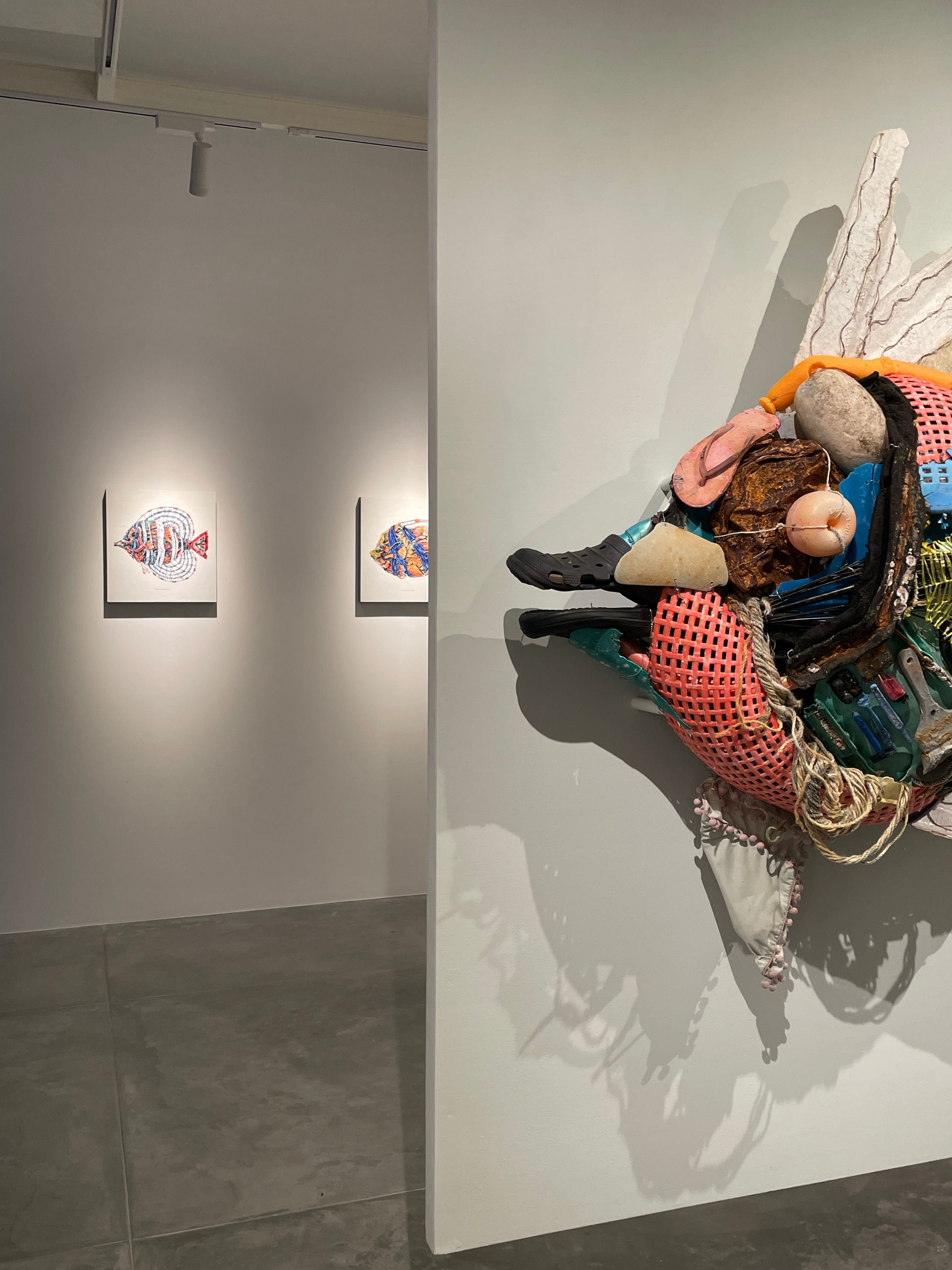
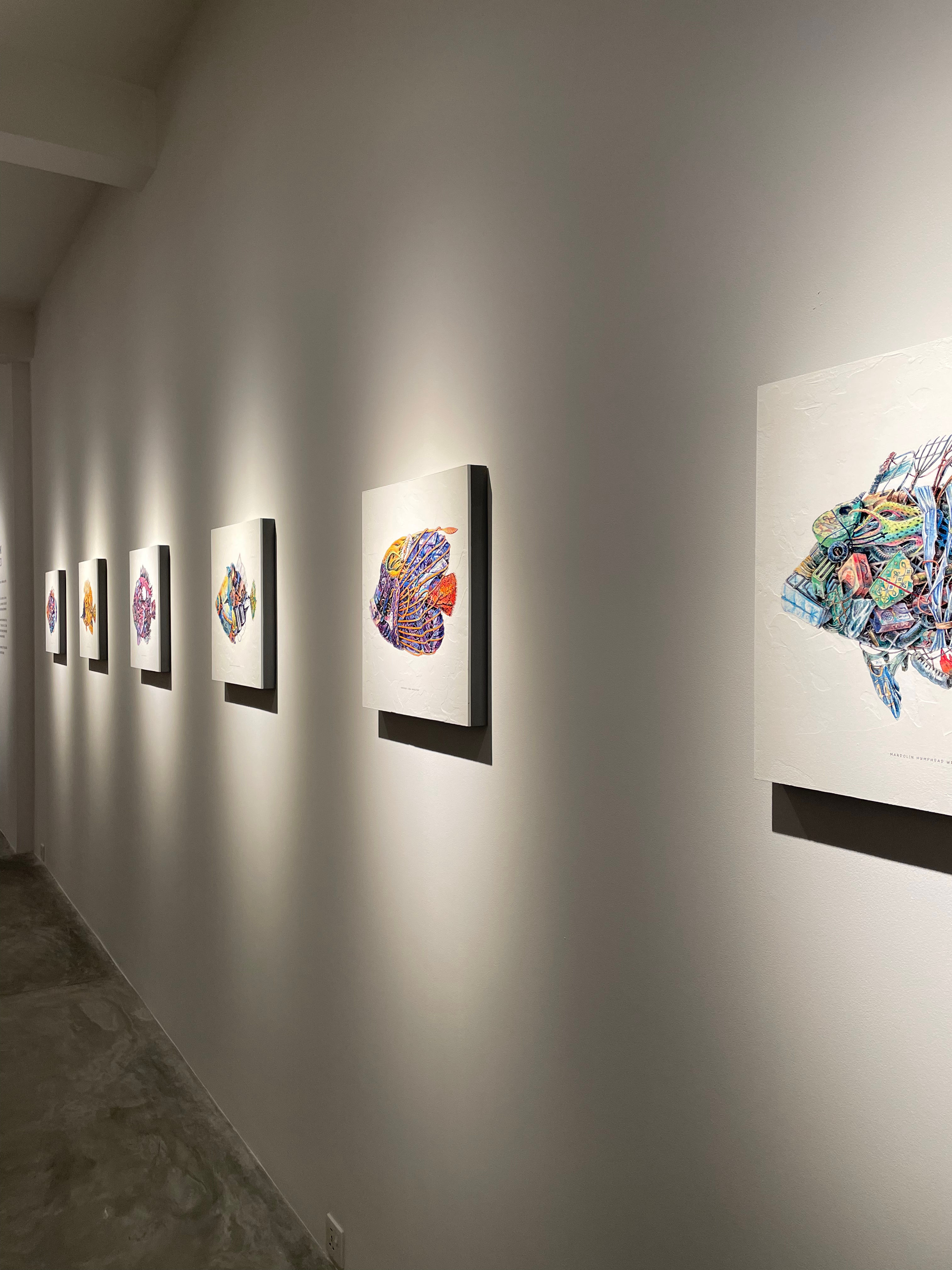
Walking into Gallery 350, a large, whimsical fish installation greets us. Along the white walls, like its foot soldiers, is a procession of illustrations of fish – or rather, something that resembles fish. From somewhere at the back of the gallery comes the gurgling and sloshing of water, creating the sensation that we have somehow been submerged. A two-minute video is being projected onto the wall.
I was eager to get to the video projected at the back of the gallery, but after taking in these strange-looking creatures, I found myself pausing to look more closely.
‘Vase-tailed Phantom Bannerfish'. ‘Mandolin Humphead Wrasse’. ‘Fan-tailed Triggerfish’.
The names become increasingly outlandish, but the drawings demand attention.
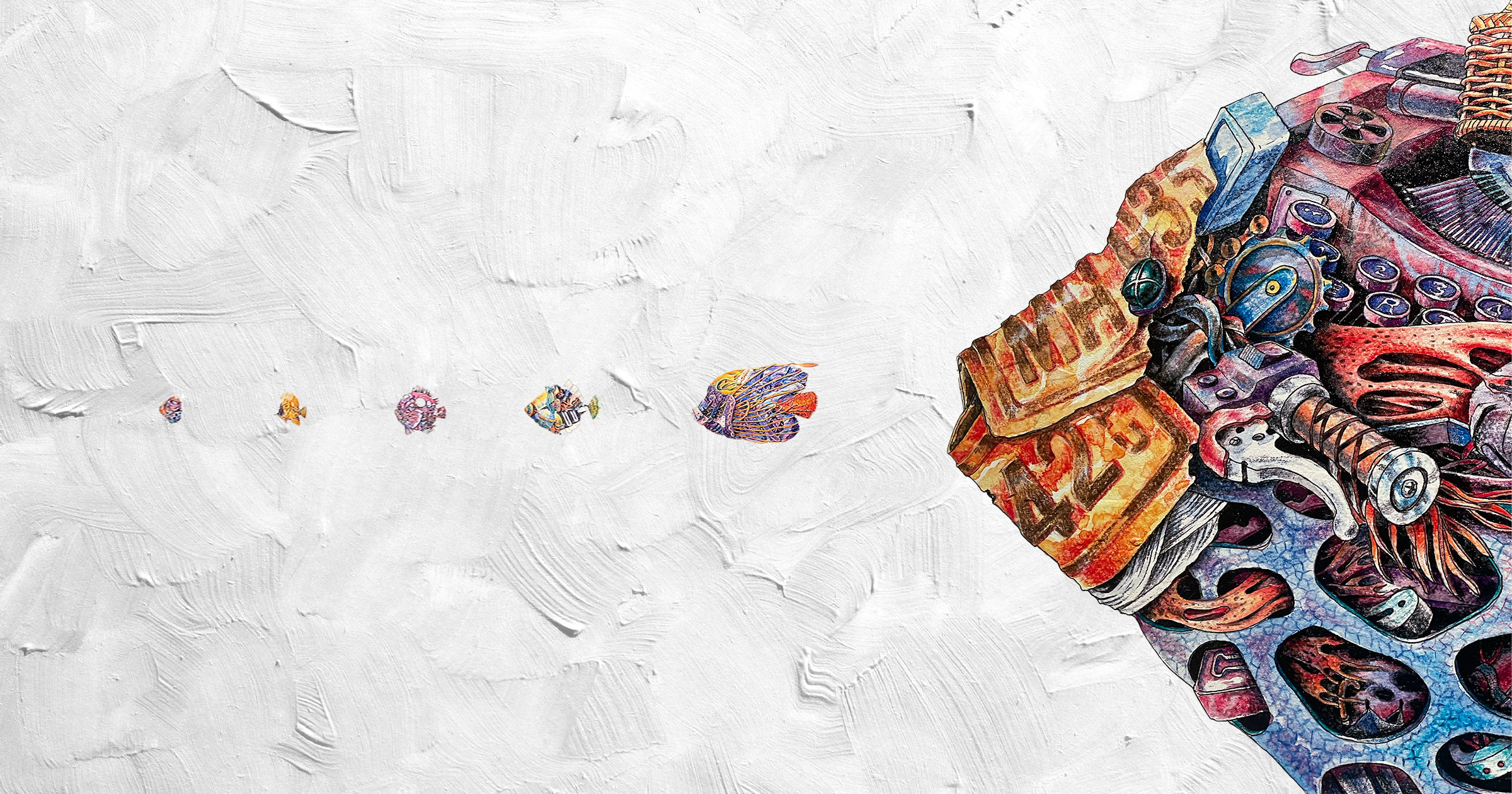
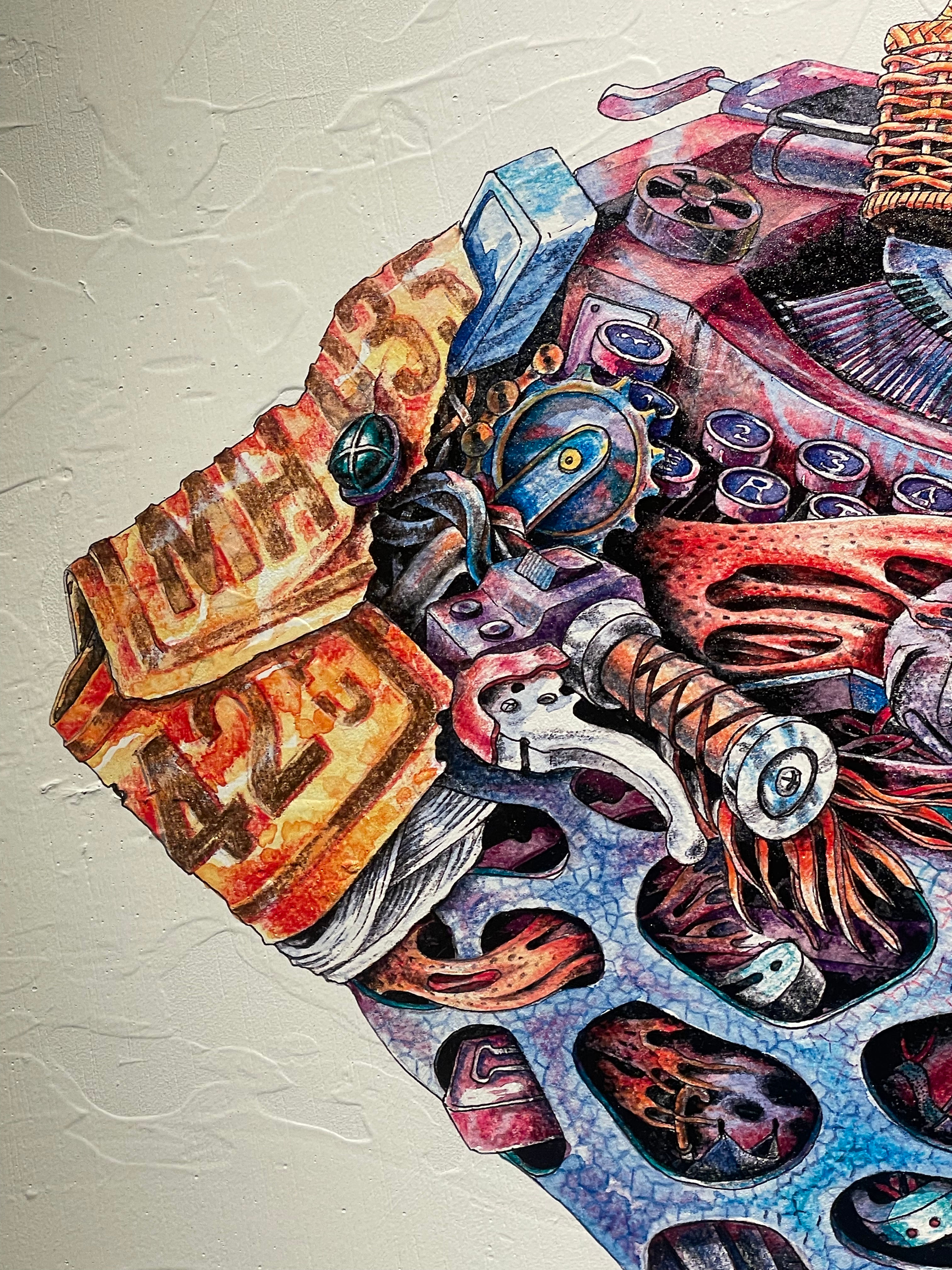
Rendered in watercolour, pencil, inks and acrylic, each illustration depicts a bizarre new species. At first glance, the flat, two-dimensional forms recall the reef fish I am familiar with – the unicorn fish, triggerfish or emperor angelfish for instance – but Afu’s versions are something else entirely.
One has a broken lyre for a tail and a butter knife for a horn. Another carries the remains of a boat within its belly or twisted cutlery as dorsal fins. There is even a fen faivaan and a kettle tucked into the body of one creature.
The result is bizarre, whimsical and unmistakably surreal.
Afu imagines these as creatures that could take over the oceans once humans have finished polluting and destroying the earth and its inhabitants. They seem less like living organisms and more like strange, robotic amalgamations – formed from human waste and whatever microscopic life might have survived, mutated and adapted.
The illustrations feel almost like documentation from a scientific study conducted in a dystopian future. Seventeen illustrations chart an imagined marine ecosystem in which the familiar has been replaced by the discarded.
And there is an extraordinary amount of detail to discover.
I spotted cassette tapes, torn rugs, shattered bottles, rows of plastic bags, a typewriter, seaplane plates and pipes. Everyday objects, weathered, broken, bent and moulded, are transformed into graceful, fish-like forms.
At one point, I found myself thinking: these could make fascinating stamps.
An artist who keeps exploring
One thing I have noticed throughout my observations of Afu’s work is that he never really stops exploring.
It has been one of the most interesting artistic journeys to watch. He experiments with techniques, mediums, styles and materials, seemingly unwilling to settle into one particular visual language. There is a hunger to understand and explore every possible element – both tangible and intangible – that might find its way into his work.
'Ocean Junk Reimagined' itself began taking shape around 2016, with ‘Plier-Mouthed Butterflyfish’ as the first illustration in the series Imagining a new species of marine life, even a dystopian version of one, became another avenue through which Afu could explore surrealism.
There were precedents. His ‘Urban Triggerfish’, painted live at the Maldives Festival of Arts, and the mechanical anglerfish he created for Inktober in 2015 were among countless surreal illustrations through which he was already experimenting with the idea of transforming familiar marine life into something strange and mechanical.
As Afu and I chatted, I also found myself thinking about the scrap-metal works he exhibited after participating in a workshop with Prageeth Manohansa, one of the most revered sculptors and contemporary artists of South Asia, who visited the Maldives to conduct a short workshop around 2012.
There seemed to be a connection between those earlier works and what I was seeing now. The rigid pipes, steel objects, cutlery and other discarded materials had once again been manipulated into graceful, almost organic forms.
"I think these are all connected," Afu agreed.
Perhaps it is.
A throwback, not a full stop
'Ocean Junk Reimagined' may be making its debut in Raajje, but the exhibition is, in many ways, a throwback to a decade-long body of work that has travelled beyond the Maldives. The series was exhibited in Beijing in 2019. It was shortlisted for the David Shepherd Wildlife Foundation’s Wildlife Artist of the Year in 2021.
Since then, Afu has continued to experiment and evolve.
Works such as the dreamlike, abstract large-scale oil paintings he made while studying for his Master’s at Bath Spa University in the UK. ‘A Painful Tune of Endless Sorrow’ formed part of 'Forethought,' his solo exhibition at Gallery 350 in 2023, where his surreal works were presented as large oil paintings on canvas.
Seen against this broader body of work, 'Ocean Junk Reimagined' feels less like a statement of where Afu is today and more like a chapter in an ongoing artistic journey.
His evolution as an artist is something I would describe as hungry – still driven by the curiosity of a child eager to explore one style, technique, material or thought after another.
And as an onlooker, we get the privilege of watching that mind at work.
It is inspiring. It is a reminder of what can happen when curiosity is allowed to remain restless, when an artist refuses to stop experimenting, and when even discarded objects can become a starting point for imagination.
Perhaps, ultimately, that is what Afu’s work leaves us with: the encouragement to never stop exploring.
When the illustration comes to life
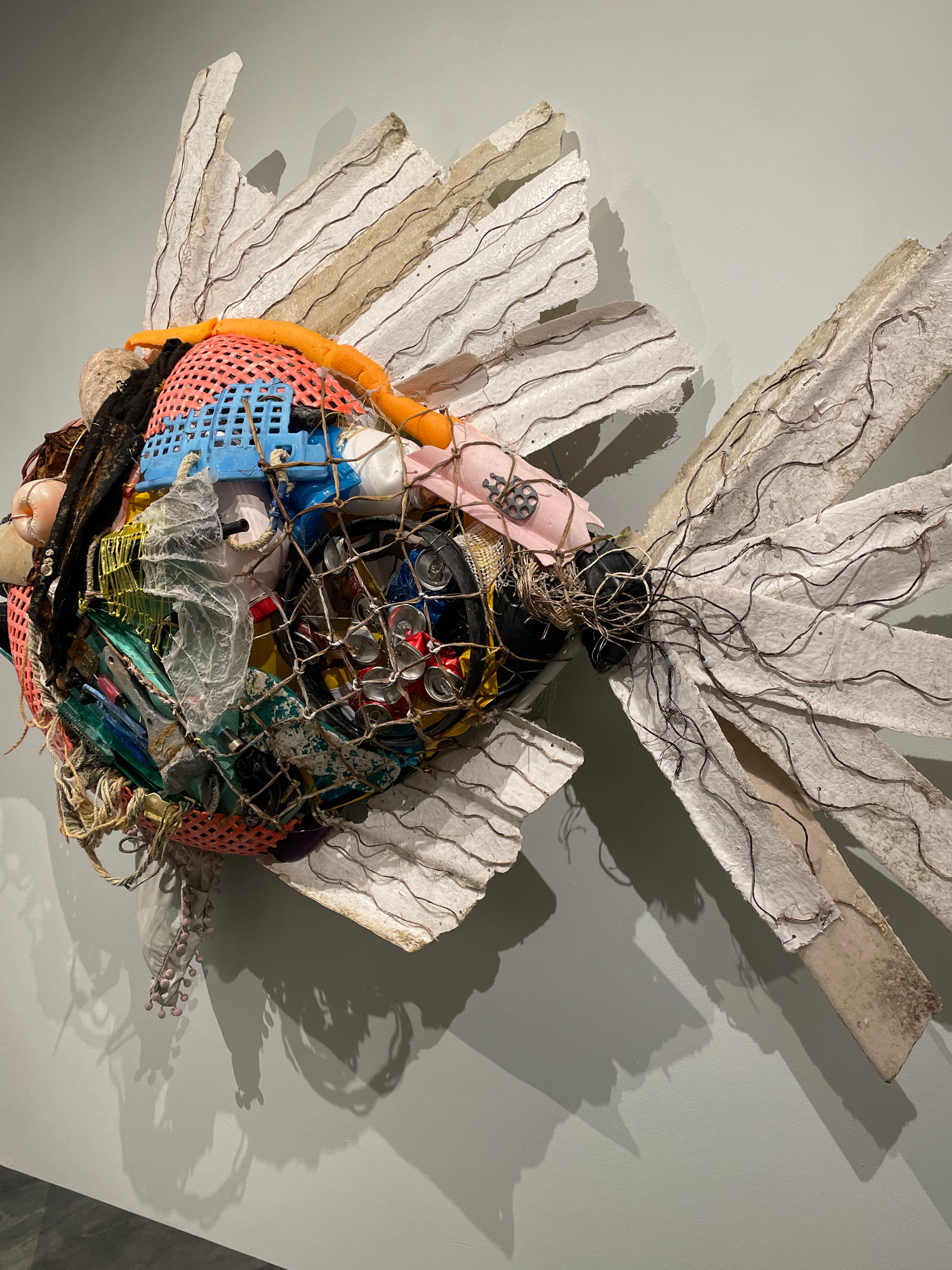
The installation that stands as the exhibition’s centrepiece feels as though one of his illustrations has simply popped out of its panel and inflated into the real world.
‘Dinghy-Finned Common Fish’ is fun, strange and almost comical at first glance. But knowing that every element of the installation was created using waste Afu collected from the swim track in Malé makes the work considerably more arresting.
The discarded objects have been given another life. What was once rubbish becomes the anatomy of an imaginary creature.
Perhaps that is where the whimsy becomes unsettling.
As natural life continues to thrive around us, it does so despite our continued negligence and waste. There is a possibility that one day we may look back at the butterflyfish and triggerfish we know today in much the same way we might look at a scientific illustration of an extinct species.
Except in Afu’s imagined future, the scientific charts may instead document the strange, mutated creatures that emerged from what we left behind.
Ocean Junk Reimagined runs at Gallery 350 until 15 September.
Discussion
No comments yet. Be the first to share your thoughts!
No comments yet. Be the first to join the conversation!
Join the Conversation
Sign in to share your thoughts under an alias and take part in the discussion. Independent journalism thrives on open, respectful debate — your voice matters.
Support Independent Journalism
Help us keep the news free and fearless
Give once
$
or
Become a memberfrom $5/month