
A million plays later, is Pest’s L2 any good?
In patches, yes, and rarely the patches the crowd picked.
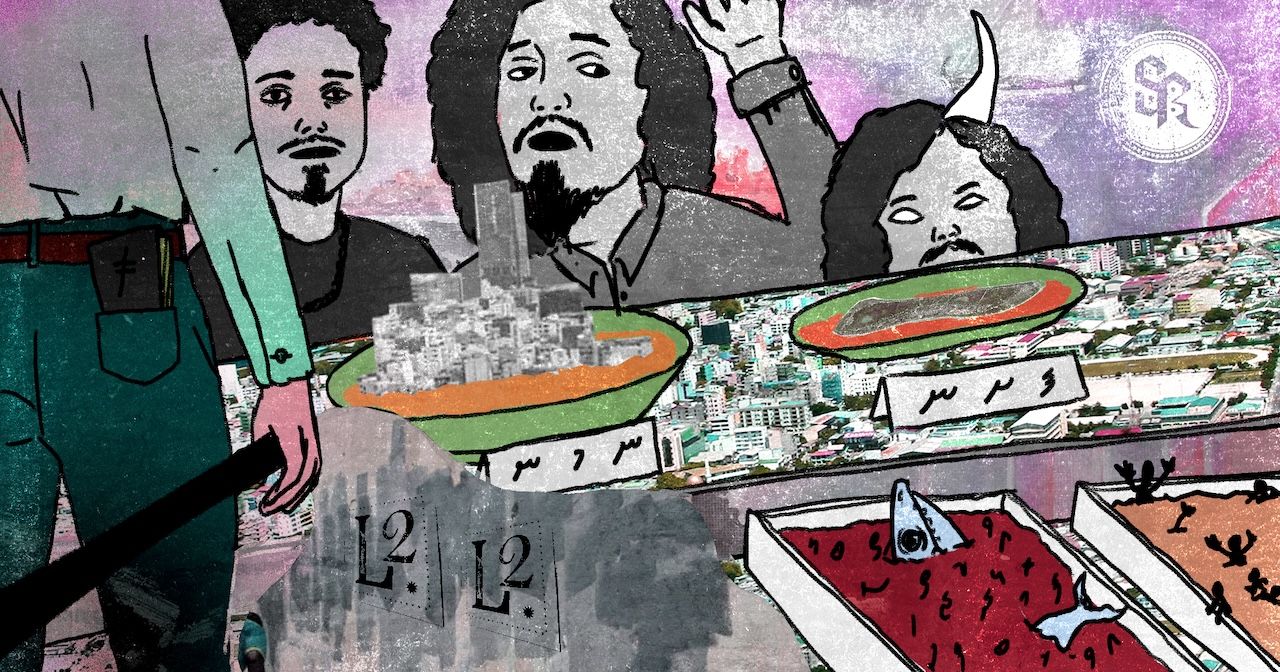
Artwork: Dosain
29 Aug, 17:26
When Pest’s much anticipated debut "L2" dropped last year, it made big waves on streaming platforms. Fans on Soundcloud gushed commenting, "The King is Back," plenty of "lit" emojis and "Pest comeback best comeback." The album has since accumulated over a million plays and tens of thousands of likes. That’s more plays than twice the population of the country and more likes than all the people in Maafannu. His popularity is undeniable. Other popular rappers on Soundcloud have rarely had tracks that surpassed 200,000 plays, despite being online for several years. And while not releasing a full LP, he had fed his legion with strong EPs and hits like "Koavareh" and "Veringe Verikan."
The most popular track by far is "Ey Malaa," which has racked up almost 350,000 plays on Soundcloud. It's produced by Sanchu again, no surprises there, and is a duet between Pest and female vocalist Isra. Musically, it is percussion heavy with a tom-tom groove that sounds incredibly organic, but neither Pest's nor Isra's flow has the magic of earlier tracks. It is repetitious. The melodies, though somewhat ear-wormy, soon exhaust themselves, which perhaps goes some way towards explaining its popularity.
L2 is semi-autobiographical, describing scenes of Pest's early life in Fuvammulah in "Karudhaasthah Matheegaa" where a clever but recalcitrant MC stays in school merely by virtue of his grades. He is inches from being expelled. It describes homely scenes of waking up early, drawing parallels between father and son who both put on their respective uniforms and go their separate ways, the father to the airport and the son to, well, you know where. The absence of the father is felt almost throughout as is the weariness of a mother bringing up her children mostly on her own. Musically, it starts off slow, but then Pest gets into a propulsive flow as the drums kick in, a beat recalling Tribe. Pest said Haisham Naseer, who produced the track, was discovering hip hop himself when he made the beat but it feels clean and professional, like someone on hugging terms with the genre.
"Gang mie", which features Danny from Blueberry Waters, takes the MC on a darker journey, with trap produced by young producer Reaper. It has choral stabs, rolling hi-hats, a booming bass, all in service to Pest's ruthless diagnosis of society: of gangs, institutions, of inequality. Danny's contribution really shines, his flow surprises and delights, and despite their playful nature, his words carry real weight. Pest mastered the words while Danny did the flow and together they create a powerful vortex that pulls the listener in, ready or not.
"Loaibey," also produced by Haisham Naseer, has the veneer of a hard rock song. It's Pest experimenting with genres, a healthy habit in any musician. It has an aggressiveness, a kind of bravado that is new to the album. But musically, the guitar tone sounds like it came on a synth preset and the drums are far too neat. Overall, it feels like it's emulating what it strives to be, an obvious simulacrum of a rock song if you will.
Which brings us to "G-lyf," the first track on the album produced by the enigmatic Sanchu, who made most of "L2." It blows everything that came before completely out of the water, the sounds are crisper, the beats heavier, this is a producer who knows his sh*t down to individual clauses in the fine print. The aural spectrum is completely used up..And yet no one instrument competes for space with another. The crackly synths wiggle and the bass hits like shocks to the system. Meanwhile, the MC is a megalomaniac and the music fits the vibe perfectly. It's the most accomplished track on the LP, giving the impression that it can hold its own against rap from basically anywhere.
"Gendhey Dhurah" has a melancholic air, with a doomed sample that Sanchu threads through the song – there isn't anything that stands out musically here, but Pest's lyrics keep the momentum going. His alter seems to have embarked on a journey of self-reflection, realising that it is impossible to even know oneself.
Things become intense again on "Hithuga Sikka." It's a pivotal moment in the album where the MC reflects on his life, confronts death and experiences his moment of grace, the violence of which is conjured up by the dark atmospherics that Sanchu deftly weaves around the vocals. The haunting choral jolts, and the insistent beat, the somber rapping and the subject matter make it sound like a mini-apocalypse, as befitting a track on which hinges the transformation of the anti-hero.
"Keehve" though finds the MC at his most conventionally philosophical, and Pest's simple but infectious melody carries it without friction on the back of Sanchu's beat. "Why? Could this be the reason?" Pest sings, as if his alter has finally hit on something. Is all of life just a single moment? he asks, implying that it's stretched out and made to appear like something more. Think of your childhood, where has all that time gone? There's that old thought experiment where you imagine that the world was created a second ago but with all your memories of the past. Would it be identical to the world you're living in now? Who's to say but maybe I am diminishing Pest's contemplation – his alter on the album has clearly undergone a radical shift from its abrasive start. The track's instrumentation is sparse but Sanchu's synths shimmer, and its narcotic beat slows to a halt when the MC talks of time coming to a standstill.
And now, on Visnaalevy, we find the MC learning to surrender himself to love in order to learn how to love. Gone is the cynicism of "Loaibey," or the control freak in "Ey Malaa." Sanchu's gorgeous synths create a lush, romantic cosmos where Pest's desire becomes rich with care, wanting without objectifying his beloved. It's a song that is perfect for comedowns, or 2am listens, completely unashamed to be feelsy.
The last track, "Minivan Roohu," produced again by Reaper gives this mostly dark album its final moment of luminescence. It's not especially strong, nor weak, a middling track by the album's own standards but still pleasant enough to listen to, not least because of the catchy violin hook.
So, what to make of L2? There are moments of stellar brilliance, just enough of them to take this album to rarified air. The words pick up when the music, at times, falters, as it does on "Loaibey" and "Gendhey Dhurah": there's always something lending the LP the needed buoyancy. It's a worthy debut by the country's most famous rapper and it showcases the prodigious talents of Reaper, Haisham, and of course Sanchu. I await Pest's sophomore record but will have bits of this on replay in the meantime.
Discussion
No comments yet. Be the first to share your thoughts!
No comments yet. Be the first to join the conversation!
Join the Conversation
Sign in to share your thoughts under an alias and take part in the discussion. Independent journalism thrives on open, respectful debate — your voice matters.
Support Independent Journalism
Help us keep the news free and fearless
Give once
$
or
Become a memberfrom $5/month