
"We could have done better": conversations with an independence hero
Abdul Sattar Moosa's recollections of the negotiations with the British.

Artwork: Dosain
26 Jul 2025, 11:27
This article was originally published on the occasion of the 50th anniversary of independence on July 26, 2015. The state dignitary passed away on November 27, 2015.
Abdul Sattar Moosa Didi was just 29 when he led the negotiations to obtain independence for the Maldives from the British. “I didn’t think I’d be alive to see this day. I am 79, I am no longer what I was 50 years ago,” he said. Today, he laments the forgotten legacy of Prime Minister Ibrahim Nasir, and worries about the growing crime rate and political instability in the Maldives.
Sattar was the Maldivian government’s representative in Colombo in the early 1960s. He humbly said, “I was only given the work because I was the representative in Colombo.” When he was first sent there in 1960, there was no talk of independence. The issue came up after the southern atolls of Addu, Fuvahmulah and Huvadhoo broke off to form the short-lived United Suvadive Republic.
At the time, the British had an Air Force base at Addu Atoll Gan, originally built without the government’s knowledge in the Second World War. The Maldives had sought British protectorate status in 1887, but prohibited interference in domestic politics. “Nevertheless, they periodically interfered in politics,” Sattar said, noting that sometimes British approval was needed in appointing Sultans.
“I think they had the opportunity to interfere in Maldivian politics because of internal strife. We even became a protectorate because of a conflict between the ruling families,” he said.
The British followed divide and rule tactics in the Maldives too, stoking the southern rebellion. Nasir twice raided the island of Thinadhoo in Huvadhoo as the rebellion persisted, the second time depopulating the island and destroying all properties there.
The trigger for independence came when the British in 1963 transported Abdulla Afeef, the leader of the breakaway republic, to Seychelles without the government’s knowledge.
“Nasir heard of Afeef’s departue on the BBC. That afternoon, the Prime Minister had a meeting with Humphrey Arthington-Davy, the British representative here, and he was told the news. He said, how can a Maldivian citizen be taken abroad like that without the knowledge of the Maldivian government? Davy, very rudely, said that anyone under the British protectorate can be taken anywhere. That’s when Nasir said, in that case we don’t want protectorate status any longer.”
The British government then presented a draft agreement. Its power was waning on the world front, and many of its former colonies had gained independence, including neighbouring India, Pakistan, Burma (present-day Myanmar) and Ceylon (now Sri Lanka). The negotiations for Maldivian independence took two years. From Colombo, Sattar sent messages via wireless to Nasir on details of the day’s discussions.
At times, negotiations were heated, but they never broke into quarrels, Sattar said. Talks on the Addu issue and the right of passage for British ships through the Huvadhoo channel were particularly difficult, he said.
“In some ways the process was easy because I could send details of an update of the day’s discussions straight to Prime Minister Nasir, written in Latininised Dhivehi. When I asked for advice, he responded very quickly. If it wasn’t a public holiday, I would receive an answer by the second day, at the latest. The answer would be signed by Nasir himself.”
Finally on July 26, 1965, Nasir signed the declaration of independence for Maldives in Colombo. Sattar still has the pen Nasir used to sign the agreement.
England was the first country to recognise the newly-independent Maldives. Nasir stayed back in Colombo to send more than 100 letters to the heads of state of sovereign states and the UN, informing them of the Maldives’ independence and asking for their support.
The biggest change, the one that affected all citizens, was that they now could get a Maldivian passport. Before independence, they had to request one from the British government for international travel, such as to go on Hajj.
The new state faced numerous challenges in nation building; the most significant was the lack of human resources. But Sattar said Nasir had already laid the foundations to allow for advancements in education, health and broadcasting. He had established English medium schools and a radio station. With independence, the World Health Organization (WHO) trained nurses. Australia offered scholarships to train teachers and public health providers.
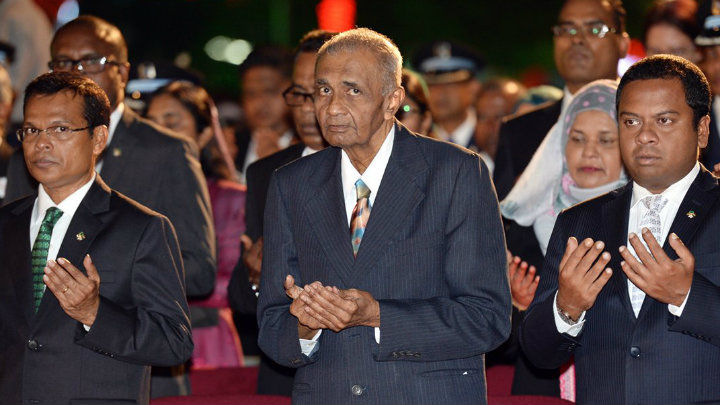
Noting India had remained the Maldives’ most important development partner, Sattar stressed the need to keep up good relationships with neighbours and the need for a non-aligned foreign policy.
“It was the time of the Cold War. A non-aligned policy is important, not just then, but now as well. At the time, the government thought if we were to favour one side, it will bring about issues for us, as a small and newly independent nation,” he said.
With independence, Maldives had only two missions – in Sri Lanka and Washington. Nasir pursued a tight fiscal policy and did not want to open more embassies. “He didn’t like the idea of borrowing. He wanted to spend within our means.” That meant development was slow, but Nasir laid good foundations, Sattar said.
“Most of what we see today was started in his tenure. Tourism, broadcasting, British medium instruction, road construction, dealing with communicable diseases, and building an airport, everyone, nationwide, participated in the construction of the airport. Nationwide, people contributed labour to the project. That opened us up to the world.”
After serving as prime minister from 1957 to 1967, Nasir served as the president of the Maldives from 1967 to 1978. His successor, Maumoon Abdul Gayoom, stripped him of his property, tried and sentenced him in absentia for alleged corruption. Nasir died in exile in Singapore in 2008, soon after Mohamed Nasheed assumed power. His body was brought back to the Maldives and given a state funeral.
“Nasir’s legacy was buried. He was the president here. Everything he did was definitely not bad. The transition from Nasir to Maumoon was very smooth, but what followed was another matter. It was not very nice, it really went out of limits,” Sattar said.
At fifty years of independence, the country is badly in need of healing, for numerous wrongs done by various leaders to individuals and communities, Sattar said. He believes civil society organizations, rather than politicians, must lead the process.
“Political stability must be there. The people should decide on who rules them. If not, there will be frequent changes in the leadership and arbitrary actions. We need continuity,” he said.
Sattar’s biggest worry today is the growing crime rate in the Maldives.
“The crime rate, drug abuse, these are major issues. I even pray for a solution to these problems. The crime rate is saddening. Just 15 years ago, I had heard of only one murder. Now it’s one murder a week. These are issues related to drugs and gangs. We must resolve them. We may not have a completely crime free Maldives, but these must be controlled with strict actions,” he said.
Reflecting back on the fifty years since Maldives gained independence, Sattar said there is much we could have done better.
“I’d like to compare [Maldives] with Singapore, which received independence at the same time as we did. It is also a very small country with very few natural resources and a small population. Compared to Singapore, we received a lot of foreign currency through tourism, but I think we could have done better. They even had to import water. But look where they are today,” he said.
“Even if we were unable to develop at the same level as they did, we could have done better.”
The following is a timeline of important events in the story of independence with commentary from historian Mohamed Shathir:
For Shathir, two key events in the early 1960s heralded the Maldives’ independence from the British: the expulsion of the Borah traders from Malé and the suppression of a revolt in the southern atolls.
Reclaiming control over the economy after 105 years and reunifying the country showed the Maldives had “the courage to secure full independence,” Shathir told the Maldives Independent.
“National spirit and unity was very strong then. It’s notable that everyone was united and came together,” he observed. “So that makes it easier for rulers. If there were big divisions over it in the country, it couldn’t have been done.”
Antiquity to mid-1880s – Historical records show that the Maldives was first settled about 2,500 years ago.
The territory of the Maldives stretched from Minicoy in the north to Addu atoll in the south during the reign of King Sri Mahabarana (1120 AD to 1142 AD). The King reclaimed Minicoy and Bodu Thiladhunmathi atoll from the Chola Empire.
The Maldives converted to Islam in 1153 AD during the reign of King Sri Tribuvana Aditiya, who adopted the name Mohamed Ibn Abdulla and sent missionaries across the country to spread Islam.
In its millennia-long history, the Maldives only lost its independence and sovereignty twice. The Maldives was under Portuguese colonial rule from May 19, 1558 to July 2, 1573. The Malabars from South India conquered and ruled the Maldives from December 20, 1752 to April 7, 1753.
The Maldives has a proud history of independence. There are only a few countries in the world with such a long history of independent self-rule, Shathir said.
December 16, 1887 – Maldives becomes British protectorate.
By the mid-1880s, India and Ceylon were under British imperial rule. The Maldivian government paid a ceremonial annual tribute first to the Dutch and then the British based in Ceylon.
The Borah traders from the neighbouring countries had taken over the Maldivian economy during the reign of King Imadudheen IV (Muskulhi Bandaarain) with the backing of the British.
The political rivalry between two royal families led by Athireege Ibrahim Didi and Kakaage Mohamed Rannabadeyri Kilegefaanu allowed the British to intervene in domestic affairs.
In late 1886, Ibrahim Didi or Dhoshimeyna Kilegefaanu deposed the Sultan, who was replaced with Mohamed Mueenudeen III, known as Kuda Bandarain.
The Maldives became a British protectorate with the cooperation of the Athireege family, which had ties to the British.
The formal acceptance of protectorate status followed the state’s bankruptcy and politically motivated arson campaigns in Malé.
The Maldives had already lost economic independence to the Borah traders and lost its independence on foreign affairs when it became a British protectorate.
December 22, 1932 – First written constitution adopted.
The British were involved in drafting the constitution and the Governor in Ceylon had arrived in the Maldives prior to its adoption.
1941 – Britain establishes military base on Addu atoll Gan during the second World War. The British were also stationed in Dhoonidhoo near Malé and in Haa Alif Kelaa.
April 24, 1948 – Maldives signs agreement with Britain for independence in domestic or internal affairs.
Since the Maldives became a protectorate, the British were involved in domestic affairs and had to be consulted on matters of succession to the throne. The British had also compiled a report on the deposing of King Shamshudheen in 1903.
In the late 1950s, during Prime Minister Nasir’s rule, Maldivians were granted more individual liberty and freedom than before, including the right for the common people to wear sandals and use umbrellas and for women to visit local and foreign-owned shops. The prevailing culture of class or caste system was slowly eroding.
Nasir also introduced wages for government employees in the atolls. On January 1, 1959, Nasir discontinued the practice of paying atoll and island chiefs with a portion of the fish catch.
The Gregorian calendar was adopted on January 1, 1958 and the Olympus theatre was opened on May 21, 1959.
March 1959 – Three southern atolls – Addu, Fuvahmulah, and Huvadhoo – secede from the Maldives and declare the United Suvadive Republic.
The southern rebellion took place amidst a dispute over a British military base on the island of Gan in Addu atoll.
In July, Nasir led an armed expedition to Huvadhoo atoll and makes mass arrests on the island of Thinadhoo. The Malé government began negotiations with the British over the Gan military base.
Nasir’s predecessor thought it was in the best interest of the Maldives as a small island nation to remain under the protection of a world power. He had leased Gan to the British for 100 years in 1957, but the agreement was not approved by the Maldivian parliament.
Nasir, who was 30 years old when he became prime minister, believed the time was ripe for the Maldives to become an independent nation.
January 1960 – The Suvadive Republic is formally established with Afeef Didi as its head.
February 1960 – The Malé government signs an agreement with the British to lease Gan island and the Maamendhoo area of Hithadhoo for 30 years.
The British government recognizes the Sultan as the Maldivian head of state and reaffirms the ‘UK government’s desire and concern to promote an early reconciliation between the inhabitants of Addu atoll and the government of His Highness the Sultan.’
The Suvadive Republic agrees to accept the sultan of Maldives as their head of state in Addu.
British representative Humphrey Arthington-Davy arrives in Malé and is based on nearby Dhoonidhoo Island
February 3, 1962 – Nasir leads a second attack against Thinadhoo and depopulates the island. A violent demonstration occurs in Gan, rejecting British attempts to restore the southernmost atoll to rule by the capital.
Shathir believes that Nasir’s actions in quelling the secessionist movement must be judged in the context of his time and Maldivian traditions.
“We have to view it as a militaristic exercise to reclaim a part of the Maldives that had broken away,” he suggested.
People sometimes refer to the depopulation of Thinadhoo, without sparing women and children, as cruel and excessive, but Shathir said he believes it should be weighed in consideration of the circumstances of the time.
August 1, 1962 – After 105 years, the Borah traders are banned from doing business and are forced to leave the Maldives.
The Borah traders had links to prominent members of Maldivian society and were based in the country. Young members of the cabinet and parliament at the time pushed for the move. But it did not prove easy under Prime Minister Ibrahim Faamdheyri Kilegefaanu. Efforts to force out the Borah traders began when Ibrahim Nasir became Prime Minister on December 12, 1957.
The British did not attempt to stop the eviction.
September 1963 – The British agree to return Addu to Malé control by the end of the year. Afeef and his supporters agree to end the revolt. Afeef and his family are taken to Seychelles by the British.
Nasir demands independence as a further price of the Addu facilities. The Maldives joins the Colombo Plan.
July 26, 1965 – Prime Minister Ibrahim Nasir signs independence agreement with the British. The population of the Maldives at the time was 97,743.
After the end of the World War, both India and Sri Lanka secured independence from the British.
The main event that led to the Maldives seeking independence was the secession of three southern atolls and the short-lived Suvadive Republic from 1959 to 1963.
The agreement was reached following discussions between the Maldives representative in Sri Lanka, Abdul Sattar Moosa Didi, and Humphrey Arthington-Davy, the British representative.
The public also staged protests against the British before the agreement was signed.
Less than two months after securing independence, Nasir secured membership in the United Nations on September 21, 1965. The Maldivian flag was raised at the UN headquarters on October 12, 1965.
The first Maldivian permanent representative to the UN was Ahmed Hilmy Didi, a minister at the time, who had served as representative to Ceylon under President Mohamed Ameen.
Discussion
No comments yet. Be the first to share your thoughts!
No comments yet. Be the first to join the conversation!
Join the Conversation
Sign in to share your thoughts under an alias and take part in the discussion. Independent journalism thrives on open, respectful debate — your voice matters.
Support Independent Journalism
Help us keep the news free and fearless
Give once
$
or
Become a memberfrom $5/month