
RTI data reveals scale of student payment problems ministry says it cannot fully count
Over 100 complaints logged, but no figures on actual payment delays.

Artwork: Dosain
17 Feb, 16:03
The higher education ministry logged 63 complaints from scholarship and student loan recipients about payment delays in 2024, followed by at least 42 complaints in 2025, according to data released under a right to information request by the Maldives Independent.
Contrary to previous denials, the ministry admitted to ticket reimbursement claims stretching back three to five months. It conceded late payments of stipends but declined to disclose how many students were affected.
"While the exact number of complaints might not be determined, there have been reports from students that their stipends were not disbursed on the scheduled date," the ministry said.
The concerns outlined in Kudu's report included months-long delays in providing stipends as well as reimbursement for tickets and other expenses; lack of response to emails and unclear answers on WhatsApp; inadequate stipends that are unadjusted for inflation; and Australian universities suspending students' accounts and blocking enrolment to classes due to ministry's failure to pay course fees.
Scholarship students at three Australian universities – University of New South Wales, Curtin, and Monash – had their accounts sanctioned or scholarships cancelled because the ministry failed to pay tuition fees on time.
A day before Kudu went to the ministry in person to press for answers, a ministry official denied having received any complaints about payments owed to Australian universities. But Haidar later told Sun that the ministry was working to resolve stipend delays "this week." The minister said students who had submitted complete documentation would receive their payments.
On a podcast with the president's spokeswoman on January 19, Haidar blamed payment delays on students failing to submit the required documents in advance. In each cycle, payments are processed two months ahead of the deadline and the ministry needs to verify information submitted by students and confirm whether the student is undertaking study at their university, he said. Haidar claimed that 75 percent of stipend and tuition fee payments were processed without delay.
On February 3, the higher education ministry launched a portal to streamline the disbursement of scholarships and student loans. The "Kuri" portal will allow students to track their financial transactions in real time, check eligibility for scholarships and funding schemes, and submit documentation digitally, the ministry said.
Haidar acknowledged delays that disrupted students' education and created financial hardships. The ministry said more than 320 students had been provided with stipends in the January to June 2026 cycle as of February 8, but did not say how many were paid on time.
President Dr Mohamed Muizzu echoed the admission in his address to parliament on February 5, touting the portal as a "permanent solution" to the difficulties students face in obtaining payments by automating processes. He said it would replace the ministry's manual payment voucher system with a direct link to the government's SAP financial system, enable real-time tracking, and eliminate the need for students to repeatedly resubmit documents. Certificates and information will only have to be verified once, award letters will be generated after immediate automated evaluation, and students can use electronic signatures on automatically prepared agreements and payment schedules. An AI chatbot in Dhivehi and English would provide instant answers, he said.
Rates, gaps, and unanswered questions
The portal was presented as a remedy to manual processes causing payment delays, repeated requests for the same paperwork, and unanswered communications. But it fails to address structural issues raised by the complaints: stipend rates that students say have been frozen for years, and the gap between Australian stipends and visa requirements.
Students in other countries said stipend rates had not changed in a decade and no longer covered basic living costs. A scholarship recipient in Malaysia said the amount had remained unchanged for nearly 10 years "without any adjustment for the rising cost of living." A student heading to the UK said the stipend covered less than half of what British immigration rules recommend.
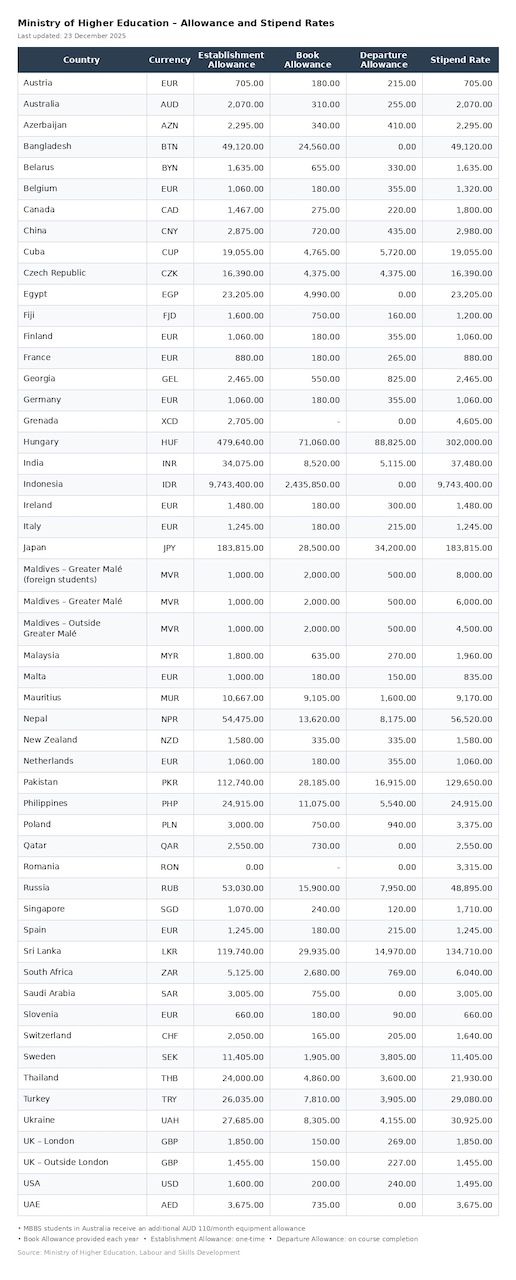
Australia's Department of Home Affairs requires international students to demonstrate access to at least A$ 29,710 per year for living expenses. The figure was updated in May 2024 to reflect rising costs. But the Maldives government scholarship provides A$ 2,070 per month, or A$ 24,840 per year. Students must account for the shortfall of A$ 4,870 annually, about MVR 50,000 (US$ 3,240), to satisfy visa requirements.
The ministry's RTI response did not address the gap when asked, answering about visa application fees rather than the financial capacity threshold.
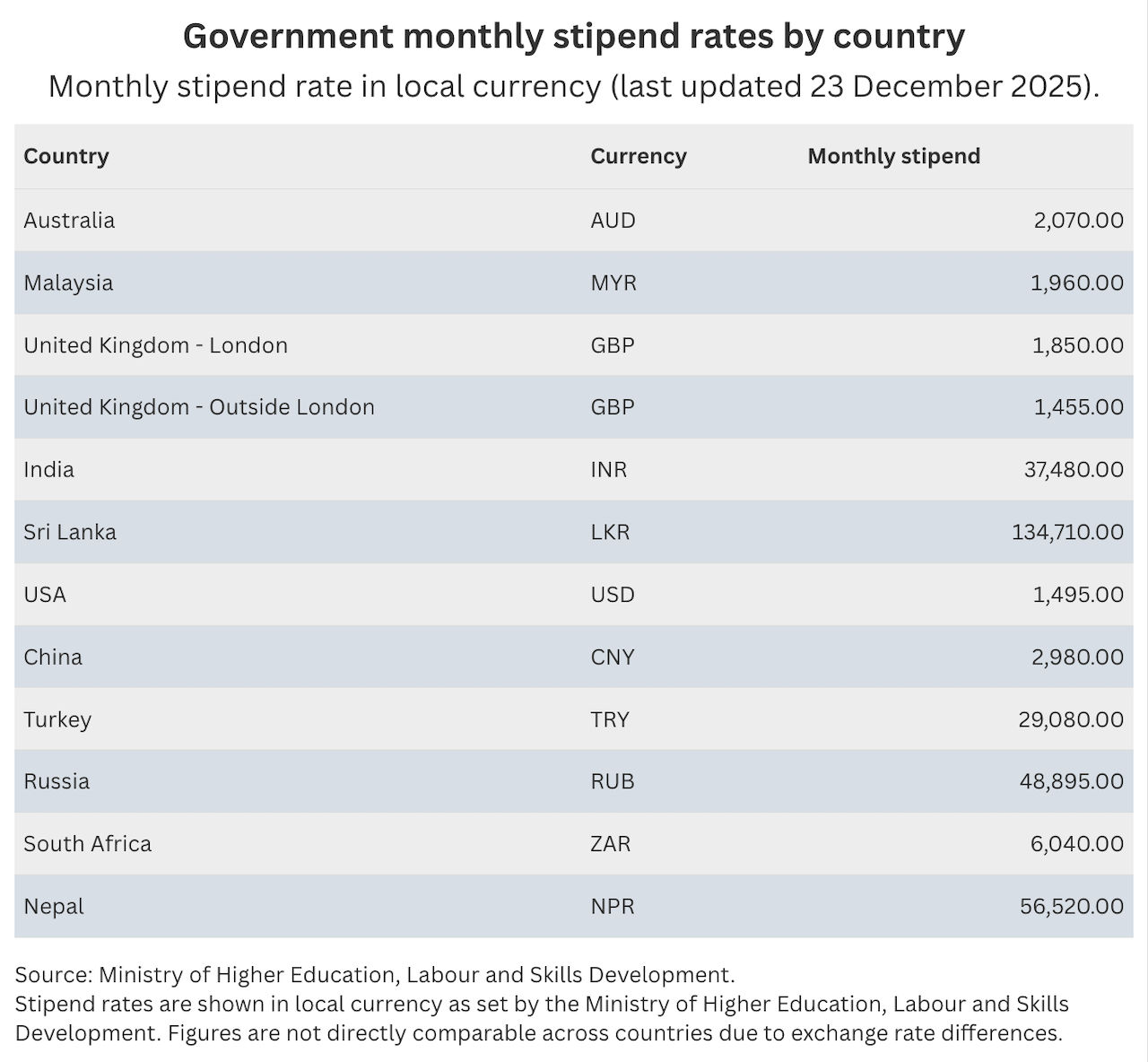
However, the ministry did provide a schedule of allowances and stipend rates dated December 23. The rates confirmed the A$ 5,000 shortfall for Australian student visas. In the UK, the stipend is £ 1,455 per month outside London.
"To determine stipend rates across multiple regions, we conduct bulk reviews by cross-referencing data from official national and academic websites," the ministry said.
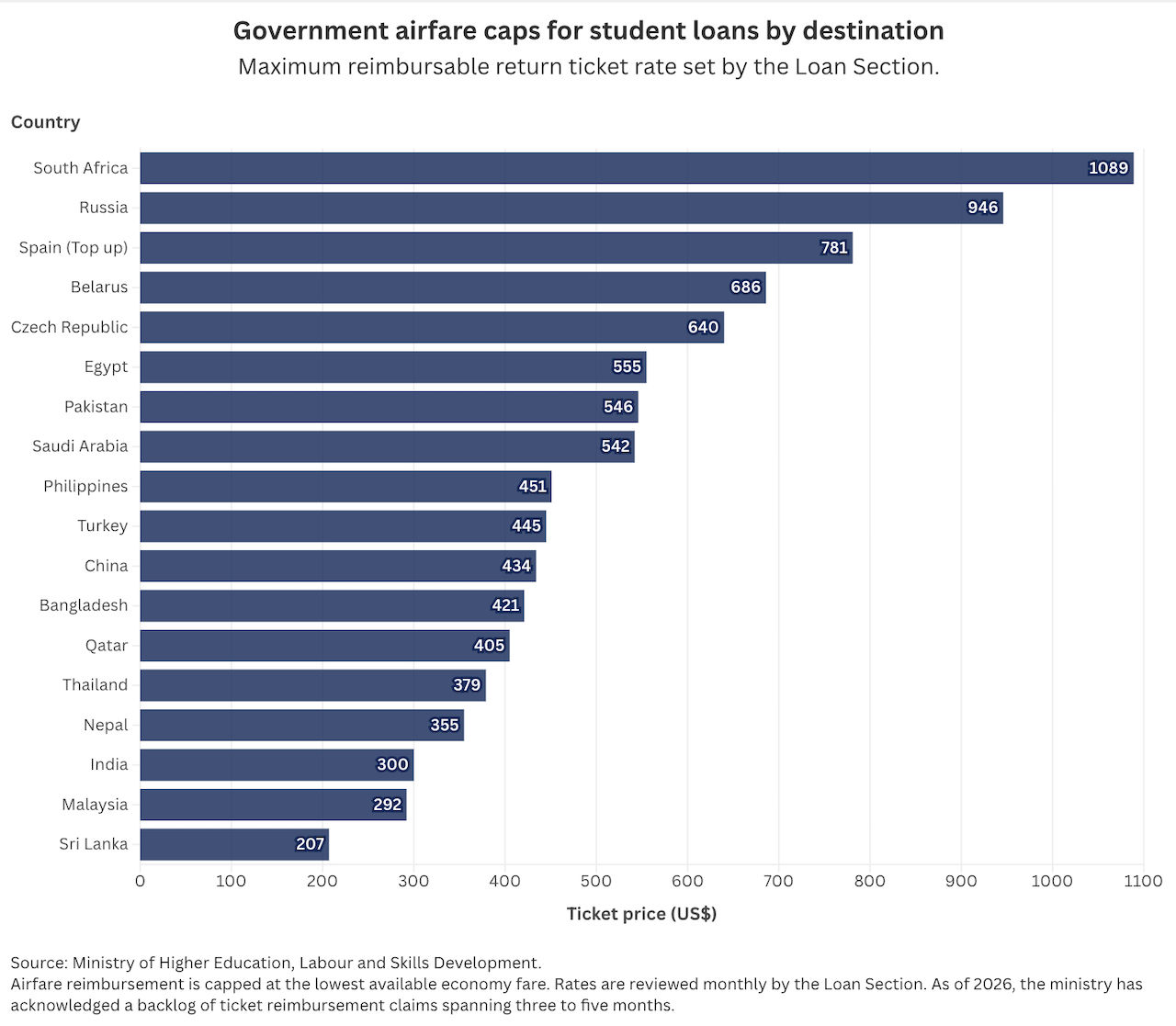
For visa application fees, the ministry either covers the payment or offers reimbursement. If students need to travel abroad to obtain the visa, the ministry provides a return ticket with funds to cover accommodation and other expenses for three days. The rates vary depending on the country or city.
While the visa fee is covered under the loan scheme, travel costs are not included, the ministry noted. "To claim the visa fee, the student must submit the visa fee receipt, after which the amount will be reimbursed," it said. The ministry's loan section set airfare rates after conducting monthly checks of ticket prices.
"As of 2026, we currently have a backlog of ticket reimbursement requests spanning the past three to five months," the ministry said.
Asked how many students received tuition fees after the payment deadline, the ministry did not provide any figures.
"We process the invoice once we receive it from either the student or university. Delays in processing and depositing the tuition fee payments occur mainly due to the issues in bank details forms," it said.
The answer was similar when asked about stipend payments delayed by more than 30 days beyond the scheduled disbursement date: "We process the stipend once we receive the request from the student (stipend payments are processed in two semi-annual cycles: January to June and July to December.) Delays in processing and depositing the stipend occur mainly due to the issues in the student bank details forms. Where all required information has been duly submitted and verified, the deposit of payments is not routinely delayed."
According to the latest fiscal update, a total of MVR 603 million out of MVR 768 million budgeted for the student loan scheme in 2025 was disbursed by December 31, down from MVR 700 million in the same period last year. Disbursements fell despite the government expanding the number of loan recipients by awarding loans to all eligible applicants.
Where the students are
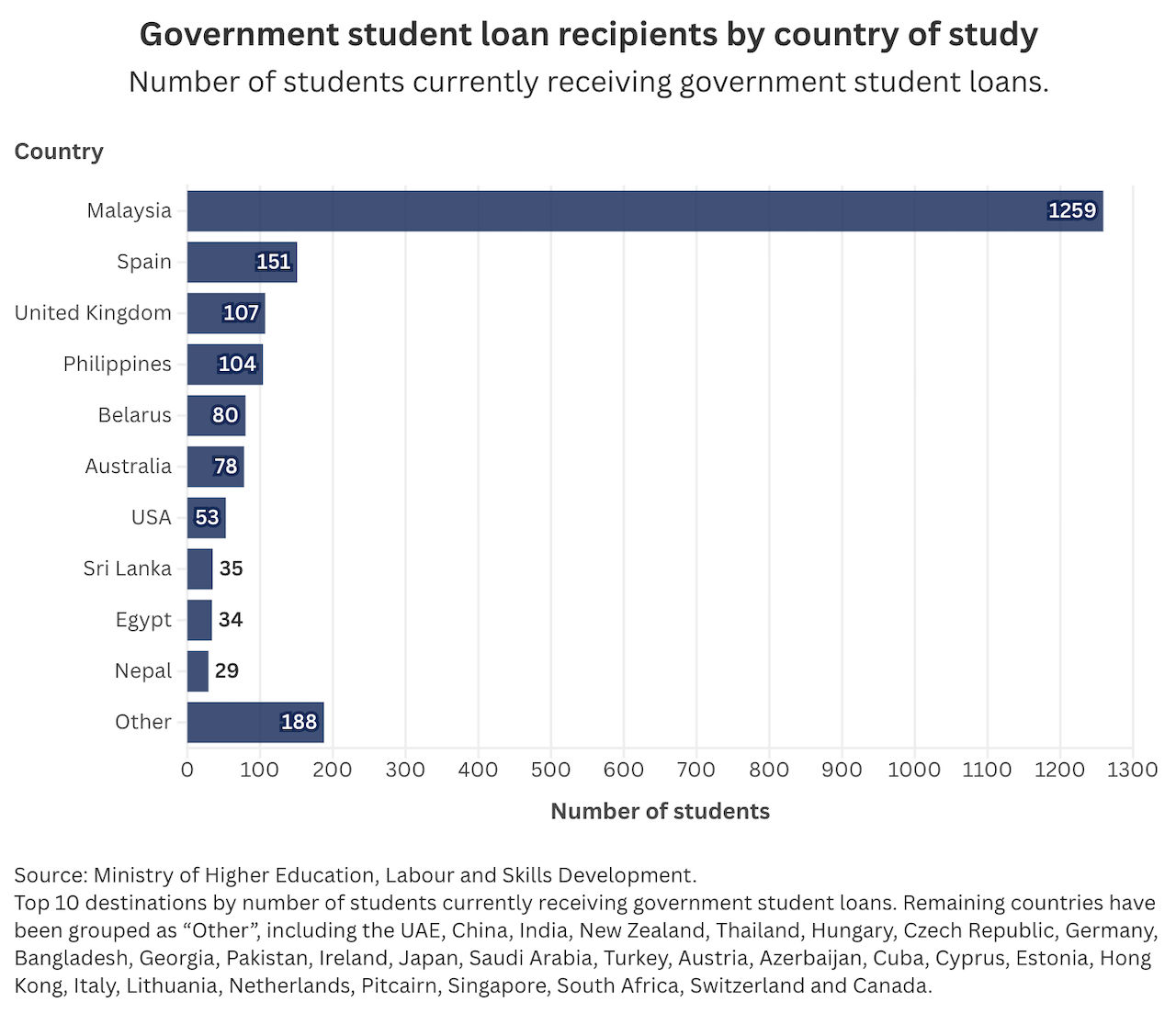
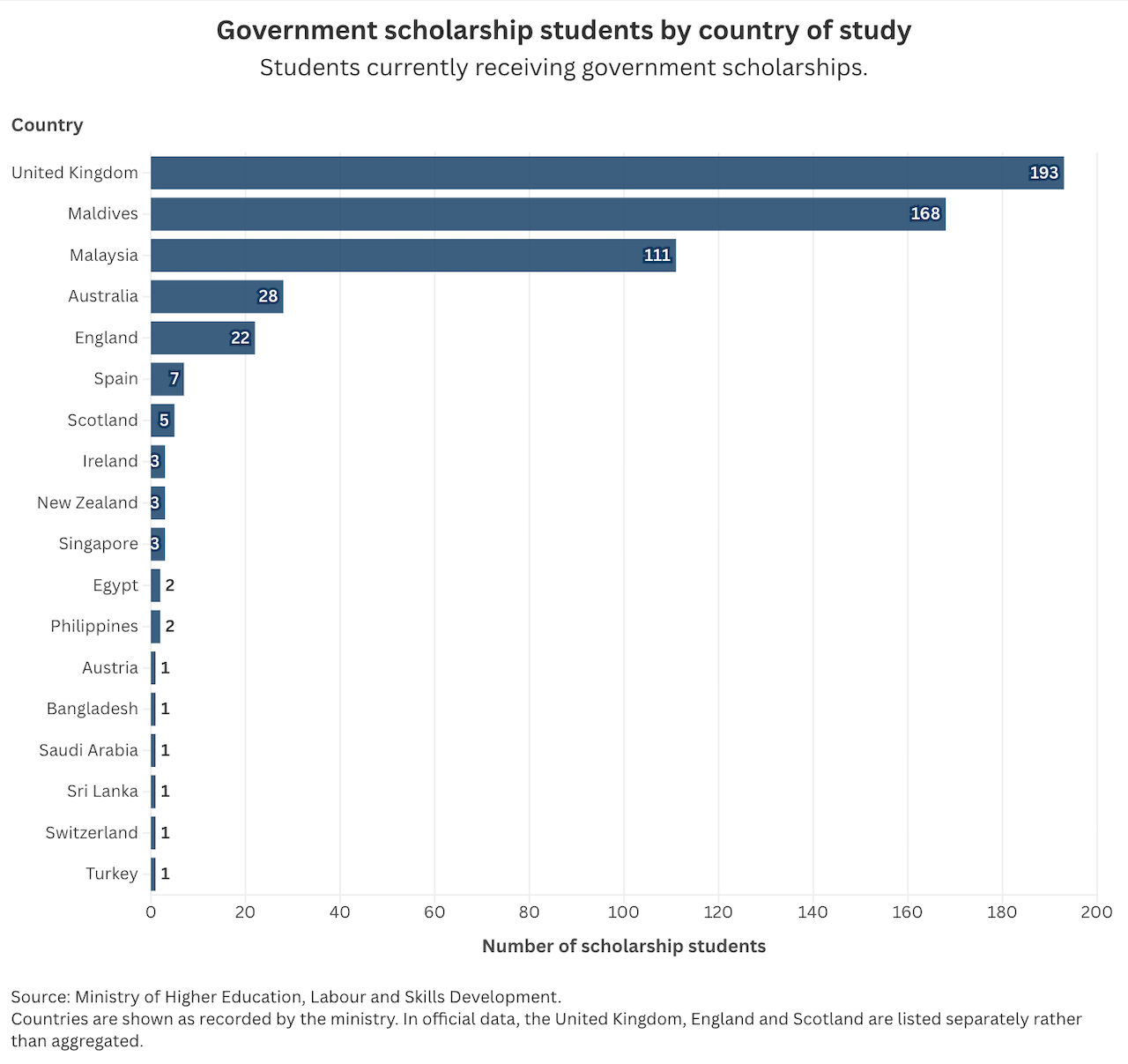
The RTI response provided a detailed picture of the scale of government-funded higher education in the Maldives and overseas. A total of 2,274 students are currently on student loans across 40 countries. A further 553 students in 18 countries separately hold government scholarships.
Malaysia accounts for the largest share of loan recipients by a significant margin with 1,259 students, more than half the entire loan programme. There are 156 students in the Maldives, 151 students in Spain, 107 in the United Kingdom, 104 in the Philippines, 80 in Belarus, 78 in Australia and 53 in the United States.
The UK has the largest cohort of students on scholarships at 193, followed by Malaysia with 111 and Australia with 28.
The figures differ from those provided to Mihaaru in a separate RTI request, which put the total number of students abroad on loans and scholarships at 1,819, roughly 700 fewer than the data provided to the Maldives Independent. The reasons for the discrepancy are unclear.
Discussion
No comments yet. Be the first to share your thoughts!
No comments yet. Be the first to join the conversation!
Join the Conversation
Sign in to share your thoughts under an alias and take part in the discussion. Independent journalism thrives on open, respectful debate — your voice matters.
Support Independent Journalism
Help us keep the news free and fearless
Give once
$
or
Become a memberfrom $5/month