

Things fall apart; the hemline cannot rise.
Let her do her job. Stop measuring her hemline.
Artwork: Dosain
04 Jan, 10:07
“Things fall apart; the centre cannot hold.” World War I had upended the old order, the Bolshevik Revolution was remaking another, Ireland was in political turmoil, the Spanish flu was at his doorstep. W. B. Yeats was staring down catastrophe. The year was 1919. On December 30, 2025, someone in the Maldivian government was measuring hemlines.
Perhaps, in the shadow of what Yeats was confronting, our 2026 troubles here in the Maldives are not so grave, our crises not so existential. But our lives are our lives. Our pond is our pond, however small. And in this pond, while the centre frays and the foundations crack, the government has found something it can hold onto: the hemline. The hemline it can measure. The hemline it can regulate. The hemline it can control. Women’s hemline.
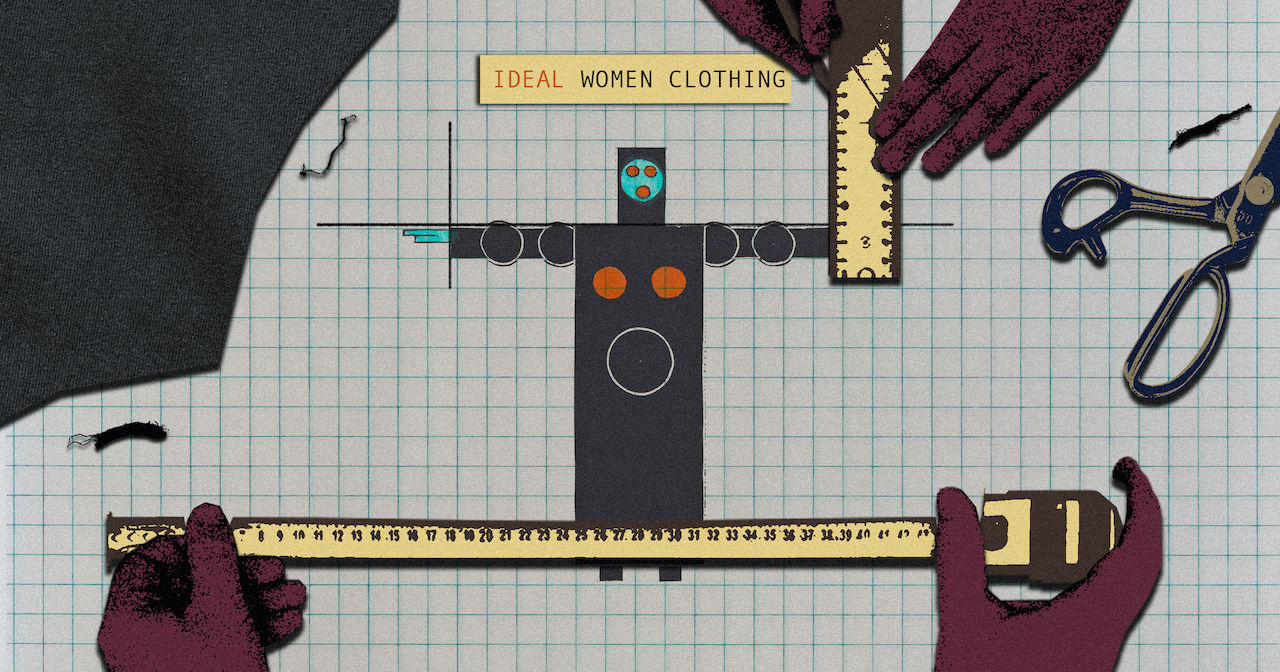
The Civil Service Commission published an amended dress code for government employees, specifying the length of women’s skirts, the coverage of their chests and hips, the permissible depth of sleeve, and what parts of their bodies may or may not be visible when they raise their arms. Women who show their hair are barred from dyeing their hair any colour other than black.
The justification offered is almost comical. According to reports, the changes came after a resident raised concerns at one of President Dr Mohamed Muizzu’s ward meetings about a “decline in the appearance and professionalism” of government staff. One complaint. One person’s opinion. And from this, a regulation governing the bodies of thousands of women.
Consider what else has been said at those meetings, and for decades before them. People have complained, government after government, about services from these offices, about corruption, about the bribes required to get a driving licence, to register a garage, to lease public land, to clear goods through customs, to get quotas for workers, to get a permit, to get a signature, to get almost any service at all. About waiting times, about a lack of response, about services that never reach the islands. In the president’s town hall meetings people have complained about healthcare, about jobs, about businesses, about housing, about the cost of living. None of that has prompted this kind of swift, decisive action. But mention women and their body parts and someone somewhere in the machinery has snapped to attention.
If there is a hierarchy of things that preoccupy my mind, top billing goes to this government’s assault on democratic institutions, whether the institutions will hold, the economy unravelling under its watch, the little regard this administration shows for investing in human development, in long-term development. Almost everyone I know is preoccupied with the same. The country is preoccupied with the same. Public debt spiralling with no game plan in sight. Government borrowing crowding out the private sector. Corruption metastasising, state-owned enterprises multiplying and haemorrhaging public funds. Jobs dispensed for loyalty rather than competence, Aasandha scaled back. Malé choking on congestion, any community, any island beyond Malé, neglected decade after decade. The status of women stagnant, no policy, no debate, no interest. The environment being gutted, no foresight, no regard for what comes next.
The government, instead, is preoccupied with what women should wear.
The civil service employs 30,287. Of these, 67.5 percent are women. The women cleaning the streets at dawn and again at dusk. The nurses. The teachers. The secretaries. The administrators. The directors and the directors general. These are the women who keep this country running. They have always been reasonably and professionally dressed. We expect a certain level of professional attire in our public offices, from women and men, and we have that. Fashion changes. Women now tuck in their shirts. Our aunts went to work in a salwar kameez. Our mothers went to work in a saree. What the people waiting in line are complaining about is not what these women are wearing. The length of their hemlines, the colour of their hair, has never interfered with the work they do, the hours they put in.
Ever since this regulation came out, nearly every commentator has said the same thing. This is not what we need from government.
Here is what we do need. The vision and leadership to see the civil service not as machinery to serve the administration, but as the apparatus that serves the people. Start from there, and everything changes. Build a culture of accountability where failure to deliver has consequences. Measure performance by what is delivered to citizens, not hours logged. Build transparency into every service, digitise even further, both of which save time and tackle bribery. Cut red tape. Slash response times. Decentralise even more services. Resource offices properly. Train staff. Make it easier, faster, fairer for every citizen who needs something from the state.
We have already made great strides, so we know how to do it. Passport applications processed in a day. Business registration, licences, tax filing, all online. Aasandha, court filings, land registration, pension queries, national ID renewals, all through digital portals. OneGov bringing services together in one place. The infrastructure exists. Work on that. Not rulers measuring helmline.
From school uniforms to civil service dress codes, this administration’s preoccupation with what women wear is clear. The link to improved governance or better outcomes for the people, however, is not.
Regulating what women wear does not deliver services to islands that have waited decades. It does not fix the economy. It does not protect the environment. It does not advance gender equality.
This is state-sponsored harassment, this is the corridors of power forcing women’s bodies into public debate at every café, every street corner, every family gathering. Objectification as policy.
But this is not about policy. This is about control, and the hemline is only where it starts.
The government needs to occupy itself with the business of governance. With housing. With healthcare. With education. With the economy. With creating opportunities for our young men and women. With running this country, and running it with respect for the men and women it is elected to serve. Not with this small, petty, gendered business of telling women what to wear. Let her choose what she wants to wear. Let her cover herself, if she wants. Let her tuck her shirt in, if she wants. Let her do her job. Government should try doing theirs.
Eva Abdulla is a former deputy speaker of parliament and three-term lawmaker who represented the Galolhu North constituency in Malé.
All comment pieces are the sole view of the author and do not reflect the editorial policy of the Maldives Independent. If you would like to write an opinion piece, please send proposals to editorial@maldivesindependent.com.
Discussion
No comments yet. Be the first to share your thoughts!
No comments yet. Be the first to join the conversation!
Join the Conversation
Sign in to share your thoughts under an alias and take part in the discussion. Independent journalism thrives on open, respectful debate — your voice matters.
Support Independent Journalism
Help us keep the news free and fearless
Give once
$
or
Become a memberfrom $5/month

