
Opinion

Crossing the chasm: the adoption lifecycle of Maldivian democracy

Voters now act like demanding customers, ready to switch brands at the next election.
Artwork: Dosain

Artwork: Dosain

1 hour ago
The seminal book on marketing by Geoffrey Moore, ‘Crossing the Chasm; Marketing and Selling Disruptive Products to Mainstream Customers,' was first published in 1991. The central thesis outlined in the book is that a significant "chasm" exists in the Technology Adoption Life Cycle – specifically between Early Adopters (Visionaries) and the Early Majority (Pragmatists) – where most disruptive innovations fail to gain traction.
Applying Geoffrey Moore’s “Crossing the Chasm” framework to the Maldivian democratic journey offers a fascinating look at how a society transitions from a 30-year autocracy to a hyper-active multiparty system. In this context, "Democracy" is the discontinuous innovation  a product that requires the population to change their behavior and beliefs fundamentally.

The adoption lifecycle

1. The Innovators & Early Adopters (2003–2008)
The Psychographics: These were the "technophiles" of political reform – activists, journalists, and the exiled elite who believed in the logic of democracy regardless of the risk.

Notable Leaders: Mohamed Nasheed (Anni) and Mohamed Latheef.

The Movement: The "Black Friday" protests of 2004 served as the "alpha test." When the Maldivian Democratic Party (MDP) was officially registered in 2005 (after a brief period of being "unauthorised"), it captured the visionaries who wanted a "New Maldives."

Affiliations: The MDP was the primary vehicle, while Maumoon Abdul Gayoom countered with the Dhivehi Rayyithunge Party (DRP) to retain his base.

2. The First Attempt to "Cross the Chasm" (2008–2012)
In Moore’s terms, the Chasm is the gap between the Visionaries (who want change) and the Early Majority (Pragmatists who want stability and results).

The 2008 Election: Nasheed’s victory (54 percent in the runoff) was the jump into the chasm. He offered a "Vision," but the "Whole Product" – a functioning state with a stable economy and independent judiciary – wasn't fully built yet.

The Fall: Pragmatists (civil servants, rural elders, business owners) became skeptical when the "innovation" (democracy) led to street protests, currency devaluation, and religious friction. This culminated in Nasheed’s controversial resignation in 2012.

3. The "Pragmatist" Pivot (2013–2018)
The Early Majority often retreats to what is "proven" if an innovation feels too "buggy" (in software and technology terms buggy usually means it does not work correctly, is prone to crashing, is slow, or behaves unpredictably – making it unstable). 

Notable Leader: Abdulla Yameen.

The Strategy: Yameen’s Progressive Party of Maldives (PPM) pitched "Stability and Development" over "Liberal Values." This appealed to the pragmatists who preferred infrastructure (the Sinamalé Bridge) over the perceived "chaos" of democratic activism.

The Chasm Widens: By 2018, however, the "product" became too authoritarian for many, leading to a massive coalition of pragmatists and visionaries.

4. Market Standardization (2018–2026)
Democracy is now the "standard" in the Maldives. No leader can feasibly claim legitimacy without an election. We are currently seeing the Late Majority (Conservatives) participate fully in the system.

Notable Leaders: Ibrahim Mohamed Solih (The Stabiliser) and Mohamed Muizzu (The Current President).

2023/2024 Shift: Muizzu’s People's National Congress (PNC) successfully won over the "Early and Late Majority" by combining Yameen’s infrastructure focus with a disciplined, "stable" democratic campaign.
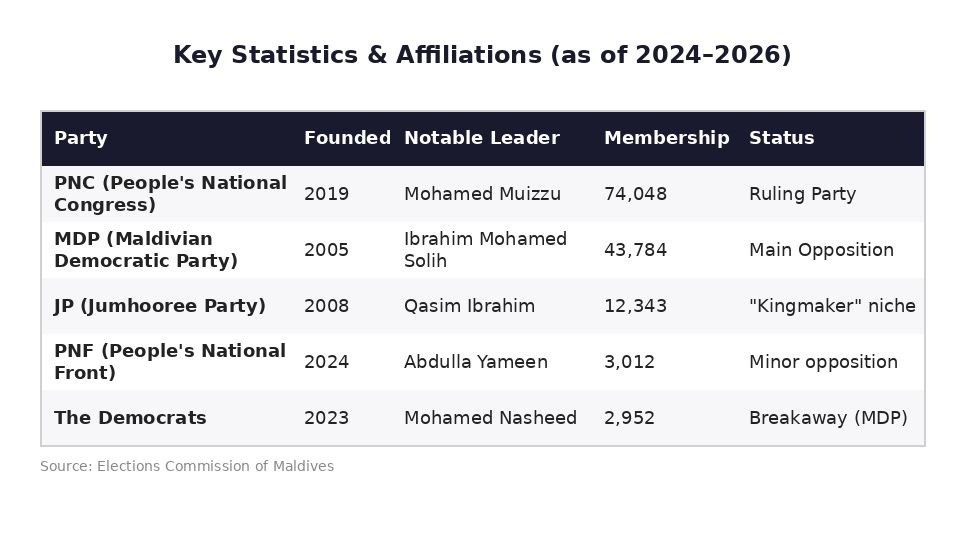
Key Statistics & Affiliations (as of 2024–2026)
The following table reflects the "Market Share" of these political "products" based on the latest registration and election data.
Historical Election Benchmarks:

2008: First multi-party election. Nasheed wins 54.2 percent (Runoff).

2018: Solih wins 58.3 percent (First round) as a "Joint Opposition" candidate.

2023: Muizzu wins 54 percent (Runoff), demonstrating the PNC's dominance in the "mainstream market."

2024: Parliamentary Election – PNC secures a "Super Majority" (66+ seats), effectively ending the fragmented "Chasm" era and entering a period of consolidated governance.

Has the chasm been crossed?

Yes. The Maldives has moved past the "Visionary" stage where democracy was a radical idea. It is now in the Mainstream stage. However, as Moore warns, once you cross the chasm, the challenge is Product Leadership. Voters now act like demanding customers: if the "Democratic Government" (regardless of party) doesn't deliver tangible "upgrades" like housing, lower costs of living, and sovereignty, they will "switch brands" at the next election.
Do you think the current consolidation of power under the PNC suggests a move toward a "one-party dominant" standard, or is the Maldivian "customer" too prone to brand-switching for that to last?
Mohamed Mamduh is a co-founder of Hotelier Maldives and presently managing editor at Maldives Wellness Reviewand managing partner at Maldives Wellness Promoters, a company that markets the Maldives for wellness travellers. 
All comment pieces are the sole view of the author and do not reflect the editorial policy of the Maldives Independent. If you would like to write an opinion piece, please send proposals to editorial@maldivesindependent.com.

Discussion

No comments yet. Be the first to share your thoughts!

No comments yet. Be the first to join the conversation!

Join the Conversation

Sign in to share your thoughts under an alias and take part in the discussion. Independent journalism thrives on open, respectful debate — your voice matters.

Support independent journalism

Explore more