
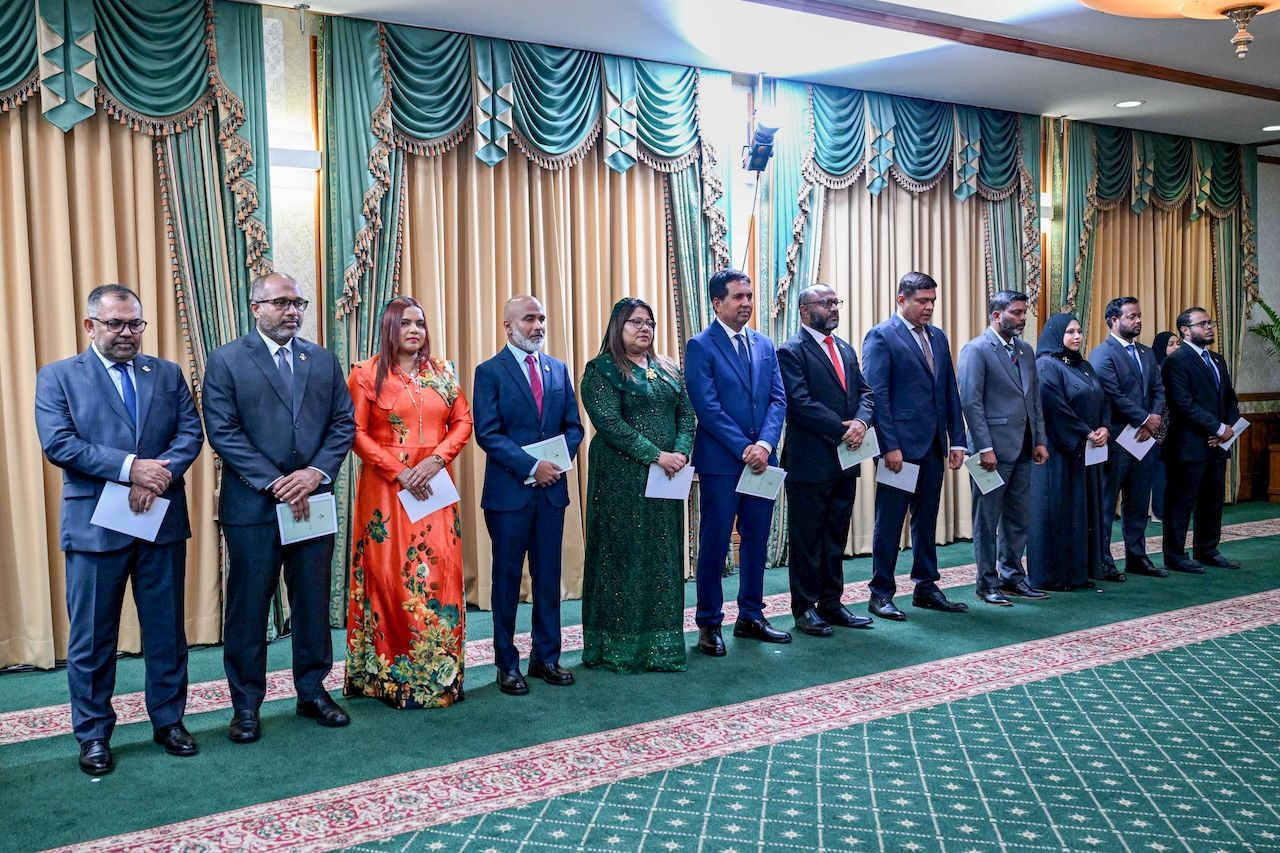
President Muizzu restructured the cabinet, reducing its size from 20 to 15, following the en masse resignation of 10 ministers. Those who stepped down included Defence Minister Mohamed Ghassan Maumoon, Foreign Minister Dr Abdulla Khaleel, Health Minister Abdulla Nazim Ibrahim, Tourism and Environment Minister Thoriq Ibrahim, Social and Family Development Minister Dr Aishath Shiham, Dhivehi Language, Culture and Heritage Minister Adam Naseer Ibrahim, Agriculture and Animal Welfare Minister Dr Maryam Mariya, Youth Minister Ibrahim Waheed, Local Government Minister Adam Shareef Umar, and Higher Education Minister Dr Ali Haidar Ahmed. The resignations were intended to pave the way for the president to implement reforms “he envisions in keeping with the aspirations of the people," the President’s Office said. Twelve ministers, including eight incumbents and four new appointees, were sworn in with revised portfolios around 7pm. Changes included reversing the merger of the tourism and environment ministries, while combining others. The new ministers are Iruthisham Adam as foreign minister, Geela Ali as minister of health, family and welfare, the president's spokeswoman Heena Waleed as minister of arts, culture and heritage, and climate envoy Ali Shareef as minister of climate change, environment and energy. Fisheries Minister Ahmed Shiyam and Attorney General Ahmed Usham were the only cabinet members whose portfolio remained unchanged. A new defence minister was not announced, and the post remains absent on the cabinet page.
Former President Nasheed called for the formation of an all-party transitional government to implement key structural reforms and ensure free and fair elections. He said the move was necessary because President Muizzu had lost confidence in his cabinet, the public had lost confidence in the president, and the Maldivian economy was beginning to feel the effects of the war in the Middle East.
The MDP issued a set of 12 demands to the government, announcing street protests. The demands range from the restoration of parliamentary, judicial, and local independence and the reversal of executive centralisation to demanding immediate corruption investigations, economic relief through fuel subsidies, and the protection of constitutional and environmental integrity. After the demands were announced at a press conference, acting chairman and MP Abdul Ghafoor Moosa called on President Muizzu to resign and hold early elections following the ruling party’s losses in the local council elections.
After nearly a year of delays, the reconstituted Supreme Court heard final arguments in a constitutional challenge to anti-defection provisions that allow political parties to unseat lawmakers. The state attorney argued the amendment does not grant parties unfettered power, saying it requires removals to be carried out “in accordance with the law,” and no such law has yet been enacted. Lawyers for petitioner Ali Hussain contended that the amendment does not state whether a new law needs to be enacted, saying it refers to the existing Political Parties Act, which gives parties discretion to remove members. Both sides also debated whether the amendment violates the constitution’s basic structure, with questions raised about the basic structure doctrine itself. Chief Justice Abdul Gani Mohamed declined to grant injunctions to halt enforcement of the amendment or to prevent the removal of Supreme Court justices before a verdict. The court said it would rule on the injunctions later and, unless further clarification is needed, deliver its judgement at the next hearing.
MDP parliamentary group leader Ibrahim Nazil delivered a scathing critique of President Muizzu’s state-of-the-nation address, calling it a “monochrome photocopy” of his speeches over the past two years. The president failed to address the country’s most pressing challenges or outline clear policies to tackle them, the minority leader said, criticising what he described as the government’s failure to deliver on key pledges, including housing, generating US$ 400 million in revenue through a development bank and bunkering services, establishing a financial centre, and reforming the Aasandha health insurance scheme.
The Maldives Media and Broadcasting Commission told Adhadhu that the online outlet is under investigation over a documentary featuring a former President’s Office staffer who alleged she had a sexual relationship with President Muizzu.
The State Electric Company urged contractors and developers to exercise greater caution around underground power cables during construction and road works. The company said a power outage in Hulhumalé Phase 2 on Sunday was caused by damage to a main power line during construction. STELCO said that it met with senior officials from the Housing Development Corporation to discuss measures to reduce the impact of such outages, including fast-tracking the planned “SCADA” system in Phase 2, repairing cables damaged in Sunday’s incident, and energising additional power lines installed by the contractor laying the power network in Phase 2.
The Maldives Qualifications Authority said students planning to study abroad can apply directly for a “Recognition of the Intended Programme” certificate to verify that their university and course are recognised. Some students have been using third-party agents charging high fees, with some ending up facing financial losses and failing to secure visas or attend classes, MQA said.
Environmental group Save the Beach Maldives raised concerns over plans to build three housing towers on a plot in Villimalé that hosts a rare grove of laurel-wood trees. The group said the grove is the only one of its kind in the Malé area, acting as a biodiversity hotspot that cools the island, stores carbon, and serves as a “living classroom” for students. Save the Beach questioned the logic of project's scope, warning that the development of three 17-floor towers would increase congestion, strain infrastructure, and reshape the island’s landscape. The group added the project is hard to justify given nearby reclaimed islands were meant to ease pressure on smaller islands like Villimalé.
Disqualified Hithadhoo North MP Mohamed Sinan said he will seek the ruling party’s ticket in the primary for the by-election for the vacant parliament seat.
Former STELCO Managing Director Hussain Fahmy was appointed to the vacant managing director post of the Malé Water and Sewerage Company.
Ibrahim Nishan Ahmed was appointed as the Health Protection Agency's new director general, following the retirement of former DG Maimoona Aboobakur. Nishan was previously the agency’s deputy director general.