
"I realised I could not return home for a very long time": Shahindha Ismail on six years in exile
From Black Friday to global human rights leadership.

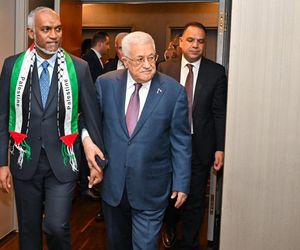
Artwork: Dosain. Photo: Nelson Cardenas.
25 Nov 2025, 17:52
Shahindha Ismail has not set foot in the Maldives since April 2019. The founder and executive director of the Maldivian Democracy Network left on a scholarship that year, intending to return within 12 months. Instead, when MDN was deregistered that December, a smear campaign and death threats made it clear she could not safely come home.
Six years later, speaking from Germany where she lives in exile, Shahindha remains defiant. MDN continues its work without legal recognition in the Maldives. In October, she was elected as one of four secretaries-general of FIDH (International Federation for Human Rights), joining the leadership of a global movement of nearly 200 human rights organisations.
In this interview, Shahindha discusses her journey from witnessing the 2004 Black Friday crackdown to two decades of human rights advocacy, the reality of leading an organisation from exile, and what keeps her fighting for a country she may never see again.
Maldives Independent: MDN began as the Maldivian Detainee Network in direct response to over 300 arrests during Black Friday. What did you see during those 22 hours of protest and its aftermath that made you decide this work would define the next two decades of your life??
Shahindha Ismail: The Black Friday was obviously, it was one of the most overwhelmingly violent and authoritarian incident[s] that I have seen in my life and it was the first. But my work was not really defined by the initial 22 hours or that particular incident.
After the gathering, I was first invited to volunteer for my brother Ibra [Ibrahim Ismail] in June that year – that was 2004 – at what was called the Office of the Malé MP. That was the office where a lot of planning and sort of the work was carried out from and everyone gathered there. And that was when I realised how dark this other side of the Maldives was.
I met a lot of activists in that office, many of the politicians of today. People came in asking for help. So through all of these people, I heard horror stories about what [former president] Maumoon [Abdul Gayoom] was doing to our country and to our people, and then I learned more from the Minivan Bahus debates that we organised in those days.
So those few months were worth an entire education for me and that's when I began my work. And I didn't really even know that I had begun my work then. After the arrests of Black Friday, I realised that the reason I was outside when almost everyone else were behind bars was purely luck. I was just outside of the protest at that given moment.
So after the arrests, we were just a handful of people who remained outside, and we just decided that we had to do something to help the people who were detained, right, and the families who had been struggling. So that is what I've been doing since then. I can't really pinpoint the moment, because it felt like I was just drawn into it from the very beginning.
You left the Maldives in April 2019 on a scholarship. When did you realise you couldn't return?
I left with the full intention of returning after a year, and then MDN was banned in December of that year. It was not the first time I have received death threats or been persecuted, but when the president and the commissioner of police repeatedly for months declared that we would not be spared, that we were enemies of the state, it was clear that they had no control over anything. They were being controlled by a bunch of religious fanatics, fanatics who had vowed that they would cut our heads off. So the moment I realised that we had made a huge mistake in electing an incompetent leader was also the moment I realised that I could not return home for a very long time.
The UN Human Rights Committee explicitly called for MDN's reinstatement in 2024, and you've filed appeals in Maldivian courts. After six years, do you still believe in engaging with Maldivian institutions, or has exile fundamentally changed your strategy?
No, it hasn't yet changed our strategy. Our appeals have only one goal, that is justice. We were deregistered without due process, and we will not stop until justice is served and the perpetrators held to account. The decision of the court or the government has no impact on our work.
Our work has not ceased for a single day since we started in 2004. So the whole appeal process will continue until we get justice.
You wrote "Gelluvaalee Mausoom Dhivehi Dharieh" about journalist Ahmed Rilwan's disappearance, and MDN has worked extensively on torture prevention, prison reform, and enforced disappearances. How do you decide which battles to fight when so many injustices demand attention?
The biography of Rilwan, I don't consider it work. It was something I did out of love and it was something necessary that somebody do. Because I refuse to let people or anyone silence Rilwan, or let his name or work be forgotten. So that is not part of my work.
But in terms of work, what I am able to do is nothing compared to what we need to do, and I would certainly not be able to do what I do without some very committed colleagues.
Some of whom have endured death threats and exile as well. We do as much as our resources will allow us. Resources that sadly do not come from our community. If local businesses and government companies employed corporate social responsibility to support civil society efforts for civil and political rights specifically, we would be able to do so much more for the people of Maldives.
Which begs the question, right? Why don't they contribute to it? But I don't decide the battles I fight. They are not my battles most of the time. I do what I can for people who struggle with their battles, and that is just how I was raised. My parents were the most generous people I have ever known, and I am always inspired by how they dedicated their lives to help others. So wherever I can be of help, I will strive to help people.
You completed a Reagan-Fascell fellowship researching violent extremism in the Maldives. What did that research reveal about the relationship between government repression and radicalisation?
Well, I think my research just confirmed what many of us probably already know, and that is that religion has always been a political tool in the Maldives. From Maumoon to [President Dr Mohamed] Muizzu, there has not been a genuine effort to prevent religious fundamentalism or violent extremism.
And it is because by using religion, religious fundamentalists play kingmaker between politicians and big businesses. I would take the 23rd December Iththihad for example. Call it what you want, but they were a violent mob that operated with full impunity. They opposed MDP [Maldivian Democratic Party] and they opposed [former president Mohamed] Nasheed's administration. They demanded that plans for local tourism be dropped, and used the sale of alcohol as a guise. They used Islam as a front, and called for people to be killed, as if that is a normal thing.
First, who benefits when local tourism is prevented? Second, Imran [Abdulla] became the home minister in 2018 and what did he do to ban the sale of alcohol in the Maldives then? How is it permissible in some establishments and unislamic when sold in others? What did he do to stop recruitment of young people to fight in foreign wars?
Meanwhile, the current government declared in Geneva earlier this month that there is no evidence of FGMC [Female Genital Mutilation/Cutting] in the Maldives, for example. How did they come to this conclusion? Do they have evidence that it has stopped, and what did they do to make it stop? You can just say anything you want, but it is not necessarily true.
The fact is that violent extremists have continued to recruit, to train and conduct their business as usual in the Maldives. It is made easier by the fact that from grades one to 12, children are taught violence in the name of Islam, in formal education. No government has addressed educational needs or public awareness to counter religious fundamentalism and violent extremism in the Maldives. That is what I found.
You're one of four Secretaries-General elected in October 2025, alongside colleagues from Colombia, Algeria, and Côte d'Ivoire. What does it mean for FIDH's direction that all four come from the Global South with direct experience of repression? How does your experience with the intersection of state violence and extremist violence inform your priorities at FIDH?
Yeah, I'm a little surprised that my election to FIDH has become – well, that it is noted in the Maldives. I have served on other human rights organisations' boards, since I've been in exile, too.
But to answer your question, the International Board (IB) of FIDH does have representation from the Global North as well, including the president and some vice presidents.
But yes, representation from the Global South is stronger, and it is also related to the strength of the membership within the movement, because there are more from the Global South. But the important thing is that we work as a united movement of the people, and I am very hopeful that the newly elected IB will make our movement stronger, especially in these times of hostility towards human rights and equality around the world.
And the fight against violence – whether it is from state or non-state actors – lies at the heart of not only FIDH, but any human rights movement. And FIDH has been an excellent partner for several years for MDN, and has stood by MDN in tough times, celebrated the good times with us, and I have no doubt that our work will only grow stronger now.
FIDH, during our last Congress, I remember, repeated calls for decolonial work, cross-regional cooperation and strengthening of our human rights movement globally. And I have every faith that our board will strive to do just that.
The Maldives faces existential climate threats while experiencing democratic backsliding. What would you tell young activists in small island nations who face this double burden – fighting for democracy while their homeland may literally disappear?
Yeah, you know, I actually think that it is a mistake to think that this double burden is only faced by small island nations alone. I think we have to look at it as a global issue. For example, last year was the hottest year recorded, with extreme heat waves in Europe, in Iran, Mali and Japan, right? We have seen increased hurricanes and typhoons in the US and flooding in China and Pakistan, for example, and coral reefs all the way from Indonesia to Haiti and Australia are impacted by climate change. So it's a global phenomenon.
Meanwhile, far right populism and fascism is rapidly taking over the world. You can see it everywhere. I think that the world as we know it is disappearing, and we all have to reckon with it. And for young activists in small island nations, as well as anywhere else, I would say, connect beyond borders. Do not fight in silos. Authoritarian governments learn from one another, they copy one another and they probably share their tactics with one another. So unite together for a stronger response. Solidarity is our strongest tool. So be a part of a global movement and fight the fight together. It's the same for everyone.
What lessons from the Maldives' democracy movement (from Black Friday to today) are transferable to other small states with limited international attention?
Yeah, for me, the strength we had then was our people. Every time we made a wave brought a change. It was because we set our differences aside and united for a good cause. It's very easy to unite against something negatively, but when we unite for something, it's stronger, and the collective voice is so much stronger.
So back then, everyone contributed and did whatever they did best. We all protested together. We had writers, musicians, lawyers, politicians, graffiti artists, builders, printers, you know, all kinds of people. Everyone had something valuable to give to the cause. So unity – that is the lesson from every win that I would say made it work.
You've said you're "learning everything all over again like a child" in Germany and constantly having to explain yourself. How has being an outsider in Germany changed how you think about being Maldivian?
This is a question that anyone forced into exile will find hard to answer. So the stage where I had to learn everything has thankfully passed, and sometimes I almost feel at home here. But not quite, you know? In Germany, I am the outsider, regardless of whether I am fully integrated or, you know, whether I am settled. And I think in the Maldives, I stand on the outside too. So it feels a little like I'm standing between two homes, but not fully belonging to either. That's the kind of feeling I have about it.
How do you balance the personal costs of this work with the conviction that it must continue?
I don't believe that my work has cost me anything. It is corrupt politicians and violent thugs who have stolen from my life, and I have no doubt that they will answer for their actions one day. So that's not my battle.
Knowing that my work helps someone is more than enough motivation for me, but I also owe it to my daughter that I do everything in our power, in my power to fight injustice. I also owe it to my friends, Rilwan and [murdered blogger] Yameen [Rasheed], that they receive justice and that their voices are not forgotten. So it must continue.
Do you have anything else you would like to add?
There actually is something I would like to add. In the Maldives, we have been in this cycle ever since I can remember of having to choose between two evils. We always have to choose the lesser evil, right? So I think it is time that we really thought about it and assess for ourselves whether this is something that works.
I think we have to start choosing politicians based on their merit, based on integrity, not party or what they are saying during the campaign, you know? Maldives is small. We can very easily see what people have done. We can very easily assess the integrity of someone. Without choosing people with integrity, I really don't think that we can move forward, and I really hope that people will be able to set their differences apart and unite for a good cause in the Maldives.
Discussion
No comments yet. Be the first to share your thoughts!
No comments yet. Be the first to join the conversation!
Join the Conversation
Sign in to share your thoughts under an alias and take part in the discussion. Independent journalism thrives on open, respectful debate — your voice matters.
Support Independent Journalism
Help us keep the news free and fearless
Give once
$
or
Become a memberfrom $5/month