

The last ruler of Suvadive: how a scholar was blamed for sinking a warship
An Al-Azhar graduate's tragic downfall.

Artwork: Dosain
02 Aug 2025, 14:22
The Maldives, an archipelagic nation, has historically been governed through a decentralised system suited to its dispersed islands. From ancient times until the early 20th century, the country was divided into administrative provinces or atolls, with their number fluctuating across eras – ranging from thirteen in ancient times to seventeen, nineteen, and eventually twenty-one, including the capital, Malé. This structure ensured that governance was distributed, preventing the concentration of power in one island or atoll. Each atoll was led by a ruler appointed by the royal authority, functioning similarly to a governor in larger continental nations. These rulers held titles such as Vaaru Veriyaa, Atholhu Veriyaa, Kaarudha Veriyaa, or, in rare instances, Kilegefaanu, and wielded significant autonomy over their atoll's internal affairs, including justice, trade, and taxation.
Each atoll operated as a semi-independent economic unit, with islanders engaging in trade, maritime activities, and international voyages. Atoll rulers oversaw tax collection (vaaru) for the central government and supervised officials like Naaibus (island magistrates), Katheebus (island chiefs appointed for islands with over forty men, responsible for leading prayers and administrative tasks), and Mudhins (religious overseers). The governance of multiple atolls under one ruler was rare, making the story of Sheikh Hussain Sharafuddeen Al-Azhari, popularly known as Sheikh Hussain Rahaa, particularly significant. He was the last ruler to govern the Suvadive region – encompassing Addu Atoll, Fuvahmulah, and Huvadhoo Atoll – under a single leadership from 1940 to 1944.

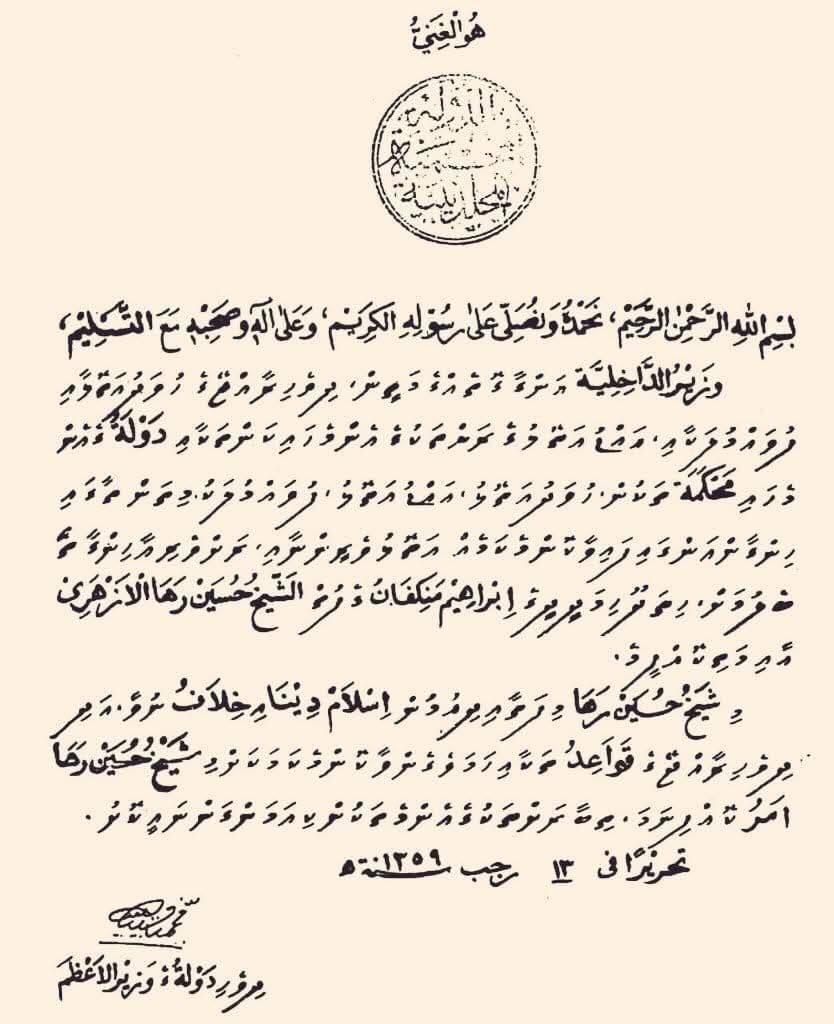
Sheikh Hussain Rahaa, an Al-Azhar University graduate, returned to Malé during a period of political stability following the Athireege Party's victory, with state affairs managed by Interior Minister Hassan Fareed Didi. Upon his arrival, Hassan Fareed sought to appoint Sheikh Hussain Rahaa as Chief Justice, a role he vehemently refused, insisting he would only accept if judgements adhered strictly to unambiguous Quranic rulings and Prophetic traditions. His refusal sparked debate, even amongst family members, including his elder brother, Sikkagey Ali Manikufaanu. During a heated discussion at his Malé residence, Sheikh Hussain Rahaa declared, as recorded by Sikkagey Dhon Manikufaanu, "I will accept the position of Chief Justice only if judgements can be made and executed based on the explicit rulings in the Holy Quran that cannot be interpreted in two ways and the rulings established from the Prophet's Sunnah. Does Alibe want to make me a puppet? Even if I have to stay on a deserted island, that's fine. I will not accept except on those conditions." Prime Minister Mohamed Fareed Didi, Hassan Fareed Didi's elder brother, supported Sheikh Hussain Rahaa's stance, ensuring he was not coerced into the role.
Rejecting the prestigious position, Sheikh Hussain Rahaa returned to his home island of Hithadhoo in Addu Atoll with permission to teach, lead Friday prayers, and deliver sermons. He began teaching at the Thakurufaanu Mosque, covering subjects like Fiqh, Arabic, inheritance law, and Islamic history for students over fifteen. His reputation as a scholar drew learners from Fuvahmulah, Huvadhoo, and other Addu islands. As the mosque became overcrowded, Sheikh Hussain Rahaa, with support from his father-in-law, Elhedidige Ali Didi, and his students, established Al-Madrasatul Jamiatuh Sa'ada, a school with six classrooms dedicated to spreading education. Sheikh Hussain Rahaa devoted himself to teaching, writing academic works, and fostering religious awareness, avoiding political involvement.
In 1940, during World War II, the British were constructing a secret naval base, known as Port T, in Addu Atoll to support their operations in the Indian Ocean. This strategic development brought increased interaction between the British and locals. That year, the Maldivian Government Representative in British Ceylon, Kakaagey Hussain Hilmy Didi, visited Addu Atoll regarding matters related to Port T. He informed Sheikh Hussain Rahaa that the chieftainship of Addu, previously held by Didige Abdullah Didi, was now entrusted to him, along with the governance of Fuvahmulah and Huvadhoo Atolls. Sheikh Hussain Rahaa accepted this role reluctantly, fearing disobedience to the state would brand him a criminal. Elhedidige Ali Didi, his father-in-law assisted in administration, whilst Buchaa Hassan Kaleygefaanu, a foreman sent from Malé to oversee British construction projects, was tasked with inspecting islands and reporting to Sheikh Hussain Rahaa. The existing atoll chiefs of Fuvahmulah and Huvadhoo continued their duties under Sheikh Hussain Rahaa's authority. Despite his frail health, Sheikh Hussain Rahaa assumed this responsibility on 13 Rajab 1359 (17 August 1940).
During his four-year tenure, Sheikh Hussain Rahaa travelled to Huvadhoo and Fuvahmulah, inspecting island offices, meeting residents, and implementing improvements. He issued legal rulings, sent delegates to oversee administrative matters, and facilitated communication between the British and the Maldivian government. Initially, his rule was peaceful, but World War II brought economic hardship, with food shortages plaguing the southern atolls. Desperate islanders defied government bans by trading with British ships to secure food, a necessity driven by survival. Sheikh Hussain Rahaa, bedridden in a British-run hospital in Addu due to severe illness, delegated administrative tasks to Elhedidige Ali Didi. Tragedy struck when Ali Didi's vessel, Yaahunbaraas, sank in a Japanese attack, plunging Addu into mourning and disrupting governance.
Administrative duties then fell to Buchaa Hassan Kaleygefaanu, whose harsh punishments – such as tying people's hands, smoking dried chillies in their faces, and torturing those trading with the British – ignited public outrage. Tensions erupted when Elhedidige Ahmed Didi was tortured to near death, sparking a riot in Hithadhoo. The mob destroyed Kaleygefaanu's residence, burnt his belongings, and chased him, though he escaped with British protection. Hassan Fareed Didi arrived to investigate, concluding both sides were at fault and granting a pardon. He relieved the ailing Sheikh Hussain Rahaa of his duties, ending Suvadive's unified governance in 1364 (1944). Sikkagey Ali Manikufaanu became Addu's new Atoll Chief.
Hassan Fareed Didi's journey to Colombo ended in tragedy when his ship, HMS Maaloy, was sunk by a German U-boat during World War II, resulting in the loss of all aboard. His cousin, Mohamed Amin Didi, a highly educated figure and prominent political leader in the Maldives, assumed power following this disaster. Despite his exposure to modern education and governance, Mohamed Amin Didi was swayed by pervasive local rumours that attributed Fareed's death to supernatural causes. Influenced by these beliefs, he accused residents of Addu Atoll – specifically Sheikh Hussain Rahaa, his father-in-law Elhedidige Ali Didi, and his brother-in-law Abdulla Afif Didi – of orchestrating the sinking of HMS Maaloy through sorcery. According to the rumours, their alleged magical practices had somehow guided the German U-boat to target Fareed's ship, a belief that, whilst rooted in the cultural context of the time, reflected the tension between traditional superstitions and the modern worldview of an educated elite.
Despite Sheikh Hussain Rahaa's frail health, Mohamed Amin Didi summoned him to Malé under the false pretence of arranging medical treatment in Ceylon. Instead, Sheikh Hussain Rahaa faced a trial overseen by Chief Justice Sheikh Abdullah Jalaaluddeen, a former classmate from Al-Azhar University, who sentenced him to 10 lashes and two years' exile in Thoddoo. During the trial, Sheikh Hussain Rahaa recited a Quranic verse to protest the injustice, but Jalaaluddeen silenced him. Ironically, Sheikh Abdullah Jalaaluddeen later faced a similar fate and was himself banished to Thoddoo, highlighting the cyclical nature of political retribution in the Maldives at the time. The harsh conditions of exile severely worsened Sheikh Hussain Rahaa's health, leading to a loss of appetite and an inability to eat, further compounding the tragedy of his unjust punishment.
Upon returning to Hithadhoo, Sheikh Hussain Rahaa's condition deteriorated further. Before his death, he made a will in the presence of his wife, Elhedidige Mariyam Didi, daughter Fathima Didi, son-in-law Maavadibeyyaage Moosa Maniku (Sheikh Moosa Al-Mustafa), Uvagey Dhon Manikufaanu, Abbeyyaage Ibrahim Didi, and Katheebu Thuthu Beyyaa.
As recorded by Sikkagey Dhon Manikufaanu, Sheikh Hussain Rahaa instructed: "Every soul will taste death. So, I will not remain forever. When I die, you will bathe my body. Make Mariyam Didi the head of the bathing. Recite the talqeen after burying me as I have taught. I wish for Thuthu Beyyaa to be entrusted with leading my funeral prayer, burying me, and reciting the talqeen. Do not build any structure on my grave. Make my school a place that benefits children by providing education and continue it to some extent. Do not stay to recite by my grave. It is better for those who recite to stay in the mosque. Allah looks at the deeds of the heart. All my books have been endowed. Facilitate access to those books for people who come seeking information. Bury me in the graveyard of Thakurufaanu Mosque."
On the night before Friday, 11 Rajab 1367 (21 May 1948), Sheikh Hussain Rahaa instructed his household to wake him for Fajr and not disturb him otherwise. When Mariyam Didi called him at fajr, he did not respond. She found him lifeless, hand on chest, having passed away at 4:15am at age 54 (Hijri calendar). His funeral followed his will, with burial beside Thakurufaanu Mosque.
Sheikh Hussain Rahaa's life exemplified unwavering commitment to education, faith, and service, even in the face of profound injustice. His focus on fostering an enlightened society through knowledge and integrity leaves a lasting legacy as a scholar, educator, and reluctant ruler. His contributions deserve national recognition through institutions and awards bearing his name, inspiring future generations. May Allah bestow His mercy upon him. Ameen.
Discussion
No comments yet. Be the first to share your thoughts!
No comments yet. Be the first to join the conversation!
Join the Conversation
Sign in to share your thoughts under an alias and take part in the discussion. Independent journalism thrives on open, respectful debate — your voice matters.
Support Independent Journalism
Help us keep the news free and fearless
Give once
$
or
Become a memberfrom $5/month

