

Why is the Maldives debating ranked choice voting?
A public referendum is to be called on electoral reforms.
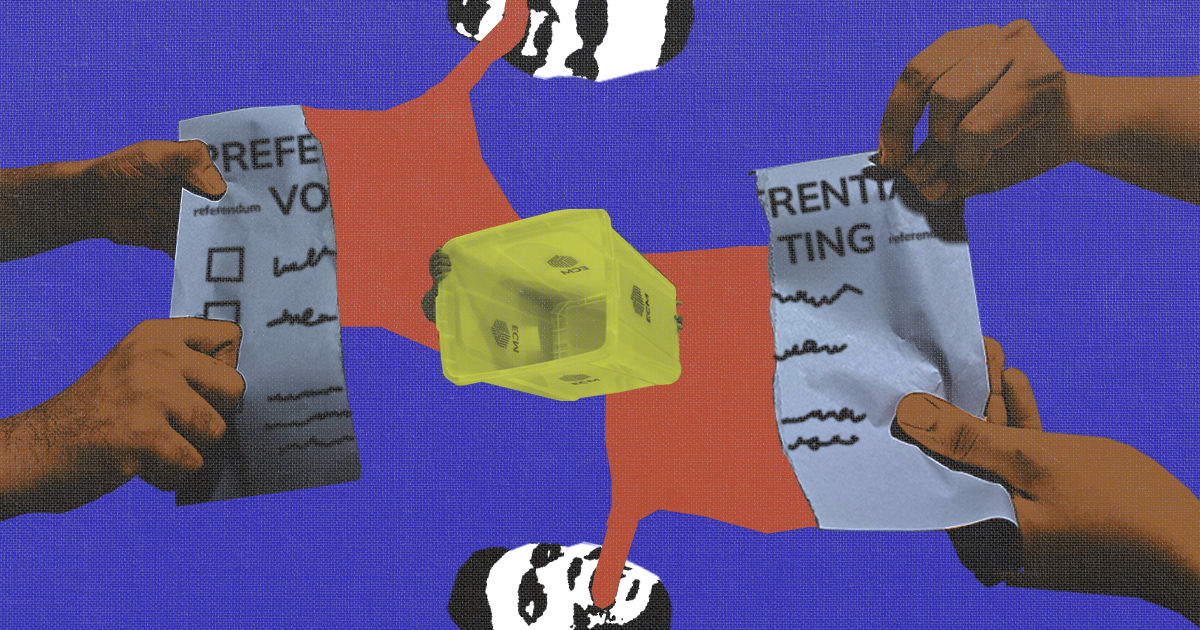
Artwork: Dosain
05 Aug 2025, 19:00
This article was produced with the support of Strengthening Peace & Democracy through Internews Europe, as part of the Advancing Political Pluralism and Transparency (APPT) project funded by the European Union.
Why are we talking about this now?
Why are we talking about this now?
At a meeting with the ruling People’s National Congress parliamentary group last Wednesday, President Dr Mohamed Muizzu sought the supermajority's support for electoral reforms aimed at concluding the presidential election in one round. Under the current system, a second round is required if any candidate fails to win more than more than 50 percent of the vote.
Rethinking the run-off between the top two candidates was a campaign pledge.
“The type of voting system that I have been advocating for is the preferential voting system,” Muizzu clarified on his new Whatsapp Group on Sunday night following media coverage of the proposed reforms.
The president told PNC MPs last week that he intends to call on a public referendum this year. He also wants to hold the presidential and parliamentary elections on the same day.
Why is a referendum necessary?
The PNC’s 75-seat supermajority in the 93-member People's Majlis is well above the three-quarters majority needed to amend the constitution.
But amendments made to the charter of rights and freedoms (chapter two) or to the provision specifying the terms of office and the conduct of the presidential election could be ratified “only after a public referendum decides so by a majority of the votes cast.”
Both the president and parliament have the constitutional authority to call public referendums on issues of public or national importance.
So what is preferential voting?
Also known as ranked choice voting, it is a system where voters rank candidates in order of preference rather than casting one vote for one candidate.
If no candidate wins a clear majority in the first-preference votes, candidates with the fewest votes are eliminated and their votes are redistributed to the voters’ next preference. The process continues until one candidate emerges with more than 50 percent.
Countries like Australia and Ireland use preferential voting in national elections. Closer to home, Sri Lanka uses a contingent vote system where up to three candidates are ranked.
How are votes counted?
If there were four candidates on the ballot, voters would mark 1 for their preferred candidate and 2 for the second choice, and so on in order of preference. If their first choice finishes third or fourth in the first round of vote counting, the candidate’s ballots would be checked for the second choice and their votes would be awarded accordingly.
What are the benefits?
Aside from saving money on costly nationwide polls, votes cast for third party or independent candidates with no realistic chance of victory would not be “wasted.” Strategic or tactical voting – choosing the second preferred option to prevent the least preferred option from winning – would not be necessary either.
The spoiler-effect of third party candidates splitting the vote and benefitting one or the other of the major party candidates would be neutralised. Voters could choose their preferred candidate as their first choice but still have a say in electing the president.
The need to appeal to a broader base of voters could encourage more civility in campaigning.
Campaigning for the change on social media, political appointees and government supporters have touted preferential voting as a simpler and fairer system that would address the problem of vote buying and divisive campaign rhetoric.
What does the opposition think?
The main opposition Maldivian Democratic Party’s leaders have come out against the proposed reforms.
“The talk of bringing changes to the voting system now is a plot to bring ballot boxes to Malé and rig the vote by prolonging vote counting by many rounds,” MDP President Abdulla Shahid alleged.
“The intention is to meddle with the ballot box, to rig the vote,” he added, calling on the public to reject the proposed changes.
Vote counting must take place at polling stations in front of witnesses and the winner of the presidential election must have a majority of 50 percent plus one vote, he insisted.
“Electoral reform should not be an excuse to limit the voices of voters. In a small nation like ours where votes are tallied in a day, the president-elect should be sworn in with a clear mandate from the majority of the voting population. The government’s justification of such a policy through ‘cutting costs’ is insincere when wasteful political expenditure is at an all time high,” MDP Chairman Fayyaz Ismail tweeted.
“The staggering of presidential and parliamentary elections are a necessary feature of our constitution; to merge the two will limit the parliament’s ability to serve as a check to the administration.”
How could ranked choice voting change Maldivian politics?
In three of the four multi-party presidential elections in the Maldives, voters were unwilling to grant a popular mandate to a single candidate. In both 2008 and 2013, the eventual winner only took a quarter of the vote in the first round but went on to defeat the frontrunner with the backing of broad coalitions.
But in both cases, the coalitions disintegrated within months. Coalition agreements have no legal weight under the Maldivian constitution, which was designed for a US-style presidential system.
Preferential voting could incentivise cooperation, friendlier relations and exchange of ideas among political parties with competing ideologies.
What about concurrent presidential and parliamentary elections?
“The staggering of presidential and parliamentary elections are a necessary feature of our constitution; to merge the two will limit the parliament’s ability to serve as a check to the administration,” MDP Chairman Fayyaz warned.
But proponents argue that concurrent elections are more likely to return a parliament that would hold the executive accountable.
In both of the last two election cycles, the party of the president who assumed office in November easily secured a supermajority in the parliamentary elections in April, as a demoralised opposition was unable to compete against a ruling party bolstered by state resources.
This article was produced with the support of Strengthening Peace & Democracy through Internews Europe, as part of the Advancing Political Pluralism and Transparency (APPT) project funded by the European Union.
This article was produced with the support of Strengthening Peace & Democracy through Internews Europe, as part of the Advancing Political Pluralism and Transparency (APPT) project funded by the European Union.
Discussion
No comments yet. Be the first to share your thoughts!
No comments yet. Be the first to join the conversation!
Join the Conversation
Sign in to share your thoughts under an alias and take part in the discussion. Independent journalism thrives on open, respectful debate — your voice matters.
Support Independent Journalism
Help us keep the news free and fearless
Give once
$
or
Become a memberfrom $5/month

