
Maldives bucks global trend as seagrass meadows triple in size
Resorts now protect meadows once seen as eyesores.

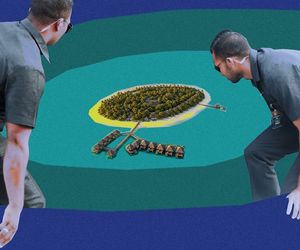
Artwork: Dosain
21 Jul 2025, 16:33
Seagrass is disappearing across the world. But the underwater meadows of the Maldives tripled in size between 2000 and 2021, defying a global trend and marking the country as a unique “bright spot.”
An expansion of seagrass coverage from 37 to 105 square kilometres – nearly a third of the country's total land area – was discovered in a 2023 study by Mathew Floyd, whose research team used satellite data to map seagrass across the archipelago.
"This is a very large and significant habitat in the context of the Maldives. It can play an important role in national greenhouse gas accounting and habitat inventories," Floyd told the Maldives Independent on the sidelines of an event in Kaafu Dhiffushi where 17 resorts pledged to protect their seagrass meadows.
The pledge signing ceremony on July 10 was part of the 'Seagrass Industry Leaders Circle' spearheaded by Maldives Resilient Reefs, the local affiliate of the British charity Blue Marine Foundation. The initiative was a continuation of an original campaign that sought to shift perceptions of seagrass meadows, long viewed as unsightly blemishes on the tourism industry's signature image of crystal-clear, azure-blue waters.
The goal was to convince luxury resorts to stop removing seagrass meadows. In 2019, a quarter of Maldivian resorts signed a voluntary pledge to protect at least 80 percent of their seagrass habitats. At the time, more than a few eyebrows were raised at what many saw as greenwashing. Critics questioned the wisdom of offering a convenient badge of sustainability to an industry that has not been shy about reshaping ecosystems for visual appeal.
But five years later, seagrass is increasingly recognised as a vital part of the marine ecosystem. The campaign also influenced national conservation policy and inspired a wave of marine and aerial photography, spurring new research and challenging the notion that the Maldives must be defined by a singular aesthetic.
The new initiative encourages resorts to turn their pledges into tangible actions by mapping the baseline seagrass around their islands, committing to ongoing monitoring, and engaging both staff and guests in seagrass education.


Mapping growth
Scientific findings have played a major role in boosting the case for seagrass conservation. According to the 2023 study, more than 76 percent of seagrass were found in southern atolls and 67 percent of the recorded area was concentrated in Huvadhoo, Laamu and Meemu atolls.
As marine biologists, researchers and government officials gathered in Dhiffushi to reflect on the campaign’s progress, some conservationists highlighted shrinking seagrass meadows in the north despite the threefold increase nationwide.
"Many participants I interviewed from northern islands reported a decline in seagrass over their lifetimes, affecting fisheries and species like turtles," Shaha Hashim, the executive director of Maldives Resilient Reefs, explained during a panel discussion.
Her research identified 12 historical seagrass locations across the central and southern atolls, seven of which have now diminished. This decline was largely attributed to coastal development and the removal of seagrass for aesthetic purposes.
The 2023 study found a strong association between the presence of seagrass and nearby human activity. Floyd's team is currently working on follow-up research looking at the abundance of juvenile reef fish that rely on seagrass as a nursery habitat.
Other studies have focused on the relationship between seagrass expansion and nutrient enrichment. A 2024 research led by Maldives Resilient Reefs found that increased nutrients from sewage and fertiliser runoff near inhabited islands may be fuelling growth, creating favourable conditions for seagrass to flourish.
But excessive enrichment can tip the balance. High nutrient loads risk triggering eutrophication, spawning algal blooms that block light and overwhelm seagrass ecosystems. Researchers recommended developing local nutrient budgets to better manage coastal water quality.
While new seagrass growth may reflect natural recovery in some areas, especially around inhabited islands, these ecosystems remain vulnerable. Conservationists warn that without effective management, continued development, harbour construction, and unchecked pollution could lead to localised diebacks.
Changing the narrative
Seagrass meadows offer a wide range of ecological benefits. They prevent coastal erosion, absorb carbon, trap sediments, support fisheries, and feed endangered green sea turtles, which are known to consume up to two kilograms of seagrass daily.
One study found that 1.1 square kilometres of seagrass could produce 853,000 kilograms of carbonate sediment – more than half of it sand-sized – contributing to reef island formation at a time when coral degradation is threatening natural sediment supplies.
Since the initial launch of the campaign, there have been fewer reports of resorts clearing seagrass. Satellite imagery indicates that many of those who signed the 2019 pledge have upheld their commitments. The Six Senses Laamu in particular has taken the lead by embracing seagrass as a feature, rather than a flaw.
The resort now runs citizen science programmes and offers seagrass-themed guest activities and snorkelling experiences in seagrass meadows.
"It's had a huge positive impact on the environment, but also on marketing," said Lawrence Menz, the resort's director of sustainability and conservation. "That's a positive feedback loop right – the more guests who come to your resort, the more money you make because you are protecting seagrass."
But changing perceptions requires more than resort-level efforts. Menz called on the government's tourism promotion company, recently renamed Visit Maldives Corporation, to take the lead.
"We got this marketing strategy for the Maldives for many many years, of having just the clear, blue lagoons and that's often what guests will come to expect. So it will take time to change that perception of guests and manage expectations," he said.
"The [corporation] that sort of runs the PR for the Maldives, one of their five future strategies is sustainability so putting seagrass and natural habitats forward first in that campaign will really help to change it at that high national level to reach the broad international tourism audience."
The challenge is even greater on local islands. As more guesthouses are built, pressure is growing to remove seagrass from designated swimming areas.
In many communities, seagrass is still seen as dirty or swampy, Muhusina Abdul Rahman, the environment ministry's director for protected areas, observed at the panel discussion.
"When we asked one island to take us to their most beautiful beach, they showed us a reclaimed area," she said. "To them, a pristine beach is one without seagrass."
She stressed the need to extend outreach beyond resorts to guesthouse operators, councils, and communities: "I think there is a lot of work that needs to be done in terms of public perception and industry perception, not just resorts but local islands."
Seagrass is also gaining ground in national policy discussions. While seagrass is not currently listed as a key priority habitat, it plays a vital role in meeting a key marine protection target, Muhusina noted.
The government is currently drafting its 'National Biodiversity Strategy and Action Plan.' which will aim to integrate such connectivity into conservation planning, she said. Other options for expanding seagrass protection involves getting resorts to formalise seagrass protection around their islands by applying for 'Other Effective Area-Based Conservation Measures.'
"We often talk about the '30 by 30 target' in terms of area only but when we entangle the full texts in the target there are a lot of details that need to be taken into consideration," Muhusina said, referring to a commitment to conserve at least 30 percent of the country's terrestrial, inland water, coastal, and marine areas by 2030.
"Ecological connectivity matters. If we're protecting a turtle nesting beach, we should also protect the seagrass meadows they feed in."


Discussion
No comments yet. Be the first to share your thoughts!
No comments yet. Be the first to join the conversation!
Join the Conversation
Sign in to share your thoughts under an alias and take part in the discussion. Independent journalism thrives on open, respectful debate — your voice matters.
Support Independent Journalism
Help us keep the news free and fearless
Give once
$
or
Become a memberfrom $5/month