
What we brought home from the world's largest investigative journalism conference
A small Maldives newsroom goes global.
23 Feb, 11:44
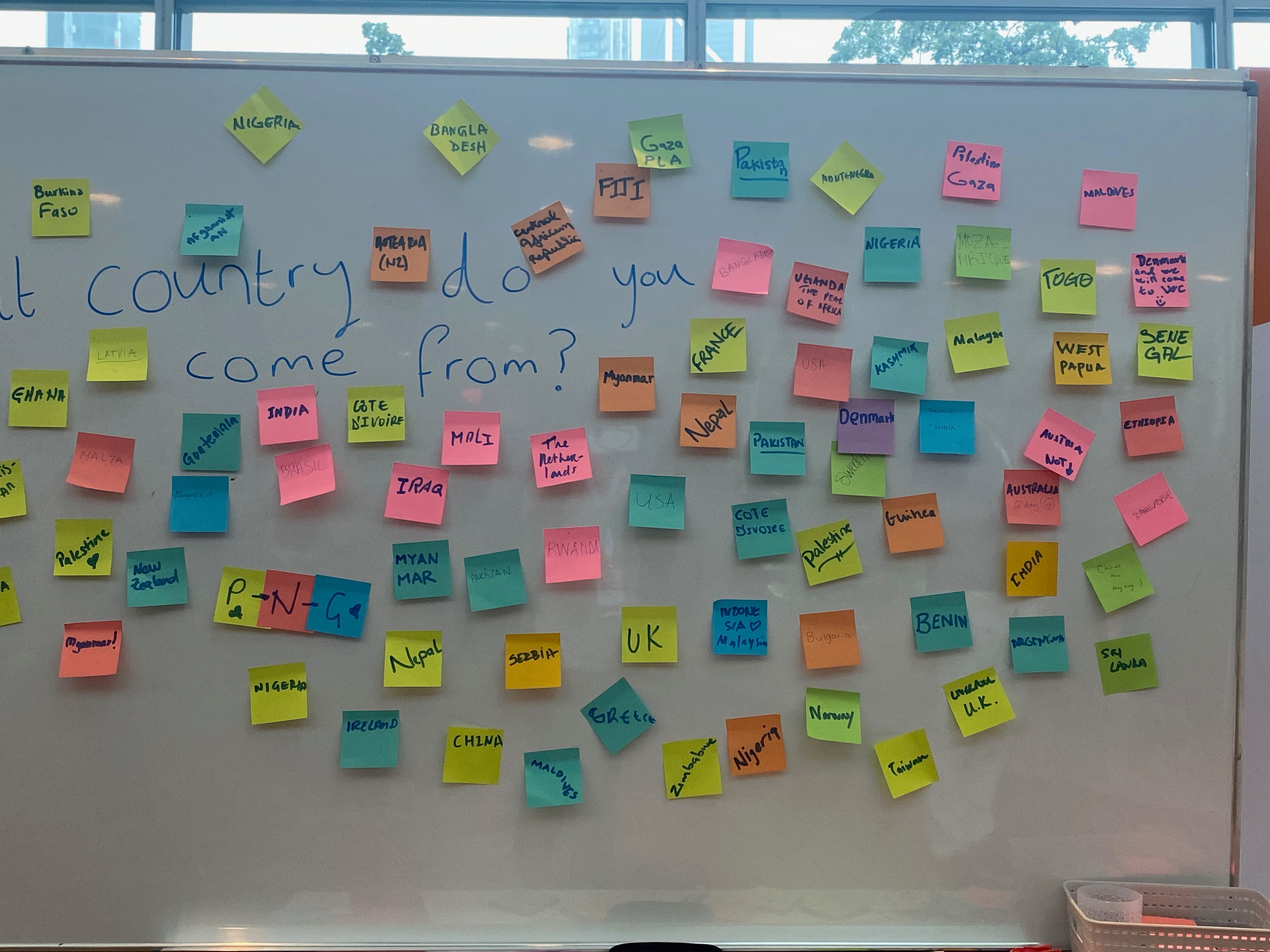
I scribbled “Maldives” on the post-it note, found a spot between Palestine and Papua New Guinea, and pasted it on the whiteboard in Malaysia. "What country do you come from?" was the simple question the board asked. By the end of the week, it was covered in sticky notes from dozens of countries.
Ours was easy to miss. As far as we know, no Maldivian news outlet has previously been represented at the Global Investigative Journalism Conference, or at any similar event of that scale. Co-hosted by Malaysiakini and the Global Investigative Journalism Network, the 14th edition took place from November 20 to 24 at the Kuala Lumpur Convention Centre. It was the first time the global conference was held in Asia. For us, it felt like an overdue introduction.
“The Maldives is very isolated and overlooked by the international media and development scene, despite its geostrategic importance in the Indian Ocean (and the abundance of newsworthy oligarchs, dictators, film stars and arms merchants visiting its turquoise waters),” observed JJ Robinson.
“As a former editor of the Maldives Independent who later worked as a journalism grant-maker with the Open Society Foundation, it was a real merging of worlds and a privilege to attend GIJC as an advisor to the outlet’s relaunch. Launching a new media project amid 2025’s cuts and funding collapses felt like madness, but the enthusiasm and encouragement from all the friends and former colleagues at GIJC, and the reception they gave the Maldivian team experiencing this for the first time, was really heartening.”
Less than 10 months after reviving the Maldives Independent following a five-year hiatus, we found ourselves among 1,500 journalists from over 100 countries and territories, sharing our story, building new connections, and seeking opportunities for collaboration.
Learning to verify in an age of manipulation
I was able to attend the conference due to the generous support of SKUP, the Norwegian Foundation for Investigative Journalism. As part of their GIJC Fellowship, I joined an exclusive Masterclass on Open Source Research led by investigative reporter Jan Strozyk from the Data and Research Centre. The intensive session was held before the main conference began. It focused on open-source investigation techniques, the kind of digital skills that have become essential for any journalist working with leaked documents, tracking assets, or verifying claims made by officials.
Jan covered four areas: geolocation and visual verification, tracing people and assets through public registries, working with messy datasets, and building reliable investigative workflows.
Some of the tools introduced were immediately applicable. Reverse image search engines like Yandex and Google Lens can help verify photographs circulating on social media. This would be useful when photos from protests in the Maldives are shared without context or attribution, I thought. As a case study, we analysed a social media image purporting to show an explosion in Kyiv caused by a Russian hypersonic missile. A reverse search and location verification showed that it was actually taken in Lebanon.
Jan showed us how to scan for clues, extracting hidden file information, and matching features on Google Maps or Street View until everything lines up. In a highlight for me, Jan pulled up SunCalc, a free tool that maps the sun's position at any given time and location. By measuring the length of a shadow in a photograph, he demonstrated how a journalist could work backwards to estimate where and roughly when a photograph was taken.
The InVID browser extension, developed by Agence France-Presse, allows journalists to quickly check whether video footage has been manipulated or recycled from an earlier event. For investigative work involving financial trails and offshore entities, tools like the ICIJ Offshore Leaks database and OpenSanctions offer searchable records of companies, trusts and individuals flagged in major leak investigations. Using the Isle of Man aircraft registry and company documents, Jan traced the ownership of a specific helicopter to Russian billionaire Roman Abramovich.
In another exercise, Jan walked the room through a real case: locating a man wanted for double murder in Canada who was rumoured to be living in Dubai. Starting with nothing but a name, he searched leaked Dubai property records through OpenAleph and found a relative listed as a Canadian property owner. From there, he used open-source intelligence tools to link phone numbers from both countries to the same social media accounts, extracted a profile photograph from a private Instagram account using browser developer tools, identified a Dubai gym visible in the background of the image, and traced the connection back to the suspect through a personal trainer's public posts. A facial comparison tool returned a 98.6 percent match with the original mugshot. The whole chain of evidence from a leaked property record to a confirmed location had been assembled using freely available tools and public data.
The masterclass also introduced several other useful tools: OpenAleph to cross-reference with other datasets; GitHub Actions for automating tasks; ExifTool to look at all metadata of a photo or document; and Hunchly, which automatically archives every webpage a journalist visits during an investigation, creating a verifiable evidence trail.
150 sessions, four people
The conference began on the following day. After they completed registration, I caught up with my fellow co-founders: CEO Nur Thoufeeq, advisor JJ Robinson, and columnist Mohamed Saif Fathih. We sat down and studied the daunting schedule: more than 150 panels, workshops, and networking sessions. After the opening event in the morning, the first slot included 10 different sessions – covering everything from environmental degradation to illegal mining and managing newsrooms to data scraping – all happening at the same time. We wanted to attend as many as possible. We picked out top priorities and divided the sessions among ourselves.
Over the next three days, I learned about the latest research on fact-checking, navigating cross-border corporate data, investigating crypto-asset crimes, reporting on carbon offsets, practical steps for safety, and building an AI assistant.
One of the conference's defining moments came from Nobel Peace Prize laureate Maria Ressa, who delivered a keynote address calling for what she described as "radical collaboration" to defend press freedom. She issued a chilling warning: at a time of authoritarian governments, all-powerful tech oligarchs, and shrinking funding for journalism, press freedom may only have one year left if we fail to act.
"Her words hit close to home, especially now, with the Maldives' new Media Control Bill looming over us,” Nur wrote in our weekly newsletter after the conference. On the sidelines, Nur also caught up with the head of innovation at the International Press Institute, the team running the Local News Accelerator that the Maldives Independent joined last year. She also met the Global Forum for Media Development team, who encouraged us to join their network.
“Sometimes I forget we’re still a tiny newsroom on a tiny island until moments like these remind me we’re part of something much bigger,” she wrote. “Beyond the panels, we attended a South Asian networking event and finally met like-minded journalists from across the region.”
For Saif, the most valuable takeaway was simpler: the realisation that we are not alone.
"There is a whole community of people experiencing similar struggles, often in far more difficult circumstances. Yet they have persisted, persevered, and even thrived,” he said.
Saif was struck by the number of support organisations willing to help through financial assistance, training, and collaboration: "What I understood from this is simple: if there is a will to write and investigate, there is a way."
The author attended the 14th Global Investigative Journalism Conference in Kuala Lumpur on a fellowship from SKUP, the Norwegian Foundation for Investigative Journalism. The conference was co-hosted by the Global Investigative Journalism Network and Malaysiakini.
Discussion
No comments yet. Be the first to share your thoughts!
No comments yet. Be the first to join the conversation!
Join the Conversation
Sign in to share your thoughts under an alias and take part in the discussion. Independent journalism thrives on open, respectful debate — your voice matters.
Support Independent Journalism
Help us keep the news free and fearless
Give once
$
or
Become a memberfrom $5/month

