
The class monitor president
The full weight of the state apparatus, serving one man's teenage insecurities.
Artwork: Dosain
21 Dec 2025, 16:01
We Maldivians go through the following stages in each presidency: “what’s he doing?” which then leads to a not-so-distant “why is he doing this?” – the latter being the stage where we remain until the next presidential election. But perhaps we should have always begun by a first more salient question: “What is he?”
On November 25, when large sections of the press and social media were occupied with the imminent decision regarding a 100-year-old banyan tree in Villimalé, the president, in a "town hall" which seemed to have been mostly composed of a majority of People's National Congress affiliates, called for a show of hands to decide whether to remove the great tree. When nearly all hands of the party plants shot up into the air, the fate of the nika was decided; “so it will be done,” said the president.
Before that in October, the principals of all public schools across the Maldives were gathered for a symposium organised by the education ministry, which was to be inaugurated by the president. Although the organisers had asked the participants to be in formal wear, when the president arrived sans jacket, a hurried memo seemed to have been whispered to the attendees, suggesting that they too would have to remove their jackets. Most of the photos from the event indeed show sad jackets draped over the backs of the chairs.
And even further back, early in his tenure, the reshuffled Local Government Authority had once suggested that criticising the president for campaigning while on official visits might be akin to violating his personal dignity and maybe even his human rights.
We need not even touch on his inscrutable need to play football against teenagers and earnestly win, while his servile cabinet and the innumerable political appointees literally clap and cheer on the touchline. So, we ask what kind of person is this?
By all accounts, Dr Muizzu had been an exemplary student. He did his sums, completed and submitted his assignments on time, and as a result, appeared on the national Top 10 honours lists for both his A-Levels and O-Levels. He subsequently obtained his bachelor's degree at University College London and a PhD in civil engineering at the University of Leeds.
On paper, these remarkable achievements present a portrait of a driven student who aimed for (and achieved) the very top marks nearly all the time. Any suggestion that this would somehow translate even faintly into competence in governance was optimistic to begin with, and two years into his term, has proven to be a case of mass delusion.
He has governed with a violent confusion, ushering in an era of chaotic rollouts, botched walk-backs, miscues, misreadings, and relentless – almost pathological – lying about even the most basic and easily verifiable facts. Computer scientists may smugly point out that there are no true random number generators in existence but anyone who has paid attention to the policy announcements from the administration would rightly suspect that there at least might be something close to it in the President’s Office. Yes, the death of determinism will find no greater proponent or exemplar than our current president, whose uncertainty and lack of confidence grips the viewer even through a television screen and they find themselves cringing into the sofa.
For the befuddled, clues about the type of man the president is can be found in his interview to Mihaaru in the walk up to the presidential election, intended to give a look into the candidates' private lives. At 16 minutes in, he mentions that he was one of only three to get a first-class degree in his engineering class at UCL, which was fine – only slightly odd for a 43-year-old man to be talking about this in a presidential campaign, but not fatal. But then in the same sentence he says that he got first place in his structural engineering subjects and, funnily adds that he got a certificate for it, in case anyone really wanted to go through a middle-aged man’s module marks.
But here the listener’s ears have really perked up. What’s going on here? And then when the unmiked interviewer prods for a funny anecdote from childhood, the would be head of state reports that he was a prefect, the deputy captain, active in the Dhivehi and English Literary Associations (the last one should raise some eyebrows), and then – to the listener’s utter disbelief – says he got 17 proficiency badges as a scout!
I could not believe my ears and kept replaying the moment till it sank in. But once the auditory doubts have been expelled, and the wave of pity passes through the listener, feeling for a man past his middle age, who could not relay one funny incident from his boyhood, the great miasma surrounding Dr Muizzu is suddenly lifted, and the viewer is welcomed into a new depressing clarity.
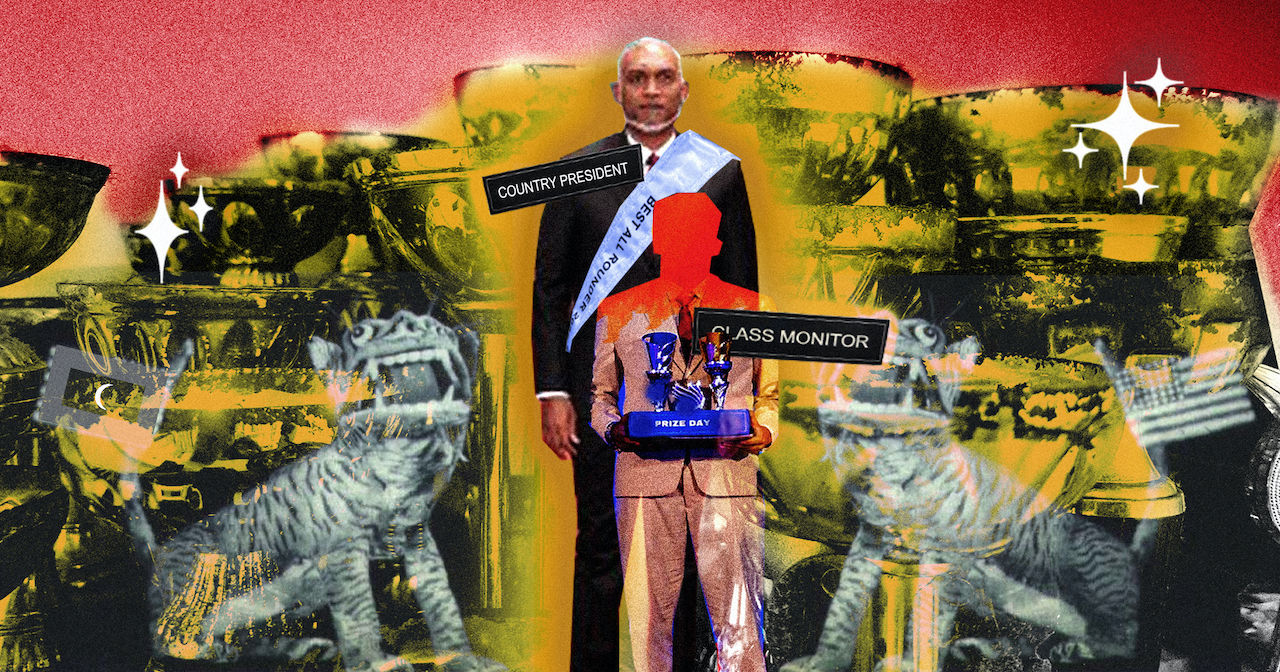
We seem to have mistakenly elected not a president but a class monitor, who very likely thinks that being president is just another rung to climb as a good student – another trophy to bring home and show the family. A man while being the head of state operates within the insular mental walls of a classroom, who for example, finds the need (and more worryingly the time) to comment on Miss Universe pageantry, the dress code of a film premiere at Olympus, and – more recently and more on the nose – school dress codes.
I also don’t think it is helpful that it is called a presidential term. It is also apparently important for the Headboy that girls under 10 years old have their knees and shins covered. This last obsession is particularly sinister, not only because this is the first change to girls’ school uniform in over half a century, but you know exactly it's directly coming from president; he has thought about this, and found reasons for it within him, and asked the ministry to implement this.
This is a man of small ideas and smaller concerns – and when viewed through this parochial lens, his policy decisions make sense not as a gradual build-up of strategy but a series of annoying perpetual class monitor's “don’t do thats" blaring from President’s Office. And in this class-monitoreque performance an old banyan tree could be removed without a need for a wider ecological, heritage, or social assessment; a simple show of hands in the class would do. It barely registers to him that in a PNC meeting, the president of the party might elicit a degree of selection bias. But why would it? The seats were filled in the classroom and the quorum met.
In his pinhole-like perception of the world, he has also shrunk the nation, the things we talk about, the scale of national ambition. The inauguration of ATMs was already farcical and the subject of nationwide ridicule, when he has just outdone himself by cutting ribbon at a petrol shed. It is as if, St. George, the mythical hero of England, where the president studied, given a magical sword, yet blissfully unaware of the prowling dragon, starts swatting house flies with it.
Back to school
Naturally, he travels to Leeds basically every quarter – what good pupil can resist a nostalgic back-to-school trip? That his daughter also studies at the same university is the effect, not the cause of his need to be in Leeds constantly. It is as if he expects his alma mater to give him another award for becoming a president. But with pretexts already thin, these frequent pilgrimages yield some comical results: being greeted by a deputy mayor of a London borough at Heathrow, giving an interview on the sidelines (how good words can sometimes be!) of a Premier League football pitch, and, funniest of all, meeting the Lord Mayor of Leeds, which suitably goes unreported even in the local papers of Leeds.
After multiple unsolicited advances, the University of Leeds finally put out a news bulletin announcing that one of its alums has been elected president – but alas, it’s about the President of Ireland. However, if you scroll down, you will find one lean sentence devoted to our president.
Conspicuously absent from the president’s account of his school days is any participation in sports. Of course, it is no personal fault to be lacking in athletic talent; this writer himself, on one afternoon in Grade 2, had to take the class teacher aside and inform her that he would not play football anymore on account of it being deeply embarrassing and damaging to his personal dignity. Fantasies of heroism on the pitch and feverish dreams about scoring a last-minute "screamer" from outside the box as the capacity crowd cheers were the extent and the end of it.
But the president, on the other hand, is enacting his fantasies across the nation by playing against school kids, and when the decidedly slack defence lets him score a goal, he celebrates earnestly. You could see, in one of the video clips: the dejection as the teenage goalkeeper picks up the ball from the net while, feet from him, the president is being congratulated by his cabinet. What an obscene impression for the young athletes of this country: that all talent, hard work, and years of practice will be set aside to placate someone more powerful.
A more worrying thing still might be that Dr Muizzu has started to think that he is a good player. What if the president does not have a Theory of Mind? What if he is unable to perceive the mental states of others – everyone’s embarrassment, for example, every time he tries to play football in an obviously rigged game? All of us, without our consent, have been drafted into a remedial playground while the full weight of the state apparatus is being used to help a man overcome his teenage insecurities – to help him get over it.
All of this could have been offset if he was good at his job but lacking even this, Dr Muizzu is reduced to playing the role of a character called “president” he saw on TV. A Maumoon lite – with his urgent need for applause and the stately treatment without a shred of competence. He spends his days reliving old tales about the president of the country walking into a small, neglected island, and to be met with an ailing petitioner, to whom the president humbly listens to, after which the citizen’s life is transformed immediately and dramatically. A story which during the “Golden 30” years of the autocracy, when broadcast by the state (and only) TV channel, would have been a real hit.
However, in the absence of the tightly controlled, heavily edited, one-source feed of TVM, and the whole spectacle now filmed vertically with smartphones held in shaky hands, as those gathered by the dirt road mumble in the background, the scene amounts to nothing more than a pathetic stage play.
A decade ago, former President Abdulla Yameen lamented that a country cannot be run with "bookworms." Maybe. But Muizzu is the opposite of one – I don’t think he could name a single long book he has read cover-to-cover that was not part of a school curriculum. In fact, it is Muizzu’s excellence in the Maldivian school system that particularly makes him unfit to govern. As a top student he has always been the smartest one in the room, never having had to relent on his point of view to accept the unquantifiable complexity of an irreducible world – where no assumption can simplify the problem at hand.
Having spent all the energy of his school years getting the required As in O-Levels and A-Levels, and then in engineering school modules, he has been hermetically sealed from and thus unaware of the world that has continued to change around him. He appears a complete illiterate in economics, philosophy, or history. I would be surprised if he could name the countries which fought in the Second World War. He is barely intelligible in Dhivehi without a prepared script and is a foundering wreck in English. In a way, he is the perfect product of the blinkered, depressing "Top 10" culture this country’s education system has devolved into.
And thus, we find a president who, having denied sea level rise in terms as rudimentary as you would find in a Facebook meme, walks back his stance when he sees the fast-closing doors of climate financing. He is a reactive novice on the international stage who, after a single visit to Beijing, talks back aggressively at India, the regional hegemon, only to find himself asking the same country for budget support.
There were some valid concerns about the government taking fascistic turns after the new media bill. However, these fears can be assuaged somewhat by remembering that the root word of fascism is fasces – the bundle of hard, sturdy rods carried by the bodyguards of Roman senators and later emperors. Anyone who has seen our president stand still knows that there is nothing hard or rigid in him; this is a soft-bellied slouch, who can still do a lot of harm, just not in the same organised way.
I hope after the class is over, the presidency is not painted with our collective amnesia as we always do with past presidents, and there is no softening of the shared memory either. I wish him the fate of Waheed (the only other Dr President), an object of ridicule, an aberration on the country’s body politic, to be excised both in memory and on paper, to be laughed at whenever he emerges from the opaque waters of political obscurity. (Much to our dismay these are not deep waters – what Nihans and Riyaz Rasheeds, what Maaz Saleems and Falaahs await just below the surface, waiting their turn).
The country will have to be rebuilt once he is gone – we will have to redefine what constitutes a university, whether any medication can really be considered a necessity, and whether the provision of uncontaminated water falls within the remit of a modern state. How did this happen?
One should not be in the business of prophesising in politics, especially in Raajje, so we should at least aim to never let such a scam be perpetrated on us; let us have the safeguards in place, the two-factor authorisation, or get a neighbour to physically restrain us even if we float the idea. But maybe the corollary of the question “how did this happen?" has to also be considered – “how could you lose an election to this?
In 2008, when Dr Hassan Saeed emerged as one of the candidates for the presidency, he was a man who – despite being well known in Malé and in his home atoll Addu (where PhDs are regarded highly, and correctly so) – was not yet a name set in the consciousness of the atolls and outer islands. Thus, urgent pamphlets and leaflets had to be dispatched across the country. The “campaign material” (a term only just entering the Maldivian lexicon) earnestly asked people to consider how educated he was, and what twin beacons of knowledge he and his brother represented. (In hindsight it’s a sign that the content was already stretched thin if the pamphleteers had to slip the brother in.)
On one such island, as the men in bright red polo shirts – stuck to their backs in the noon sun – stood wearing sunglasses and explaining to a small group gathered under the eaves of a corner shop just how brilliant Dr Hassan Saeed must have been in a classroom, sitting in a wooden chair with the desk pulled right up to his chest, keeping pace with the teacher as they scribbled on the chalkboard, Dr Saeed, the prodigy, even overtaking them. And therefore, it followed that he would do well in the highest office of the land. As this was going on, an elderly man lying in a gently swinging joali said softly, but in a way that cut straight through the memorised bullet points:
“Maybe he should be the school principal.”
The views expressed in this commentary are the author's own and do not reflect the editorial policy of the Maldives Independent. If you would like to write a comment or opinion piece, please send proposals to editorial@maldivesindependent.com.
Discussion
No comments yet. Be the first to share your thoughts!
No comments yet. Be the first to join the conversation!
Join the Conversation
Sign in to share your thoughts under an alias and take part in the discussion. Independent journalism thrives on open, respectful debate — your voice matters.
Support Independent Journalism
Help us keep the news free and fearless
Give once
$
or
Become a memberfrom $5/month