

Trousers for girls, beards for boys: school uniform policy reignites Maldives culture war
Girls must wear trousers from age nine under the new rules.

Artwork: Dosain
09 Dec 2025, 18:18
The white tunic with a pleated skirt falling just below the knee, an iconic school uniform worn by generations of Maldivian schoolgirls, is being retired.
Under a new policy announced last week, female students from Grade 4 onwards must wear trousers. Girls above nine years of age who choose skirts must wear pants underneath. Loose-fitting shirts must cover the bottom, extending two to four inches below the hip, and cannot be tucked in unless worn with a skirt.
Only girls from nursery to Grade 3 will be permitted to wear skirts without trousers underneath.
Boys in grades nine and above will be permitted to keep moustaches and beards cut short at an even length. Keeping a beard is considered obligatory or strongly recommended in conservative Islamic jurisprudence.
The changes have divided opinion along liberal-conservative lines, sparking debate on social media and reigniting concerns about whether President Dr Mohamed Muizzu's administration is quietly implementing a hidden agenda – as a first step towards mandatory hijabs – contrary to denials during his 2023 campaign.
Critics accuse the government of policing girls' bodies with a dress code unsuited to the tropical Maldivian climate. But religious conservatives have backed the changes and argue that the ministry is merely upholding Islamic standards.
The uniform code takes effect from the 2027 academic year.
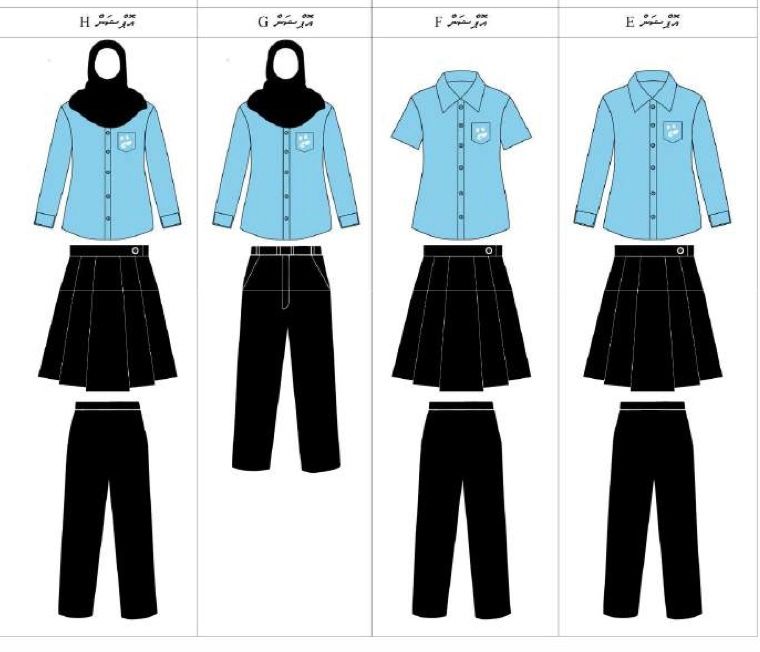
"Safety and protection"
As criticism mounted, State Minister for Education Dr Ahmed Mohamed contended in a Facebook post that older female students wearing pants is "more a matter related to their safety and protection than a religious matter."
He did not elaborate on what dangers the current uniforms pose.
The real problem was a decade of chaotic uniform changes with no guidelines, he said on Monday. More than 70 schools changed uniforms during the previous administration, each doing it differently and driving up costs, according to the state minister.
"Changing school uniforms should be done through a proper procedure rather than being something that can be changed at the whim of the relevant parties at any given time," he wrote.
The education ministry said the changes came in response to significant complaints from schools and parents, and would make uniforms more affordable and accessible. The new policy was formulated after "extensive consultations" with school principals, the ministry said.
"Body shaming, not protection"
But critics say the policy removes choice for girls – disregarding their own or their family’s preferences – and treats their bodies as something to be concealed.
"When the state declares that visible legs or the outline of a girl's bottoms are unacceptable, it is implicitly treating girls' bodies as sexual and shameful, even for children as young as nine," wrote one parent in a letter to the minister shared with the Maldives Independent.
Non-hijabi girls are now given no real choice, the mother said. "Regulations framed around 'modesty' easily become a form of body shaming, rather than protection."
She also raised concerns about the country's hot and humid climate. "For many girls, long, loose shirts and compulsory trousers will be uncomfortable, impractical and potentially unhygienic."
The criticism was echoed on social media.
The rules appear to target girls specifically while boys face no equivalent restrictions, the parent noted in her letter.
"As a country that has ratified international conventions on the rights of the child and on eliminating discrimination against women, we should strive to avoid policies that single out girls' bodies for extra control and scrutiny," she wrote.
Moreover, the policy was announced without transparent consultation with parents, students, health professionals or gender experts: "Policies that affect every girl in the country should be based on wide, genuine consultation and on evidence of benefit, not imposed overnight."
"Adequate cover"
Former president Mohamed Nasheed weighed in on Saturday, calling the policy expensive and pointless.
"Students are already adequately covered," he wrote on X. The changes would cost at least MVR 900 (US$ 58) per student and more than MVR 80 million collectively for over 90,000 students, he calculated. "Taking more than 80 million from parents and giving that money to garment shops does not make sense," he added.
Nasheed shared a black-and-white photograph of Aminiya School students wearing shorter skirts. Other users posted historical images showing traditional edhuruge attire and 1960s school uniforms.
Pushing back in an op-ed published on Sun Online today, Sheikh Mohamed Afzal defended the policy as "a good change that students needed" and one "many parents had been waiting for."
The religious scholar asked who has the authority to determine adequate coverage. "If one or two people among us decide that what they consider adequate is enough, it could lead to division among Muslims," he wrote. "The adequate level is what Allah has commanded."
The uniform "coming closer to Islamic bounds is cause for rejoicing," tweeted Sheikh Ali Zaid, questioning the opposition to trousers and asking whether the Maldives was not an Islamic country.
Meanwhile, in her letter, the concerned parent urged the ministry to reconsider the rules, particularly the mandatory trousers and the ban on tucking in for girls.
"Our education system should help children feel safe, respected and confident, not ashamed or controlled," she wrote. "No girl should be forced by the state into a level of coverage that is presented as the only 'respectable' way to exist in public."
Discussion
No comments yet. Be the first to share your thoughts!
No comments yet. Be the first to join the conversation!
Join the Conversation
Sign in to share your thoughts under an alias and take part in the discussion. Independent journalism thrives on open, respectful debate — your voice matters.
Support Independent Journalism
Help us keep the news free and fearless
Give once
$
or
Become a memberfrom $5/month

