
Where corruption complaints go to die
How the ACC quietly permits and politically manages corruption.

Artwork: Dosain
06 Jul, 15:34
A senior civil servant at the housing ministry once submitted an official application to register his own private car under the ministry's garage. The application was authorised. By himself. Signing in his official capacity.
I reported the matter to the Anti-Corruption Commission in 2021. Five years later, the ACC wrote to tell me it had found sufficient evidence to prosecute. But nobody was prosecuted. Days earlier, the man had been appointed managing director of a state-owned company.
The official was Afeef Hussain, then director general of the Public Works Department at the Ministry of National Planning, Housing and Infrastructure. When I worked at the ministry between 2019 and 2021, a colleague from the Ministry of Transport alerted us to the peculiar case. Attached to the application were the registration forms, import documents and all supporting paperwork for the car. The evidence appeared clear and concise.
Naively, I assumed this was a straightforward case of abuse of official authority. I expected the ministry to refer the matter to the Anti-Corruption Commission (ACC), the Civil Service Commission (CSC), if not the police.
My superiors did not discourage me from reporting the matter, but neither did they initiate proceedings themselves. I was, however, informed that Afeef was unofficially relieved of his duties or "ehelaafa" (docked). I know of no action the CSC took against Afeef.
I submitted the complaint personally to the ACC in 2021. I forgot about it. The ACC forgot about it. Afeef probably forgot about it too.
Then to my amusement, on June 3, 2026 – five years later – I received an email from the ACC titled 'Conclusion of the Case.'
The letter stated that the ACC had investigated my complaint, found sufficient evidence to warrant prosecution and forwarded the case to the Prosecutor General. The Prosecutor General, however, declined to prosecute.
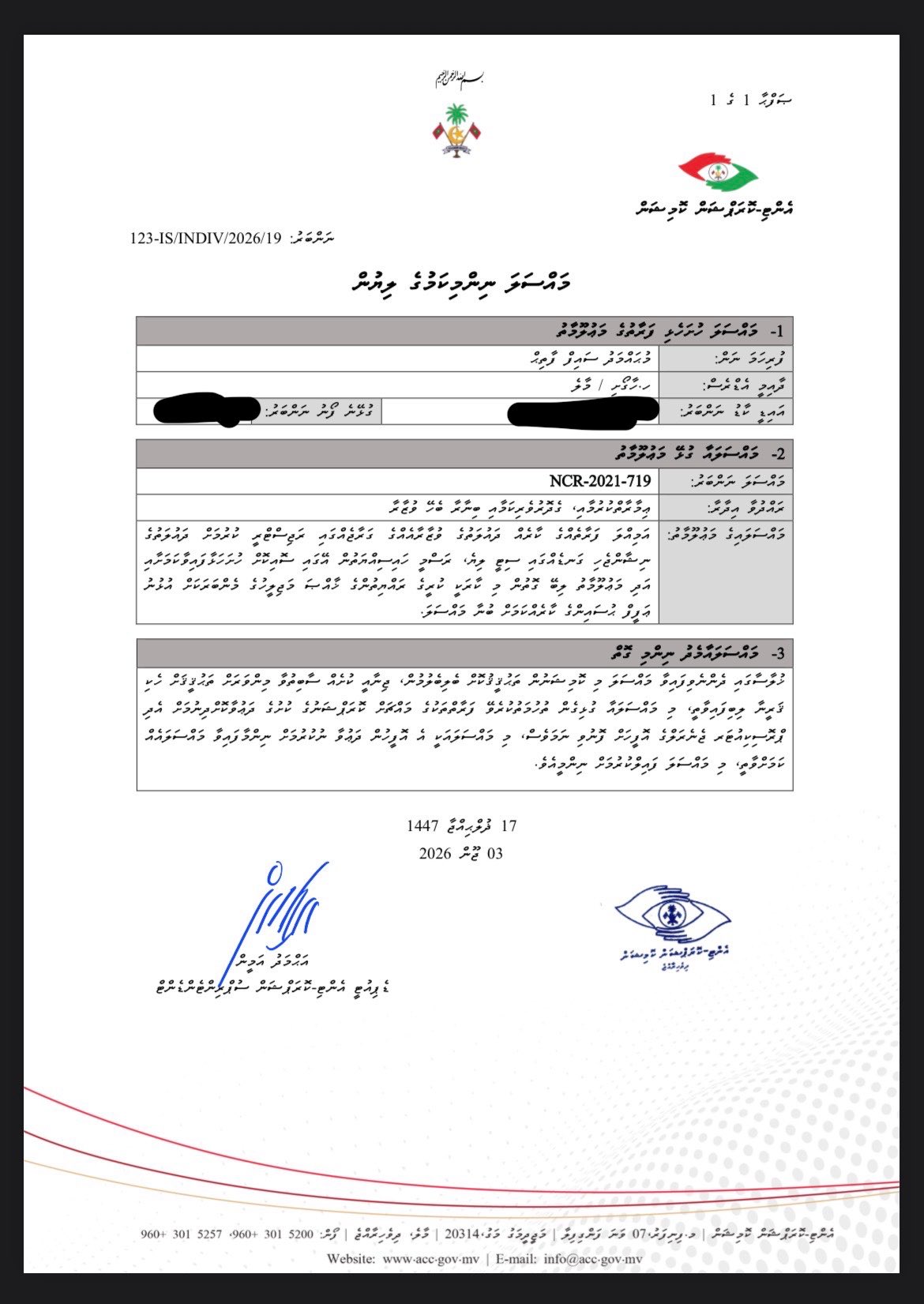
Five years after filing the complaint, the only communication I receive is to inform me that someone whom the ACC itself believed there was sufficient evidence to prosecute would face no consequences? Brilliant!
The timing was difficult to ignore.
Days earlier, Afeef had been appointed managing director of Fenaka Corporation. The conclusion of the case conveniently removed a lingering corruption file just as he assumed a prominent public position. Loose ends had to be tied up.
Following media coverage of my tweet publishing the ACC's conclusion, the Prosecutor General explained that charges had been declined because, although Afeef's actions were unlawful, the state did not incur any damage due to said unlawful actions.
Afeef is now managing director of the largest state-owned utility company. I say that is plenty of damage.
Even the one time the ACC responded to me partly favourably, it merely delayed corruption rather than stopping it.
Luck of the draw
When the ruling People’s National Congress (PNC) majority on the Malé City Council approved leasing public parking spaces along Malé's roads, I opposed the proposal from the outset. These were public spaces being allocated at heavily subsidised rates to owners of private vehicles that had been imported on the basis that they already had private garages. Why should taxpayers subsidise parking for what is, ultimately, a private luxury? For the same amount, I would gladly rent the space outside my own house to park my grandparents' joali.
During council deliberations, multiple sources told me the allocation process had already been compromised. According to them, parking permits were effectively being sold, with some councillors allegedly collecting upward of MVR 30,000 (US$ 1,945) in bribes for each slot "booked." I therefore insisted that, at the very least, the spaces must be allocated through a genuinely random draw.
Initially, the PNC majority insisted on using a computer programme to generate the winners. I objected. Without transparency, there was simply no way of knowing whether the software had been manipulated. After considerable wrangling, the council abandoned the software and instead placed all the numbered lots into a translucent glass vase to be drawn manually by council officials, as I proposed in the weekly official meeting.
That night, I watched the draw live on television rather than attending in person. It did not sit well with me.
Immediately, Galolhu West councillor Nazima Faiz and I got to work. We painstakingly reconstructed the entire draw from the video with time stamps on an Excel spreadsheet before comparing it with the published results.
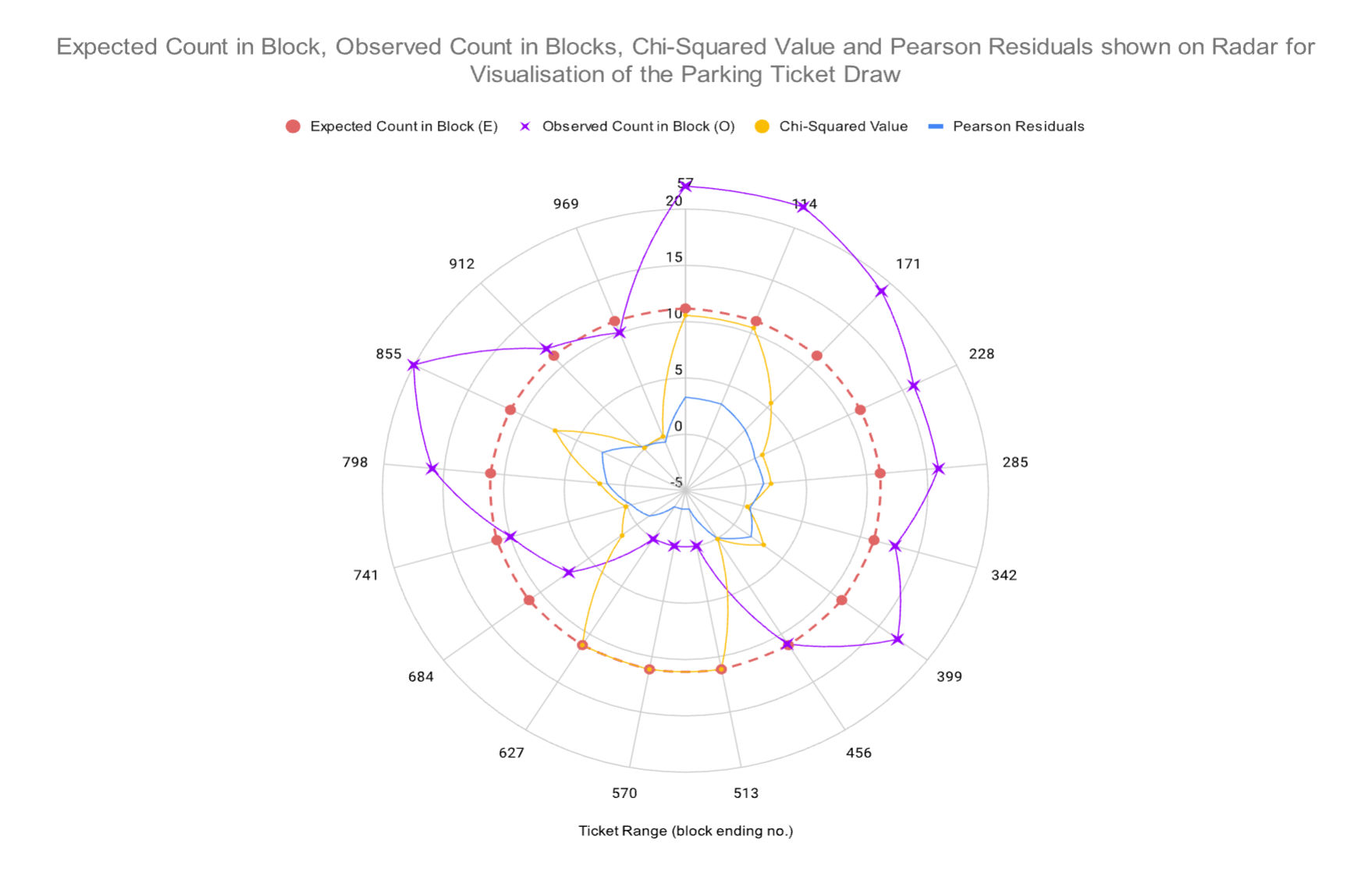
The anomalies were immediate and could not possibly be random. With help from two brainy friends we carried out a standard statistical goodness-of-fit test on the spreadsheet results to determine whether the lots drawn were consistent with a genuinely random draw.
They were glaringly not. Read below the main findings:
“According to the Facebook livestream of the draw, the deputy mayor announced slip number 665 as the 103rd lot drawn. However, slip number 665 does not appear in the published gazetted list of participants.”
“Individual Ahmed ****** submitted a total of eight applications using two separate addresses. Four of his applications appear to have been selected in the random draw. Several other individuals who secured multiple slots have also been identified.”
“Of the 211 lots drawn, no slip numbers between 432 and 650 were selected. In light of this and other observed anomalies, the results were examined using a chi-squared goodness-of-fit test. The analysis found that the observed distribution is highly unlikely to have occurred by chance, indicating a statistically significant deviation from a truly random draw.”
“According to the lot draw video, at 31 minutes and 10 seconds, the deputy mayor announced that 200 lots had been drawn. However, only 197 lots had actually been drawn at that point.”
“Ilyas ****** was included in the draw (slip 1**). However, he had already been allocated a parking slot near Salman Mosque under the previous council announcement (H00-**). Despite the council having approved extensions for individuals who were up to date with their payments, applicants who had requested such extensions were nevertheless included in the draw.
Many individuals who received slip numbers after applying for parking slots were not included in the draw, while some individuals who did not receive slip numbers were included.”
I submitted the statistical analysis to the ACC, convinced that this time the evidence would compel action. The commission did intervene. It issued an injunction, halted the allocation process and ordered the council to begin again.
For a brief moment, I thought the system had worked. It hadn't.
Instead, the council simply increased the number of parking spaces beyond the approved limit of 211, ultimately accommodating virtually everyone who wanted one. The corruption was not stopped. It merely adapted.
Subsequent complaints were quietly ignored.
More remarkably, senior PNC councillors – including then-Mayor Dr Mohamed Muizzu – appeared to receive near real-time notifications whenever I lodged complaints with the ACC. On one occasion, shortly after I had returned from submitting a complaint, a senior PNC figure confronted me.
"I know you filed a complaint with the ACC," he said.
"I know," I replied. "It's not exactly a secret."
What startled me was not that he knew I had filed a complaint. It was how quickly he knew.
In the case of the parking slot lot draw case the ACC's injunction served only one useful purpose (just not the type useful to the public): it taught those orchestrating the scheme how to conduct it more effectively the next time.
Apparently, I was once again the naive one.
Meanwhile, Nazima and I were severely reprimanded by Mayor Muizzu and the PNC majority. We were removed from committee chairmanships. The six Maldivian Democratic Party councillors were reshuffled across committees in a way that ensured we could exercise little meaningful influence over council decisions.
I can list a dozen more cases I have submitted to ACC, from land allocation scandals and procurement fraud to the infamous plant store affair. All to no avail. But these two alone sufficiently encapsulate my experience with the ACC.
Yes, the commission investigates cases. It investigates them thoroughly, sometimes for years. It even concludes that sufficient evidence exists to prosecute. And then… nothing. How useless and wasteful!
It is not uncommon for a file to sit untouched for years before quietly being closed. In the best case scenario corruption is interrupted, but briefly, only to resume in a slightly different form. Either way, those responsible have very little to fear.
If you want to understand how inaction is systematically institutionalised in the ACC, my investigation published in August 2025 may be of use. An ACC insider described an internal approval mechanism under which virtually every significant investigative step requires the ACC president's permission through a spreadsheet field labelled "huhdha libifa" ("permission granted"). Until that cell is marked, investigators cannot summon suspects or witnesses, obtain documents or bank records, conduct searches, collect evidence or even advance a complaint into a formal investigation.
The mechanics of extracting compliance from ACC is not hard to figure out. The April 2025 amendments to the commission’s law mean the ACC president is now appointed by President Muizzu from among the sitting commissioners. Those commissioners themselves are chosen by parliament – which has a ruling PNC supermajority – from a list of names nominated by the president. The Majlis, let's say, keeps ACC on a tight leash.
It is true. The Maldivian anti-corruption regime is extraordinarily efficient! Unfortunately, just not against fighting corruption but for quietly sanctioning and politically managing it.
Column By Saif Fathih
Saif Fathih is a columnist at the Maldives Independent and a former member of the Malé City Council for Galolhu North. With his educational background in communications, international studies and public policy, he previously worked as a journalist, editor and public policy advisor, with roles including senior policy director at the ministry of national planning and editor of Ocean Weekly Magazine. Saif began his career as a radio producer and presenter at Minivan Radio, writer for Minivan Daily, and translator for the British High Commission and the European Union Mission to Sri Lanka and the Maldives. He is also the host of Ithuru Vaahaka, the Maldives Independent podcast.
All comment pieces are the sole view of the author and do not reflect the editorial policy of the Maldives Independent. If you would like to write an opinion piece, please send proposals to editorial@maldivesindependent.com.
Discussion
No comments yet. Be the first to share your thoughts!
No comments yet. Be the first to join the conversation!
Join the Conversation
Sign in to share your thoughts under an alias and take part in the discussion. Independent journalism thrives on open, respectful debate — your voice matters.
Support Independent Journalism
Help us keep the news free and fearless
Give once
$
or
Become a memberfrom $5/month