
Captured by a spreadsheet: how one man controls Maldives' anti-corruption system
The watchdog shields the powerful and denies justice through digital gatekeeping.
Artwork: Dosain
10 Aug 2025, 12:11
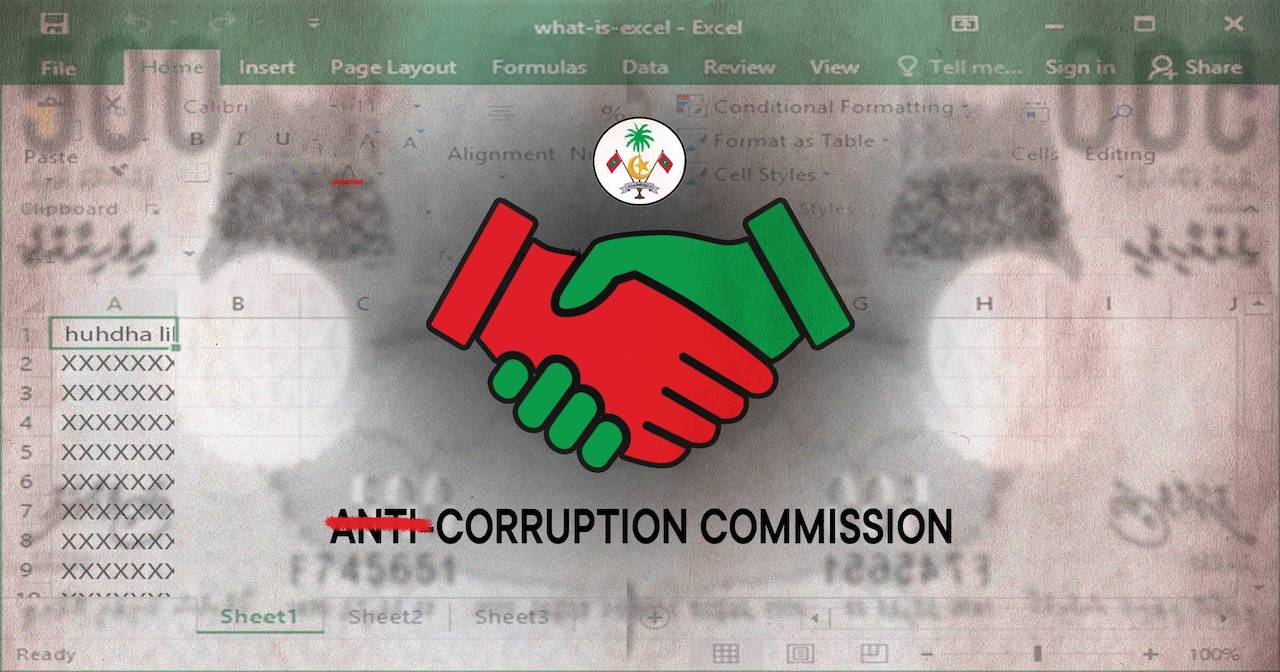
The Maldives' entire anti-corruption system is controlled by a single spreadsheet. Unless Anti-Corruption Commission President Adam Shamil personally approves cases in a field labeled "huhdha libifa" (permission granted), ACC investigators cannot summon witnesses, collect evidence, or pursue corruption allegations – no matter how serious.
In March, when investigators tried to summon the former president's wife over a housing scheme, their request disappeared into this same spreadsheet, as did summons for MPs, ministers, and ambassadors linked to the the country's biggest corruption scandal.
“The fate of each and every case now rests upon Shamil’s hands,” a source inside the commission explained.
I have personally submitted more than a dozen detailed letters to the ACC regarding various corruption cases. Despite the seriousness of the concerns, I have not received any adequate response.
These letters address a wide range of issues, including the Malé City Council's unlawful sale of public parking slots, land allocated through questionable deals by a so-called "kuda" (sub) committee, consultants acting on behalf of councils instead of elected councillors, and the embezzlement of millions through fraudulent documentation related to the procurement of trees and plants for the Gas Fihaara (plant shop). In many cases, I submitted follow-up letters, yet the commission has remained completely silent.
The only exceptions to this silence were an interim order issued in December 2021 that temporarily halted the allocation of parking slots and a brief phone call in March 2025 concerning procurement irregularities in a project at Thaisey Koshi. That call lasted no more than two minutes. Other than these isolated instances, none of the cases I reported have been acknowledged, let alone investigated or resolved.
There is no indication of commitment or accountability within the ACC. Corruption continues to thrive in nearly every sector of governance, including procurement, public sector hiring and promotions, government housing distribution, and even the selection of individuals for the Hajj pilgrimage. These processes are increasingly influenced by political favouritism and personal connections.
Adam Shamil was appointed chair of the anti-corruption watchdog along with new members Shiyama Mohamed and Shazna Hashim in March 2022. They replaced commissioners who resigned in December 2021 under pressure from the then-ruling Maldivian Democratic Party supermajority in parliament. The MPs had expressed frustration over the commission's slow progress in investigating major corruption cases, especially those related to the Maldives Marketing and Public Relations Corporation scandal that occurred during president Abdullah Yameen's administration from 2013 to 2018.
Unfortunately, the current members of the commission appear to be performing even worse.
Despite this persistent failure, members of the ACC continue to receive high monthly salaries, reportedly over MVR 45,000 (US$ 2,900). They also enjoy extensive medical benefits for themselves and their families, which include access to treatment within the Asia Pacific region. While it may be argued that such compensation reflects the gravity of their responsibilities, it becomes indefensible when the commission so clearly fails to perform its duties.
Parallel system
In an effort to understand why the commission has become so dysfunctional, I spoke with two individuals currently employed at the ACC. Both requested anonymity. They described a disturbing situation in which the formal structure of the commission has been rendered meaningless by an internal mechanism that operates in the shadows. This hidden system determines which cases are allowed to move forward and which are quietly shut down, functioning completely outside the legal and procedural framework that is supposed to guide the ACC.
The ACC's Investigation Department is officially led by the head of investigations and a deputy. It is divided into four sections, each led by a supervisor. These sections are further broken down into teams of three investigators each. However, despite this structure, actual authority lies solely with Adam Shamil, who controls all investigative activity through a single spreadsheet labeled "Task Notice for Raees [President]."
This spreadsheet contains summaries of cases, required actions, names of assigned statement takers, indicators for whether a case involves a politically exposed person, summaries of allegations, documentation details, names of individuals involved, and other relevant fields. The most important field is labelled "permission granted." Unless this field is marked as approved by Shamil himself, investigators are not allowed to proceed.
Undue influence
In March, investigators submitted formal requests to summon former first lady Fazna Ahmed in relation to a housing scheme inquiry. Requests had also been made to summon Mohamed Hussain Shareef, the Maldivian ambassador to the United Arab Emirates, Ibrahim Khaleel, a President's Office minister, and ruling party MPs Asma Rasheed and Hassan Mufeed Abdul Qadir. All of these individuals are believed to have links to the MMPRC scandal. However, none of the summons were approved and the cases have remained frozen, pending Shamil's personal authorisation.
At the same time, other cases such as those involving former Fenaka managing director Mohamed Saeed were expedited under Shamil's orders. He also played a key role in the removal of Supreme Court justices Dr Azmiralda Zahir and Dr Mahaz Ali Zahir by orchestrating weak cases against them. Shamil sent a letter to the government-controlled Judicial Services Commission stating that the justices were under criminal investigation.
“It was not even an investigation at that point, it was a mere inquiry in its preliminary stages in the evaluation section, never has ACC dispatched such a letter regarding a state official while the investigation is in its infancy,” one of the ACC sources said.
This letter contained no reference number or specific details about the alleged matter. It was not sent through the Government E-letter Management System, but was instead hand-delivered. Based solely on this letter, the JSC suspended justices Azmiralda, Mahaz and Husnu Suood.
The same Shamil-led ACC that previously halted the handover of 4,000 flats during president Ibrahim Mohamed Solih's final days in office is now completely silent. The housing ministry has resumed the handover process without publishing the list of recipients. As a result, the public has no knowledge of who is receiving these flats or the criteria used to select them.
The ACC remains idle and ineffective, reduced to nothing more than a political tool. Adam Shamil has successfully hijacked the Maldives' entire anti-corruption apparatus with one spreadsheet. Rather than functioning as an independent and impartial institution dedicated to rooting out corruption, the commission now exists to shield those in power. All decision-making authority is centralised in one person. The official structure is only symbolic, as the commission operates under rigid political control in practice.
Despite overwhelming evidence of systemic corruption and growing public dissatisfaction, no one within the ACC or the broader government appears willing to challenge this setup. Adam Shamil and co seem to be protected by powerful figures from both major political parties. This political protection allows him to evade scrutiny and continue obstructing investigations, ultimately ensuring that the culture of corruption remains firmly in place.
By Saif Fathih
Saif Fathih is a columnist at the Maldives Independent and a serving member of the Malé City Council for Galolhu North. With his educational background in communications, international studies and public policy, he previously worked as a journalist, editor and public policy advisor, with roles including senior policy director at the ministry of national planning and editor of Ocean Weekly Magazine. Saif began his career as a radio producer and presenter at Minivan Radio, writer for Minivan Daily, and translator for the British High Commission and the European Union Mission to Sri Lanka and the Maldives. He is also the host of Ithuru Vaahaka, the Maldives Independent podcast.
Discussion
No comments yet. Be the first to share your thoughts!
No comments yet. Be the first to join the conversation!
Join the Conversation
Sign in to share your thoughts under an alias and take part in the discussion. Independent journalism thrives on open, respectful debate — your voice matters.
Support Independent Journalism
Help us keep the news free and fearless
Give once
$
or
Become a memberfrom $5/month