
100,000 citizens, zero democracy: HDC's corporate stranglehold on Hulhumalé
A presidential pledge to hand over control remains unfulfilled.

Artwork: Dosain
14 Jul 2025, 14:13
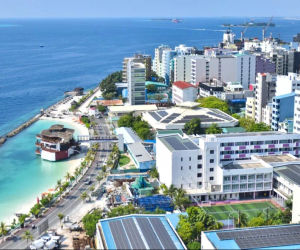
The Maldives constitution mandates decentralised local governance. But in Hulhumalé, an artificial island home to 100,000 people, a state-owned corporation calls all the shots – a constitutional crisis in slow motion that persists despite a presidential campaign pledge to end this administrative dysfunction.
In late December, Mauroof Jameel, an architect and construction minister under president Maumoon Abdul Gayoom, was appointed as managing director of the Housing Development Corporation (HDC). At the time, I wondered whether he truly believed he could make a meaningful difference. Seven months passed with little to show for his tenure. Without even a single meeting with the Malé City Council, Jameel announced his retirement last week. That, I suppose, answers the question.
According to the Decentralisation Act, the city of Malé, which includes the islands of Malé, Villingili, and Hulhumalé, falls under the jurisdiction of the Malé City Council. The council is legally responsible for providing municipal services and overseeing land use and urban planning.
That is what the law states. It is what the constitution demands. But the reality is far removed from the letter of the law.
Unconstitutional hold
In practice, it is the HDC and not the elected Malé City Council that controls Hulhumalé. A state-owned enterprise tasked with the urban development of manmade islands near Malé, HDC operates largely outside democratic oversight, undermining the constitutional promise of decentralisation.
How did HDC come to possess such sweeping authority?
The origins date back to 1995 when a presidential committee was formed to address Malé's worsening housing crisis. Land reclamation work began in 1997. The Hulhumalé Development Unit was established four years later to manage planning and development. In 2005, this unit evolved into the Hulhumalé Development Corporation. Under president Mohamed Nasheed's administration in 2009, it became the Housing Development Corporation.
In 2019, the MDP-led government reformed the decentralisation law to empower local councils. A cornerstone of the MDP's grassroots democracy agenda, these major reforms granted councils wide-ranging administrative, financial, and land ownership powers.
A new Malé City Council was elected in 2021. One of the key campaign promises of MDP mayoral candidate Anas Abdul Sattar was to bring Hulhumalé under the council's authority.
No progress
In a surprising twist, opposition candidate Dr Mohamed Muizzu – who would go on to become president in 2023 – won the mayoral race with approximately 9,300 votes to Anas's 5,500. The MDP lost control of the council, securing only six out of 18 seats, marking the first time they were not in the majority.
President Ibrahim Mohamed Solih, who previously echoed promises to hand over Hulhumalé to the city council, backed away from the commitment. Despite repeatedly stating that the transfer was imminent, he completed his term without following through.
As mayor, Dr Muizzu frequently and harshly criticised Solih for failing to hand over Hulhumalé. His own presidential campaign centred on a promise to do exactly that: transfer control of the island to the council without delay. Yet nearly two years into his presidency, Dr Muizzu has failed to act on his own demand. Nothing has changed.
Hulhumalé is still governed by a corporation. It has only one city council seat and three parliamentary constituencies, but its municipal affairs are decided by a corporate board.
Why this matters
This situation raises several fundamental concerns.
First and foremost is the absence of democratic control.
Decisions on public services, urban planning, and land use are made by HDC, a profit-oriented company. Residents have no real voice in shaping their community. A prime example is HDC's recent unveiling of a revamped master plan for Hulhumalé. Not a single resident was consulted. The Malé City Council wasn't even informed.
Most shockingly, Hulhumalé phase three, which previously included more than 3,000 residential plots, has vanished from the new plan. These plots had been identified and publicised, yet there has been no announcement, no public explanation, and no reallocation.
Second, HDC lacks accountability.
As a government-owned company, HDC is managed by politically appointed directors who report not to the public, but to the president. There is no comprehensive legal framework regulating how these enterprises function.
A 2022 report by the Anti-Corruption Commission and Transparency Maldives highlighted how procurement processes in such state-owned companies are often manipulated to benefit politically connected individuals. Both the IMF and World Bank have warned that mismanaged SOEs pose a major threat to the Maldivian economy.
Third, civic rights are being curtailed.
HDC denied the MDP permission to hold a rally in Hulhumalé on January 21. This blatant suppression of public political expression illustrates the dangers of allowing a corporate body to manage civic spaces. Road safety measures in Hulhumalé have also been lacking. Upgrades have been implemented only in response to public outrage following fatal accidents. Only recently were some hazardous intersections converted into roundabouts.
Corruption and mismanagement
The recent "fake plot" scandal offers a clear illustration of how dysfunction and corruption permeate HDC.
Fazeel Rasheed, the brother of then-HDC Managing Director Fazul Rasheed, was allowed to construct a wall around a plot to which he had no legal claim. Fazeel Rasheed did not even apply or qualify for the Binveriya scheme. Yet permission was granted and the wall was built.
Although both Fazul and President Muizzu claimed to have no knowledge of the scam, evidence to the contrary exists. In July 2024, former HDC Chairman Ahmed Zuhoor submitted a letter to the president detailing serious allegations against Fazul Rasheed, including:
Selling Vinares flats through secret deals and bribes
Selling land to his wife through special arrangements
Allocating land to politically connected companies
Granting 15,000 square feet of public land to those companies
Issuing three Hulhumalé plots in exchange for land in West Park, all without board approval.
This consistent pattern of abuse shows why public lands and services must not be left in the hands of an opaque corporation, led by appointees who serve at the discretion of the executive.
A constitutional crisis in slow motion
The 2019 amendments to the Decentralisation Act explicitly state that HDC holds no legal authority over public lands in Hulhumalé, except those reserved for commercial use. Yet HDC continues to behave as though it controls everything.
Before his resignation, Fazul Rasheed openly stated that even if Hulhumalé were to be handed over to the Malé City Council, income-generating assets such as Central Park, beachfront stalls, and commercial housing projects would not be transferred.
So what remains for the public?
The Hiya flats, billed as social housing, lack even the most basic considerations, including access for people with disabilities. Meanwhile, the landscape of Hulhumalé is now dominated by luxury condominiums and gated communities designed as holiday homes for the wealthy. These developments are entirely unaffordable for the average Maldivian.
Hulhumalé was reclaimed to alleviate Malé's housing crisis – a worthy mission that has been buried, under glass towers, political scandal, and broken promises.
By Saif Fathih
Saif Fathih is a columnist at the Maldives Independent and a serving member of the Malé City Council for Galolhu North. With his educational background in communications, international studies and public policy, he previously worked as a journalist, editor and public policy advisor, with roles including senior policy director at the ministry of national planning and editor of Ocean Weekly Magazine. Saif began his career as a radio producer and presenter at Minivan Radio, writer for Minivan Daily, and translator for the British High Commission and the European Union Mission to Sri Lanka and the Maldives. He is also the host of Ithuru Vaahaka, the Maldives Independent podcast.
Discussion
No comments yet. Be the first to share your thoughts!
No comments yet. Be the first to join the conversation!
Join the Conversation
Sign in to share your thoughts under an alias and take part in the discussion. Independent journalism thrives on open, respectful debate — your voice matters.
Support Independent Journalism
Help us keep the news free and fearless
Give once
$
or
Become a memberfrom $5/month