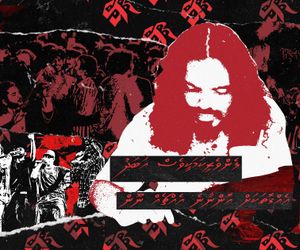

Hulhangu, by Little Faratas n Monkey – an album that changed everything
A look back at a record that altered modern Maldivian music.

Artwork: Dosain
27 Jun, 15:00
“I'm telling you, these guys are really special, they’re going places,” said a discerning friend many years back, linking me to the track 'Haamaan' on Soundcloud.
That song seemed an exercise in silliness, in keeping with the band name, which is not to demean the track – it goes far beyond the realm of stupidity, coming out the other side sounding sage-like. A memorably enjoyable listen whose refrain must have been born of a particularly fruitful session with, well, something.
It served as a good introduction to a mysterious musical entity whose musicianship was, even then, beyond reproach. As of writing, the track has amassed over 21,000 listens on Soundcloud alone.
Little Faratas n Monkey’s subsequent 2022 album, ‘Hulhangu’, marks a divide. There was what came before, and now, with bands such as Fantastic 4 Fihaara and Monochromacy Project, we’re witnessing what followed.
Even as early as 2017, when LFM teased us with the EP 'Anbu Majaa' – whose interpretation of the jalu lava 'Dhon Aisa' proved extremely popular – it was obvious something great was happening.
Hulhangu, their first full-length album, was mastered at the famous Abbey Road Studios in London. It is short, with a running time that barely inches past the half-hour mark. Prior to the drop, LFM released a song and some cover art on Instagram, collaborating with a coterie of artists that included Nadhee Rachey, Gaihal and Virusikah, among others.
Sonically, the album is unified, with no sound out of place or purposeless. Some may think it's too neat, maybe even suspect algorithms at work, but to me, it just feels painstakingly made.
From beginning to end, Hulhangu brims with a frightening, supernatural energy which spills over to the listener, and they pulled it off live. The band sounds possessed, deep in the vajidhu zone, drawing from the spirits of King Crimson, Tool, Animals as Leaders and their like. For fans, this can only mean ecstasy.
Even when the music trails off, and a fading yet powerful vocal note is held trembling in the wake of waning guitars, you can sense it lurking, shifting in the lull. Yes, if there is one thing the album has in abundance, besides intensity, it is the ability to surprise.
In the mosh pit joashu of the opener 'Balaa Balaa', with its insane, rambling bass, prediction may be a fun but ultimately futile endeavour. The song stomps in conventional time right up to the chorus with its playful, percussive hollers of 'balaa balaa balaa', then you confront a bridge that defies all expectation.
Also noteworthy is LFM's use of the melodica, a forlorn and recurring sound on several tracks, including on the kinetic, titular tune 'Hulhangu', evoking Ennio Morricone, spaghetti westerns and the loneliness of sweeping vistas (a band member purportedly works at Madhoship, a film production studio putting out exciting work by young talent).
Lauh Mohamed (@lauhmohamed) designed the artwork for the title song, with the Faratas' simian mascot mounted on a horse, shooting a man in the distance. The horse, too, is a corporeal presence in the album, deepening Hulhangu's spiritual kinship with the outlaw west.
Meanwhile, on the third track, 'Hirafus', you come to realise the band has been holding back. It's an aural feast where LFM toys with time signatures and devastates with deliciously syncopated drumming.
Lyrically, they switch on a black light. The nihilism of 'thadhuvaanee effaharey (it'll hurt only once)/maruvaanee effaharey (you'll die only once)' is palpable in Janavaaru's soaring voice, which channels the great frontmen of glam rock and more than a fair share of Maynard James Keenan.
'Hirafus's' approach to percussion finds a successor in 'Nudhemeynan', a beautiful, foreboding track with deeply paranoid lyrics.
And lyrically, there is a sense throughout the album that semantics has been sacrificed on the altar of rhythm and rhyme. Yet, there's always a phrase or two that leap up to shoot out the lights.
It's difficult to pick favourite songs, from a lofty range whose individual peaks are not pronounced, only different. At the moment, and this will change, it's the punny closer 'Asthaa Molhee' with its aptly galloping beat and wild-west iconography.
In the week I’ve spent with this album – and I mean soberly listening, end to end, eating to it, walking along Sosun Magu with it, even napping to it to see if any liminal messages arise – it remains apparent that it represents a seismic shift in our contemporary musical landscape.
Discussion
No comments yet. Be the first to share your thoughts!
No comments yet. Be the first to join the conversation!
Join the Conversation
Sign in to share your thoughts under an alias and take part in the discussion. Independent journalism thrives on open, respectful debate — your voice matters.
Support Independent Journalism
Help us keep the news free and fearless
Give once
$
or
Become a memberfrom $5/month