
Eight insects in a jar: the poems Hawla Riza wrote for her father
An indie legend’s daughter who found her art in grief.
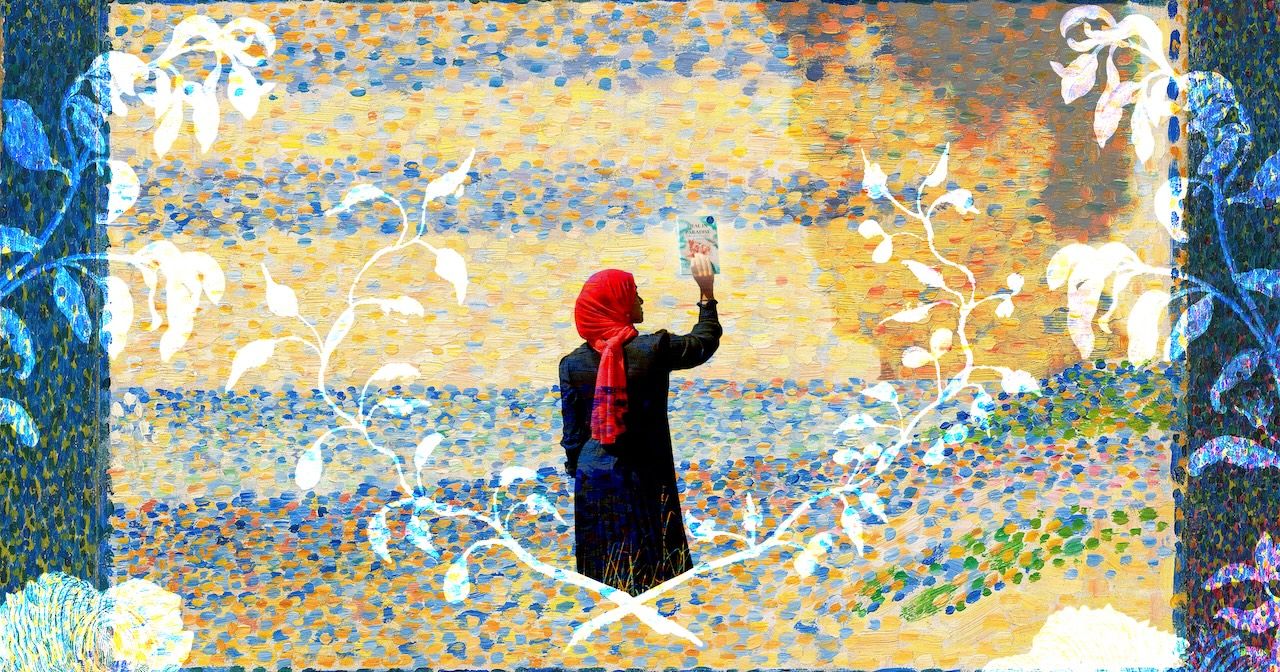
Artwork: Dosain
11 minutes ago
‘Tharabooz’ Ahmed Riza had a home studio visited by luminaries like Fasy, Ziya Abbas, Violet Addiction, Kushehnooney, and later Ali Rameez and Mukhtar Adam among several others.
"Tharabe Riza was a legend, a multi-instrumentalist, a champion of indie music in the 90s," Ahmed Saeed 'Andhu,' guitarist of Kushehnooney, tells me. "No one helped bands who wanted to make original songs as much as him. He should be praised in every hukuru khuthubaa."
Andhu is also part of a band called Tharabe Jazz, as homage to his hero.
In our chats, Hawla Riza, the author of the poetry collection Heal in Paradise, describes her late father as her champion, who was “delusionally proud” of her achievements. She recalls going on afternoon walks and her father fondly waiting for her while she spotted dhonmoosa by the hirundhu trees – significant as he wasn’t a patient man. But he doted on his daughter.
However, Hawla’s mother did not wish for her children to have musical aspirations, so she and her siblings were sent to their rooms when the musicians arrived.
The passing of Riza in 2021 devastated friends and family. A crushed Hawla found herself journalling intensely to process her grief. And those journal entries eventually transformed into lines of poetry. She shared verses with her followers and sites like poemhunter.com. Then, based on an idea she came across in an online "writing club," she began to work on a collection of poetry, waking up early to pin her best thoughts to the page.
A philosopher claimed that the human Being is a being-toward-death. The awareness of the finitude of life reveals the fact that your life consists of a finite set of possibilities. This gives a sense of heft to each life choice instead of losing yourself in what the thinker calls Das Man, the everyday life where you simply go through the motions of living. This awareness does not necessarily produce authenticity in how you live but it creates the ground for its possibility.
“We become creatures of loss as we get older,” Australian singer Nick Cave told ABC’s Australian Story in 2024. “[…] We are things of loss. This is not a tragic element to our lives but rather a deepening that brings incredible meaning.”
This is especially true for Hawla. The death of her father awakened something in Hawla – she stopped being a people pleaser and started on a path to become the version of her that rang truest. She sent me a poem from the time, around 2022 that describes the change, which is infused with violence, as change often is:
my old self is poison now
she needs to go, I sob
I claw it out of me
and bury a stake in her
my old self is dead now
I roll her off the cliff
to turn and greet my new
my old self gnawed at me
foolish child, it said
I am still in you
in all you feel
“It’s a little cringe, I don’t write like this anymore,” she says a bit embarrassedly. I tell her that she didn’t kill the old Hawla but sedated her, which she finds agreeable.
Does she fear that her old self might awaken from her slumber?
“The old Hawla might fear that, not me,” she replies confidently.
Her confidence is on full display on her Instagram, where she not only posts poetry but also photos of herself that don’t always attempt to be "modest." This proved uncomfortable for certain groups: a male friend advised her not to, implying that it was "cheap," and that her poetry was enough.
When she tells me that, I think how easy we men have it here – telling women how to present themselves on their own Instagram.
It’s no-one’s business. And with a following of over 11,000 and monthly views that hit over 250,000 hers is an instantly recognisable and popular brand.
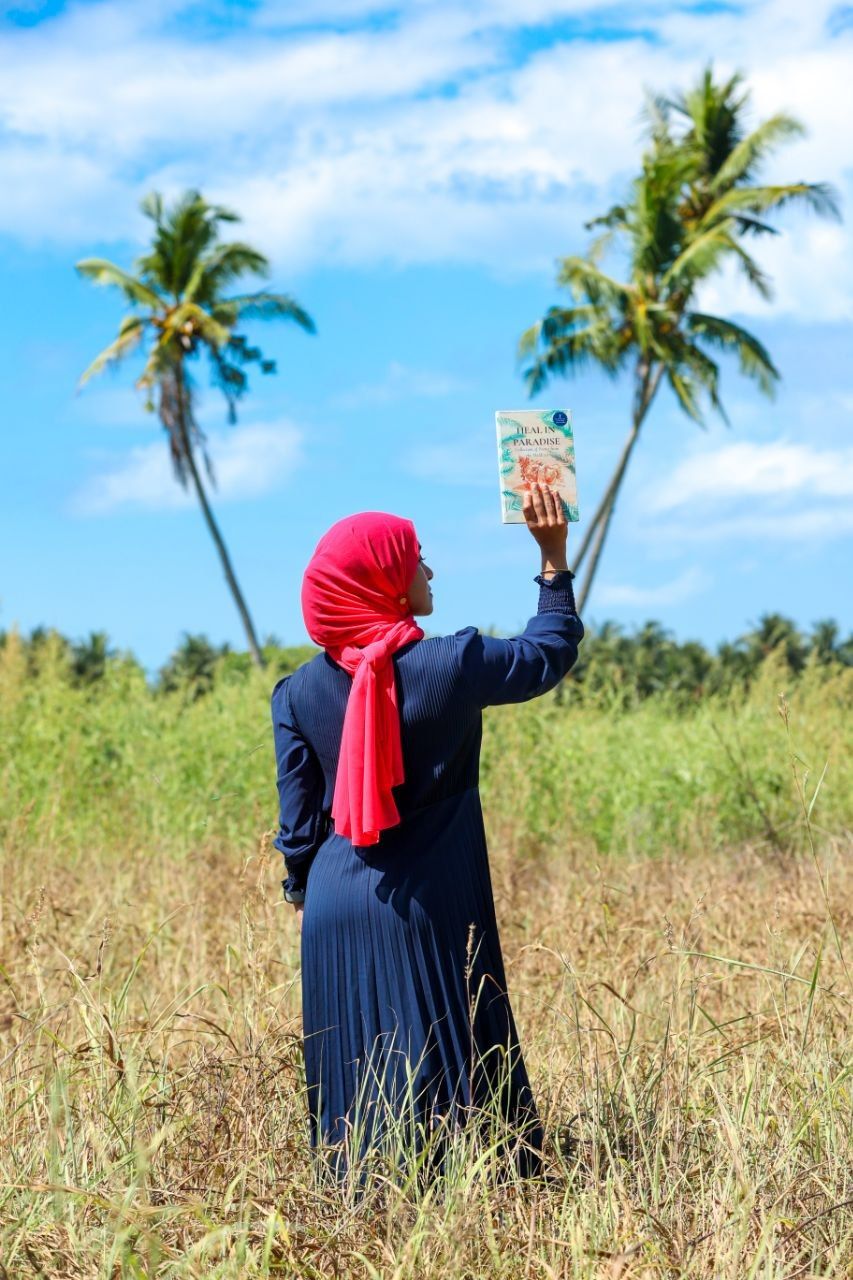
But it didn’t come easy. Hawla worked for two years to produce the collection that became Heal in Paradise. She would slave over her writing, missing meals, forgetting sometimes to bathe. Yet her foray into poetry was met initially with doubt even from friends and family.
“It didn’t stop me,” Hawla says. “It would have been nice to have them be supportive then, but I was able to kickstart my journey on my own.”
My first impression of her poetry was that it is very simple, which explains the appeal to a large audience. But then, take this poem "time to go":
when i was a kid,
i went with my father
to collect insects
he smile proudly
when i pick an insect
and place it carefully
inside my jar
‘time to go’ he smile
i pretend not to hear
counting eight insects
inside my jar
i grew up
as he grew old
i tell him about the time
i counted eight insects
when it was time to go
i sit on his bed now
counting eight pillows
pretending not to hear
that he is now gone
This narrative poem (which harks back to her dhonmoosa walks with her father) is easy to follow, easy to understand. But there’s something deeper here, obscured by the simple language. First, it’s the child’s turn to go but she pretends not to hear her father and lingers, and the father waits for her. And then she is sharing that same memory with him as an adult, a recollection of how she pretended not to hear him. Next, the grief-stricken person on her father’s bed after he has been called back, denying his absence, the eight insects now mirrored by an equal number of inanimate objects – pillows. The poem is suffused with time and transformation: youth turning to age, presence becoming absence, life becoming inert. But something is retained: memory, like insects trapped in the jar, to be observed and preserved yet utterly dead, memory, the sole survivor of time’s discrete and damning movement.
Hawla was inspired by the Palestinian poet Mahmoud Darwish whose work also shows a profound simplicity. Hawla’s poetry may not be my thing exactly, but at its best, it is deeper than it appears and seems distinctly hers. It’s no surprise that she won first place in a competition that attracted several popular local poets, though she herself belongs to no poetry clique or group. An outsider.
“I am a competitive person,” she says. “Winning that award has changed me though. It gave me the confidence to be interviewed by Maldives Independent, which I know wouldn’t lavish praise on my writing. But I’ve gone beyond needing that kind of validation now.”
Hawla’s Instagram bio describes her as an entrepreneur, a term she identifies with more than "poet." Her books were popular at the expo with locals and tourists. Meanwhile, she also sells them on her website hawlariza.com. She tells me she’s recovered the cost and made a bit extra. A ‘bit’ sounds like modesty to me. Hawla seems a shrewd businesswoman and there’s no reason why an artist can’t be one. I tell her that all the poets I know are broke. She laughs.
“Most artists aren’t good with money,” she says. She’s walking the same path as the screenwriter and novelist Fathimath Nahula, gifted with a rare knack for art and commerce. That is, art that sells. Hawla says she writes for herself, not for an audience, but you wonder if she doesn’t have an idea of what will sell and what won’t before she puts pen to paper. Her transformation came from grief, poetry was how she made sense to herself. But she has no qualms about going to great lengths to promote her work.
“I’m really an entrepreneur,” she tells me, smiling. It’s a half-truth, I believe, by an artist who survived the death of her father through poetry.
Discussion
No comments yet. Be the first to share your thoughts!
No comments yet. Be the first to join the conversation!
Join the Conversation
Sign in to share your thoughts under an alias and take part in the discussion. Independent journalism thrives on open, respectful debate — your voice matters.
Support Independent Journalism
Help us keep the news free and fearless
Give once
$
or
Become a memberfrom $5/month