The unchecked power of Maldives' executive presidency
From democratic hope to institutional decay.
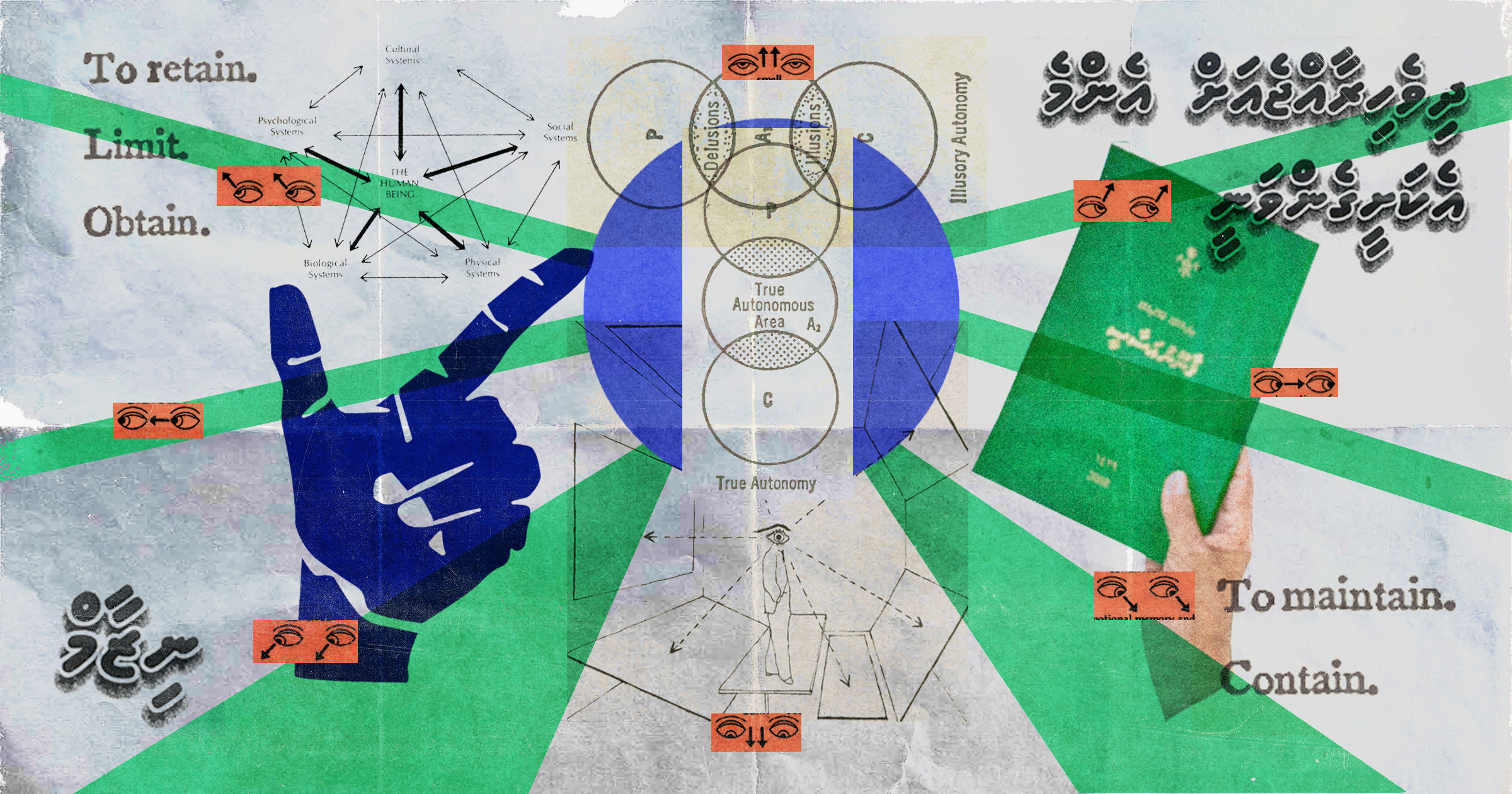
Artwork: Dosain
12 Aug 2025, 16:21
This article was produced with the support of Strengthening Peace & Democracy through Internews Europe, as part of the Advancing Political Pluralism and Transparency (APPT) project funded by the European Union.
No Maldivian president has been re-elected since the adoption of the 2008 democratic constitution 16 years ago – a symptom of a system that concentrates overwhelming power in one person's hands while offering no meaningful way to hold them accountable.
The entire state apparatus revolves around the executive. The president is seen not only as the head of government but as the ultimate protector of the state. Once elected, he remains virtually untouchable for a full five-year term.
Pinning the security and fate of an entire nation on the shoulders of a single individual is a romanticised vision of leadership that history has proven to be flawed and unsustainable. No state institution, especially one as critical as the presidency, should depend solely on one person's virtue, judgment, or sanity. Yet this is precisely the political reality of the Maldivian executive presidency.
From nominating Supreme Court justices, including the chief justice, to being the chief of armed forces and scouts, the president's influence reaches into every corner of the state. Recent legal amendments have only cemented this control. The president now holds the authority to endorse the heads of both the Anti-Corruption Commission and the Elections Commission, two institutions that must remain free from executive interference to ensure democratic integrity.
This problem is not unique to the Maldives. Even in the United States, a mature democracy with deeply rooted institutions, the executive presidency has raised serious concerns as President Donald Trump's executive overreach reached unprecedented levels. Trump repeatedly bypassed Congress through executive orders, declared a national emergency to divert military funds for a border wall that Congress had refused to finance, and fired inspectors general who were tasked with independent oversight of federal agencies. These events have reignited debates about reining in presidential power – something the Maldives must also confront head-on.
Parliamentary rubber stamp
While the constitution empowers Members of Parliament to exercise oversight and hold the president accountable, in practice this has rarely been effective. In the 2009 parliamentary elections, president Mohamed Nasheed's party secured only 26 out of 77 seats. However, each of his successors managed to secure a clear parliamentary majority, growing to a massive supermajority for both former president Ibrahim Mohamed Solih and incumbent President Dr Mohamed Muizzu, and effectively any eliminating real checks on executive power.
MPs find themselves beholden to the President's Office, hoping for development projects vital to their constituencies. Road paving, harbour repairs, and basic infrastructure improvements are all administered by the president's unelected ministers. Criticising a minister or the president could mean indefinite delays for key infrastructure. This dynamic forces MPs to fall in line with the executive or risk their political survival.
Parliament has also become a tool for legitimising executive overreach, corruption, and mismanagement. Former President Abdulla Yameen used his parliamentary majority to amend the constitution for freehold leases and criminalise defamation while curbing freedoms of assembly. President Solih buried the MMPRC corruption scandal and passed laws offering leniency to tourism establishments for unpaid dues, all while reshuffling members of independent commissions to suit political convenience. President Muizzu has inserted an anti-defection clause into the constitution – effectively allowing the ruling party to enforce its whip line with the threat of removal from office – while simultaneously curbing the authority of local councils.
The current 93-member legislature is so toothless it has become the norm for ministers to ignore summons by oppositions MPs.
Unchecked appointments
The president, except when appointing cabinet ministers, requires no parliamentary approval to make political appointments. Qualifications and track records are often disregarded in favour of loyalty. This results in a government filled with clueless political appointees who are neither accountable nor subject to public oversight.
Moreover, the president wields sweeping control over decentralisation. He can unilaterally alter the jurisdiction of local councils, reassigning islands, removing councils that challenge authority, and centralising power back into ministries. Even the declaration of tourism zones, vital for local economic autonomy, can be done without local council consultation or approval. One day, an uninhabited island may fall under Kulhudhuffushi City's jurisdiction. The next day, it may not, depending on the political whims of the presidency.
The Maldivian executive presidency has morphed into an institution of absolute power. Far from being a balanced democratic structure, it has become a centralised apparatus where the president acts as judge, jury, and executioner. Parliament has become a rubber stamp. Councils are sidelined. Independent institutions are defanged.
The danger of concentrating a nation's fate in one individual's hands is no longer a theoretical concern in the Maldives. It is a daily reality. And unless systemic reforms are undertaken to rebalance the distribution of power, this pattern of overreach, megalomania, and institutional decay will continue to erode the democratic fabric of the country.
This article was produced with the support of Strengthening Peace & Democracy through Internews Europe, as part of the Advancing Political Pluralism and Transparency (APPT) project funded by the European Union.
Discussion
No comments yet. Be the first to share your thoughts!
No comments yet. Be the first to join the conversation!
Join the Conversation
Sign in to share your thoughts under an alias and take part in the discussion. Independent journalism thrives on open, respectful debate — your voice matters.
Support Independent Journalism
Help us keep the news free and fearless
Give once
$
or
Become a memberfrom $5/month