
Comment: Mosque, story of my country
The sermons coming out of the Mosque almost always address matters relating to creed, never relating them to issues that are more directly connected to socio-economic problems, writes Aisha Hussein Rasheed.
05 Jul 2015, 10:00
Aishath H. Rasheed
This article was first published on www.patheos.com. Republished with permission.
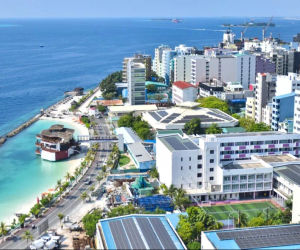
I feel the weight of a nation on my shoulders; a nation that is too often spoken of in the global community in terms of its natural beauty rather than in terms of its people. And I wonder whether my individual experience reflects the experiences of all those Maldivians, who share this fate of having their life experiences casually set aside whenever their country is mentioned. ‘Maldives has really beautiful beaches, right?’ I am often asked. ‘Yes, and very interesting people.’
Most of us are Muslims, living in about 190 of the 1200 islands that form our country. Islam is the state religion, and the constitution requires all laws made in the country to abide by Islamic principles and all Maldivian citizens to be Muslims. As young Muslims, growing up Maldivian is a privilege that few of us seem to appreciate. Our community is mostly Muslim; our education system, our laws, our traditions and ethos are loosely based around Islamic principles; we have historically been spared the sectarian disputes that have plagued many other Muslim communities worldwide; almost always, no matter where we are on an inhabited island, we have a mosque within walking distance.
That is not to say we don’t have our share of difficulties. Our rather reserved society has failed to respond to the spiritual, social, economic and other needs of our youth demographic, and we are suffering the consequences. Many young people are becoming either disillusioned with religion or radicalised by groups who promote sectarian violence and Takfiri ideologies among others. Faced with a general lack of everything: proper housing, jobs, educational opportunities, space for self-expression, and for many kids, even a stable family environment – Maldives has one of the highest divorce rates in the world -, many young people are turning to drugs and delinquency as outlets for their emotions and frustrations. To top it all, in an environment rife with corruption and political discord, the growing disillusionment of youth from the political process and social structures is resulting in young people becoming more sidelined from the general community.
In all of this, the failure of the Mosque – as an institution representing religion – becomes apparent. The sermons coming out of the Mosque almost always address matters relating to creed, never relating them to issues that are more directly connected to socio-economic problems. When such matters are addressed, often there is a huge disparity between the preachings of the religious scholar and the tested and proven principles of human sciences.
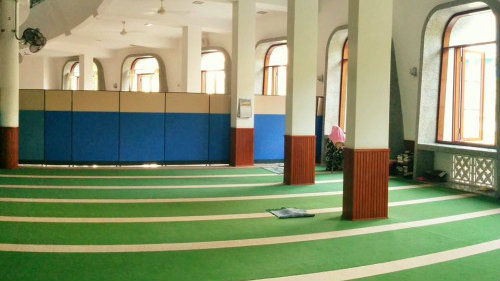
Moreover, the Mosque is often not a welcoming space for women. In the past year or so, I have carried out a project to photographically document the differences between the men’s and women’s prayer areas. Not all mosques have a women’s area. Of the mosques that do, some mosques have the rainwater drainage pipes coming from the roof ending right at the women’s entrance. Others have women’s prayer areas too small, especially for the number of women who come out to pray Tarawih in congregation at the mosque during Ramadan. And of all the mosques in the capital that I have been to, few have a women’s area that shares the general ambiance of the prayer area used by the men.
This general lack of consideration towards women is doubled by the lack women’s access to the lectures given by scholars (most importantly, perhaps, foreign scholars), in the men’s prayer areas of the mosques. Moreover, no female Islamic scholar in the country holds, or in fact has ever held, a public lecture in a mosque.
Despite the odds, though, Maldivians are inching their way forward. Young people are trying to beat the rising rate delinquency. Despite the failure of the mosque to address human rights, administrative justice and other important issues, the youth are filling the moral gap as they know how, with the help of international and local rights groups. Female worshipers are increasing at mosques, especially for Tarawih and Eid prayers.
Maldives is a country that is moving forward currently, perhaps, in spite of its mosques. The community, and often its most vulnerable, are suffering the consequences and compensating for the current failure of the Mosque. I hope that one day, the Mosque will be an institution that drives and contributes to our progress. For that to happen, the Mosque has a lot of catching up to do.
All comment pieces are the sole view of the author and do not reflect the editorial policy of Minivan News. If you would like to write an opinion piece, please send proposals to [email protected]
Discussion
No comments yet. Be the first to share your thoughts!
No comments yet. Be the first to join the conversation!
Join the Conversation
Sign in to share your thoughts under an alias and take part in the discussion. Independent journalism thrives on open, respectful debate — your voice matters.
Support Independent Journalism
Help us keep the news free and fearless
Give once
$
or
Become a memberfrom $5/month