
Comment: Maldives’ judiciary an impediment to democratic consolidation
11 Oct 2013, 14:00
Mushfiq Mohamed
This article first appeared on Dhivehi Sitee. Republished with permission.
In September 2003, 30-year dictator Maumoon Abdul Gayoom declared a state of emergency after the dictatorships guards killed an inmate named Evan Naseem in Maafushi jail. Security services on duty resorted to the use of firearms to defuse the revolt, killing three others and injuring 17.
The riots that erupted forced Gayoom to initiate a reform agenda. The security forces and the judiciary came to the forefront of the discourse on democratic transition. The constitutional assembly, which proposed democratic restructuring of the system of governance and the report published by legal expert Professor Paul Robinson in 2004, highlighted these reforms needed for the criminal justice system. Professor Robinson concluded that “the reforms needed [for the Maldivian judiciary] are wide-ranging, and that without dramatic change the system and its public reputation are likely to deteriorate further.”
The Constitution ratified in August 2008, which paved way for the first democratic elections won by Mohamed Nasheed in October that year, consisted of a mechanism to re-appoint sitting judges during the interim period from August 2008 to 2010 and ensure judicial independence for the first time in Maldives’ history.
During the interim period, in accordance with sub-article (b) of Article 285 of the Constitution, the Judicial Service Commission (JSC) was mandated to ascertain whether all sitting judges possess mandatory characteristics and standards prescribed under Article 149. Aishath Velezinee, former JSC member appointed by Nasheed, who publicly spoke out about JSC’s failures, claims that judges appointed during Gayoom’s regime secured their positions on the bench through a “Failed Silent Coup” in 2010 which subverted the Constitutional processes to re-appoint judges. In January 2011, her criticism of the manipulation of the Constitution by judicial actors made her the victim of a knife attack.
The interim Supreme Court judges, who were also subject to Article 285, wrote to the Nasheed administration as early as June 2010, declaring that they would permanently remain on the bench. Velezinee recalled the appointments to the Supreme Court as a “grave blunder.” The JSC defied Article 285, declaring it “symbolic” and swore-in all sitting judges, securing their tenure for life. A report published by the International Commission of Jurists in February 2011, also raises concerns about “the politicisation of the judicial vetting process.”
Coup to undo democratic gains
The first democratically elected government of Nasheed was forcefully brought to an end on 7 February 2012 by a televised coup d’état, led by loyalists of dictator Gayoom’s regime, and facilitated by Nasheed’s deputy Mohamed Waheed. The international community was quick to recognise the post-coup government headed by Waheed. A Commission of National Inquiry [CoNI] backed by the Commonwealth declared the chaotic transfer of power “lawful”.
The CoNI report published at the end of August 2012 was heavily criticised by the MDP, and with good reason, claiming that the inquiry selectively ignored evidence that did not fit its contrived conclusion.
International legal experts also echoed MDP’s concerns with regard to the report. The MDP, however, accepted the report with reservations as it acknowledged police brutality on 6, 7, and 8 February 2012. To date its recommendations regarding police brutality have not been implemented, resulting in impunity for Special Operations officers who were involved in the violent crackdown in early February 2012.
During the onset of the political turmoil, MDP maintained that elections should be held that same year, without letting the post-coup regime “entrench itself.” International community supported calls for an early election in 2012, although Waheed’s administration stated that “earliest an election could be held under the Maldivian constitution was July 2013.”
In July 2012, MDP’s presidential candidate Nasheed was prosecuted for the arrest of chief judge of the Criminal Court, whom the Judicial Service Commission (JSC) failed to take any action against despite his prior criminal record and misconduct in 2011.
Nasheed also faced proceedings against him at the Civil Court over allegations of defamation made against him by dictator-loyalists Minister of Defence Mohamed Nazim and Commissioner of Police Abdulla Riyaz who led Nasheeds ouster. Over 20 MDP parliamentarians and some 800 active members and supporters were also subjected to various politically motivated criminal proceedings against them. In hindsight, the period leading up to elections was used by the post-coup regime to create shock and awe among the electorate, characterised by manufactured incidents and political persecution of MDP supporters in order to dissuade them from taking part in political activity and deflect attention away from the disputed legitimacy of the regime.
The juridical system continues to act as the means by which the regime achieves these ends under a democratic façade. Without a constitutional mandate to regulate lawyers, the Supreme Court issued a resolution for all practicing lawyers and prosecutors in April 2012. The resolution restricted lawyers’ freedom of expression, ordering that lawyers shall not discuss or criticise judicial proceedings or judges.
Lawyers were pressured to sign the resolution since the courts refused right of audience to those who didn’t. Ahmed Abdul Afeef who was part of Nasheed’s legal team was not able to represent him in court since he had protested the resolution and remained without signing it.
The muzzling of lawyers didn’t end there; Abdullah Haseen who represents a huge number of pro-democracy protestors was suspended for appearing on a TV show on Raajje TV disseminating information of the law. Although there is no legislation that prohibits sketching inside the courthouse, a lawyer named Shafaz Wajeeh was fined by the Supreme Court for his sketch. Lawyer and MDP parliamentarian Imthiyaz Fahmy is currently being prosecuted for contempt of court due to remarks he has made against the judiciary, although his comments are in line with international bodies such as the United Nations Human Rights Committee.
Nasheeds prosecution further revealed the state of Maldives’ judiciary to the international community. Trial observer Blinne Ní Ghrálaigh from Bar Human Rights Committee of England and Wales noted in her report that the panel of judges in the Hulhumale Magistrates’ Court was “cherry-picked for their likelihood to convict by a highly politicised JSC.”
The 2012 report by United Nations Special Rapporteur on Independence of Judges and Lawyers Gabriela Knaul detailed the crisis Maldives’ criminal justice system is faced with. The report expressed concerns over the “politicised and inadequate” JSC, noting that “the concept of independence of the judiciary has been misconstrued and misinterpreted in the Maldives, including amongst judicial actors” to benefit judges, enabling a culture of unaccountability. The UN Special Rapporteur also questioned legitimacy of the Hulhumale Magistrates’ Court since it contravened the Judicature Act 2010 and was declared invalid by a parliamentary oversight committee in November 2012.
The selective manner in which the JSC has taken disciplinary measures against judges suggests that the judicial watchdog refrains from taking action where it suits its political needs to shield loyalists of the former regime. In 2009, then Chief Judge of the High Court was removed from his position, and the JSC suspended a Civil Court judge for sexual misconduct. In 2013, a Criminal Court judge was suspended for sexually harassing a public prosecutor and Chief Judge of the High Court who was hearing Nasheeds appeals was also suspended.
However, it has not occurred to the JSC to take any form of action against Justice Ali Hameed of the Supreme Court whose scandalous escapade in Colombo with three prostitutes have become public knowledge with leaked video footage of him doing the deed. The Bar Association of Maldives called for the immediate suspension of Justice Hameed back in July 2012. JSC’s inconsistency in penalizing Justice Hameed is left unscathed so he can sit in the Supreme Court hearing the motions filed by Qasim Ibrahim who has close family ties to Gayoom’s family. It is also worth remembering the motion filed by Gayoom’s half-brother Abdulla Yameen Abdul Gayoom at the Supreme Court.
Ballots to restore democracy
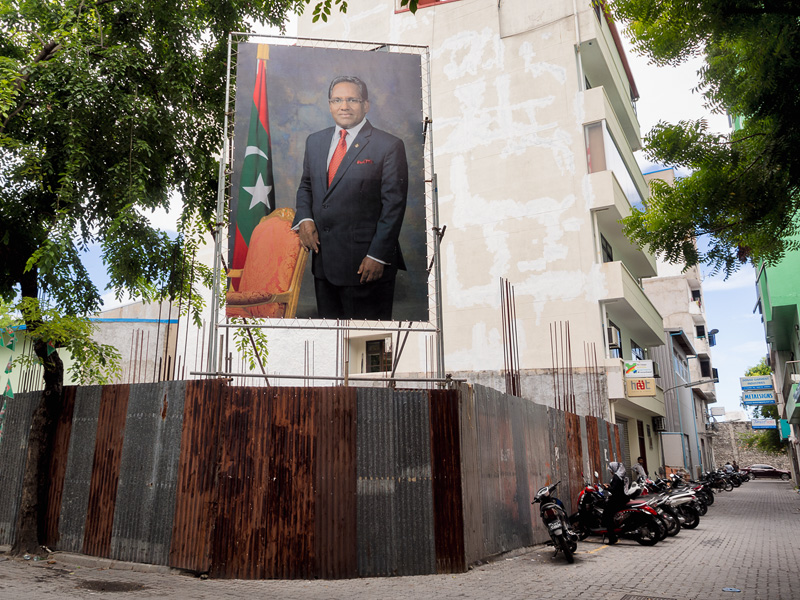
One of many gigantic posters of incumbent Mohamed Waheed put up across Male’ ahead of 7 September polls. Waheed got 5%. Photo: Aznym
February this year, the Elections Commission of the Maldives (EC) announced the presidential election to be held on 7 September 2013. On 28 July 2013 the EC officially announced the order of the candidates on the ballot paper, after approving the candidacy of all four candidates; Qasim Ibrahim with his Jumhooree Party (JP) and Islamist party Adhaalath (AP) coalition; Dr Waheed, independent, incumbent president, endorsed then, by Dhivehi Rayyithunge Party (DRP); Abdulla Yameen Abdul Gayoom from the Progressive Party of Maldives (PPM) in a coalition with Maldivian Development Alliance (MDA); and Nasheed from Maldivian Democratic Party (MDP).
Foreign and local observers such as the Commonwealth, the European Union, Transparency Maldives, Human Rights Commission of the Maldives declared that the first round of polls were “peaceful and inclusive” with a markedly high voter turnout of 88%. Transparency Maldives, which observed the election across the country, stated “none of the incidents reported on Election Day would have a “material impact on the outcome of the election”.
The chair of the Commonwealth observer group, former Prime Minister of Malta Dr. Lawrence Gonzi stated, “the vote count at the polling station was highly transparent with media monitors, party observers, and national and international observers able to scrutinize the process closely.”
In accordance with sub-article (a) of Article 111 of the Constitution and sub-article (a) of Article 19 of the Presidential Elections Act 2008, the EC began preparations for the presidential election’s runoff as none of the four candidates secured 50% of the votes; Nasheed had 45%, Waheed an embarrassing 5% and Qasim who had 24% came closely behind Abdul-Gayoom who secured 25%. The third place JP coalition refused to accept the first round of elections, and filed a motion at the Supreme Court requesting annulment of first round of polls. The JP also filed a motion at the High Court, requesting the Court to release the voters’ list.
JP produced three documents as evidence for their motion at the High Court, which indicated three lists of alleged discrepancies in the voters’ registry. Out of the first list that JP claimed consisted of deceased people who appeared on the registry, only seven were found on the original voters’ registry, and five were found to be alive. The other list consisted of allegedly repeated names of eligible voters. The EC’s legal counsel later proved in court that these were not repeated names but in reality different people with different national identification numbers and dates of birth. The third list consisted of people who were on Male Municipality’s Special Register who have mailing addresses registered in the capital. The High Court decided that there was no evidence of fraudulent activity with regard to the motion. However, it allowed supervised viewing of the electoral registry.
Supreme tyranny of the electoral process
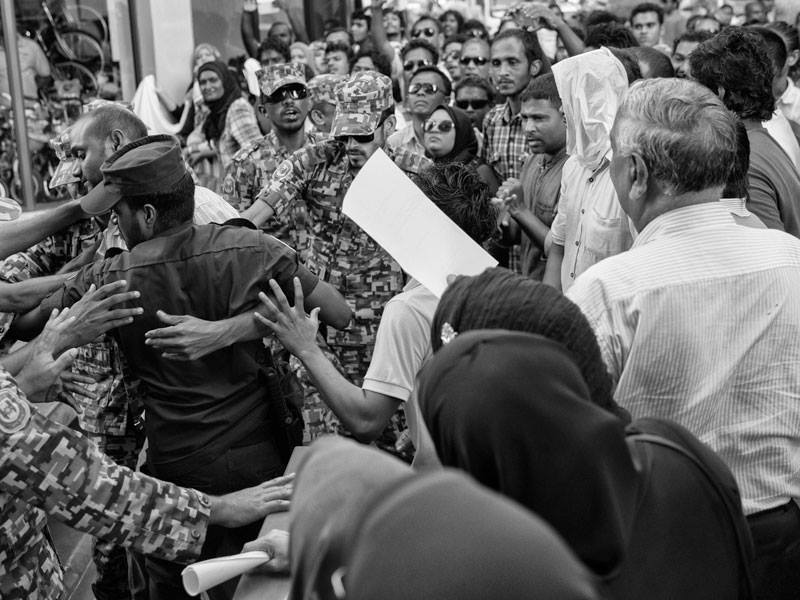
Protests near the Supreme Court in Male’ as it deliberated JP’s case to annul 7 September election Photo: Aznym
Article 172 of the Constitution indicates that the High Court has the appellate jurisdiction for electoral motions, while Article 113 states the Supreme Court shall have final jurisdiction over such motions. Regardless, JP filed their motion directly at the apex court. MDP, the Attorney General (AG) and PPM made inter-partes claims to the motion, with PPM supporting JP’s claim and with the AG calling for the Court to order the Prosecutor General and Maldives Police Service (MPS) to investigate the alleged “irregularities” in the electoral registry.
The request by the AG is contrary to electoral laws and the Maldives Constitution, which clearly outlines the forum and mechanism to investigate and adjudicate on disputed results of an election. Sub-article (b) of Article 64 of the Elections Act 2008 states that if electoral laws have been violated, only the EC has the legal authority to initiate criminal proceedings through the Prosecutor General. Article 62 stipulates that the electoral complaints mechanism shall be established by the EC, and if a party is not satisfied with the recourse given by the complaints bureau, he or she may file a case at the High Court in accordance with sub-article (a) of Article 64.
The EC’s lawyer, former AG Husnu Al Suood noted an astounding lack of evidence to back JP’s claims. Suood also claimed that any delay could result in a constitutional void, citing US Supreme Court case Bush v. Al Gore 2000. MDP’s lawyers Hisaan Hussein and Hassan Latheef expressed concern at the lack of substantial evidence to claim electoral fraud, and stated that JP had not submitted complaints to the EC regarding the registry when the EC had publicly requested for complaints with regard to the publicized list of eligible voters.
JP’s lawyer and its presidential candidate Qasim’s running mate Hassan Saeed stated that the JP had thirteen reasons for annulment, reiterating claims made at the High Court. At the proceedings Saeed requested that; the security services oversee a fresh round of elections after nullifying the first round and for the Court to issue an injunction halting the EC’s work to hold the runoff dated 28 September 2013. The AG Azima Shakoor echoed JP’s criticism over the EC, but refrained from vocally supporting an annulment. The international best practice where either a public prosecutor or state attorney does not support actions of a state institution would be to refrain from commenting.
It is of importance to note such procedural irregularities that took place during the proceedings for this extraordinary motion. Despite the case being deemed a constitutional matter by the Supreme Court, and anonymous witnesses whose identities are protected by courts are only very rarely admitted in serious criminal cases, the apex court acted as a court of first-instance, admitting 14 witnesses submitted by JP who gave their testimonies in secrecy. Out of the three witnesses submitted by the EC, only one was admitted.
The AG also withheld certain evidence and this was left unquestioned by the Court. The AG’s office requested to submit a police intelligence report as “confidential” evidence – solely submitted as evidence to the Court’s Bench. The Chief Justice responded on behalf of the Bench, inquiring whether the intelligence report (or at least parts relevant) should be disclosed to the EC since their lawyers requested it. In her response to the Chief Justice, the AG stated that she will not submit the police intelligence report if the contents of the report would be disclosed to the EC.
“Where is my vote?”
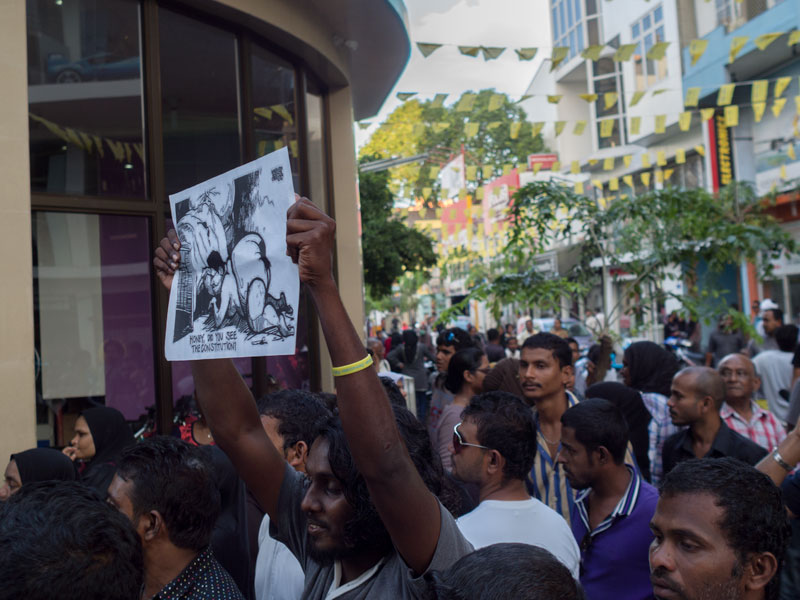
Protesters near Supreme Court hold up cartoons making fun of disgraced Justice Ali Hameed Photo: Aznym
At approximately 8:00 pm on 23 September 2013, four justices from the apex court signed and issued a stay order indefinitely postponing the runoff election until the court reaches a verdict. After the issuance of the stay order, the Commonwealth, European Union, Transparency Maldives, Human Rights Commission of Maldives, the United Kingdom, United States of America, Canada, Russia, and India all expressed concern over the postponement of the second round, calling Maldivian authorities to hold the second round according to the timescales stipulated under the Maldivian constitution.
At the proceedings the next day, the Supreme Court ejected and suspended lawyers Suood representing the EC, Hussein and Latheef representing MDP as a third party to the case, claiming that they were in contempt of court for their comments on social media regarding the Court’s stay order. Subsequently the MDP revoked its inter-partes claim to the case, claiming that the Court cannot guarantee the rights of over 95,000 of its supporters.
MDP’s chairperson Moosa Manik sent an open letter to the Chief Justice, criticizing the apex court’s contravention of the Constitution by denying fundamental right of reply and issuing a stay order indefinitely suspending sub-article (a) of Article 111 of the Constitution. The chairperson also called on the Chief Justice to restrain the Court to the “legal ambit of the Constitution” and “uphold Article 8 of the Constitution, which states that all powers of the State shall be exercised in accordance with the Constitution.”
After weeks of countrywide protests against indefinite postponement of the runoff election, the four Justices; Abdullah Saeed, Ali Hameed, Adam Mohamed Abdullah and Ahmed Abdullah Didi who infamously legitimised the Hulhumale Magistrates’ Court earlier this year, also issued the stay order halting elections, and on 7 October 2013 decided to annul the first round of elections held on 7 September 2013. Chief Justice Ahmed Faiz and Justices Abdullah Areef and Ahmed Muthasim Adnan gave dissenting judgments, which claimed that the Court has adjudicated based on “inadmissible evidence” which the EC, the respondent in the motion, was not privy to, and questioned the Court’s jurisdiction in accepting the motion prior to the High Court.
The confrontations the judiciary continue to have with the legislature and executive from 2008 to present day is proof that elements within the Maldives’ judiciary is adamant on holding onto the power structures that existed during the former dictator Gayoom’s regime. The dregs of dictatorship continue to impede realisation of democratic governance in Maldives as envisioned in the Constitution.
The final chance to consolidate democracy through universal suffrage is at risk due to justices in the Supreme Court who have assumed supreme powers unto themselves, in order to benefit those politicians who unequivocally support their tenure, and are against overhauling or reforming the judiciary.
Mushfique Mohamed is a former Public Prosecutor and a member of MDP’s Electoral Complaints Committee. He has an LLB & a MScEcon in Post-colonial Politics from Aberystwyth University.
All comment pieces are the sole view of the author and do not reflect the editorial policy of Minivan News. If you would like to write an opinion piece, please send proposals to [email protected]
Discussion
No comments yet. Be the first to share your thoughts!
No comments yet. Be the first to join the conversation!
Join the Conversation
Sign in to share your thoughts under an alias and take part in the discussion. Independent journalism thrives on open, respectful debate — your voice matters.
Support Independent Journalism
Help us keep the news free and fearless
Give once
$
or
Become a memberfrom $5/month