

Community policing belongs in the law. Don't gut it.
A former commissioner warns against dismantling trust-building reforms.
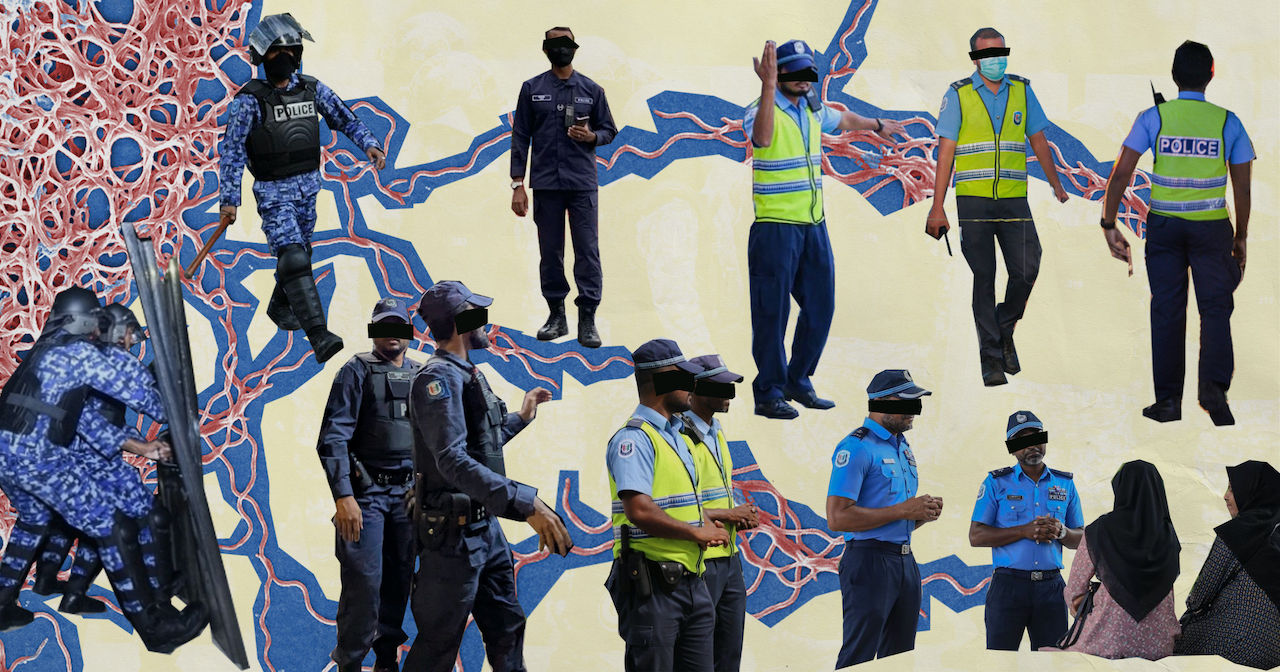
Artwork: Dosain
11 Dec 2025, 17:43
Community policing in the Maldives was never a decorative reform or a borrowed trend. It was a deliberate, carefully thought-out shift in the way the police understood themselves and the way they related to the public. For a young institution with a complicated history and a significant trust deficit, embedding this philosophy in law was essential. It provided the Maldives Police Service with an organising principle: that the people are not passive recipients of law enforcement, but active partners in creating safety.
This foundation is now at risk.
There is ongoing work toward a broader “reset,” which includes amending the Police Service Act. Within these discussions, some senior officers have proposed removing community policing from the law entirely. Their view, based on a misinterpretation, is that defining community policing in legislation restricts the police from adopting other operational models. Before any such fundamental shift is even considered, it is crucial to recall why community policing was deliberately placed at the heart of our policing framework in the first place.
A reform formed by context, not convenience
The evolution toward community policing did not happen overnight. In the late 1990s and early 2000s, the country experimented with ideas borrowed from Japan’s Koban system and Singapore’s Neighbourhood Police Posts. These efforts, while promising, were unstructured and lacked any formal support from legislation or national strategy. Still, they hinted at the value of a policing model built on engagement rather than mere enforcement.
The real shift began in 2004, when the police were formally separated from the military and reconstituted as a civilian service. This transition required the police to cultivate a new legitimacy, one rooted not in hierarchy or force, but in public service. When the Police Service Act was drafted and enacted in 2020/2021, community policing was finally given legal recognition. This was more than symbolic. It was a declaration that the Maldives Police Service would build its future on openness, accessibility, and partnership with the communities it served.
The strategic plans that followed, covering 2019 to 2024 and then 2024 to 2028, were aligned with this philosophy. “Partnerships for Community Safety” became a central pillar. This was not rhetoric; it influenced recruitment, training, deployments, operational planning, and even daily routines at island police stations.
Community policing found its place in the Act because it filled a deep need. It addressed the public distrust that had accumulated over decades, and it offered a positive, forward-looking model for a policing service still maturing within a democratic context.
Avatteri fuluhun and the humanisation of policing
The Avatteri Fuluhun model grew out of this reform wave. Its signature feature was the creation of the Neighbourhood Support Officer (NSO), an officer assigned not to respond only when things go wrong, but to be a constant, accessible presence in communities. This officer became the bridge connecting police stations with councils, schools, youth groups, NGOs, and elders. Their work focused on understanding local concerns, supporting early intervention, and helping prevent problems long before they escalated into criminal matters.
On many islands, residents said this was the first time they had a police officer whose job was not defined solely by authority, but by approachability and service. Over time, NSOs helped reshape public perception, transforming the police from a distant or reactive force into a familiar and reliable community partner.
By the end of 2023, this model had reached every inhabited island with a police presence. It became a rare example of a nationwide reform implemented consistently, backed by law, strategy, and organisational structure.
This is why the suggestion to remove community policing from the Act is concerning. It misunderstands the reform’s depth, purpose, and relevance.
Misinterpreting community policing as a limitation
There is a belief among some that defining community policing in legislation restricts the police from practicing other policing models. This is a misunderstanding. Community policing does not prevent the adoption of intelligence-led policing, problem-oriented policing, COMPSTAT, or targeted tactical operations. On the contrary, it strengthens them. Every modern policing model depends on trust, cooperation, and open lines of communication between police and the public. Removing the philosophy that enables this cooperation would weaken the operational effectiveness of all other approaches.
Community policing was enshrined in law not to limit the police, but to ground them. It reflects a recognition that without legitimacy, no policing model, no matter how sophisticated, can function effectively in a dispersed, close-knit island nation.
The Police Board: another pillar under threat
Alongside the push to remove community policing, there is now talk of dismantling the Police Board established under the current Act. Critics argue that the Board is “too advanced” for the Maldives or that its role in selecting the Commissioner and Deputy Commissioners oversteps what is necessary for our context. Others go further, saying that the president should be commander-in-chief of both the military and the police, implying that democratic oversight mechanisms complicate leadership.
This thinking represents a serious departure from global democratic practice. Police oversight bodies exist precisely because policing affects every facet of society and must remain protected from political swings. The Police Board was designed to help professionalise leadership appointments, safeguard continuity, and build long-term stability. Weakening or dismantling it will not strengthen the police. It will expose the institution to short-term political pressures and undo years of work spent building credibility.
Rather than being rolled back, the Police Board should be strengthened, supported, and allowed to mature into the independent oversight institution the Maldives needs.
Laws should not shift with political wind
The Police Service Act was crafted after extensive consultation, comparative study, and professional input. It reflected a broad consensus that policing needed stability, clarity, and a transparent, democratically anchored framework. Amending such a law because of political turnover or shifting administrative preferences is not institution-building. It is institution-weakening.
Any serious amendment must be preceded by a comprehensive internal review, broad public consultation, and evidence-based analysis. The current proposals appear to stem less from a genuine need for reform and more from a combination of misunderstanding and political haste.
The trust gap remains – the foundation must not be removed
Public trust in policing remains a delicate and fluctuating issue in the Maldives. Removing community policing from the Act would weaken the very philosophy designed to bridge that gap. It risks undoing a model that has helped humanise policing, empower local communities, and rebuild a damaged relationship between the public and the institution meant to protect them.
A police service without a strong community foundation begins to drift. It loses legitimacy. Cooperation declines. Intelligence flow dries up. And policing becomes reactive rather than preventive. That is not a direction the Maldives can afford to take.
Before changing the law, ask what problem we are trying to solve
The Maldives does not need legislative amendments driven by confusion or the urge to demonstrate change. It needs stability, clarity, and reforms that flow from evidence rather than impulse.
Community policing does not hold the police back. It anchors them in the values of accessibility, partnership, and democratic accountability. Removing it from the Act would not free the police. It would leave them unmoored.
Before altering the foundation of modern Maldivian policing, we must ask a simple question: Is this change solving a real problem, or creating one that will take years to repair?
Mohamed Hameed served as the commissioner of police from 2019 to 2023.
All comment pieces are the sole view of the author and do not reflect the editorial policy of the Maldives Independent. If you would like to write an opinion piece, please send proposals to editorial@maldivesindependent.com.
Discussion
No comments yet. Be the first to share your thoughts!
No comments yet. Be the first to join the conversation!
Join the Conversation
Sign in to share your thoughts under an alias and take part in the discussion. Independent journalism thrives on open, respectful debate — your voice matters.
Support Independent Journalism
Help us keep the news free and fearless
Give once
$
or
Become a memberfrom $5/month