
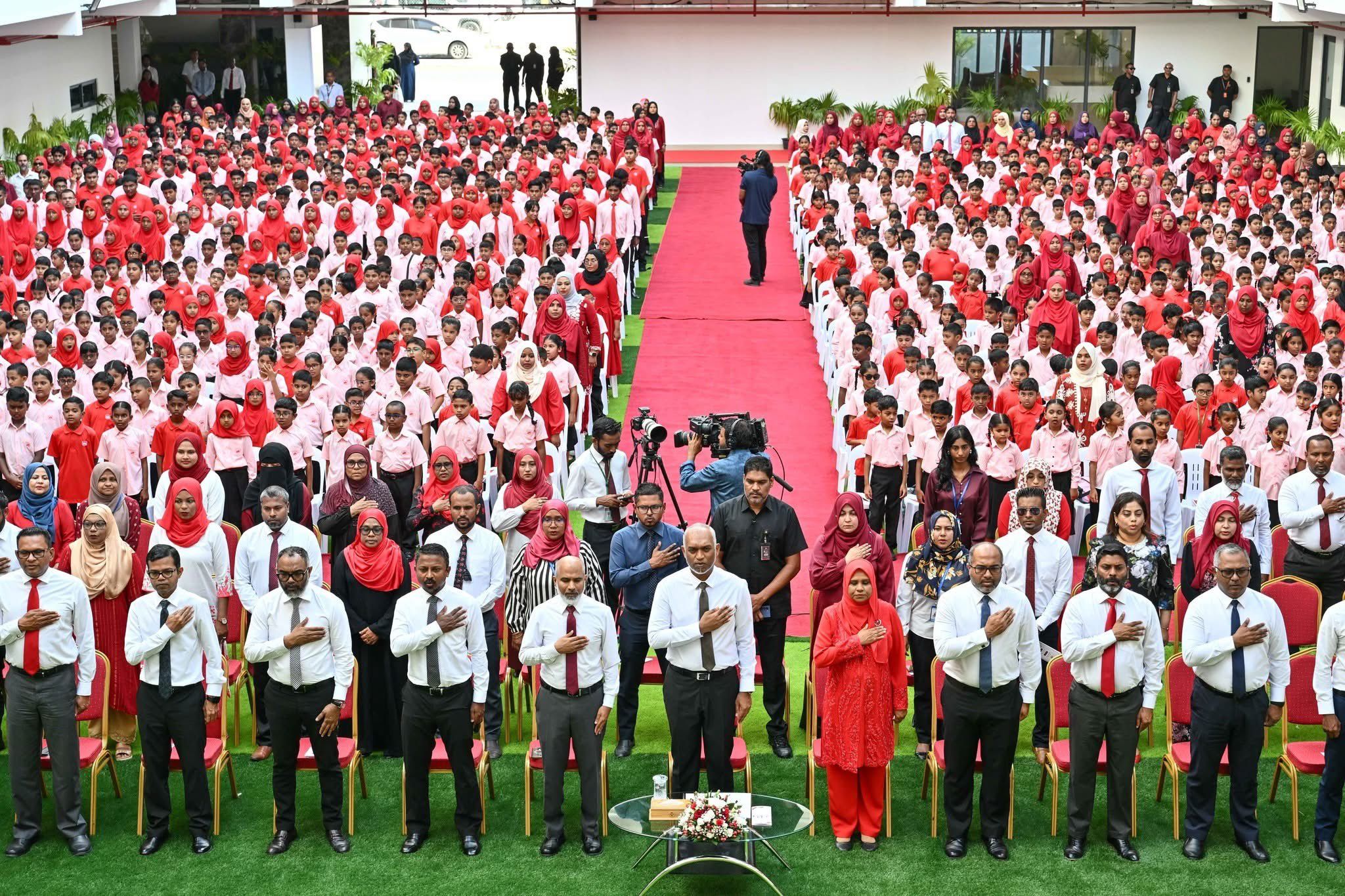
The new academic year began with over 77,000 students across 218 government schools, which employ about 10,500 teachers, including 8,000 Maldivian and 2,500 foreign teachers, according to state media. A total of 4,790 children enrolled in Grade 1, with 1,748 in the Greater Malé Region and 3,042 on other islands. Some 1,530 students requested transfers from atoll schools to Malé, while 836 moved from Malé to Hulhumalé. President Muizzu opened the newly-built Shaheed Ali school in Hulhumalé Phase 2. Built by RCC – the family company of Malé Mayor Adam Azim and MNP MP Mohamed Nazim – with contractor financing at a reported cost of MVR 247 million (US$ 16 million), the school accommodates over 1,900 students from grades one to 10 with a staff of 230 teachers. According to the new academic calendar, revised by the current administration to revert the start of the school year to January, schools will close after the first week of Ramadan and reopen on March 23 following Eid. The first term break runs from July 14 to August 1. The annual break is scheduled from December 18 to January 12, 2027.
President Muizzu added oil and mineral exploration to the list of economic activities permitted in Special Economic Zones. The annual decree issued under the SEZ Act previously allowed only gas exploration in that category. The minimum investment thresholds remain unchanged at US$ 100 million for SEZ projects and US$ 500 million for sustainable township developments. Nine categories of strategic investment are now permitted: export-oriented manufacturing; transhipment ports and logistics services; universities and tertiary hospitals; ICT parks; international financial services; renewable energy; new technologies; food security; and gas, oil, and mineral exploration. It is unclear whether the change reflects an investment proposal or signals government interest in offshore resource extraction.
The Bank of Maldives awarded contracts to three local firms to build affordable housing under central bank regulations requiring commercial banks to invest in the sector. RCC, FW Construction, and Amin Construction were enlisted to build 859 units across Hulhumalé and Vilimalé. The bank's subsidiary, BML Affordable Home Leasing Company, had previously contracted two Chinese firms – Beijing Urban Construction Group and China Machinery Engineering Corporation – to build 2,341 units, drawing criticism for bypassing public tender. BML has not disclosed contract values for any of the projects. The combined 3,200-plus units will be offered on a lease-to-own basis. RCC has received multiple high-value government contracts under the current administration, often through direct award rather than competitive bidding.
The state must establish policies to support gifted children, the High Court ruled, finding that the education ministry failed to consider a child's advanced abilities when applying age-based grade placement rules. The case was brought by a parent of a Kangaroo Kids student who challenged a circular that was retroactively applied to children already enrolled in the school system. In its ruling, the court noted that under the Education Act and the Convention on the Rights of the Child, the state has a responsibility to tailor education to individual circumstances. Just as the system allows students to repeat grades when they need additional support, it must also provide appropriate challenges to prevent gifted children from disengaging, the court said. The ruling called on the ministry to develop standardised assessment criteria for identifying exceptional ability, rather than relying solely on private testing arranged by parents. The court pointed to existing cases of students successfully completing A-Levels before the typical age as evidence that such children exist in the Maldives.
The finance ministry issued new regulations to allocate at least two percent of estimated annual state revenue to the judiciary. The public finance rules establish a framework for planning, disbursing, managing, and reporting judicial sector funding. The two percent floor excludes earmarked revenue and projected income from new revenue measures. The Department of Judicial Administration must submit its budget proposal by September 30 each year. Funds will be managed through a dedicated account at the Maldives Monetary Authority, with monthly expenditure reports published before the end of the month and reconciliation statements submitted to the ministry by the middle of the following month. The regulations prohibit subsidies on goods and services and require that compensation payments be made only after final court judgments.
Former MP Mohamed Abdul Kareem (Rukuma) resigned as deputy managing director of Maldives Gas to take up a similar position at another state-owned enterprise, he told Sun, declining to name the new company. Rukuma, who was appointed to Maldives Gas in July last year, has now held DMD positions at four SOEs under the current administration, moving from WAMCO to Fenaka to Maldives Gas. His departure comes amid ongoing investigations into the company over a gas shipment that was paid for but never delivered.
Velana International Airport handled 89,163 tonnes of cargo last year, a 10 percent increase from 2024. Imports accounted for 66,840 tonnes and exports 23,323 tonnes. Transshipment cargo saw the strongest growth at 22 percent, reaching 16,372 tonnes, of which 13,180 tonnes was air-to-air and 3,192 tonnes was sea-to-air. Dedicated freighter operators made 524 flights carrying 4,300 tonnes. MACL said it plans to expand apron storage for cargo containers and install additional X-ray machines to speed up clearance.
Education minister Dr Ismail Shafeeu announced plans to officially include Quran as a subject in the 2027 SSC exams.
HPA said the risk of Nipa Virus remain low after cases were reported in parts of India but urged those travelling to West Bengal to exercise caution. No cases have been reported in Maldives so far.
An audit revealed that MVR 930.3 million in environmental fines imposed since 2011 remain unpaid. The report said the Ministry of Environment failed to collect the penalties within prescribed periods and urged stricter enforcement, including written reminders, final notices and court action to recover the outstanding amounts.